
- Best business credit cards for travel rewards
- Best business travel credit cards by category
- What is a business travel credit card?
- Types of business travel credit cards
- Business travel credit cards vs. corporate cards
- How to choose the best business travel credit card
- Pros and cons of business travel credit cards
- How to maximize business travel rewards
- Tax implications of credit card rewards
- Annual rewards calculation example
- Travel rewards vs. cashback for business travelers
- Application tips and requirements
- Find the best business credit card for your travel needs
- How companies are saving on travel with Ramp
- Simplify business travel with Ramp's all-in-one business credit card
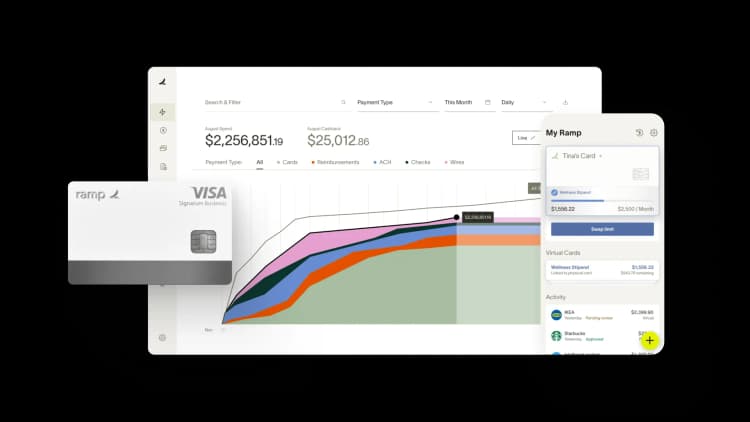
Business travel credit cards help your company earn rewards, reduce travel costs, and control spending across flights, hotels, and rental cars. The right card delivers meaningful savings when its rewards and perks match your actual travel habits.
Because employees travel for different reasons and with different preferences, choosing the right card starts with understanding where you spend the most and which benefits matter most to your team.
Note: The cashback percentages, limits, fees, and other figures mentioned in this article are for illustrative purposes only. They do not represent guaranteed or expected rates. Actual terms, credit limits, rewards, and approval criteria vary by card issuer and may change at any time. Readers should verify current details directly with each issuer before applying.
Best business credit cards for travel rewards
The best business travel credit card combines strong earning rates on travel purchases with perks that offset its annual fee and tools that make expense management easier. Here are ten cards worth considering, starting with options that pair travel rewards with built-in financial controls.
| Card name | Best for | Annual fee | Key travel benefit | Rewards rate |
|---|---|---|---|---|
| Ramp Corporate Card | Companies wanting travel rewards + expense management | $0 | Built-in travel management, real-time controls | Cashback on purchases |
| Capital One Venture X Business | Premium travel rewards at a mid-tier fee | $395 | Lounge access, travel credits, transferable miles | 2X–10X miles depending on category |
| Ink Business Preferred Credit Card | Small businesses with varied expenses | $95 | Chase Ultimate Rewards transfer partners | 3X points on travel and select categories |
| Chase Sapphire Reserve for Business | Frequent travelers who value premium perks | $795 | Priority Pass lounge access, travel credits | 3X–8X points depending on category |
| American Express Business Gold Card | Businesses with variable spending patterns | $375 | Flexible bonus categories that adapt to spending | 4X points on top two spending categories |
| The Business Platinum Card from American Express | Luxury business travelers | $895 | Centurion Lounge, airline fee credits, elite status | 5X on flights/hotels via Amex Travel |
| Capital One Spark Miles for Business | Predictable, flat-rate earning | $95 | Transferable miles, no category tracking | 2X miles on all purchases |
| Ink Business Unlimited Credit Card | No-fee flat-rate earning | $0 | Combine with Chase travel cards for portal redemptions | 1.5% cashback on all purchases |
| Bank of America Business Advantage Travel Rewards | No-fee travel rewards | $0 | Flexible points redemption for travel | 1.5X points on all purchases |
| Brex Card | Startups without personal credit history | $0 | Built-in travel booking, no personal guarantee | Points vary by category |
Ramp Corporate Card
Ramp's corporate card pairs cashback rewards with built-in expense management and travel controls, so you don't have to choose between earning rewards and keeping spending in check.
- Annual fee: $0
- Rewards: Cashback on purchases
- Key features: Automated receipt matching, real-time spending controls, custom trip budgets, and accounting software integrations
- Best for: Companies that want to combine travel rewards with financial operations and automated expense tracking
- Pros: No annual fee, built-in travel management, automated expense controls, and no personal guarantee
- Cons: Cashback rate is lower than premium travel card multipliers, and rewards are cashback rather than transferable points
Capital One Venture X Business
The Capital One Venture X Business card offers strong rewards and premium travel perks at a price point that works for many growing companies. It combines high earning rates on travel bookings with flat-rate rewards on everyday spending.
- Annual fee: $395
- Rewards: 10X miles on hotels and rental cars and 5X miles on flights and vacation rentals booked through Capital One Business Travel; 2X miles on every other purchase
- Sign-up bonus: Up to 150,000 bonus miles based on meeting spending thresholds
- APR: None; a 2.99% late fee applies to any outstanding statement balance
- Key features: No foreign transaction fees, transferable miles to airline and hotel partners, and lounge access
- Best for: Businesses wanting premium travel benefits at a more accessible annual fee
- Pros: High rewards rates, lounge access, and travel credits
- Cons: Requires excellent credit and full monthly repayment
Ink Business Preferred Credit Card
The Chase Ink Business Preferred card delivers strong travel rewards and flexible redemption options that suit a wide range of small business spending patterns. Its bonus categories cover many common expenses beyond travel.
- Annual fee: $95
- Rewards: 3X points on the first $150,000 spent on travel and select business purchases per year; 1X on other spending
- Sign-up bonus: 100,000 points after $8,000 spent in the first 3 months
- APR: 17.74%–26.74% variable
- Key features: Broad bonus categories and access to Chase Ultimate Rewards airline and hotel transfer partners
- Best for: Small businesses with varied travel and operational expenses
- Pros: Strong earning structure, high-value transfer partners, and solid travel protections
- Cons: No lounge access or travel credits
Chase Sapphire Reserve for Business
The Chase Sapphire Reserve for Business is a high-end option built for frequent travelers who want premium perks and don't mind paying a higher annual fee to get them.
- Annual fee: $795
- Rewards: 8X points on all travel booked through Chase Travel; 3X points on social media and search engine advertising; 1X on everything else
- Sign-up bonus: 150,000 points after you spend $20,000 in the first 3 months
- APR: 17.74%–28.49% variable
- Key features: Priority Pass lounge access, $300 annual travel credit, premium travel insurance, and Global Entry/TSA PreCheck credit
- Best for: Frequent business travelers who value lounge access, travel insurance, and premium perks
- Pros: Extensive lounge access, strong travel protections, and high point value through Chase portal
- Cons: High annual fee and requires excellent credit
American Express Business Gold Card
The American Express Business Gold Card automatically adjusts its top bonus categories based on where you spend the most each month, making it a strong fit for businesses with variable expenses.
- Annual fee: $375
- Rewards: 4X Membership Rewards points on the two categories where you spend the most each billing cycle (from a list including electronics and software, telecom, advertising, and more, on up to $150,000 in combined purchases per year); 1X on other purchases
- Sign-up bonus: Up to 200,000 Membership Rewards points after you spend $15,000 in the first 3 months
- APR: 17.74%–28.49% variable for Pay Over Time
- Key features: Flexible bonus categories, Membership Rewards transfer partners, and expense management tools
- Best for: Businesses with spending that shifts across travel, advertising, shipping, and other categories
- Pros: Adaptive bonus categories and strong transfer partner network
- Cons: 4X earning is capped at $150,000 annually, and the annual fee is significant
The Business Platinum Card from American Express
The American Express Business Platinum card delivers extensive premium travel perks, strong earning rates through Amex Travel, and access to a wide network of lounges.
- Annual fee: $895
- Rewards: 5X points on flights and prepaid hotels booked through Amex Travel; 2X points on eligible business purchases or single purchases of $5,000 or more; 1X on other spending
- Sign-up bonus: Up to 300,000 Membership Rewards points after you spend $20,000 in the first 3 months
- APR: 17.74%–28.49% variable with Pay Over Time
- Key features: Centurion Lounge access, Delta Sky Club access (when flying Delta), airline fee credits, elite status benefits, and flexible redemption options
- Best for: Frequent travelers who want premium service and broad travel partnerships
- Pros: Robust travel perks, extensive lounge network, and flexible point transfers
- Cons: High annual fee and lower earning rates outside Amex Travel
Capital One Spark Miles for Business
The Capital One Spark Miles for Business card keeps things simple with a flat-rate earning structure across all purchases, so you don't need to track bonus categories.
- Annual fee: $0 for the first year; $95 thereafter
- Rewards: Unlimited 2X miles on every purchase
- Sign-up bonus: 50,000 miles after you spend $4,500 in the first 3 months
- APR: 24.49% variable
- Key features: Transferable miles to airline and hotel partners, no foreign transaction fees, and no category tracking required
- Best for: Businesses that want predictable rewards without managing bonus categories
- Pros: Simple earning structure and transferable miles
- Cons: No lounge access or premium travel perks
Ink Business Unlimited Credit Card
The Ink Business Unlimited Credit Card offers flat-rate cashback with no annual fee and becomes especially valuable when you pair it with other Chase cards for travel redemptions through the Ultimate Rewards portal.
- Annual fee: $0
- Rewards: 1.5% cashback on every purchase (or 1.5X Ultimate Rewards points if combined with a Chase travel card)
- Sign-up bonus: $750 cashback when you spend $6,000 in the first 3 months
- APR: 0% for first 12 months, then 16.74%–24.74% variable
- Key features: No annual fee, unlimited flat-rate earning, and ability to pool points with Chase travel cards
- Best for: Businesses that want a no-fee card they can combine with Chase's travel ecosystem
- Pros: No annual fee, simple earning, and flexible when paired with other Chase cards
- Cons: Low standalone rewards rate and no travel-specific perks
Bank of America Business Advantage Travel Rewards
The Bank of America Business Advantage Travel Rewards card provides simple, predictable rewards without an annual fee, making it an attractive fit for teams that want value without added cost.
- Annual fee: $0
- Rewards: 1.5X points on all purchases
- Sign-up bonus: 50,000 points after $5,000 spent in the first 3 months
- APR: 0% for 7 billing cycles, then 16.74%–26.74% variable
- Key features: Simple earning structure, no annual fee, and no foreign transaction fees
- Best for: Businesses seeking straightforward rewards without added costs
- Pros: No annual fee and predictable earning rates
- Cons: No lounge access or elevated travel multipliers
Brex Card
The Brex Card is designed for startups and growing companies that may not have extensive credit history. It doesn't require a personal guarantee and uses your business financials for underwriting.
- Annual fee: $0
- Rewards: Points vary by category (elevated rates on travel, rideshare, and software)
- Key features: Built-in travel booking, no personal guarantee, spend-based credit limits, and expense management tools
- Best for: Startups and venture-backed companies that need a corporate card without personal credit requirements
- Pros: No personal guarantee, built-in expense management, and startup-friendly underwriting
- Cons: Requires a business bank balance or venture funding for approval, and the rewards structure is less straightforward than flat-rate cards
Best business travel credit cards by category
Not every company has the same travel needs. Here's a quick breakdown of which card wins in each category so you can jump straight to the best fit.
Best overall business travel credit card
Capital One Venture X Business—Balances strong earning rates (up to 10X on travel), lounge access, and transferable miles at a $395 annual fee that's easier to justify than ultra-premium options.
Best business credit card with no annual fee
Ramp Corporate Card—Earns cashback on purchases with $0 annual fee and includes built-in expense management, making it ideal for cost-conscious teams that still want travel controls.
Best premium business travel card
The Business Platinum Card from American Express—Delivers the broadest lounge network, airline fee credits, and elite status benefits for high-volume travelers who can maximize the $895 annual fee.
Best business credit card for airport lounge access
Chase Sapphire Reserve for Business—Offers Priority Pass lounge access alongside Chase's own lounges, giving you broad coverage across domestic and international airports.
Best flexible travel rewards business card
Ink Business Preferred Credit Card—Offers 3X points on travel and select categories with access to Chase Ultimate Rewards transfer partners, giving you flexibility across airlines and hotels.
Best credit card for small business travel
Bank of America Business Advantage Travel Rewards — No annual fee, no foreign transaction fees, and a simple 1.5X earning rate make it accessible for smaller teams just getting started with travel rewards.
Best corporate card for business travelers
Ramp Corporate Card—Designed for companies issuing cards to multiple employees, with individual spending controls, real-time monitoring, automated policy enforcement, and custom trip budgets that keep travel spending visible.
What is a business travel credit card?
A business travel credit card is designed for company spending on flights, hotels, rental cars, and other trips, helping your team earn rewards while keeping travel costs visible and manageable. These cards often support higher credit limits than personal travel cards and offer built-in expense tracking that connects with your accounting tools.
They also allow you to issue employee cards with custom spending controls, making them a strong fit for businesses that send employees on regular trips or want clearer oversight of travel spending.
Benefits of business travel credit cards
Business travel credit cards offer rewards and cost-saving features tailored to company travel, helping you get more value from flights, hotels, and other trip expenses. These cards also provide tools for monitoring and managing employee spending as it happens.
- Travel-focused rewards: Earn elevated points or miles on flights, hotels, and rental cars compared with standard purchases
- Travel protections: Access coverage for trip cancellations, delays, lost luggage, and rental car damage
- Travel perks: Airport lounge access, Global Entry/TSA PreCheck credits, and no foreign transaction fees
- Expense management tools: Capture receipts, view detailed spending reports, and sync data with your accounting software
- Employee card management: Issue cards with individual limits and category restrictions for better control over team spending
Types of business travel credit cards
Business travel cards vary in how they reward spending and the kinds of perks they provide. The right type depends on your travel patterns and how much flexibility your team needs.
Flexible rewards business cards
These cards earn points that transfer to multiple airline and hotel partners, giving you broad redemption options. Programs like Chase Ultimate Rewards, Amex Membership Rewards, and Capital One miles let you shift points to whichever partner offers the best value for a given trip. They're well suited for businesses with unpredictable travel schedules or teams that want choice when booking.
Co-branded airline business cards
Airline cards reward loyalty to a specific carrier with enhanced earning rates and perks such as free checked bags, priority boarding, and companion passes. They're best for companies that consistently fly the same airline due to hub locations or negotiated rates. The trade-off is reduced value when booking outside that airline's network.
Co-branded hotel business cards
Hotel cards deliver elevated earning rates and perks when booking with a specific chain, often including built-in elite status and free night certificates. They work well for businesses that travel to the same markets repeatedly and rely on a consistent hotel brand. The trade-off is limited flexibility when booking outside the chain.
Corporate expense travel cards
Corporate expense cards are designed for companies issuing cards to multiple employees. They include built-in spending controls, automated expense tracking, and accounting integrations that simplify reconciliation. Ramp fits squarely in this category, combining travel management with real-time policy enforcement and receipt matching.
Cashback business travel cards
Cashback cards offer straightforward rewards and easy redemption without managing transfer partners or point valuations. They're ideal if you prioritize simplicity in expense tracking and card management. The downside is that you may miss out on higher-value travel redemptions available through points-based cards.
Business travel credit cards vs. corporate cards
Business travel credit cards and corporate cards both cover travel expenses, but they differ in who carries liability and how spending is controlled. Business travel cards typically require a personal guarantee and offer straightforward rewards, while corporate cards place liability on the company and provide deeper spend management features for larger teams.
| Feature | Small business travel cards | Corporate cards |
|---|---|---|
| Best for | Companies with fewer than 50 employees, startups, and small teams | Larger organizations with established credit histories |
| Liability | Personal guarantee from the owner | Company liability with no personal exposure |
| Approval based on | Owner's personal credit score | Business financials, credit profile, and revenue |
| Credit requirements | Accessible to newer businesses | Requires strong financials and established credit |
| Expense management | Basic tracking tools and employee card controls | Advanced reporting and centralized spend oversight |
| Spending controls | Simple limits and category restrictions | More granular, department-level controls |
| Application process | Faster and simpler | More detailed review of financial documentation |
| Rewards programs | Travel rewards and multipliers | Varies; often focused more on management features |
| Employee cards | Available with customizable limits | Available with detailed reporting options |
| Ideal company size | Fewer than 50 employees | 50+ employees with multiple teams |
| Financial separation | Personal and business finances linked through guarantee | Full separation of personal and company liability |
| Hybrid option | Good match for executives or small travel teams | Can supplement business cards for broader employee use |
A corporate card like Ramp makes more sense when you need to issue cards to multiple employees, enforce travel policies automatically, and keep personal liability off the table. If you're a solo founder or very small team, a traditional business credit card may be simpler to start with.
How to choose the best business travel credit card
The right business travel credit card depends on how your company actually spends, not on which card has the flashiest marketing. Walk through these six steps to find the best fit.
1. Evaluate your travel spending patterns
Track where your travel dollars go—airlines, hotels, car rentals, rideshares, or dining. If 60% of your travel budget goes to flights, a card with 3X–5X on airfare will outperform a flat-rate card. Pull 3 to 6 months of expense data to identify your biggest categories before comparing cards.
2. Compare rewards earning rates and redemption value
A card earning fewer points per dollar might still deliver more value if each point is worth more at redemption. For example, Chase Ultimate Rewards points are often valued at 1.5 cents each when redeemed through the travel portal, while some airline miles may be worth less than a penny. Compare both the earning rate and the per-point value.
3. Calculate annual fee ROI against travel perks
List each card's perks and estimate their cash value based on your usage. A $395 card that includes $300 in travel credits, lounge access you'll actually use, and a Global Entry reimbursement can pay for itself quickly. If you won't use the perks, a no-fee card like Ramp or Bank of America's travel card is a better bet.
4. Review travel protections and insurance benefits
Trip cancellation coverage, delay protection, rental car insurance, and lost luggage reimbursement can save you thousands on a single disrupted trip. Compare what's included automatically versus what requires enrollment, and check coverage limits and exclusions before relying on card-provided insurance.
5. Consider expense management and accounting integration
For companies with multiple travelers, automated expense tracking, receipt capture, and accounting sync matter as much as rewards. Cards that integrate with your accounting software reduce manual reconciliation and speed up month-end close. Ramp's automated receipt matching and real-time spending controls are built for this.
6. Check credit and revenue requirements
Premium travel cards typically require excellent personal credit (740+), while some corporate cards like Ramp and Brex evaluate your business financials instead. Know your credit score and your company's revenue before applying so you target cards you'll actually qualify for.
Pros and cons of business travel credit cards
Business travel cards can deliver real value, but they're not the right fit for every company. Here's a balanced look at what you gain and what to watch out for.
Pros:
- Earn rewards on necessary expenses: You're already spending on flights, hotels, and rental cars, and a travel card turns that spending into points, miles, or cashback
- Reduce risk with built-in protections: Trip cancellation coverage, delay reimbursement, and rental car insurance can save you thousands when things go wrong
- Improve the travel experience: Lounge access, priority boarding, and Global Entry credits make frequent travel more comfortable for your team
- Separate business and personal expenses: Dedicated business cards simplify bookkeeping and make tax time easier
Cons:
- Annual fees add up on premium cards: A $395–$895 annual fee only pays off if you consistently use the perks and earn enough rewards to offset the cost
- Points programs can be complex: Managing transfer partners, point valuations, and redemption windows takes time and attention
- Rewards can encourage overspending: Chasing bonus categories or sign-up thresholds can lead to purchases you wouldn't otherwise make
- Category restrictions limit earning: Many cards only offer elevated rates in specific categories, so spending outside those categories earns at a lower rate
How to maximize business travel rewards
Earning rewards is only half the equation. How you use your card day to day determines whether you get $500 or $5,000 in annual value.
Concentrate spending in bonus categories
Use the right card for each purchase type. If your card earns 5X on flights booked through its travel portal, don't book through a third-party site that only earns 1X. Assign specific cards to specific expense types so every dollar earns at the highest possible rate.
Meet welcome bonus spending requirements strategically
Time new card applications around large planned expenses—annual software renewals, conference registrations, or equipment purchases—so you hit spending thresholds naturally. Don't increase spending just to chase a bonus.
Use travel portals and transfer partners for better value
Booking through your card's travel portal often earns bonus points, and transferring points to airline or hotel partners can multiply their value. A 50,000-point transfer to the right airline partner might be worth $750 or more in flights, compared to $500 if redeemed as a statement credit.
Stack card rewards with corporate travel discounts
Combine card earnings with negotiated corporate rates, loyalty program benefits, and employer travel discounts. You can earn credit card points on a flight while also accruing airline miles and using a corporate discount, all on the same booking.
Automate expense tracking to capture every purchase
Manual expense tracking means missed receipts and uncategorized purchases that don't earn their full reward potential. Tools that automatically categorize spending and match receipts—like Ramp's expense management—ensure every reimbursable expense is captured and correctly classified.
Tax implications of credit card rewards
Business credit card rewards earned through regular spending are generally treated as purchase rebates rather than taxable income. This applies to most sign-up bonuses that require you to meet a spending threshold.
Tax treatment becomes more complex when redeeming rewards. Points used for business travel typically remain non-taxable, while cashback deposited into your business account may be handled differently depending on your accounting approach. Keep clear records of how you earn and redeem rewards, and consult a tax professional if you're unsure about how to report them.
Annual rewards calculation example
Here's an example calculation showing potential annual rewards value for a 2X points card with a $95 annual fee. Assume your small business spends the following on travel annually:
- Flights: $25,000
- Hotels: $15,000
- Car rentals: $8,000
- Other business expenses: $12,000
- Total annual spending: $60,000
Points earned:
$60,000 * 2 points per dollar = 120,000 points annually
Redemption value: Most travel rewards points are worth approximately 1–1.5 cents per point when redeemed for travel:
- Conservative estimate (1 cent per point): 120,000 points = $1,200 value
- Moderate estimate (1.25 cents per point): 120,000 points = $1,500 value
- Optimized estimate (1.5 cents per point): 120,000 points = $1,800 value
Net value after annual fee: The card has a $95 annual fee.
- Conservative: $1,200 – $95 = $1,105 net value
- Moderate: $1,500 – $95 = $1,405 net value
- Optimized: $1,800 – $95 = $1,705 net value
Result: You'd earn between $1,105 and $1,705 in net rewards value annually, representing a 1.8% to 2.8% return on spending.
Travel rewards vs. cashback for business travelers
Choosing between travel rewards and cashback comes down to how much time you want to spend optimizing redemptions and how often your team travels.
| Factor | Travel rewards (points/miles) | Cashback |
|---|---|---|
| Best for | Frequent travelers who book flights and hotels regularly | Teams with moderate travel or those who prefer simplicity |
| Earning potential | Higher per-dollar value through bonus categories (3X–10X) | Flat rates typically between 1%–2% |
| Redemption flexibility | Transfer to airlines/hotels or redeem through portals | Statement credits, direct deposit, or bill payments |
| Complexity | Higher—requires tracking transfer partners and point valuations | Lower—what you earn is what you get |
| Value ceiling | Higher—strategic transfers can yield 1.5–2+ cents per point | Lower—cashback is fixed at face value |
Choose travel rewards if your team flies and stays in hotels frequently enough to take advantage of transfer partners and portal bookings. The extra complexity pays off when you're redeeming tens of thousands of points for premium flights or hotel stays.
Choose cashback if your travel is moderate or unpredictable, or if you'd rather skip the optimization and put rewards directly toward business expenses. Cards like Ramp offer cashback alongside expense management, so you get value without the complexity.
Application tips and requirements
Most business travel credit cards require at least good personal credit and a clear picture of your business's financial health. Issuers often review both your credit score and your business's revenue when determining approval.
Typical credit score ranges are:
- Excellent: 800–850
- Very good: 740–799
- Good: 670–739
- Fair: 580–669
- Poor: 300–579
You'll usually need your business tax ID or Social Security number, annual revenue, and basic business details such as legal structure and establishment date. Some issuers may request bank statements or tax returns for newer businesses. Having this information ready can speed up the application process.
You can improve your approval odds by paying down existing credit card balances, correcting errors on your credit report, and waiting several months between applications. Applying when your business revenue is steady or improving can also strengthen your profile.
Common application mistakes to avoid
Avoiding these frequent errors increases your chances of approval and helps you start with the right card.
- Applying for too many cards at once: Multiple applications within a short time frame damage your credit score and signal financial desperation to issuers, often resulting in denials across the board
- Underestimating revenue projections: Lowballing your business income reduces your approval odds and credit limit, so report realistic revenue figures that reflect your actual business performance
- Not having proper business documentation: Missing tax IDs, incomplete business registration, or outdated financial records create unnecessary delays and can lead to application denials
- Ignoring pre-qualification tools: Most issuers offer soft credit checks that show approval likelihood without affecting your credit score, helping you target cards you'll actually qualify for
Take time to prepare your application properly rather than rushing through the process and risking a denial.
Find the best business credit card for your travel needs
The best business travel credit card is the one that matches your spending patterns, travel frequency, and operational needs. A premium card with lounge access and 5X earning rates won't deliver value if your team only travels a few times a year. Likewise, a no-fee flat-rate card might leave money on the table if you're spending six figures annually on flights and hotels.
If you want automated expense tracking, real-time spending controls, and travel management built into the same platform, Ramp's corporate card is worth a look. You can try an interactive demo to see how it works for your team.
How companies are saving on travel with Ramp
Companies using Ramp for travel management are seeing significant cost savings and operational improvements. Here's how real businesses have transformed their travel expense process.
Sana Benefits: From 'no rules' to controlled spending
Sana Benefits, a healthcare company with 115 employees, was facing uncontrolled travel spending. Like many businesses, employees had full autonomy to book travel however they wanted, with finance dealing with the aftermath later. This approach led to wildly inconsistent spending on flights and hotels, with no guidelines to keep costs in check.
After implementing Ramp Travel, Sana achieved:
- 10% reduction in out-of-policy travel spend
- Automated expense tracking that reduced receipt collection from weeks to moments
- Effortless policy setup with flexible parameters
"The ability to create flexible parameters, such as allowing bookings up to 25% above market rate versus rigid guidelines, has been really good for us," says Caroline Hill, assistant controller. "Plus, having all the information within the same platform is really amazing."
JDC Power Systems: Eliminating manual expense management
JDC Power Systems, with 41 field service technicians who travel frequently, was bogged down by manual expense reports and multiple credit cards. Their CFO Rocco D'Andraia explains: "We had multiple accounts, and everyone would mail envelopes with paper copies to our corporate office, where we'd match them up with paper statements one by one."
The results after switching to Ramp:
- Cut 1–2 days per month of manual expense management
- Eliminated expense reports entirely
- Expedited month-end close by 1–5 days
"It's hard to manage various travel policies without a platform in place. Now with Ramp Travel, we can manage by exception rather than have to review every single person traveling," notes Rocco.
Simplify business travel with Ramp's all-in-one business credit card
Instead of a business credit card that offers rewards for travel only, consider a card that meets all your business's spending needs. While traditional credit cards encourage spending to earn rewards, Ramp's corporate card offers cashback on purchases and comes with spend management software designed to help your business save.
Ramp cards also come with travel management features such as real-time trip expense monitoring, custom trip budgets and spending categories on employee cards, and easily accessible travel itineraries.
See a demo to learn how Ramp customers save an average of 5% a year.

FAQs
The 2/3/4 rule refers to Chase's application limits. You can be approved for a maximum of two Chase cards in 30 days, three in 12 months, and four in 24 months. This matters when you're planning to apply for multiple Chase business cards like the Ink Business Preferred and Ink Business Unlimited. Time your applications accordingly to avoid automatic denials.
Most business travel credit cards require good to excellent personal credit, typically a score of 670 or higher. Premium cards like the Amex Business Platinum or Chase Sapphire Reserve generally require 740+. Some corporate cards like Ramp evaluate your business financials instead of personal credit scores, which can be a better path for newer businesses or founders who want to keep personal credit separate.
You can, but it's usually not a good idea. Using a personal card for business travel complicates your expense tracking, makes tax deductions harder to document, and may violate your company's expense policy. Business travel cards also offer higher credit limits, business-specific protections, and employee card options that personal cards don't provide.
Most premium business travel cards waive foreign transaction fees, including the Ink Business Preferred, Capital One Venture X Business, Bank of America Business Advantage Travel Rewards, and Ramp Corporate Card. Always verify before traveling internationally, as some cards that waive fees on certain transaction types may still charge them on cash advances or ATM withdrawals abroad.
LLCs can apply for most business credit cards, and the best choice depends on your spending patterns and travel frequency. If you want travel rewards and points multipliers, cards like the Ink Business Preferred or Capital One Venture X Business are strong options. Corporate cards like Ramp offer the added benefit of not requiring a personal guarantee, which keeps your personal credit separate from your business liability.
Traditional business credit cards let you add employee cards with shared credit limits, but visibility into individual spending is often limited to basic transaction reports. Corporate expense cards like Ramp take a different approach. You can issue individual cards to employees with custom spending limits, category restrictions, and merchant controls set per card. Transactions sync in real time, receipts can be captured automatically, and managers get full visibility into who spent what, where, and why.


“I assumed I would have to choose between speed and control. What I found is that you can have both. A well-designed system takes friction out, for the finance function and for everyone else.”
Justin Webster
CFO, Denver Broncos

“A well-run district should not have to choose between getting work done at the school site and keeping control of the dollars behind it. We're not hiring more people to do more jobs, so we have to be smarter about the process. With Ramp, the purchase, the receipt, and the record stay together from the start. ”
Nick Brizeno
Director of Purchasing, San Marcos Unified School District

“AI is moving faster than the finance context around it. Prices change, models change, and the value is not always obvious from an invoice. We needed enough detail to know which bets deserved more investment — and which ones did not.”
Greg Cooley
Controller, AngelList

“Invoices, cards, tokens. The categories change but the principle doesn't: know where the money is going, remove the work around it, and make sure the spend is worth it.”
Maciej Mylik. Finance
ElevenLabs

“We weren’t trying to retrofit an old finance system. We had a blank canvas, and Ramp gave us the foundation to build a global finance function of the future.”
Justin Dourado
Director of Finance, Othership

“There's just no surprises anymore. No more waiting two months to find out how a job did. We know how it's doing as it's happening.”
Erich Kuss
Financial Systems Manager, Infinity Home Services

“More token spend isn’t proof that AI is working. Less isn’t proof that it isn’t. What matters is whether we’re buying the right level of intelligence for the work. Ramp lets us make that judgment in the same place we manage every other type of spend.”
Cody Nutt
Senior Director of Business Systems, Daxko

“Most banks treat the back office as a cost to keep down. We treat ours as a return to compound, which is why we run it on Ramp. Now we put our clients on Ramp, too.”
Patrick Gaughen
President & COO, Hingham Institution for Savings
