
- What is real estate accounting software?
- At a glance: Comparing the best real estate accounting software
- The best real estate accounting software
- Best real estate accounting software by use case
- Property management software vs. real estate accounting programs
- Essential features of real estate accounting software
- How to choose the best accounting software for your real estate business
- How real estate financial software integrates with your accounting stack
- Simplify your real estate financial operations with Ramp
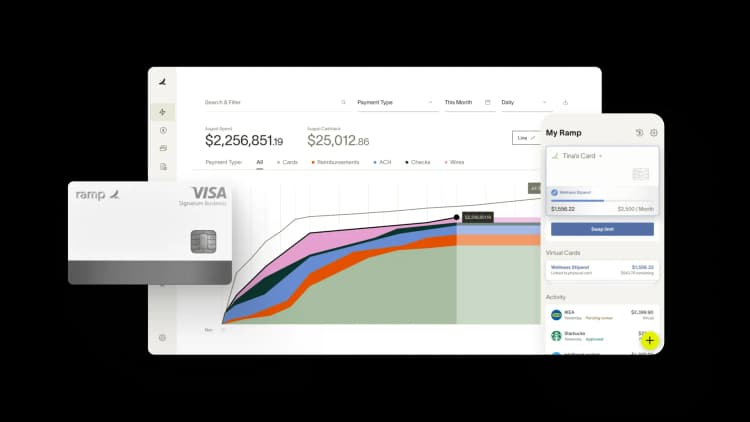
Real estate finances pile up fast: rent collection, vendor payments, and multi-entity structures all demand specialized handling. Generic tools weren't built for this world—they miss property-level reporting, LLC separation, and IRS-aligned tax categories like Schedule E. The right software works the way your business actually does, keeping every property, payment, and tax obligation organized in one place.
What is real estate accounting software?
Real estate accounting software tracks income and expenses at the property, portfolio, and entity level. Unlike general accounting tools, it's built to handle the granularity real estate investors and managers need, down to which unit drove which repair cost.
A few features set it apart from standard bookkeeping software:
- Property-level tracking: Assigns income and expenses to individual properties rather than lumping everything into one ledger
- Portfolio visibility: Aggregates data across multiple properties so you can see your full financial picture at a glance.
- Entity separation: Handles multiple LLCs or ownership structures while still rolling up to a parent view.
Real estate accounting software brings the financial detail your properties demand without requiring you to wrestle data into shape yourself.
At a glance: Comparing the best real estate accounting software
The best real estate accounting software depends on whether you manage rentals, sell homes, or run a commercial portfolio. This table compares 11 tools on who they're built for, their standout features, and starting price.
| Software | Best for | Key features | Starting price |
|---|---|---|---|
| QuickBooks Online | Solo agents and brokerages | Payroll, AP/AR, and bank feeds | $38/month |
| Xero | Small portfolios | Multi-currency, app integrations | $25/month |
| Sage Intacct | Enterprise and REITs | Multi-entity, advanced reporting | Custom |
| Landlord Studio | DIY landlords | Property-level tracking, Schedule E | Free tier |
| Buildium | Property managers | Lease tracking, tenant screening | $62/month |
| AppFolio | Large portfolios | Marketing tools, maintenance tracking | Custom |
| FreshBooks | Realtors and agents | Invoicing, time tracking | $23/month |
| Stessa | Beginner investors | Automated tracking, dashboards | Free tier |
| REI Hub | Short-term and mixed rental portfolios | Property-based accounting, Schedule E, Airbnb/VRBO imports | Free tier |
| Baselane | Landlords who want banking plus bookkeeping | Integrated banking, rent collection, bookkeeping | Free tier |
| Realtyzam | Solo real estate agents | Bank feeds, one-click tax report, receipt scanning | Free trial, then $11.58/month |
The best real estate accounting software
Several accounting platforms are designed specifically for real estate. These tools vary in pricing, features, and scalability, so the right choice depends on your business's size, budget, and financial complexity.
QuickBooks Online
QuickBooks Online is the household standard for solo agents and traditional brokerages that need flexible general accounting. It handles payroll, AP/AR, and bank feeds well, and you can pair it with a real estate add-on like Propertyware for property-level reporting.
Key features
- Payroll processing: Handles agent commissions and contractor payments.
- Bank feed integration: Automatic transaction imports from most financial institutions
- App ecosystem: Connects with real estate-specific add-ons for enhanced functionality.
Drawbacks
- Lacks property-level tracking out of the box
- Class and location tracking workarounds get messy at scale.
- Requires third-party apps for tenant management or Schedule E automation.
Pricing
Plans start at $38/month for Simple Start, with Essentials at $85/month, Plus at $140/month, and Advanced at $340/month. Most real estate users need Plus or higher for class tracking.
Xero
Xero accounting software is best for small real estate portfolios and international investors who need multi-currency support. It's cloud-based, has an extensive app marketplace, and works as solid bookkeeping software for realtors managing simple portfolios.
Key features
- Multi-currency support: Ideal for investors with international holdings
- Unlimited users: Collaborate with your accountant at no extra cost
- App integrations: Connects with property management tools for extended functionality
Drawbacks
- Lacks property-level reporting without add-ons
- Less brand recognition with US-based CPAs than QuickBooks
- Reporting library is thinner than competitors at the entry tier
Pricing
Xero starts at $25/month (Early), with Growing at $55/month and Established at $90/month. Real estate users typically need Growing or higher for unlimited transactions.
Sage Intacct
Sage Intacct is built for enterprise operations, REITs, and commercial real estate accounting needs. It handles multi-entity consolidation, waterfall structures, and complex fund accounting that smaller platforms can't touch.
Key features
- Multi-entity consolidation: Manage dozens of LLCs from one platform
- Advanced financial reporting: Customizable dashboards for investor reporting
- REIT compliance: Built for real estate fund accounting software requirements.
Drawbacks
- Overkill for small landlords
- Steep learning curve and implementation timeline
- Requires dedicated accounting staff or a consultant to deploy well
Pricing
Sage Intacct uses custom pricing based on entity count, user count, and modules. Contact them directly for a quote.
Landlord Studio
Landlord Studio is the top pick for DIY landlords and residential investors. It's purpose-built real estate investment accounting software with property-level tracking, Schedule E reports, and integrated rent collection.
Key features
- Schedule E automation: Tax-ready reports aligned with IRS categories.
- Mileage tracking: Log property visits for deductions
- Rent collection: Accept online payments directly through the platform
Drawbacks
- Limited commercial real estate features
- Reporting depth doesn't match enterprise tools like Sage
- Free tier is capped at three units
Pricing
Landlord Studio offers a free tier for up to three units. The Pro plan starts at $12/month for up to three units, scaling based on unit count. The Pro Plus plan starts at $28/month.
Buildium
Buildium is the best accounting software for property management companies overseeing residential units. It pairs lease tracking, tenant screening, and maintenance coordination with a capable property management accounting system.
Key features
- Tenant screening: Background and credit checks built in
- Lease management: Digital lease signing and renewal tracking
- Maintenance tracking: Coordinate repairs and track costs by property
Drawbacks
- Minimum unit requirements on lower tiers
- Less suited for investors without tenants
- Add-on fees for screenings, e-leases, and 1099 e-filing
Pricing
Buildium starts at $62/month (Essential), with Growth at $192/month and Premium at $400/month. Pricing scales with unit count above plan thresholds.
AppFolio
AppFolio is built for large portfolios and scaling property management firms that need a fully integrated property management and accounting platform. It includes marketing automation, AI-powered leasing tools, and owner portals.
Key features
- Marketing automation: Syndicate listings and fill vacancies faster
- AI-powered leasing: Automate applicant communication
- Owner portals: Give investors real-time access to property financials.
Drawbacks
- Expensive for small portfolios
- Minimum unit requirements (typically 50 units)
- Implementation and onboarding can take weeks
Pricing
AppFolio uses custom pricing. Contact them directly for a quote.
FreshBooks
FreshBooks is realtor bookkeeping software built for agents focused on invoicing and expense tracking. It has a clean interface, a strong mobile app, and time tracking that fits accounting software for realtors managing commission income.
Key features
- Professional invoicing: Brand your invoices and automate payment reminders
- Expense tracking: Snap receipts and categorize on the go
- Time tracking: Bill clients for consulting or property management hours
Drawbacks
- Lacks property-specific features
- Better for service-based real estate professionals than investors
- Client limits on lower tiers
Pricing
FreshBooks starts at $23/month (Lite, five clients), with Plus at $43/month (50 clients) and Premium at $70/month (unlimited clients). Select plan custom pricing is also available.
Stessa
Stessa is the best choice for beginner investors and those scaling a residential portfolio. The free tier offers automated income and expense tracking, real-time dashboards, and tax-ready reporting. It's owned by Roofstock, so it integrates with the property marketplace.
Key features
- Automated transaction tracking: Bank feed imports with smart categorization
- Tax-ready reports: Schedule E and other IRS-aligned reports
- Portfolio dashboard: Real-time NOI, cash flow, and asset value tracking
Drawbacks
- Limited features in free tier
- Focused on residential rentals
- No built-in tenant screening or lease management
Pricing
Stessa offers a free Essentials plan. Manage costs $12/month and Pro runs $28/month (billed annually), adding advanced reporting, e-signature, and maintenance tracking tools.
REI Hub
REI Hub is rental property accounting software built for landlords and investors running short-term or mixed portfolios. Its property-based framework ties every dollar of income and expense to the unit that generated it.
Key features
- Automatic transaction import: Rule-based matching pulls activity from linked bank, loan, and credit card accounts
- Short-term rental support: Imports Airbnb and VRBO payout statements alongside traditional rent
- Per-property reporting: Generates P&L, cash flow, and fixed asset schedules for each property
- Schedule E automation: Produces tax-ready reports aligned with IRS categories, plus mileage allocation.
Drawbacks
- Built for rental investors, not agents, brokerages, or heavy commercial portfolios.
- No tenant screening or leasing suite like Buildium offers.
Pricing
REI Hub offers a free tier for every portfolio size, with no credit card required. Its professional plans, for higher-volume investors who want automated bookkeeping, start at $9/month billed annually (or $15/month billed monthly) and scale by unit count.
Baselane
Baselane combines landlord banking, rent collection, and property-level bookkeeping in one platform. It's built for residential landlords who want their banking and their books to live in the same place.
Key features
- Integrated banking: Open property-specific accounts to keep each entity's funds separate
- Automated rent collection: Collect rent online and track it against each property automatically
- Schedule E-ready bookkeeping: Auto-tags transactions to the right property and tax category
- Analytics dashboards: Track cash flow and portfolio performance in real time
Drawbacks
- Focused on residential landlords, not commercial or fund accounting
- The banking-led model may not fit investors who are happy with their current bank
Pricing
Baselane's core plan is free with no monthly fees or minimums, and its Smart plan adds advanced automation for $20/month.
Realtyzam
Realtyzam is simple accounting software built exclusively for real estate agents. It focuses on commissions and expenses, so you can generate a tax report without traditional bookkeeping.
Key features
- Automatic bank feeds: Connects to over 15,000 supported banks with auto-categorization
- Receipt scanning: Capture and store expense receipts from the mobile app
- One-click tax report: Generate quarterly and year-end reports in seconds
- Custom categories: Organize expenses to match how you run your business
Drawbacks
- Built for agents only, not landlords, investors, or property managers.
- No property-level rental tracking or W-2 payroll, and it replaces QuickBooks rather than syncing with it
Pricing
Realtyzam offers a free 30-day trial and stays free until you sell two properties or log $3,000 in income and expenses. After that, it's about $11.58/month billed annually or $14/month billed monthly.
Best real estate accounting software by use case
The right software depends on your specific role in real estate. Individual investors, property managers, commercial firms, and brokerages all have meaningfully different needs—and picking the wrong category fit means paying for features you'll never use while missing the ones you actually need.
Best real estate investment accounting software for landlords
Landlord Studio or Stessa. Both offer free tiers, property-level tracking, and Schedule E reporting. For short-term or mixed rental portfolios, REI Hub is a strong alternative with Airbnb and VRBO payout imports. They're ideal if you want clean books without hiring a bookkeeper.
Best bookkeeping software for realtors and brokerages
QuickBooks Online or FreshBooks. Your real estate brokerage accounting needs center on commission tracking, invoicing, and simple expense management rather than property-level accounting. QuickBooks scales better if you have employees, while FreshBooks and the agent-only Realtyzam are cleaner for solo agents.
Best accounting software for real estate agents
Realtyzam. It's built exclusively for agents, with bank feeds and one-click tax reports that track commissions and expenses without full bookkeeping.
Best accounting software for property management companies
Buildium for small-to-mid portfolios, AppFolio for enterprise scale. Both combine property management and accounting in one platform with tenant-facing features. Buildium is the better choice if you're managing costs; AppFolio if you need automation and can support a larger portfolio.
Best commercial real estate accounting software
Sage Intacct for REITs and large funds. If you're a CRE syndicator, tools like Agora (outside our top eight, but notable) handle waterfall structures and K-1 delivery natively. Both meet real estate fund accounting software requirements that smaller platforms can't.
Best accounting software for real estate developers
Sage or QuickBooks with construction add-ons. You'll need job costing, project-based accounting, and draw tracking that standard real estate software doesn't provide. Real estate developer accounting often requires customization or add-on modules such as Knowify or Buildertrend.
Property management software vs. real estate accounting programs
These two categories often get confused, but they solve different problems. Property management software handles tenant-facing operations such as leases, rent collection, and maintenance requests. Real estate accounting programs focus on bookkeeping, financial reporting, and tax preparation—and choosing the wrong category means you'll either be missing financial visibility or paying for tenant tools you don't need.
Some platforms combine both: Buildium and AppFolio bundle property management with accounting, while QuickBooks, Xero, and Stessa stay firmly on the financial side.
| Feature | Property management software | Real estate accounting programs |
|---|---|---|
| Primary focus | Tenant operations | Financial tracking |
| Core functions | Lease management, rent collection, and maintenance requests | Income/expense tracking, financial reports, and tax prep |
| Best for | Active property managers | Investors focused on bookkeeping |
| Examples from list | Buildium, AppFolio | QuickBooks, Xero, Stessa |
Essential features of real estate accounting software
Strong real estate accounting platforms share a few must-have capabilities. Knowing what to look for before you evaluate vendors saves you from signing up for a tool that looks good in a demo but falls short when your books get complicated.
Property-level income and expense tracking
This is the core differentiator. You need profit and loss by property, not just a single consolidated P&L statement. Property-level tracking helps you spot underperforming assets, justify rent increases, and inform buy/sell decisions with actual data.
Tax preparation and Schedule E reporting
Real estate investors file Schedule E to report rental income, and good software generates tax-ready reports aligned with IRS categories. This saves hours at tax time and trims your CPA bill because your accountant gets clean, categorized data instead of a shoebox of receipts.
Bank and credit card account syncing
Automatic transaction imports eliminate manual entry and missed deductions. Look for real-time or daily syncing across all your accounts.
Corporate cards with built-in automation like Ramp go a step further. Ramp's Accounting Agent auto-codes 3.5x more transactions than rules-only tools, with 98% accuracy on the transactions it flags ready to sync, so your data lands clean before it ever reaches your accounting software.
Receipt capture and document management
Mobile receipt scanning and digital storage protect you in audits and at tax time. Most modern platforms use OCR to extract vendor, date, and amount data automatically, so you're not typing it in manually.
Multi-entity and multi-property support
If you hold properties in separate LLCs, you need software that tracks each entity's books independently while still rolling up to a portfolio view. This is also critical for trust accounting in real estate, where commingling funds across entities creates legal and tax problems.
Real-time financial reporting and dashboards
Look for cash flow statements, P&L by property, and net operating income dashboards available on demand. Real-time data lets you make decisions without waiting for a month-end close, and it supports better budgeting against benchmarks like the 50% rule or 7% maintenance rule.
How to choose the best accounting software for your real estate business
Choosing real estate accounting software comes down to four factors: your real estate niche, the integrations you need, the level of automation, and total cost of ownership. Getting clear on each one before you start evaluating tools will save you from a costly platform switch 6 months down the road.
Define your real estate niche and portfolio size
Start by identifying your category, because different software fits different operators. A DIY landlord with three rentals doesn't need the same tools as a syndicator managing $50 million in commercial assets.
- DIY landlords: Want simplicity, low cost, and tax-ready reports.
- Property managers: Need tenant screening, lease tracking, and maintenance coordination alongside accounting.
- Commercial investors and funds: Require multi-entity support, waterfall distributions, and investor reporting.
- Solo agents and brokerages: Focus on commission tracking, invoicing, and expense management
Evaluate integration with existing financial tools
Check whether the software syncs with your bank accounts, credit cards, and any accounting software you already use. Most modern platforms support direct bank feeds, but the depth of those connections varies.
Some real estate-specific tools such as Stessa and Landlord Studio integrate with QuickBooks or Xero, letting you keep specialized property tracking on one side and general bookkeeping on the other. Understanding the difference between an ERP vs. accounting platform can also help you decide whether a standalone real estate tool is enough or whether you need a broader system.
Assess automation and time-saving features
Look for automatic bank feeds, receipt capture, and categorization rules. These features cut manual data entry and reduce reconciliation errors at month-end. Pairing your real estate accounting software with dedicated accounting reconciliation software can further streamline your close process.
Compare pricing and total cost of ownership
Free tiers exist (Stessa, Landlord Studio) but often lack advanced reporting and integrations. Paid plans range from $23/month for FreshBooks up to $62+/month for Buildium, with enterprise tools like Sage Intacct quoted custom.
Factor in per-unit fees, add-on costs for payroll or 1099 filing, and whether you'll outgrow the platform within a year or 2. The cheapest option up front isn't always the lowest cost over time.
How real estate financial software integrates with your accounting stack
Real estate accounting programs rarely operate in isolation. They're one layer in a broader financial stack, and the strength of your integrations determines how much manual reconciliation you're doing at month-end. Strong integrations across banking, payments, expense management, and your general ledger keep data flowing without manual reconciliation.
Ramp's Accounting Agent auto-codes GL, department, class, location, and custom fields the moment a transaction posts, then syncs to QuickBooks Online, NetSuite, Sage Intacct, and Microsoft Dynamics in real time, helping real estate teams close their books 3x faster. Every AI decision includes a confidence level, rationale, and override capability, so you keep a full audit trail.
Plan for a few integration categories:
- Banking connections: Direct feeds from checking, savings, and credit accounts
- Payment processors: Rent collection services and tenant payment apps
- Corporate cards: Expense management tools that categorize spending automatically
- General ledger: Sync with QuickBooks, Xero, Sage, or NetSuite for consolidated reporting
Simplify your real estate financial operations with Ramp
Real estate accounting software tracks property-level finances, but you still need to manage day-to-day expenses, vendor payments, and corporate card spending. That's where Ramp's accounting automation software fits in.
Ramp's Accounting Agent auto-codes spend, captures receipts, and routes approvals, so your real estate accounting software receives clean, organized data from the start. Instead of reconciling card transactions at month-end, you get coded entries that flow directly into your books.
Key Ramp benefits for real estate companies include:
- Automated expense categorization: Transactions are coded before they hit your books.
- Receipt matching: Receipts auto-attach to transactions, eliminating manual uploads.
- Vendor management: Track and pay contractors, maintenance providers, and suppliers.
- Accounting integrations: Syncs with QuickBooks, Xero, Sage, and NetSuite.
Try an interactive demo of Ramp to see how it fits into your real estate accounting stack.

FAQs
Yes, many platforms support multi-entity accounting. Sage Intacct, Landlord Studio, and Buildium let you keep separate books for each LLC while consolidating data for portfolio-level reporting. This matters for both legal liability protection and accurate tax filing.
Most platforms offer CSV import tools or direct bank feed connections that pull historical transactions. Start by connecting your bank accounts, importing the last 12 months of data, and categorizing transactions to build your chart of accounts. From there, set up property tags and reconcile against year-end balances.
Some platforms, including QuickBooks and Buildium, generate and e-file 1099s for contractors you've paid. Others require you to export data to a separate 1099 filing service or hand it off to your accountant. If you pay multiple contractors annually, prioritize built-in 1099 support.
For most real estate businesses, yes. Cloud-based software offers real-time access, automatic updates, and easier collaboration with accountants and partners. Desktop versions give you more local control but lack remote access and require manual backups, a real risk if you're managing properties across multiple locations.
The 7% rule suggests that annual property repairs typically cost around 7% of annual rent collected. It's a budgeting guideline, not a software feature, but good real estate budgeting software helps you track actual maintenance costs against this benchmark so you can spot properties trending above the norm.


“I assumed I would have to choose between speed and control. What I found is that you can have both. A well-designed system takes friction out, for the finance function and for everyone else.”
Justin Webster
CFO, Denver Broncos

“A well-run district should not have to choose between getting work done at the school site and keeping control of the dollars behind it. We're not hiring more people to do more jobs, so we have to be smarter about the process. With Ramp, the purchase, the receipt, and the record stay together from the start. ”
Nick Brizeno
Director of Purchasing, San Marcos Unified School District

“In senior living, scale only works if the communities still feel personal. We needed the back office to carry more of the complexity, not the people serving residents. Ramp helped us build that infrastructure, so the experience in the community could stay human.”
Ryan Cole
CFO, Agemark Senior Living

“AI is moving faster than the finance context around it. Prices change, models change, and the value is not always obvious from an invoice. We needed enough detail to know which bets deserved more investment — and which ones did not.”
Greg Cooley
Controller, AngelList

“Invoices, cards, tokens. The categories change but the principle doesn't: know where the money is going, remove the work around it, and make sure the spend is worth it.”
Maciej Mylik. Finance
ElevenLabs

“We weren’t trying to retrofit an old finance system. We had a blank canvas, and Ramp gave us the foundation to build a global finance function of the future.”
Justin Dourado
Director of Finance, Othership

“There's just no surprises anymore. No more waiting two months to find out how a job did. We know how it's doing as it's happening.”
Erich Kuss
Financial Systems Manager, Infinity Home Services

“More token spend isn’t proof that AI is working. Less isn’t proof that it isn’t. What matters is whether we’re buying the right level of intelligence for the work. Ramp lets us make that judgment in the same place we manage every other type of spend.”
Cody Nutt
Senior Director of Business Systems, Daxko
