How small finance teams are scaling like big ones

- Insight 1: Ramp customers run leaner finance teams at the same company size
- Insight 2: Leaner teams aren’t explained by lighter transaction workloads
- Insight 3: Leaner teams don’t mean less responsibility — Ramp customers do more
- Insight 4: Leverage shows up in real staffing and hiring decisions
- Why this happens: Ramp removes work that normally requires headcount
- The takeaway for finance leaders: Scale comes from leverage, not team size
Perplexity, a category-leading AI company, runs finance with ten people.
Cursor, a $30B company, does it with just three.
They’re not smaller because there’s less work: they handle real transaction volume, manage vendors, enforce controls, and support fast-growing businesses. What’s different is how much is left to do when the work reaches finance.
In a new survey of finance leaders at companies with 25–999 employees, we found the same pattern: teams using Ramp support the same finance workload with more than 40% smaller teams than non-Ramp teams.
Not by cutting scope. Not by burning people out. But by removing routine work that normally forces teams to hire.
For decades, finance followed a rule: as the business grows, the team grows with it. The data shows that rule no longer holds.
The teams scaling best today aren’t adding headcount — they’re building leverage through intelligent tools.

Insight 1: Ramp customers run leaner finance teams at the same company size
We compared the median finance team size as a percentage of total headcount, grouping by company size.
In those company-size bands, Ramp customers are leaner in every case, with differences ranging from 42% smaller to 80% smaller and increasing with company size.
| # of employees | Non-Ramp customers finance team % | Ramp customers finance team % | Delta |
|---|---|---|---|
| 25–99 | 10% | 5.8% | 42% smaller |
| 100–249 | 8.3% | 4.2% | 49% smaller |
| 250–499 | 6.2% | 2.6% | 58% smaller |
| 500–999 | 4.5% | 0.9% | 80% smaller |
Insight 2: Leaner teams aren’t explained by lighter transaction workloads
To test whether smaller teams were simply handling less work, we compared monthly finance transaction volumes across Ramp customers and non-customers within the same company-size bands.
Across every overlapping workload band, both groups operate at similar levels of volume.
For example, in the 500–999 employee range, median monthly transactions are nearly identical:
- Ramp customers: 1,492
- Non-customers: 1,500
Workload doesn’t explain the staffing gap.
Insight 3: Leaner teams don’t mean less responsibility — Ramp customers do more
To account for scope, the survey measured which finance functions teams own in-house.
Across comparable company sizes, Ramp customers own a broader set of finance responsibilities. That gap is most visible at 25–249 employees, when teams begin taking on forecasting, cash management, and compliance — functions that often drive specialist hires.
Among companies with 25–249 employees:
| Finance functions | Covered by non-Ramp customers | Covered by Ramp customers |
|---|---|---|
| Strategic finance functions (FP&A, treasury, procurement) | 35–40% | 87% |
| Governance and control functions (compliance, audit, risk) | 25–30% | 79% |
“We saved money by not hiring additional headcount and allowing team members to become more strategic versus operational.”
Survey respondent
This means smaller Ramp teams run forecasts, manage cash and vendors, and enforce controls without adding dedicated FP&A, AP, or compliance roles.
Insight 4: Leverage shows up in real staffing and hiring decisions
Compared to non-customers, Ramp customers consistently choose different ways to use their teams:
- More likely to redeploy existing staff to higher-impact work (Non-customers 31% vs. Ramp customers 54%)
- More likely to delay or postpone hiring altogether (33% vs. 44%)
- Less likely to rely on working longer hours (33% vs. 18%)
- Less likely to use outsourced or fractional support (31% vs. 16%)
“Less time pushing paper and more time analyzing our business.”
Survey respondent
Why this happens: Ramp removes work that normally requires headcount
Ramp doesn’t just make finance teams faster. Customers report that it removes routine work that forces teams to hire in the first place.
When asked what drives their efficiency gains, 96% of Ramp customers surveyed point to Ramp itself.
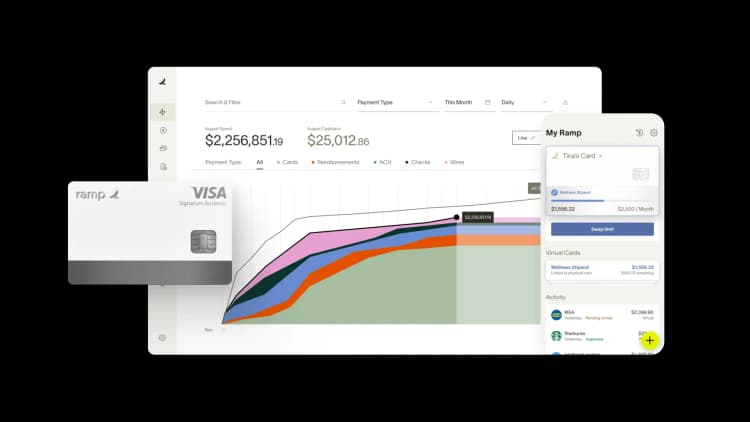
With Ramp, spend is controlled at the point of payment, so fewer back-and-forths surface later. Transactions arrive with the right context and coding, reducing review time and follow-ups. And because spend, payments, and controls live in one system with real-time ERP syncs, teams spend less time reconciling across tools.

The takeaway for finance leaders: Scale comes from leverage, not team size
If you’re scaling a business, hiring shouldn’t be the first lever you reach for.
Headcount growth is often a downstream consequence of outdated systems and processes, and teams that remove that work upstream avoid scaling people at the same pace.
The better questions to ask are operational:
- Where does manual work enter the process and how can we automate it?
- Which controls can be enforced at the point of spend instead of after the fact?
- What information can be captured upfront to avoid scrambles later?
- Where does human judgment add unique value?
Teams that answer those questions thoughtfully invest in systems that stop unnecessary work upstream. That lets finance focus on forecasting, governance, and decision support.
See how Ramp can help you do more with less.
Methodology
This analysis compares Ramp customer survey responses and transaction volumes to a non-Ramp customer survey of US finance team leaders.
The surveys were designed and processed to ensure valid, apples-to-apples comparisons across company size bands. Finance staffing efficiency is measured using median finance headcount as a percentage of total company headcount, with workload controlled via monthly transaction volume bands and scope controlled via finance function coverage. All reported comparisons are limited to overlapping company-size bands (25–999 employees).


“I assumed I would have to choose between speed and control. What I found is that you can have both. A well-designed system takes friction out, for the finance function and for everyone else.”
Justin Webster
CFO, Denver Broncos

“A well-run district should not have to choose between getting work done at the school site and keeping control of the dollars behind it. We're not hiring more people to do more jobs, so we have to be smarter about the process. With Ramp, the purchase, the receipt, and the record stay together from the start. ”
Nick Brizeno
Director of Purchasing, San Marcos Unified School District

“In senior living, scale only works if the communities still feel personal. We needed the back office to carry more of the complexity, not the people serving residents. Ramp helped us build that infrastructure, so the experience in the community could stay human.”
Ryan Cole
CFO, Agemark Senior Living

“AI is moving faster than the finance context around it. Prices change, models change, and the value is not always obvious from an invoice. We needed enough detail to know which bets deserved more investment — and which ones did not.”
Greg Cooley
Controller, AngelList

“Invoices, cards, tokens. The categories change but the principle doesn't: know where the money is going, remove the work around it, and make sure the spend is worth it.”
Maciej Mylik. Finance
ElevenLabs

“We weren’t trying to retrofit an old finance system. We had a blank canvas, and Ramp gave us the foundation to build a global finance function of the future.”
Justin Dourado
Director of Finance, Othership

“There's just no surprises anymore. No more waiting two months to find out how a job did. We know how it's doing as it's happening.”
Erich Kuss
Financial Systems Manager, Infinity Home Services

“More token spend isn’t proof that AI is working. Less isn’t proof that it isn’t. What matters is whether we’re buying the right level of intelligence for the work. Ramp lets us make that judgment in the same place we manage every other type of spend.”
Cody Nutt
Senior Director of Business Systems, Daxko
