

- The quadrillion token blind spot
- The quiet AI story: Cheaper and Smarter
- The problem isn't spending. It's blind spending.
- “Token Spend Management” (2026—)
- Don’t miss the decade
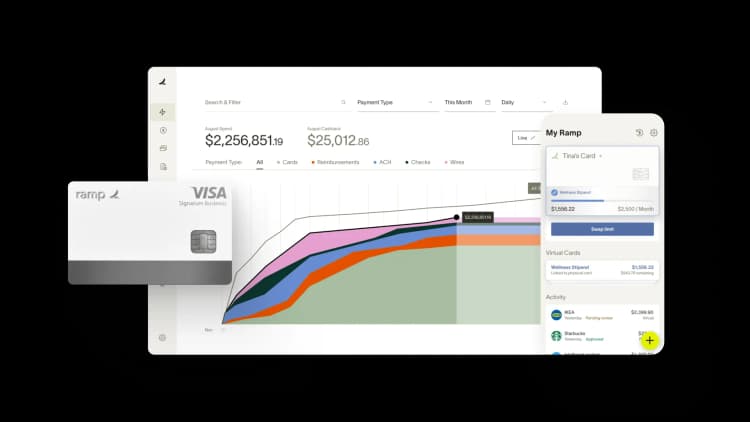
For as long as we’ve sold sacks of grain, business ran on two pillars. People and Vendors.
Keeping track was tricky. So we spent the last five centuries building modern finance to manage them. Double-entry bookkeeping was invented in 1494, corporate cards in 1958, then software arrived and digitized expenses, invoices, bill pay, and procurement.
Ramp made these systems ‘intelligent’ but the two pillars never changed. People had wages. Vendors had contracts. A 21-year-old in FP&A could glance at a P&L and tell you exactly how each line item was governed. Every cost was a number you could see coming.
Then in the space of 24 months, it all changed. Work was no longer constrained by headcount or contracts — intelligence could do it too. And you’d pay for it by the meter with something called Tokens.
Two pillars became three. Tokens quickly became the fastest growing cost in the history of business. Just one small problem:
They’re invisible to the system we spent the last five centuries designing.
The quadrillion token blind spot
Boil down 500 years of finance and it’s really three questions:
a) “who’s spent what?” b) “was it worth it?” c) “what’s the bill next month”?
Imagine a SaaS contract is up for renewal. The CFO has all three answers by lunch. Tick. Tick. Tick. Approved. The old line items answered themselves.
Now picture the same CFO. Her AI bill tripled last quarter. Same three questions — what does she find? A single line item from Anthropic. One number. No breakdown. She has no idea.
What’s going wrong? Well, tokens are not SaaS.
They don’t live in one department's budget; they cross all of them. There’s no annual contract you can review; AI usage moves daily. There’s no bill you can forecast; a single prompt change can triple it overnight.
It’s like hiring Tom Cruise, finding out he charges by the stunt, and you don’t know if you’re making Jerry Maguire or Mission: Impossible.
You’ve seen the headlines. “Uber blows yearly AI budget in just one quarter”. “Meta employee burns 281 billion tokens in April.”
That’s the loud AI story. If you’re a CFO reading this, I imagine your instinct might be to slow down.
But before you do, let’s zoom out.
The quiet AI story: Cheaper and Smarter
It is better to be directionally right than precisely wrong.
- AI will keep getting cheaper: In 2023, matching GPT-4-level intelligence cost $60 per million tokens.¹ Today, about 40 cents.²
- AI will keep getting smarter: In 2023, GPT-4 solved 2 out of every 100 software bugs.³ Today’s leading models: 94.⁴

This is the shape of technology. Transatlantic calls, phone cameras, GPS. You don’t know the price, or exactly when — but you can see the direction.
I’ve seen it first-hand. Last May, our engineering department wrote 100% of customer-facing code. This May, 19 different departments made code changes. The PM who spots the bug now fixes it.
And I’ve seen it with our customers: Since 2023, the top quartile of our AI spenders doubled their revenue. The bottom quartile? Flat. Both groups are mostly not tech companies. A window installer in Utah, up 59%. A five-person construction firm in Florida, up 65%.

The problem isn't spending. It's blind spending.
So if spending works, what's the issue? Well, in one word: measurement.
You don’t know which spend worked.
A sales team has qualified leads. A support team has resolved conversations. These are units you can measure against. All a token can tell you is the meter ran, not whether the work was worth it or not.
Finance says, “half the budget,” engineering says, “double it” and you don’t know who’s right because there is no shared language of value.
For example, right now, all work, no matter the size or shape, defaults to frontier models. But meeting summaries and calendar updates don’t require GPT-5.5 Pro.
In isolation this seems trivial, but think again. If you can re-route just 10% of a $10M AI bill from frontier to GPT-4 level intelligence you’ve saved nearly one million dollars. It truly is that much cheaper. Not every task needs Tom Cruise.
This is the future of finance: better-matched intelligence. Not rubber-stamping AI spend or rejecting it wholesale, but allocating it with the same rigor companies apply to headcount, software, and vendors.
Fortunately, that’s what we’re building.

“Token Spend Management” (2026—)
But how do you ‘manage’ intelligence? It’s invisible. It sits in one line item. It cuts across every function.
At Ramp, we like to say, “see it, understand it, control it”.
See it: You can’t manage what you can’t measure. So, we pull token-level usage and costs directly from Anthropic, OpenAI, Gemini, and Cursor into one dashboard.
Understand it: A token is just a unit until you know what it bought. For the first time finance can see them as dollars attributed to teams, projects, and, crucially, use cases. This is how CFOs measure ROI.
Control it: Intelligence is baked in. Running ahead of forecast? We’ll recommend which workflows could switch to a less expensive model. Cost spiked overnight? We’ll create an alert and set a limit.
None of your employees went to school for tokenomics. So, we’re making it as easy as possible.
Where’s this heading? Well, by 2028, Gartner projects ~$15T in B2B purchases will be handled in full or part by AI agents.⁵ That’s roughly 10% of global GDP. So in April, we gave agents their own corporate cards. Soon they’ll be sourcing vendors, running procurement, signing contracts, executing payments just like your workforce.
So, how do you ‘manage’ intelligence? Tokens are just dollars. Agents are just hires. And we’re building a new finance system ready to manage both of them.
Don’t miss the decade
Last April, Shopify CEO Tobi Lütke wrote an internal memo titled “Reflexive AI usage is now a baseline expectation.”
At the time it was mildly controversial. One year on the only controversy is how to pay for it. If you spend too much time online, the choice appears to be:
“Slow down? Miss the decade. Speed up? Blow the quarter.”
And I’m here to tell you that’s a false choice. The companies pulling away aren't spending less, or more, they're spending better.
Your least governed cost is also your single greatest opportunity.
The third pillar is here. The CFO’s job just got bigger. And yes, we’re here to help.
Job’s not finished.
— Eric
1 GPT-4 launch pricing, OpenAI, March 2023 — $60 per million output tokens.
2 2026 pricing for GPT-4-equivalent models (e.g. DeepSeek V4), ~$0.40 per million output tokens. Sources: TokenMix, TokenCost AI Price Index, 2026.
3 Rein et al. (2023), GPQA: A Graduate-Level Google-Proof Q&A Benchmark, arxiv.org/abs/2311.12022
4 Epoch AI, GPQA Diamond, epoch.ai/benchmarks/gpqa-diamond
5 Gartner, "Gartner Unveils Top Predictions for IT Organizations and Users in 2026 and Beyond," press release, October 21, 2025.
“I assumed I would have to choose between speed and control. What I found is that you can have both. A well-designed system takes friction out, for the finance function and for everyone else.”
Justin Webster
CFO, Denver Broncos

“A well-run district should not have to choose between getting work done at the school site and keeping control of the dollars behind it. We're not hiring more people to do more jobs, so we have to be smarter about the process. With Ramp, the purchase, the receipt, and the record stay together from the start. ”
Nick Brizeno
Director of Purchasing, San Marcos Unified School District

“In senior living, scale only works if the communities still feel personal. We needed the back office to carry more of the complexity, not the people serving residents. Ramp helped us build that infrastructure, so the experience in the community could stay human.”
Ryan Cole
CFO, Agemark Senior Living

“AI is moving faster than the finance context around it. Prices change, models change, and the value is not always obvious from an invoice. We needed enough detail to know which bets deserved more investment — and which ones did not.”
Greg Cooley
Controller, AngelList

“Invoices, cards, tokens. The categories change but the principle doesn't: know where the money is going, remove the work around it, and make sure the spend is worth it.”
Maciej Mylik. Finance
ElevenLabs

“We weren’t trying to retrofit an old finance system. We had a blank canvas, and Ramp gave us the foundation to build a global finance function of the future.”
Justin Dourado
Director of Finance, Othership

“There's just no surprises anymore. No more waiting two months to find out how a job did. We know how it's doing as it's happening.”
Erich Kuss
Financial Systems Manager, Infinity Home Services

“More token spend isn’t proof that AI is working. Less isn’t proof that it isn’t. What matters is whether we’re buying the right level of intelligence for the work. Ramp lets us make that judgment in the same place we manage every other type of spend.”
Cody Nutt
Senior Director of Business Systems, Daxko
