
- What is travel management software
- Best travel management software compared
- 8 best travel management software platforms
- Key features to look for in travel management software
- Benefits of using travel management software
- How to choose the right travel management software
- Common travel management challenges and solutions
- How Ramp simplifies business travel and expenses
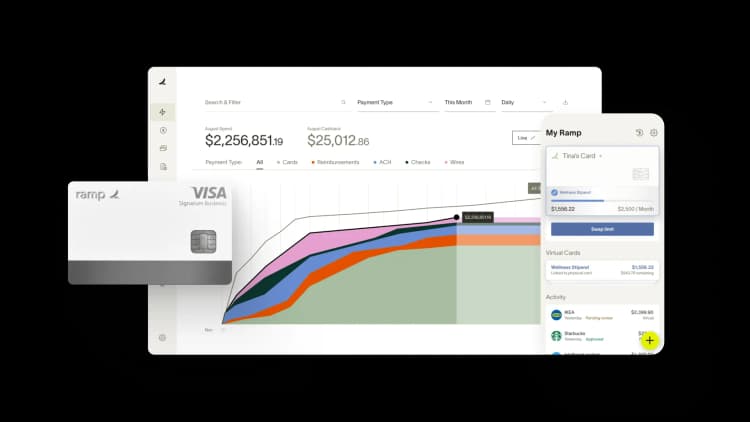
Travel management software gives you a smarter way to control costs, simplify approvals, and centralize reporting. Business travel spending will exceed $2 trillion by 2029, making it more important than ever to get travel spend under control. The right platform turns reactive firefighting into proactive cost control.
What is travel management software
Travel management software centralizes booking, expense tracking, and policy enforcement for business trips into a single platform. It replaces manual workflows with automated systems that give finance teams real-time control over travel spend.
Beyond flights and hotels, leading platforms handle expense tracking, approval workflows, and real-time reporting so finance and HR can monitor spend and keep purchases aligned with your corporate travel policy. Unlike consumer travel booking software, these platforms include policy controls, approval workflows, and reporting built in.
Core functions include:
- Booking: Centralized platform for flights, hotels, and car rentals
- Policy enforcement: Automatic rules that flag or block out-of-policy bookings
- Expense tracking: Capture receipts and categorize travel spend in real time
- Reporting: Visibility into travel spend across teams and departments
Best travel management software compared
Not all corporate travel management software is built the same. The table below breaks down how the top platforms stack up across pricing, strengths, and ideal use cases:
| Platform | Best for | Pricing | Standout feature |
|---|---|---|---|
| Ramp | Integrated travel, expense, and card on one platform | Free; Plus $15/user/mo; Enterprise custom | Hotel Price Drop and Flight Savings |
| Navan | AI-driven travel recommendations | Free for companies under 300 employees; quote-based beyond | AI-powered trip recommendations and rewards |
| SAP Concur | Large enterprises with global compliance | Quote-based | Global regulatory compliance and ERP depth |
| TravelPerk | Booking flexibility and sustainability | Starter $0/mo + 5% per booking; Premium $99/mo + 3% per booking | FlexiTravel 80% refund on cancellations |
| Egencia | High-volume programs needing 24/7 support | Quote-based | Amex GBT global network |
| Engine | Budget-conscious teams focused on hotel savings | Free, no contracts | Engine reports 26% average hotel savings |
| BILL Spend & Expense | Small businesses managing spend together | Free with BILL corporate card; paid tiers for AP/AR | Integrated spend management |
| Circula | European companies needing multi-country compliance | Per-employee pricing | EU tax and per diem automation |
8 best travel management software platforms
Here are eight leading business travel software solutions, compared across features, ideal use cases, and pricing:
1. Ramp

Ramp brings travel booking, expense management, and corporate cards together on one platform with zero fees. While many corporate travel platforms charge per-booking fees, Ramp charges $0 platform fees and $0 per-booking fees. Policy is enforced at the moment of booking, so finance teams catch out-of-policy spend before it happens, not weeks later during reconciliation.
Ramp also works to save you money, not just process bookings. Hotel Price Drop monitors refundable hotel rates and automatically rebooks when the price decreases by $50 or more. Flight Savings surfaces comparable lower fares at the point of booking with a one-click switch, so you're getting savings that most platforms don't offer.
Key features
- Integrated travel booking, expense management, and corporate cards on one platform
- Hotel Price Drop automatically rebooks when refundable hotel rates drop $50+
- Flight Savings surfaces comparable lower fares at booking with a one-click switch
- Policy enforcement at the point of booking
- Automated receipt matching and expense categorization
- Real-time dashboards and spend reporting for finance teams
Pros
- $0 platform fee and $0 per-booking fee
- Travel, expenses, and cards on a single platform eliminates reconciliation across tools
- Active savings features reduce spend automatically
- Policy enforced before the transaction, not flagged after the fact
- 95%+ of travel transactions have receipts auto-matched and memos generated
Cons
- Not a full-service TMC; companies needing complex international itineraries or white-glove support should pair Ramp with a travel management company integration
- Best suited for domestic travel; employees based outside the U.S. and frequent international-to-international travel have limited support
Pricing
Unlimited free tier; Ramp Plus $15/user/month; Enterprise custom. No platform fees or per-booking fees on any tier.
Best for
Mid-market companies (50 to 1,000 employees) wanting integrated travel, expense, and card management on a single free platform. Especially strong for finance teams tired of reconciling spend across multiple tools.
2. Navan

Navan (formerly TripActions) combines a consumer-grade booking experience with AI-driven recommendations that learn traveler preferences over time. The Navan Rewards program incentivizes employees to book under budget by sharing savings back as personal rewards, driving adoption and cost savings at the same time.
Key features
- AI-driven trip recommendations that learn from traveler behavior
- Navan Rewards program incentivizes under-budget bookings
- Consumer-grade booking interface designed for high adoption
- 24/7 travel agent support
- Online booking for employees, guests, or groups up to 50
Pros
- Intuitive booking experience reduces off-platform bookings
- Rewards model aligns employee incentives with cost savings
- Strong AI personalization improves over time
- Guest and group booking support built in
Cons
- Pricing is opaque for larger organizations
- Rewards model may not appeal to companies with strict travel policies
- Some users report limited customization for complex approval workflows
Pricing
Free for companies under 300 employees; quote-based beyond that threshold.
Best for
Companies wanting AI-powered travel recommendations with a rewards-based incentive model to drive adoption and savings.
3. SAP Concur

SAP Concur is one of the most established names in corporate travel and expense management, serving large enterprises with complex global operations. The platform offers separate modules for travel, expenses, and invoices, each of which can scale independently as your needs grow.
Key features
- Enterprise-grade travel, expense, and invoice management
- Separate modules that scale independently
- Global regulatory compliance across currencies and tax jurisdictions
- Deep ERP integrations, especially within the SAP ecosystem
- Extensive partner network for travel content
Pros
- Mature platform with decades of enterprise deployment experience
- Strong global compliance across multi-currency and multi-tax environments
- Deep SAP ERP integration
- Large inventory of travel content through supplier connections
Cons
- Steeper learning curve and complex implementation
- Interface can feel dated compared to newer platforms
- Pricing isn't transparent; requires custom quotes
- Modular pricing can add up quickly for full-suite access
Pricing
Quote-based. Pricing depends on modules selected, user count, and configuration.
Best for
Large enterprises with global operations, complex compliance requirements, and existing SAP infrastructure.
4. TravelPerk

TravelPerk offers one of the largest global travel inventories paired with a clean, intuitive interface. FlexiTravel provides an 80% refund on cancellations for any reason, which is valuable if your plans change frequently. TravelPerk also runs GreenPerk, a carbon offsetting program for sustainability-focused organizations.
Key features
- Large global travel inventory with an intuitive booking interface
- FlexiTravel provides an 80% refund on cancellations for any reason
- GreenPerk carbon offsetting program
- 24/7 concierge support for flights, cars, and accommodations
- Integrates with Ramp for expense tracking
Pros
- FlexiTravel cancellation protection is among the most flexible in the market
- Clean booking experience with strong inventory
- GreenPerk appeals to sustainability-conscious companies
- Integrations with major expense management and HR tools
Cons
- Per-booking percentage fees can add up at higher volumes
- Some features (like FlexiTravel) cost extra on top of base pricing
- Expense management is handled through integrations rather than natively
Pricing
Starter $0/mo + 5% per booking; Premium $99/mo + 3% per booking; Pro $299/mo + 3%; Enterprise custom.
Best for
Teams that prioritize booking flexibility, cancellation protection, and sustainability initiatives.
5. Egencia

Egencia, now part of American Express Global Business Travel (Amex GBT), serves mid-to-large enterprises that need a global travel program with dedicated support. The platform combines a large inventory of travel options with risk management tools and 24/7 customer assistance.
Key features
- Amex GBT global network and travel inventory
- High user experience marks for booking interface
- 24/7 customer support and travel assistance
- Risk management and traveler safety features
- Integrates with a variety of expense management platforms
Pros
- Backed by Amex GBT's global infrastructure and negotiated rates
- Strong traveler safety and risk management tools
- Dedicated support for complex itineraries
- Broad integration ecosystem
Cons
- Pricing is opaque and typically requires lengthy sales cycles
- Can be more complex to configure than newer, lighter platforms
- May be more platform than smaller companies need
Pricing
Quote-based. Pricing varies by travel volume, region, and support tier.
Best for
Medium to large enterprises with high travel volume needing global coverage, dedicated support, and traveler safety features.
6. Engine

Engine (formerly Hotel Engine) focuses on hotel savings, offering a free platform with no contracts or minimum spends. Engine reports 26% average savings on hotel bookings compared to consumer rates. The platform is built around simplicity: sign up, search, book, and save.
Key features
- Free to use with no contracts or minimum spends
- Engine reports 26% average savings on hotel bookings
- DirectBill consolidated monthly invoicing
- Group and crew travel coordination
- FlexPro cancellation protection
- Engine X card for additional rewards
Pros
- Free with no per-booking fees
- Strong hotel savings for budget-conscious teams
- DirectBill simplifies invoicing for accounting teams
- Group booking tools are useful for construction, logistics, and field teams
Cons
- Focused primarily on hotels; limited flight and car rental support
- Savings claims are self-reported and may vary by location and season
- Less policy enforcement compared to full-suite platforms
Pricing
Free. No contracts, no minimum spends, no per-booking fees.
Best for
Budget-conscious SMBs focused on hotel savings and group travel, especially field-heavy industries like construction and logistics.
7. BILL Spend & Expense

BILL Spend & Expense (formerly Divvy) is a popular expense management platform for small and mid-market businesses. While BILL doesn't include a dedicated travel management tool, it still helps finance teams monitor T&E and automate operations with customizable spend controls and automatic expense categorization. If employees make eligible purchases with BILL corporate cards, your company can also collect rewards points and redeem them for cashback, gift cards, statement credit, or travel.
Key features
- Customizable spend controls and budgets
- Automatic expense categorization
- BILL corporate cards with rewards points
- Real-time spend visibility and reporting
- Approval workflows for purchase requests
Pros
- Free tier available with BILL corporate cards
- Strong spend controls for small business finance teams
- Rewards points redeemable for cashback, gift cards, or travel
- Simple onboarding and user-friendly interface
Cons
- No dedicated travel booking tool
- Travel management requires pairing with a separate booking platform
- Rewards program is less competitive than dedicated travel platforms
Pricing
Free with BILL corporate card; paid subscription tiers for AP/AR automation.
Best for
Small businesses wanting spend management and expense controls without a dedicated travel booking tool.
8. Circula

Circula is built for companies with an international presence, from professional service firms and startups to large corporations. The platform is designed for business travelers, with mobile-first UX, AI-powered receipt scanning, and offline mode for submitting expenses without internet access (handy on flights). Travelers can also use Assistant mode to allow colleagues to submit expenses on their behalf.
Key features
- Multi-country compliance for EU tax and per diem rules
- Mobile-first UX with AI-powered receipt scanning
- Offline mode for expense submission without internet
- Assistant mode for delegate expense submission
- Automated per diem calculations across European jurisdictions
Pros
- Purpose-built for European regulatory compliance
- Mobile-first design works well for frequent travelers
- Offline mode is valuable for international flights and remote locations
- Strong per diem automation reduces manual calculations
Cons
- Primarily focused on European markets; less suited for U.S.-only companies
- Travel booking isn't a core feature; you'll need a separate OBT
- Smaller platform with fewer integrations than larger competitors
Pricing
Per-employee pricing starting at approximately EUR 15/user/month.
Best for
European companies needing multi-country compliance, per diem automation, and mobile-first expense management.
Key features to look for in travel management software
The right travel and expense management software goes beyond basic booking. These are the capabilities that separate effective platforms from glorified search engines, and the ones that solve real pain points for finance teams.
Real-time spend visibility
You need to see what your team is spending on travel as it happens, not 3 weeks after the trip. Real-time dashboards let you spot overages, track budget utilization, and catch anomalies before they balloon into month-end surprises. Platforms that only surface spend data in batch reports leave you reacting instead of managing.
Policy enforcement at booking
The most effective way to control travel spend is to prevent out-of-policy bookings before they happen. Platforms like Ramp enforce policies at the point of booking, blocking out-of-policy spend upfront. This is different from tools that flag violations after the transaction.
Pre-booking enforcement removes the awkward conversation of asking employees to rebook, and it prevents overspend from hitting your books in the first place.
Travel inventory and booking experience
If your booking tool is clunkier than Google Flights, employees will find workarounds. They'll book on consumer sites and submit expense reports after the fact, defeating the purpose of a managed travel program. Look for a platform with a broad inventory of flights, hotels, and car rentals, plus an interface that feels as fast and intuitive as the consumer tools your team already uses.
Integration with accounting and ERP systems
Your corporate travel platform should connect directly to the tools your finance team already uses. Look for native integrations with QuickBooks, NetSuite, Sage, and your HRIS. Without these connections, you're stuck manually exporting data and reconciling across systems, adding hours of work and increasing the risk of errors.
Mobile app functionality
Travelers need to manage bookings, capture receipts, and get real-time alerts from their phones. A strong mobile app should support receipt capture via camera, push notifications for itinerary changes or policy alerts, and the ability to modify or cancel bookings on the go. If the mobile experience is an afterthought, adoption will suffer.
Duty of care and traveler safety
For companies with employees traveling domestically or internationally, duty of care is non-negotiable. Look for features like real-time traveler location tracking, emergency alerts (natural disasters, civil unrest, health advisories), and the ability to contact travelers quickly. This is especially critical for international travel, where risks are harder to predict and response times matter more.
Benefits of using travel management software
Controlling travel costs starts with having the right tools. Business travel management software gives finance teams the visibility, automation, and policy controls needed to turn travel from a cost center into a managed program.
The biggest benefit is cost savings. You get access to negotiated rates, pre-booking policy enforcement that prevents overspend, and automated tools that surface cheaper alternatives. Business travel spending will reach $1.57 trillion in 2025, and even small percentage savings on that volume add up quickly.
Platforms with active savings features, like automatic hotel rebooking or lower-fare alerts, go further than processing transactions alone.
Travel management software also improves the traveler experience while keeping your team safe. Simplified booking with mobile access, trip tracking, and emergency alerts means employees spend less time on logistics and more time on the work they're traveling for. When booking is fast and policy-compliant options are easy to find, employees are less likely to book off-platform.
Automation is where these platforms pay for themselves. Automated booking approvals, receipt matching, and expense categorization eliminate hours of manual work for both travelers and finance teams. Instead of chasing receipts and building spreadsheet reports, your team gets auto-compiled expense data with fewer errors.
Centralizing travel data in one platform gives you a single source of truth for spend analysis and forecasting. You can see trends across teams, vendors, and locations, negotiate better rates with data behind you, and forecast travel budgets with actual spend patterns instead of guesswork.
How to choose the right travel management software
Start by aligning the tool to your program's realities: travel volume, integrations, user needs, and total cost. Then run a scored evaluation to pick the best-fit partner.
1. Match the platform to your travel volume
Your travel volume should dictate the complexity of the platform you choose. If your team takes a handful of trips per quarter, a lightweight tool with basic booking and expense tracking is plenty. If you're managing hundreds of trips per month across departments, you need strong approval workflows, real-time dashboards, and automated policy enforcement to keep things from spiraling.
2. Evaluate integration requirements
Before you shortlist platforms, map out every system that touches travel spend: your accounting software (QuickBooks, NetSuite, Sage), HRIS, corporate cards, ERP, and calendar tools. If the travel platform doesn't integrate natively with your stack, you'll end up with manual data entry and reconciliation gaps that eat up the time you were trying to save.
3. Consider user adoption
The best platform in the world is useless if employees don't use it. If the booking experience is clunkier than the consumer sites your team already knows, they'll book on Expedia and submit expense reports after the fact. Look for a platform with an intuitive interface, mobile access, and minimal friction.
Run a pilot with a small group before rolling out company-wide to catch adoption issues early.
4. Calculate total cost of ownership
The sticker price on a pricing page rarely tells the full story. Factor in per-booking fees, implementation costs, premium support tiers, training time, and the internal admin hours needed to manage the platform. A "free" tool with $15 per-booking fees can cost more than a paid subscription at scale.
Build a total cost model before committing.
5. Step-by-step evaluation process
Once you're ready to evaluate, use a scorecard that tracks how each platform meets your requirements:
- Define your needs: Goals, pain points, travel volume, user counts
- Prioritize must-have features: Identify non-negotiables and desired customizations
- Shortlist and request demos: Line up three to five vendors that match your criteria
- Compare pricing vs. ROI: Map pricing models to expected time and cost savings
- Check reviews and references: Validate onboarding, integrations, and support quality
- Decide and plan implementation: Select the best fit and coordinate rollout with the vendor
Consider building a 1-to-5 scoring matrix for each evaluation dimension (features, pricing, integrations, support, UX). This makes it easier to compare platforms objectively and get stakeholder buy-in.
Common travel management challenges and solutions
Corporate travel often breaks down around manual workflows, limited visibility, and policy gaps. A modern travel management platform centralizes booking, spend, and approvals so you can address these issues up front.
- Manual booking and approvals: Email-and-spreadsheet workflows create delays and overspend. Centralize booking and automate approvals in one system to cut turnaround to minutes.
- Limited visibility into travel spend: Without real-time data, finance teams are flying blind until month-end close, when surprise overages surface too late to course-correct. Get a real-time view of who's traveling, what they're spending, and which budgets they're hitting via dashboards and reports.
- Policy noncompliance: When travel policy enforcement happens after the fact, out-of-policy bookings slip through regularly. Enforce rules at booking and flag or block out-of-policy purchases automatically, so compliance is built into the workflow instead of bolted on after.
- Time-consuming expense reconciliation: Manual receipt matching and expense coding can consume hours per trip for both travelers and finance staff. Automate receipt capture and matching so reports compile themselves with fewer errors and faster close cycles.
- Fragmented data: When travel lives in one system, expenses in another, and card transactions in a third, you're stuck manually stitching together a complete picture. Pull everything into a single reporting dashboard for easier analysis, vendor negotiation, and forecasting.
How Ramp simplifies business travel and expenses
Managing business travel expenses often means chasing receipts, enforcing policies after the fact, and reconciling spend weeks later.
Ramp replaces this manual work with real-time automation. Expenses are automatically captured and categorized, and receipts are matched to transactions as they happen, so your team isn't stuck tracking down missing documentation.
You can set spend limits by category, such as hotels or meals, and block out-of-policy purchases before they occur. Instead of catching issues later, controls are applied at the point of spend.
Real-time visibility gives finance teams a clear view into travel costs as they occur, not just at month end. With automated reporting and built-in policy enforcement, managing travel expenses becomes faster and easier to control.
Ramp Travel brings booking, expense management, and controls into one place, so your team can manage trips without switching between tools while maintaining full visibility into spend.
Try an interactive demo to see how Ramp automates travel booking and expense management for 85,000 businesses.

FAQs
Travel management software centralizes booking, expense tracking, and policy enforcement for business trips. It replaces manual processes like spreadsheets and email chains with a single automated system that gives finance teams real-time visibility into travel spend.
The best expense tracking app depends on your needs. Ramp combines travel booking with automated expense capture and categorization. Navan and SAP Concur also offer integrated expense tracking. For expense-only tools, BILL Spend & Expense and Spendesk are strong options.
For small to mid-market businesses, look for a platform that integrates travel booking with expense management and corporate card controls. Ramp offers an unlimited free tier with integrated travel, expenses, and cards. Engine is another free option focused on hotel bookings. For enterprise needs, SAP Concur and Navan offer more advanced configurations.
Pricing varies widely. Ramp and Engine offer free tiers. TravelPerk's Starter plan charges 5% per booking, and Premium is $99/month plus 3% per booking. Navan is free for up to 300 employees. SAP Concur, Egencia, and most enterprise platforms require custom quotes. Factor in per-booking fees, implementation costs, and integration setup when comparing.
A traditional travel management company (TMC) provides human agents who handle bookings and support, typically charging per-transaction fees. Travel management software provides self-service booking platforms with automated policy enforcement, usually through a subscription or free model. Many modern platforms offer both self-service and agent-assisted options.


“I assumed I would have to choose between speed and control. What I found is that you can have both. A well-designed system takes friction out, for the finance function and for everyone else.”
Justin Webster
CFO, Denver Broncos

“A well-run district should not have to choose between getting work done at the school site and keeping control of the dollars behind it. We're not hiring more people to do more jobs, so we have to be smarter about the process. With Ramp, the purchase, the receipt, and the record stay together from the start. ”
Nick Brizeno
Director of Purchasing, San Marcos Unified School District

“In senior living, scale only works if the communities still feel personal. We needed the back office to carry more of the complexity, not the people serving residents. Ramp helped us build that infrastructure, so the experience in the community could stay human.”
Ryan Cole
CFO, Agemark Senior Living

“AI is moving faster than the finance context around it. Prices change, models change, and the value is not always obvious from an invoice. We needed enough detail to know which bets deserved more investment — and which ones did not.”
Greg Cooley
Controller, AngelList

“Invoices, cards, tokens. The categories change but the principle doesn't: know where the money is going, remove the work around it, and make sure the spend is worth it.”
Maciej Mylik. Finance
ElevenLabs

“We weren’t trying to retrofit an old finance system. We had a blank canvas, and Ramp gave us the foundation to build a global finance function of the future.”
Justin Dourado
Director of Finance, Othership

“There's just no surprises anymore. No more waiting two months to find out how a job did. We know how it's doing as it's happening.”
Erich Kuss
Financial Systems Manager, Infinity Home Services

“More token spend isn’t proof that AI is working. Less isn’t proof that it isn’t. What matters is whether we’re buying the right level of intelligence for the work. Ramp lets us make that judgment in the same place we manage every other type of spend.”
Cody Nutt
Senior Director of Business Systems, Daxko
