

Painless procurement in half the time: Foursquare's single system for spend
“We chose Ramp because it replaced several disparate tools with one platform our teams actually use—if it’s not in Ramp, it’s not getting paid.”
Head of Business Operations, Foursquare

When Michael Bohn, Head of Business Operations at Foursquare, was asked to take on procurement, the company didn't have a dedicated procurement team—or a coherent system. What he inherited was dense, outdated documentation and a daily grind of juggling logins and steps across multiple systems just to get a single purchase approved. It was the natural outcome of 15+ years of growth, mergers, and an ever-evolving tech stack. But this setup was more patchwork than system, and 40% of company spend was happening without oversight.
"I had to go from procure to pay with no playbook," Bohn says. "It wasn't smooth, it wasn't efficient, and nobody knew where their requests stood. At a certain point you have to ask: do I keep patching this together, or find something built to work from day one?”
Bohn didn't set out to buy a point solution for procurement. Instead, he drove a unified approach: one platform to manage requests, approvals, cards, invoices, and payments. With Ramp, Foursquare consolidated its fragmented back-office tech stack, cut procurement cycles in half, eliminated rogue contracts, and gave a one-person operations team the leverage to handle twice the volume without adding headcount.
The hidden cost of scattered systems
Foursquare's legacy procurement stack looked comprehensive from a distance—purpose-built tools for intake, purchase orders, AP, cards, and travel. In practice, it meant employees moving between multiple systems and navigating outdated documentation just to submit a request. Approvals stalled. Visibility evaporated. What was designed to deliver governance instead produced guesswork.
Creating a PO in prior point solutions required a 20-page guide, so employees did what employees everywhere do when systems fail them: they found workarounds. Contracts landed directly in finance's inbox, procurement was bypassed entirely, and business justification for purchases were weak. The gap was impossible to ignore. Bohn estimates spend under management was at only 60%. And IT knew there were many overlapping tools, but lacked the visibility to identify duplicates and start reducing operating expenses.
The result was a procurement function that broke down when employees actually tried to use it. As Bohn puts it: "It reminded me of the 1971 Ford Bronco my dad rebuilt piece by piece. It technically ran, but it was a Frankenstein system. At a certain point you have to ask: do I keep fixing this, or find something built to work from day one?"
One platform that matches how teams actually work
Bohn knew that fixing the Frankenstein system meant solving for adoption — not features — first. He knew that if teams couldn't figure it out without training, they wouldn't use it, and governance would fall flat.
In his search, he found most procurement tools force the same trade-off: simple but limited, or powerful but complex. Ramp broke that pattern. It wasn't another point solution bolted onto the finance stack. It was a spend platform that unified intake, AP, and cards and expenses in one place, designed to be intuitive from day one while scaling to handle complex enterprise workflows. Legacy point solutions on the market like Zip and Coupa are often optimized for a slice of everything that goes into procurement. For Foursquare, Ramp unified the full procure-to-pay cycle in one platform without the complexity overhead.
That meant three core capabilities working together:
- Unified intake. Every spend request flows through one front door, regardless of amount or type. No swivel-chair between systems.
- Workflows that scale. Simple purchases get one-click approvals. Six-figure enterprise contracts trigger multi-team workflows. The platform flexes to the request, not the other way around.
- Transparency by default. Anyone can check request status without pinging and distracting finance.
The wins compound. When procurement runs in half the time and every dollar is visible, it stops being a cost center—it becomes a strategic function that shapes vendor relationships and creates measurable leverage across the business.
"The average person can figure Ramp out without training. That's what drives 100% adoption."
— Michael Bohn, Head of Business Operations
From back-office hassle to strategic advantage
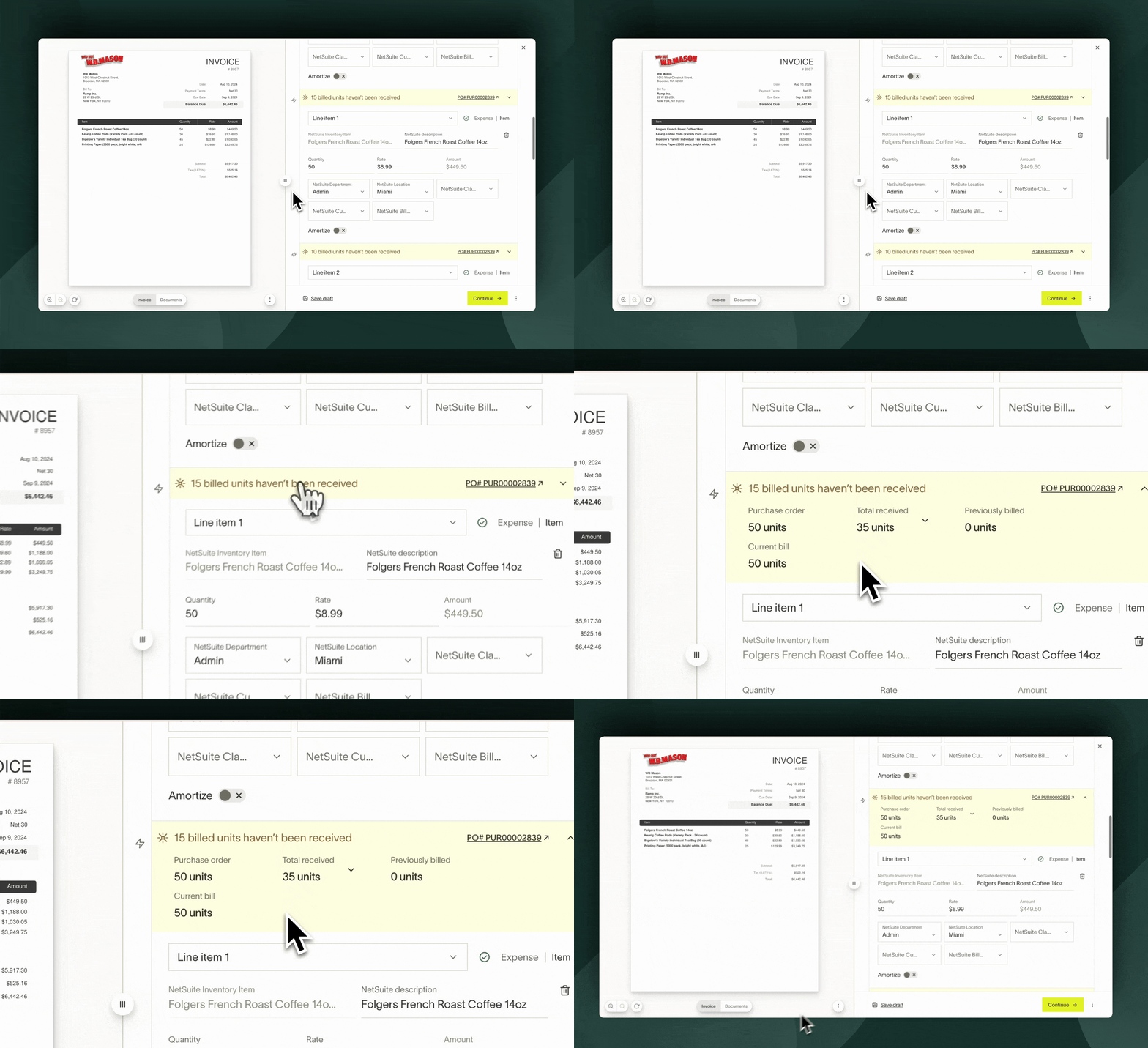
What changed wasn't just speed. It was more control and real leverage. With Ramp, approvals happen up front, contracts are searchable, and finance can see and steer spend while there's still time to affect the outcome. That shift from reactive to proactive is what really scales.
By rebuilding procurement on Ramp, Bohn not only achieved frictionless adoption across the company but also drove major wins across the business:
- 4x faster PO and invoice processing. PO creation and invoice processing that used to take hours now happens in minutes.
- Vendor consolidation and cost savings by >30%. With full spend visibility, Foursquare eliminated surprise renewals and duplicate licenses, cutting its software stack by about a third.
- Over 2x capacity without adding headcount. The finance team can now focus on stronger negotiations and renewals with vendors instead of chasing purchase orders.
Bohn's insight proved out. By solving for adoption first, he didn't just replace tools. He built a system that actually works for everyone. Nearly 100% of spend now runs through Ramp, which means finance finally has the visibility to prevent problems instead of discovering them after the fact. What started as a patchwork hassle became a competitive edge for Foursquare—procurement isn't just faster, it's a lever the business can pull.
"We've eliminated rogue spend and cut our vendor stack by a third. Ramp gave us leverage — not just to save money, but to reinvest where it moves the business."
— Michael Bohn, Head of Business Operations
How to replicate this system and scale with Ramp
Some takeaways from Foursquare’s story for anyone looking to revamp procurement at their company:
- Set one rule. If only 60% of spend flows through the platform, you're flying blind on the other 40%. Draw your line in the sand: all spend flows through a single platform— if it isn't in the system, it isn't getting paid.
- Make adoption easy. If onboarding takes more than 5 minutes, adoption fails. Ramp's one-page guide vs. Coupa's 20-page manual made the difference.
- Keep status visible. Give everyone self-serve visibility (it shouldn’t require a ping finance to find out where things stand).
- Reinvest the time saved. Use those hours for vendor negotiation and stack consolidation — the work that actually moves the business forward.
Procurement is just the beginning. Ramp unifies corporate cards, bill pay, expense management, and travel into one platform.


