It’s time to rewrite your expense policy for AI: Insights from 10,000 expense policies

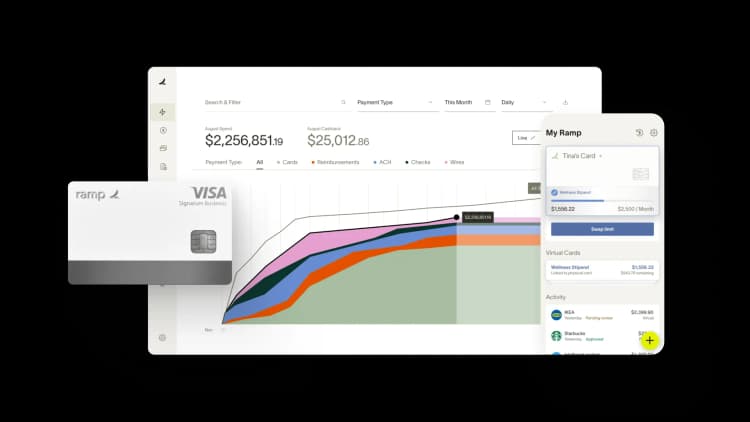
We read 10,000 expense policies. Most aren't ready for AI.
For decades, expense policies relied on human managers to fill in the blanks. A $150 client dinner? Use your judgment. A gray-area Uber charge? Approve it and move on. The result: inconsistent decisions, invisible leakage, and a queue that didn't scale.
There wasn't a better option when no one could see the gaps, but now AI exposes every one.
Ramp's agents now review more than a million expenses a month. Three out of four in-policy expenses get approved without a human ever seeing them. The rest get pushed to a manager.
But here's the catch: AI can't approve what isn't clear. Companies with vaguely written policies see roughly twice the rate of expenses kicked back to a person. We call it the policy ambiguity gap, and the same AI exposing it is starting to close it.
We analyzed 10,000 real expense policies to understand (1) where the policy ambiguity gap is, (2) what it's costing companies, (3) how it’s closing, and (4) the four key traits of a successful policy in the AI era.
Where the policy ambiguity gap is
The most interesting thing in the data is not differences in policies but what they explicitly specify versus what they leave out.
Most expense policies cover the categorical rules: what types of expenses are off-limits and what general exceptions exist. For example, 54% prohibit vice purchases like alcohol, cigarettes, drugs and gambling, and 63% list allow exceptions like first-class or business-class upgrades on long flights.
But the gaps lie in dollar thresholds — or the lack thereof.
- Despite meals being the most common expense category, a daily meal cap is only specified in 66% of policies.
- Only 7% specify an allowable flight amount, the most costly expense category.
The operational rules are often missing too.
- Only 65% specify when a receipt is required.
- Only 48% specify a submission deadline for expenses and/or expense requirements.
Including "no first-class flights" doesn't tell you the maximum economy fare; “require receipts" doesn't tell you whether the threshold is $25 or $100. What’s interesting is when companies do provide specifics, the numbers converge.
- The median meal cap is $75. Breakfast, lunch, and dinner land at $15, $20, and $35 across nearly every industry.
- Receipt requirement thresholds cluster at $25.
- Submission deadlines are usually around 14 days.
There's an invisible standard most companies already follow; many just don’t know or haven't documented it.
What unenforceable rules cost
The cost of an unenforceable policy compounds in two ways: time and money.
An agent only makes a judgement call when it’s certain and escalates otherwise. Companies with vaguely written policies see roughly 100% more transactions flagged than those with clear policies. That’s twice as much manual review and twice as many "is this OK?" questions that distract from strategic work.
On the flip side, the cost of this ambiguity can show up in different ways. Approvers might sign off on a $200 dinner that violates a written $75 cap because nobody actually checks against the policy. That’s non-compliant spend that likely would never get uncovered. Other times, there may be no rule at all, so enforcement depends on the reviewer’s interpretation; one might approve a $150 client dinner, another might reject a $100 one.
How AI helps close the gap
With every escalation and ambiguous flag where the policy needs to be clearer, the agent is the forcing function for improvement.
Even in gray areas, the agent isn't just kicking decisions back. It pulls signal from vendor history, submitter patterns, and how similar transactions were handled before, the kind of context a human reviewer rarely has the time to gather and never at scale.
What the agent can't resolve, it surfaces as a policy refinement suggestion to reduce human intervention and reinforce compliant behavior in the future. The result is a self-enforcing loop:
- Finance refines what's vague. With the agent’s suggestions, the average customer updates their policy 2-plus times within six months and at 7x the rate of customers without it (44% vs 6.4%).
- The agent enforces what's tightened. Across customers on the agent for 6+ months, agent-unsure rates decline by roughly 60% from month one to month six.
- Employees’ behavior recalibrates. Agent-driven rejection rates peak in the first 30 days post-activation, then begin declining as employees adjust their spending.
Over time, the gap shrinks toward whatever residual ambiguity is genuinely irreducible, the true novel situations and edge cases that will always warrant human review.
Four traits of a policy AI can actually enforce
After a year of agent data and the convergence on thresholds we shared earlier, there’s a clearer picture of what AI-ready starting policies look like and they share these four traits:
- Specific rules, not vibes. The cleanest policies use explicit dollar amounts and categories rather than language like "reasonable" or "appropriate."
- Match the structure to the spend. Across expense categories, there’s a fine line between adding enough structure vs noise. Policies with one to two spending categories AND policies with six or more both have higher agent-unsure rates than policies with three to five.
Too few categories means distinct kinds of spend get treated the same, while too many means there are distinctions that don't matter. Within a category, when there are meaningful sub-types, the rules have to follow. For example, meals aren't one kind of spend: solo lunches, group dinners, client meetings, and travel meals all demand different thresholds, so a flat $50/day cap penalizes legitimate group dinners and under-catches solo abuse. - Tolerances built for the real world. Rigid caps that don't account for taxes, tips, or regional pricing wrongly flag transactions and create unnecessary back-and-forth. The cleanest policies bake the latest tolerance into the cap itself. Ramp's own policy, for example, uses the GSA per diem rate plus 10%, which auto-adjusts by city. The agents enforce the latest GSA per diem rates, lodging rates, and mileage reimbursement rates, so manual adjustments to hard-coded amounts aren’t necessary.
- A review cadence. A meal per-diem set in 2024 is overly restrictive in 2026. The cleanest policies are refined as the agent surfaces patterns and benchmarks, not written and forgotten.
What that means in practice
Most teams we talk to aren’t stuck on understanding the value of an agentic expense reviewer; they’re stuck on writing a defensible policy. They don’t know what "good" looks like for a company of their size and industry, what categories they should include, and what thresholds to set.
Ramp's Policy Builder generates a personalized expense policy from the same dataset that powers this analysis: key questions about a company, every rule benchmarked against peers, and language an agent can reliably act on while escalating just the exceptions to human.
Make sure your policy isn't outdated.
Build a policy built from the best practices of 10,000+ policies just like yours.


“I assumed I would have to choose between speed and control. What I found is that you can have both. A well-designed system takes friction out, for the finance function and for everyone else.”
Justin Webster
CFO, Denver Broncos

“A well-run district should not have to choose between getting work done at the school site and keeping control of the dollars behind it. We're not hiring more people to do more jobs, so we have to be smarter about the process. With Ramp, the purchase, the receipt, and the record stay together from the start. ”
Nick Brizeno
Director of Purchasing, San Marcos Unified School District

“Invoices, cards, tokens. The categories change but the principle doesn't: know where the money is going, remove the work around it, and make sure the spend is worth it.”
Maciej Mylik. Finance
ElevenLabs

“We weren’t trying to retrofit an old finance system. We had a blank canvas. As a Canadian company growing quickly in the U.S., Ramp gave us the scalable foundation to build the finance function of the future.”
Justin Dourado
Director of Finance, Othership

“There's just no surprises anymore. No more waiting two months to find out how a job did. We know how it's doing as it's happening.”
Erich Kuss
Financial Systems Manager, Infinity Home Services
