

IHS prevents the margin leak nobody can see from the ground, so its 20+ local companies build what they bid
“There's just no surprises anymore. No more waiting two months to find out how a job did. We know how it's doing as it's happening.”
Financial Systems Manager, Infinity Home Services

Back in 1997, Mike Saglin was a subcontractor installing windows for Infinity Exteriors when one job after another arrived measured wrong. After roughly fifteen of them, he was ready to walk away. Then he noticed another forty or fifty windows stacked in the warehouse.
“There were at least fifteen or twenty thousand dollars’ worth of windows sitting there, going in the trash,” Mike remembers. “I asked who was measuring them. The person wasn’t there anymore. I said, ‘I’ll measure your windows.’”
That decision began a career at Infinity Exteriors that would eventually take Mike from the field into the company’s day-to-day leadership. The lesson was as practical as it was expensive: when a business measures the wrong thing, or measures it too late, good work can still end in wasted material and lost margin.

Infinity Exteriors’ owners, Josh and MJ Sparks, later entrusted Mike with the business they had built while Josh went on to create Infinity Home Services. IHS brings together exceptional local roofing and exterior-remodeling companies around an important principle: protect the names, people, customer trust, and field judgment that made each company successful, while giving them greater resources and the strength of a larger organization. Its mission is to raise standards in an industry where homeowners too often pay the price for contractors who do not keep their promises.
That principle depends on knowing what is happening inside every job. Across more than 20 companies in the United States and Canada, the craft remains local, but the financial record must be current and consistent. In exterior remodeling, where margins often run between 3% and 7%, a purchase can happen in seconds while its effect on the job remains unclear for weeks.
Erich Kuss, who leads financial systems for IHS, didn’t just choose accounting as a career. He grew up in it. Coming from a family of accountants, he learned early that the profession is equal parts discipline and puzzle-solving. The same attention to detail that makes a great roofer or installer proud of their work drives him to understand the economics behind every job.
“Margin leak tends to drip one purchase at a time, and you only ever find the leak if you’re costing the job while it’s still open.”
— Erich Kuss, CPA, Financial Systems Manager at IHS
The crews were already protecting the work in front of them. The harder question was whether the financial record could keep pace—while there was still time to protect the bid, the margin, and the promise made to the homeowner.

The margin you can’t see until its gone
Infinity Exteriors has more than 100 employees and can make around 200 purchases on a busy day across more than 40 active job sites. Most are routine. Others are tied to a custom fabrication, an unexpected condition uncovered after demolition, a supplier with exactly one part needed to keep a crew moving, or a homeowner request that cannot wait until tomorrow.
Construction rarely pauses long enough for accounting to catch up, but every one of those purchases still has to find its way back to the right job.
For years, every purchase left behind a trail that accounting had to reconstruct: supplier accounts, receipts, invoices, emails, text messages, and calls back to crews who had already moved on to the next job. The work happened in the field. The explanation happened later, pulling both finance and the people closest to the work back into a conversation that should never have needed to happen.
One wrong purchase-order number was enough to start the hunt. A receipt with the wrong job number could send the team back to a supplier hours later, trying to figure out who bought the material, why they bought it, and where it belonged.
At Infinity Exteriors, enough of those transactions accumulated that the accounting team gave them a name.
“We had a name for the money we couldn’t trace: ‘X purchases.’ When your accounting team has to invent a word for something, you don’t have a paperwork problem. You have a business problem.”
— Mike Saglin, Brand President at Infinity Exteriors
In a business that may keep only three to seven cents of every dollar earned, an expense without a job is not a bookkeeping inconvenience. It’s margin the company cannot explain, defend, or recover.
The obvious answer was the wrong one
Many organizations built through acquisitions create consistency by making every company look and operate more alike. Infinity Home Services was built on a different belief.
The companies that join IHS keep the names on their trucks, the people who know their markets, the customer relationships they’ve spent decades earning, and the judgment that built those businesses in the first place. What IHS brings together are the financial systems, controls, and visibility that help those companies become stronger without becoming the same. As Mike puts it: “Nothing changes boots on the ground.”
Inside IHS, the philosophy has a name: “freedom with fences”. The freedom belongs to the people closest to the customer and the work. The fences make sure every company can exercise that judgment without losing sight of the economics behind it.
That balance becomes harder as the organization grows. Infinity Exteriors has eight locations and a dedicated finance team. Another company joining IHS may rely on one person to keep the office running, manage the books, pay vendors, answer the phones, and support the field. The same financial standard has to work for both without forcing either to operate like the other.
The challenge wasn’t deciding which local choices to eliminate. It was making sure every one of those choices left behind a financial record the rest of the organization could trust.
Move the accounting to the field
Mike will tell you he did not immediately grasp what had arrived. “I thought it was just a credit card at first,” he recalls. What Ramp actually did was move the accounting to the register without asking crews to become accountants.
An employee buys the material, swipes, photographs the receipt, and picks the job from a list on their phone. “Swipe, enter, send, done,” Mike says. The person who knows why they bought something is the person who codes it, before leaving the parking lot. The transaction reaches accounting with its chain of custody already attached: employee, vendor, timestamp, amount, and project.
Usually, the tell is the list. Ask a foreman to choose from four hundred cost codes and he will pick the first one every time. Because Ramp shares the same jobs, phases, and cost codes as IHS’s Acumatica instance, each person sees only the options relevant to the work they are doing.
“They know which job they’re on, so they can accurately select it,” Erich says, “instead of us trying to guess after the fact where it should have been.”
Every purchase knows its job
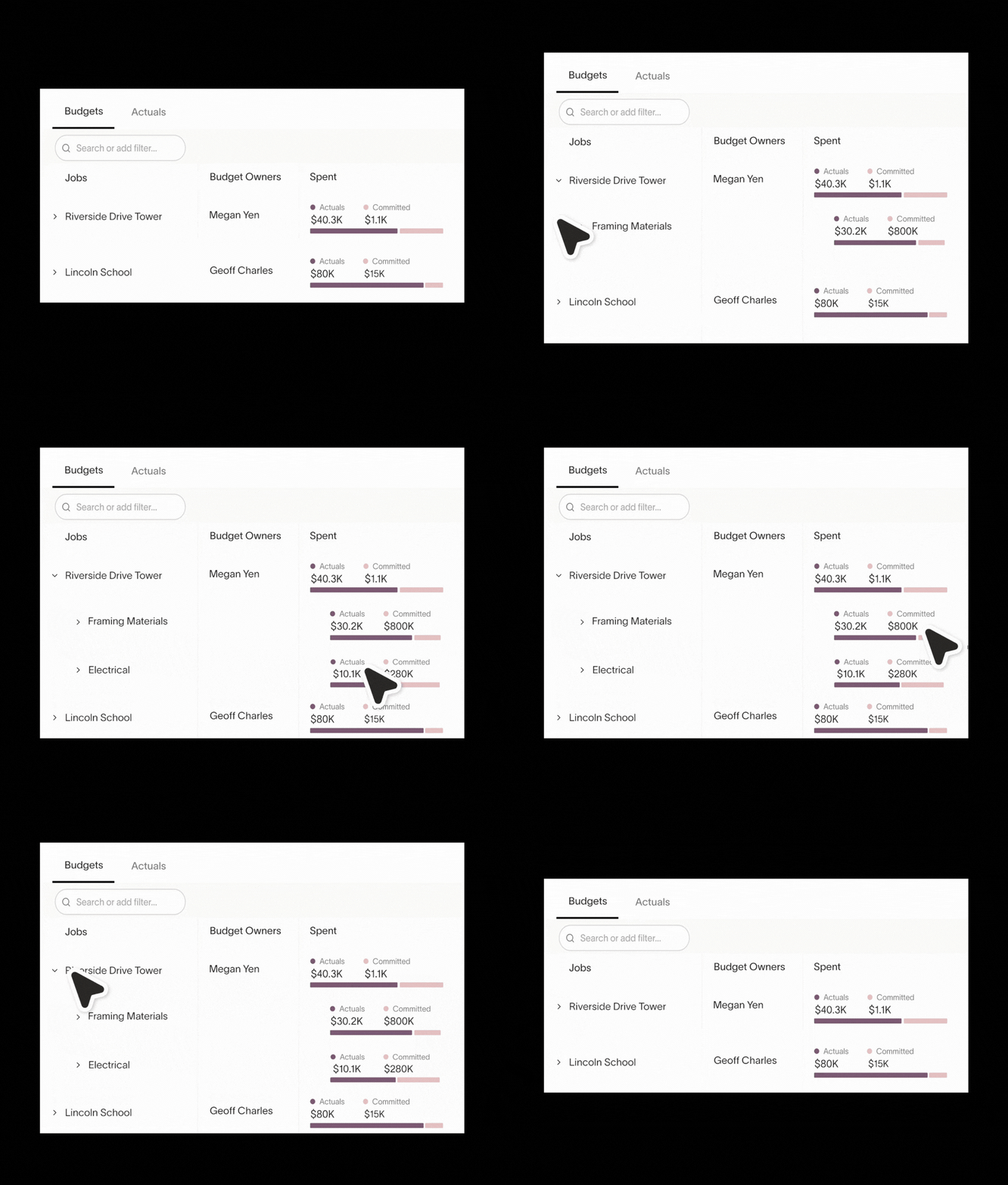
That simple shift changes the relationship between the field and finance. Crews can keep projects moving without waiting for accounting to catch up, while finance gains consistent, reliable job-cost data across every location. The field spends less time explaining purchases. Accounting spends less time chasing them.
Captured at the source, not reconstructed at close
The ledger side changed at the same time. Transactions once had to be entered twice: first in Ramp, then again in Acumatica. “Now it’s just a click of a button, and boom, it’s in Acumatica,” Erich says.
IHS operates what is now Ramp’s largest Acumatica instance, and the native integration meant the team could connect its financial workflows without a lengthy implementation or an outside implementation partner.
That simplicity mattered. IHS did not have to redesign its accounting operation around a new system, maintain a separate set of coding rules, or create another handoff between the field and the ledger. Ramp worked with the structure already defined in Acumatica, allowing transactions to move from the point of purchase into the system of record with the right job, phase, and cost code attached.
The result is more than faster expense reporting or a cleaner month-end close. The financial record now begins where the work begins, with the people making decisions in the field instead of the people reconstructing those decisions weeks later. For Infinity Exteriors, that means better job costing and fewer unanswered questions. For Infinity Home Services, it means every company can operate with the same financial discipline without giving up the independence that made it successful in the first place.
Every bill knows its contract
Once the card workflow was working in the field, IHS began extending the same model to accounts payable: invoice intake, construction-specific approval requirements, and coding that reaches Acumatica without another round of manual reconstruction.
The reason that is harder than it sounds is that a construction invoice is not really a bill.
“A construction invoice isn’t a bill. It’s a contract with a due date. Retainage, the lien waiver, the certificate of insurance—miss one and you’ve paid money you weren’t supposed to pay yet.”
— Erich Kuss, CPA, Financial Systems Manager at IHS
Roughly a quarter of those invoices end in a credit memo. Every vendor is a little different, Erich says. What nobody tells you is that those differences are the job.

This is the part horizontal spend tools do not solve by adding a field. Retainage, lien waivers, and certificates of insurance are not metadata about a payment. They are part of the contract, and they only work if they live where the payment happens.
Retainage is the clearest example. It is not complicated; it is simply impossible to remember across every crew and every agreement. The number used to live on “some sheet in your desk.” Now Ramp's AP agent can learn it from the contract, bills route to the project manager who owns the job, and a compliance step can hold payment until the lien waiver and certificate of insurance are on file.

IHS did not take any of this on faith. An incumbent's contract was already sitting on the CFO's desk when the team put Ramp through an extensive review and comparison process, including a session dedicated to Acumatica connector configuration and multi-entity setup. Ramp emerged as the clear choice.
Logan Wehking, IHS’s corporate controller and the leader of the AP rollout, had already given the project its own description: “It’s more than just a system change.”
He was right. Every company IHS brings on from this point forward inherits the same accounting foundation instead of rebuilding it from scratch.
"If Ramp were a tool on one of our job sites, it'd be the jackhammer. It never stops. Somewhere across our brands, somebody is always swiping a card or entering a bill. None of it waits for us to catch up."
— Erich Kuss, CPA, Financial Systems Manager at IHS
Month-end stopped being where they found out
A crew opens a wall, finds more damage than the bid assumed, and buys what it needs to keep working. The project manager sees the cost against the job budget that day, while there is still a change order to write and a homeowner to call. Real-time costing, Erich says, “lets the team act before there is an angry customer or a failed margin job.”
By month-end, most of the repetitive work has already been decided. 82.5% of field coding is automated to the right job, phase, and cost code, so purchases arrive classified instead of waiting in a queue for accounting. Across 20+ sets of books, that removes about seven hours from every month-end close.
The money followed the same logic. Field spend that once moved through a founder’s personal card and a patchwork of store accounts now runs through one controlled program that earns cashback, stops purchases that should not happen, and surfaces opportunities to save. Through cashback, spend controls, and savings insights, $2.1 million (and counting) has stayed in the business. On margins of 3% to 7%, that’s margin nobody had to go win on a job site.
And the “X purchases” account, the one that once held expenses belonging to no identifiable job, does not fill up anymore.
The same model is producing measurable results in accounts payable. In its first months on Ramp Bill Pay, IHS moved more than 1,600 bills through the system and automated more than 90 hours of invoice processing, bill creation, and approval routing. Work that once depended on manual handoffs now moves through a consistent process across entities, with the contract requirements and project ownership still attached.
The system spread because people wanted it
For many companies joining IHS, the card is one of the first visible signs that something has changed. “Honestly, that’s one of their favorite things when IHS takes over,” Erich says. That is unusual in construction finance, where a new system is normally something done to the field.
Mike has run Infinity Exteriors through store cards, personal cards, and the handful of employee cards that came before. Nobody had to make a push for Ramp. “We didn’t force anything,” he says. “It’s just, well, can Ramp do that? Can we do this through Ramp?”
Nobody at headquarters had to push it, either. IHS kept extending the same system outward on its own initiative: cards first, then accounts payable, then its first international entity in Ontario, which now serves as the foundation for IHS in Canada. Multi-currency support had been on Ramp’s 2027 roadmap; IHS helped bring it forward to 2026.
Next year, Infinity Exteriors turns thirty, which means it has started re-roofing homes it first roofed in the 1990s. Mike calls that a great feeling. Most companies in his trade, he notes, do not last five years.
The roofs will need replacing again someday. IHS is helping more great local companies become the kind of businesses homeowners still trust when they do
The systems behind companies built to last:
- Put the coding where the decision is made. The person who made the purchase is the one who knows why. Give them a short, job-filtered list and let them complete the record while the context is still fresh.
- Let the ERP define the structure, not a spreadsheet. When jobs, phases, and cost codes come from the system of record, miscoding stops being a habit and becomes difficult to do.
- Standardize the information, not the decision. Build shared financial fences across companies while preserving freedom inside them. Local judgment stays local; the financial truth becomes consistent.


