

What it takes to pay for an NFL season: inside the Denver Broncos’ finance rebuild
“I assumed I would have to choose between speed and control. What I found is that you can have both. A well-designed system takes friction out, for the finance function and for everyone else.”
CFO, Denver Broncos

The first Broncos home game Sharon Erwin went to after taking over accounts payable, she spent most of it taking inventory. I pay for that, she remembers thinking, looking around the stadium. And I pay that. And I pay that.
Three rings, eight conference championships, and a multibillion-dollar business spanning five legal entities that does not pause between seasons. The club buys everything from advertising and airline seats to catering, equipment, and the community grants it has been making since 1993. A finance team of roughly ten accounts for every dollar of it, down to the electric bill that keeps the lights on.
Most of it crosses Sharon's desk. She had never watched a full NFL game when the Broncos hired her fifteen years ago, part-time, at the front desk. It was the best seat in the building for learning how the place works.
Everything a season costs runs through one desk
Sharon moved from the front desk into accounts payable eleven years ago. "Everything is bigger than you could ever imagine," she says. She had never written a check that large before. She learned the organization the way almost no one else does, one invoice at a time. A police detail. A caterer. An architect. An advertising buy. Each one a vendor she had to set up, verify, and pay.
Four systems, none of them speaking to each other
Finance ran on four separate pieces of software, and each was good at one thing. Invoices and documents sat in Kwiktag. Expense reports went through Concur. The cards people actually spent on came from a bank program Concur could not see, so someone carried every charge from the one to the other by hand. Vendor records lived somewhere else again.
"Every one of those tools was a reasonable choice on its own but they didn’t talk to each other. Together they were not a system."
— Justin Webster, CFO, Denver Broncos
Each had been chosen for a reason. What sat in the gaps between them was Sharon. What those tools handled was documents and records. Paying the vendor was a separate act, and it was hers. Sharon entered every invoice from start to finish, built every vendor from start to finish, and then ran the payments herself: check runs, ACH batches, virtual card batches.
A check release meant running a report, saving it to PDF, and sometimes walking it to the copier to scan. Justin reviewed the list by email. When a line raised a question, she went back into the system, pulled the record, scanned it again, and walked it down the hall. Then she printed, stuffed, and mailed about 150 checks a week.
Setting up one vendor was heavier still. She called the company, collected its tax forms, and keyed in its bank details herself. "The errors fell on me," she says. "If I'm sending money to someone, I want to make sure it's going to the right account."
It was, in her words, “death by a thousand cuts”. Each invoice took a couple of minutes. It was everything around each invoice that took the day.
The year everything landed at once
Then her colleague in payables retired, and leadership asked whether Sharon wanted to run the operation alone. She said yes. For over a year, she did the work of two people, most evenings with the laptop open again after dinner.
The calendar ahead was also daunting. The Broncos were moving their ERP to NetSuite. They were replacing their FP&A suite. And they were finishing Broncos Park Powered by CommonSpirit, a $175 million headquarters that would put players, football operations, and business staff under one roof for the first time in franchise history.
Every invoice from that build would cross Sharon's desk. "I was very scared of all the bills that were going to come with a $175 million new headquarters," she says. She had already proved she could carry more than the job asked but Justin knew a better system could lighten the load.
Rebuild it once, or rebuild most of it twice
Justin looked at that calendar and drew a conclusion most finance leaders would argue with. If the organization was rebuilding anyway, this was the moment to stop preserving what had never worked. He chose to replace the spend stack in the same window as everything else. Conventional wisdom says sequence but Justin’s approach was more about arithmetic than risk appetite.
"Converting several systems at once was not easy. But upgrading one and wiring it to the old companions around it only means redoing that work later. We did it all at the same time to cause less disruption over the long term."
— Justin Webster, CFO, Denver Broncos
Sharon and the controller defined what AP at their scale actually needed before they saw a demo. Ramp had not been on the club's radar at all. A colleague had noticed what the company was doing and suggested they take a look.
From there, one test governed every decision: eliminate handoffs by keeping the transaction (and its controls) in one system."We were trying to eliminate as many manual handoffs as we could," Justin explains.
Vendors onboard themselves, coding learns, and the ledger keeps up
The tools they were leaving managed documents. The one they chose moved money. Almost everything that changed for Sharon follows from that difference.
Five entities moved onto a single instance in a matter of days: the team, the stadium management company, the Foundation, the cheerleaders, and the partnerships business. One login, five sets of books, no separate check stock.

Four things changed about how a bill moves:
- Bills arrive on their own. Invoices reach the queue through the AP inbox, a vendor portal, or a recurring rule. 97% of them now land there without anyone uploading anything.
- Vendors enter their own details. Tax forms and bank details arrive from the company that owns them instead of from Sharon's keyboard.
- The coding learns. More than three in four accounting fields now fill themselves before anyone touches them. "Once I show it where I want something coded a couple of times, the memory learning kicks in," she says.
- Approvals arrive sorted. Exceptions are flagged and the reasons come attached.
Each bill is checked before it reaches a person, so what arrives is already triaged: the ones that look right, the ones that do not, and the reason why.
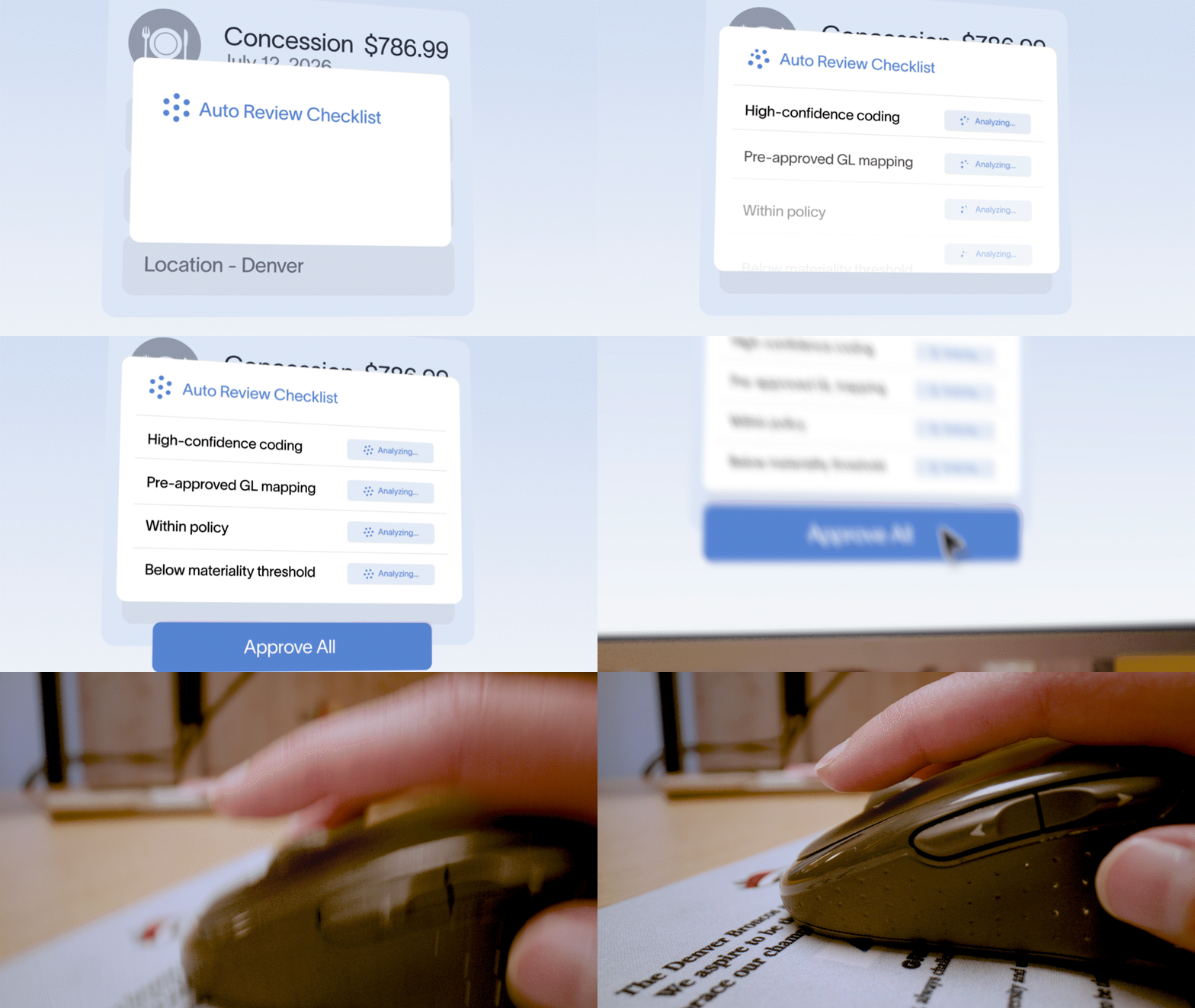
The sync to the ERP is the part most finance teams brace for, because an integration that drifts only creates a second job reconciling it. Here the entry posts to NetSuite as the payment goes out, coded the way it was approved, so the ledger stays current without anyone having to work at keeping it that way.
What leaves at the end is a payment: check, ACH, or virtual card, run from the same place the invoice arrived. Nobody walks anything down the hall anymore.
The expense report stopped existing
The cards moved into the same system as the bills, and the rest of the organization came with them. Hundreds of people across the five entities have Ramp accounts, and for almost none of them is it a “just a finance tool” they have to use. It’s where a purchase ends, whether that’s a flight, a hotel out on the road, supplies, or a team dinner. A charge arrives carrying the merchant, the amount, the date, and most of the coding, and whoever spent can simply upload a receipt from their phone.
"With Ramp, there’s basically no such thing as doing an expense report anymore," Justin says.

Further out, the change is larger. Allie Engelken runs the Denver Broncos Foundation and community impact for the team, and she is not in finance. She manages two organizations on two fiscal years, defends a budget to a board of directors, and she used to learn where a payment stood by messaging the finance team and waiting. Now she works in the same system Sharon does, looking at the same record rather than a copy of it.
What her team carries is not abstract. The Foundation has committed to putting a brand-new helmet on every high school football player in Colorado, more than 15,500 of them over four years, covering every tackle program in the state. Each one is a purchase order, a delivery, a school district, and a budget line that has to be right.
For the finance team the gain was hours. For the rest of the organization it was a single view of where the money is, current enough to act on, instead of one assembled from four places after the fact.
Even the money standing still has a job
Even after the Broncos brought bills, payments, and the ledger into one system, there was still one more handoff: the cash itself. Money set aside for upcoming bills sat at the bank until it was needed, because keeping it available mattered more than earning on it.
The Broncos chose to keep that cash in Ramp Treasury, alongside the bills it would eventually pay. It now earns while it waits, and when a bill comes due, the payment leaves from the same place—without waiting for a transfer from another bank.
The Broncos did not have to move their money to make it work harder. They just stopped moving it.

More than two weeks of manual work nobody has to do each month
The work did not simply get faster. It stopped relying on manual handoffs to hold four disconnected systems together.
Sharon reviews and sends. What reaches Justin is already sorted. "It flags these twenty transactions as good to approve, and these five as needing a second look, with the reasons why," he says. "Instead of just telling me to look, it’s telling me where to look."
A bill now takes an average of just 21 seconds of hands-on time. More than 8,000 of them have moved through that way across all five entities, and Sharon has not printed a check in any of them.
The time saved adds up. More than 80 hours a month of entering, coding, chasing and releasing no longer gets done by anyone, which is two working weeks handed back to a finance team of ten. The club absorbed the largest build in its history with one person in accounts payable, and the construction invoices Sharon had spent a year dreading turned out to be the easiest part of it.
The same shift reaches well past her desk. Not everything the club buys arrives as an invoice. Travel, meals on the road and the hundreds of small purchases a season requires go on a card instead, and all of it now moves through the same system as the bills and the vendors, earning thousands in cash back every month on spending the club was going to do anyway.
The people furthest from finance feel it as something bigger than saved time and money. The impact reaches how the organization shows up in the community.
"We can get our grantees their funding faster, and the people who are boots on the ground can start the work sooner. That makes us a better partner in the community, not just a faster one."
— Allie Engelken, VP of Community Impact & Foundation Executive Director
Days off the close, and a laptop that stays shut
The Broncos have already cut multiple days from month-end close. Those reclaimed days give the finance team room to look beyond the books and toward what the business needs next.
"We've already taken multiple days out of our month-end close. Every handoff we take out gets us more optimized to focus on going from bookkeepers to business partners."
— Justin Webster, CFO, Denver Broncos

The part Sharon mentions first has nothing to do with invoices. "Now when I go home from work, I'm home from work and I don’t have get the laptop out again every evening," she explains with a sigh of relief.
The standard does not stop at the sideline
A football team is judged on what happens on Sundays. The organization behind it is judged on nothing anyone can see, and it is where nearly all of the work lives: the vendors, the payroll, the catering, the grants, the lights.
Justin wanted the operation behind the team to meet the same standard as the team on the field: everything working as one.
What the Broncos have now is not just a faster back office. It is one live account of how money moves through a multi-billion dollar business that spans five entities, hundreds of people and a stadium to fill, and a CFO, an accounts payable analyst and a Foundation director can each open it and find the same answer.
Sharon still knows where every dollar in the building goes. But now she’s not the only place that knowledge lives.


