Hiring and office expenses emerging as key areas to monitor in 2023

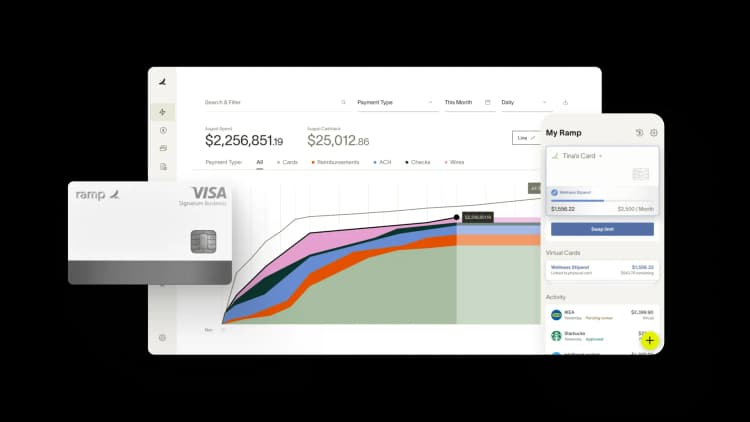
Despite fewer working days in Q4 and ongoing recession worries, cohort-adjusted business spending rose last quarter for Ramp customers, suggesting business leaders are feeling more optimistic about where the economy is headed this year.
Companies increased spending on discretionary categories like entertainment and restaurants. At the same time, “same-store sales” for shipping and other T&E categories fell, supporting analyst reports that inflation has peaked and prices are dropping.

Small SMB spending drove the bulk of the increase, with the mean card spend per business rising 12.8% compared to Q3. Large SMB spending rose more moderately, but their mean transaction sizes soared 36.5%. The spike came from areas like ads, indicating businesses are once again willing to invest in top-line growth. Larger businesses seem to be much more keenly aware of the need to make trade-offs in their business spend.
But new challenges have emerged. Our latest Spending Benchmark report highlights two areas that finance leaders should scrutinize in the coming months.
Hiring slow-down
Even if they’re able to avoid layoffs, our data show that companies across many industries—not just tech—are continuing to downsize their workforces, likely due to high labor costs and a shortage of qualified candidates.
IT spending on electronics strongly correlates with hiring patterns. For much of last year, spending in this category has trended downward, with total transaction volume ending the year down 54.6% from its peak in March. At the vendor level, we see the number of transactions with top computer manufacturers tapering even faster: spending on Apple dropped 61.2% in 2022.

We predict hiring will remain muted this year in tech-oriented industries that are focused on enhancing profitability metrics. It will pick up in labor-intensive industries that are addressing supply chain issues and demand.
Download our full report to see how businesses are adjusting their spending with key electronics vendors like Apple, Lenovo Group, and Dell as a result. We also report on new vendors that companies are testing out to increase productivity.
Rising office costs
The great debate over whether offices are a thing of the past may have concluded. Offices are officially making a comeback as organizations look for ways to drive employee productivity. In Q4, office spending jumped 5.7% quarter-over-quarter, making it the fifth-fastest growing bucket of spend among top categories.
But the post-pandemic office has a different look as companies continue to adjust to hybrid work. Our data shows organizations are increasing spending on co-working spaces—specifically WeWork. With T&E spending still on the rise, finance leaders will need to work with their HR partners to reassess the mix of travel and office budget that’s required for optimal hybrid work.

See how much companies are spending on top co-working vendors in our full report.
Get our Q4 2022 report to see where peer companies are spending
In 2022, many businesses saved their bottom line by slashing spending. In 2023, businesses that start to reinvest in strategic growth opportunities—without losing sight of their margins—will win. To provide a fuller view of corporate spending patterns, our report contains data from our accounts payable (AP) automation segment for the first time, representing $3B+/year in bill payments. Download the complete report today to improve your company’s budgeting rigor and achieve a competitive advantage in 2023.


“I assumed I would have to choose between speed and control. What I found is that you can have both. A well-designed system takes friction out, for the finance function and for everyone else.”
Justin Webster
CFO, Denver Broncos

“A well-run district should not have to choose between getting work done at the school site and keeping control of the dollars behind it. We're not hiring more people to do more jobs, so we have to be smarter about the process. With Ramp, the purchase, the receipt, and the record stay together from the start. ”
Nick Brizeno
Director of Purchasing, San Marcos Unified School District

“In senior living, scale only works if the communities still feel personal. We needed the back office to carry more of the complexity, not the people serving residents. Ramp helped us build that infrastructure, so the experience in the community could stay human.”
Ryan Cole
CFO, Agemark Senior Living

“AI is moving faster than the finance context around it. Prices change, models change, and the value is not always obvious from an invoice. We needed enough detail to know which bets deserved more investment — and which ones did not.”
Greg Cooley
Controller, AngelList

“Invoices, cards, tokens. The categories change but the principle doesn't: know where the money is going, remove the work around it, and make sure the spend is worth it.”
Maciej Mylik. Finance
ElevenLabs

“We weren’t trying to retrofit an old finance system. We had a blank canvas, and Ramp gave us the foundation to build a global finance function of the future.”
Justin Dourado
Director of Finance, Othership

“There's just no surprises anymore. No more waiting two months to find out how a job did. We know how it's doing as it's happening.”
Erich Kuss
Financial Systems Manager, Infinity Home Services

“More token spend isn’t proof that AI is working. Less isn’t proof that it isn’t. What matters is whether we’re buying the right level of intelligence for the work. Ramp lets us make that judgment in the same place we manage every other type of spend.”
Cody Nutt
Senior Director of Business Systems, Daxko
