
- Why companies are looking for Brex alternatives in 2026
- At a glance: Brex alternatives compared
- 1. Ramp: The best overall Brex alternative
- 2. BILL Spend & Expense (formerly Divvy)
- 3. Rho
- 4. Mercury
- 5. Navan (formerly TripActions)
- 6. Airbase (now paylocity for finance)
- 7. Airwallex
- 8. SAP Concur
- Brex competitors for small businesses
- How to choose the right Brex alternative
- Choose the top-rated Brex alternative
Brex was one of the first corporate cards built specifically for venture-backed startups, and for nearly a decade it was a fixture in early-stage finance stacks. That changed in January 2026, when Capital One announced a $5.15 billion acquisition that closed on April 7.
For current and prospective Brex customers, the deal raised legitimate questions: Will Brex's product, pricing, and roadmap stay aligned with high-growth startups? Or will it shift toward the enterprise customers Capital One has historically targeted?
Luckily, if you're evaluating Brex alternatives, you have more options than ever. These eight competitors span integrated spend management platforms, banking-first stacks built for VC-funded startups, and global payments infrastructure:
- Ramp
- BILL Spend & Expense (formerly Divvy)
- Rho
- Mercury
- Navan (formerly TripActions)
- Airbase (now Paylocity for Finance)
- Airwallex
- SAP Concur
To compile this list, we looked at customer reviews and product capabilities across corporate card and spend management platforms, then layered on our own research to cut through the marketing and identify where each platform excels and who it's actually built for.
Why companies are looking for Brex alternatives in 2026
Most teams evaluating Brex competitors are leaving for three reasons: Capital One's acquisition of Brex, Brex's earlier exit from small businesses, and lingering uncertainty about the roadmap and underwriting. Each one changes what you can count on going forward.
1. The Capital One acquisition changes Brex's direction
Brex is now a wholly owned subsidiary of Capital One, so its direction sits with a legacy bank. Capital One acquired Brex for $5.15 billion in a deal announced in January 2026 and closed on April 7, 2026.
That raises a fair question: will Brex's roadmap and pricing stay aligned with high-growth startups, or with the bank's broader priorities? Ramp stays independent, so its roadmap is driven by customer needs, not a legacy bank's playbook.
2. Brex stopped serving small businesses
Brex left small businesses behind years ago, and many teams have needed a new home since. In June 2022, Brex dropped small-business customers and kept institutionally backed or larger, midmarket companies.
If you sat below those thresholds, you were looking for an alternative well before Capital One entered the picture.
3. Roadmap and underwriting risk under a legacy bank
Under bank ownership, both underwriting and the pace of innovation could shift toward conservative, enterprise-oriented models. Brex credit limits have historically leaned on cash-on-hand, and that approach may tighten under Capital One's risk models.
You can't predict how those policies will evolve, so it's worth prioritizing what you can verify today: an independent roadmap and pre-spend automation that enforces policy before money leaves the account.
At a glance: Brex alternatives compared
| Platform | Best for | Key strengths | Pricing |
|---|---|---|---|
| Ramp | Finance teams of any size that want the most complete, AI-native platform | Independent roadmap; deepest automation and agentic capabilities; procurement, AP, travel, and business banking & treasury in one platform | Free; $15/user/mo. for Ramp Plus |
| BILL Spend & Expense | SMBs focused on budgeting discipline | Tight budget controls; free corporate card; integrates with BILL's AP ecosystem | Free; AP/AR requires separate paid plan |
| Rho | Funded startups that want banking, cards, and AP in one stack | Integrated banking, cards, treasury, and AP | Free core platform |
| Mercury | Startups prioritizing a banking-first foundation | Startup banking; Mercury IO Mastercard; FDIC-insured treasury | Free; paid tiers for advanced features |
| Navan | Travel-heavy teams | Travel booking, cards, and reimbursements in one platform; strong global reimbursement reach | Free for first 5 active monthly users |
| Airbase | HR-led mid-market companies | Procurement, bill pay, expense tracking unified with HR data | Custom pricing |
| Airwallex | Companies with significant multi-currency operations | Local accounts in 20+ currencies; multi-currency cards | Tiered pricing |
| SAP Concur | Enterprises already running SAP ERP | Deep SAP integration; mature T&E and AP modules | Custom pricing |
1. Ramp: The best overall Brex alternative
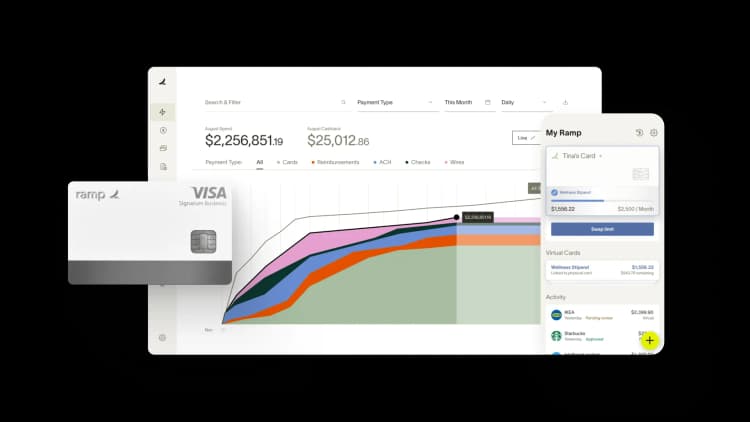
Full disclosure: We're biased on why Ramp should be your choice for finance operations. From corporate cards and expense management to AI agents that can handle AP, purchasing, policy enforcement, and transaction coding, our platform is purpose-built to save your business time and money.
So, how is Ramp different from Brex?
One of the biggest differences is independence. Ramp is an independent, AI-native finance operations platform built for modern teams. Our product roadmap is driven entirely by customer needs, not the competing priorities of a legacy banking institution, which means faster feature releases and no uncertainty about strategic direction.
Brex was originally designed for venture-backed startups. With the acquisition, current and prospective customers might question whether Brex's product direction, pricing, and customer focus stay aligned with high-growth startups or shift toward the enterprise customers Capital One has historically served.
Ramp serves businesses at every stage, from bootstrapped startups to large enterprises. Our independence means we can keep moving fast, keep shipping features that matter to growing teams, and keep our roadmap aligned with the customers we serve.
Key features
- Unlimited physical and virtual corporate cards for employees, plus tokenized virtual cards for AI agents to make purchases on your behalf (now in early access)
- Complete finance operations platform that unites data and workflows across AP, procurement, business travel, treasury, and accounting integrations
- AI agents that cover the full spend lifecycle, including agents for expense policy enforcement, bill pay, and month-end close
- No credit check or personal guarantee required. All you need is an EIN and $25,000 in a U.S. business bank account to qualify.
- Clean, modern, easy-to-use web and mobile apps for finance teams and employees alike
- Over 200 integrations with the tools you already use, from ERPs and accounting software to Gmail, Uber, DoorDash, and Amazon Business
- Invoice automation with bill pay via card, ACH, check, and wire transfer
- Companies that use Ramp save an average of 7.5% a year across all spending
Why customers choose Ramp vs. Brex
More than 85,000 organizations use Ramp to save over $1 billion a month and over a year’s worth of work every hour, and over 4,200 companies have switched directly from Brex. Almost 90% of the 2,300+ users who reviewed Ramp on G2 gave our platform a 5-star rating.
Here's why finance teams choose Ramp out of all the Brex alternatives available today:
- AI that works before spend happens: Ramp enforces policy at the moment of swipe, blocking 3.5% of transactions that would otherwise violate policy before they clear, and auto-codes 90% of transactions. That's a concrete contrast to Brex's after-the-fact expense review, where problems surface only once the money is gone.
- Banking on your terms: Ramp connects to 80+ banks so you can diversify funds and keep your existing banking relationships. Brex's banking stack routes cash through a single provider—now part of Capital One.
- Expense reports that submit themselves: Ramp's receipt capture auto-matches transactions, auto-populates memo fields based on historical transactions, and can even auto-generate receipts when they're missing. No more chasing down employees to submit missing documentation.
- End-to-end procurement and AP: Brex's procurement capabilities are limited. Ramp pairs corporate cards with vendor management, savings intelligence, and full procure-to-pay, so spend visibility doesn't stop at the card. See how Ramp's own team uses Ramp procurement to manage vendor spend end to end.
Pricing
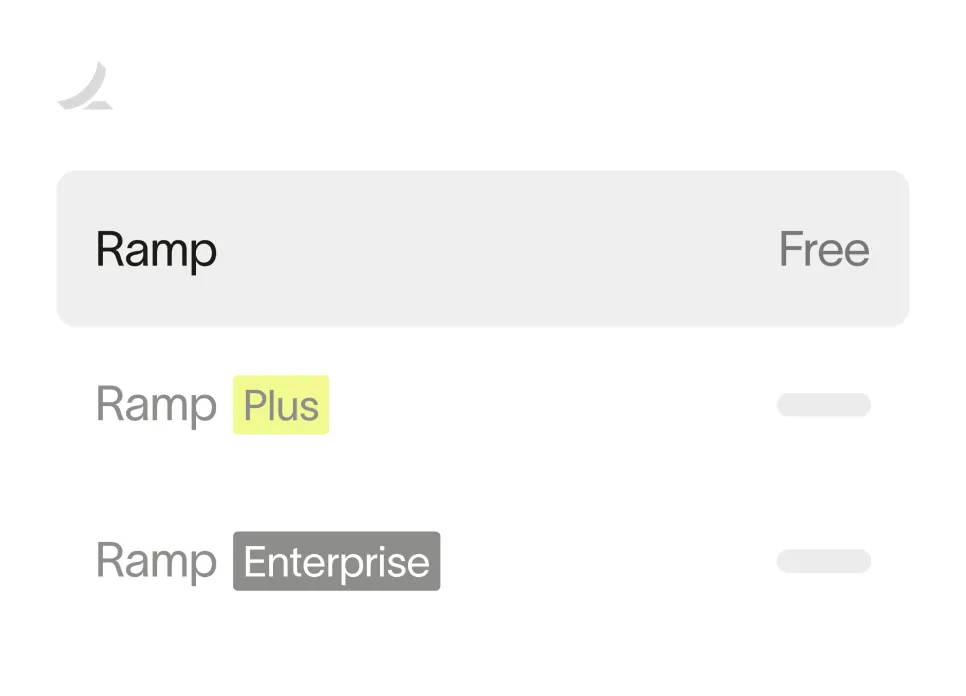
Ramp's corporate cards, expense management, accounts payable, accounting automation, and reporting are all free. Ramp Plus offers greater control and customization at $15 per user per month. Custom enterprise plans are available as well—just get in touch to talk through your needs.
Reviews and ratings
- G2: 4.8/5 (2,300+ reviews)
- Capterra:4.9/5 (200+ reviews)
Ready to take control of your finances?
Learn about Ramp’s pricing plans and start saving today.
2. BILL Spend & Expense (formerly Divvy)
Key features
BILL Spend & Expense, formerly Divvy, combines corporate cards and expense management in one free platform. It's part of the broader BILL product suite, which also includes accounts payable, accounts receivable, and AP automation as paid add-ons.
- Top-down budgets allocated by team, department, or project, with spend controls enforced before transactions clear
- Real-time spend visibility and automatic transaction categorization
- Physical and virtual BILL Divvy cards with customizable controls
- Built-in receipt capture and reimbursement tools
- Direct sync with QuickBooks Online, NetSuite, Sage Intacct, and Xero
Why customers choose BILL vs. Brex
BILL takes a budgeting-first approach to spend management. Where Brex organizes controls at the card level, BILL starts with top-down departmental budgets that enforce limits before anyone swipes. If your team prioritizes proactive budget discipline over after-the-fact review, that model is a better fit.
It's also much easier to qualify for BILL than Brex. Brex generally requires either equity funding or over $1 million in annual revenue just to open an account. In contrast, the BILL Divvy card requires a minimum of $20,000, making it a practical landing spot for SMBs that don't meet Brex's funding or revenue bar.
Pricing
BILL Spend & Expense is free, including the corporate card and core expense management features. Using BILL's AP module for bill pay requires a separate paid subscription.
3. Rho
Key features
Rho pairs business banking, corporate cards, expense management, bill pay, and treasury management in a single platform. Built primarily for funded startups and growth-stage companies, Rho positions itself as a finance stack that scales with you from incorporation through later-stage operations.
- Free business checking and savings accounts with no monthly platform fees
- Rho corporate cards with cashback on spend, no personal guarantee, and balance-based credit limits
- Expense management with virtual cards, receipt capture, and policy enforcement
- AI-powered bill pay with invoice scanning, automated approval routing, and direct vendor payments
- Multi-entity banking with the ability to manage subsidiaries and consolidate spend on a single platform
Why customers choose Rho vs. Brex
If you liked what Brex offered before the Capital One acquisition—banking, cards, AP, and treasury built specifically for venture-backed companies—Rho is a close equivalent. Both platforms target the same audience and bundle business banking with spend management on a single platform.
Multi-entity banking is one of the most common reasons why users pick Rho. For companies receiving large investor wires, paying contractors, or running concentrated AP cycles, Rho's high transfer limits and bulk payments workflow handle volume that other platforms route through workarounds.
Pricing
Rho offers its core platform for free.
4. Mercury
Key features
Mercury pairs FDIC-insured checking and savings accounts with a corporate charge card, expense management, bill pay, invoicing, and treasury management. It is primarily built for startups, e-commerce, and other digital-first businesses.
- Free business checking and savings accounts with no minimums
- The Mercury IO Mastercard with cashback, no personal guarantee, and credit limits based on account balances
- Expense management with virtual cards, spend controls, receipt policies, and subscription tracking
- Bill pay with AI-powered invoice extraction, plus invoicing for inbound payments
- Treasury management offering competitive yield on idle cash, subject to a minimum balance
Why customers choose Mercury vs. Brex
As a Brex alternative, Mercury is a natural landing spot for companies that originally chose Brex for its banking features. Both platforms target venture-backed and digital-first companies, both pair business banking with a corporate card and expense management, and both offer a finance operations platform.
Like Ramp, Mercury remains an independent fintech, while Brex is now a wholly owned subsidiary of Capital One. For finance teams whose original draw to Brex was the modern, founder-friendly banking experience, and who are now uncertain how that experience will change under Capital One, Mercury is an attractive option.
Mercury has also strengthened its footing on the banking side. In April 2026, it received conditional approval from the OCC to establish Mercury Bank, N.A., a step toward becoming a national bank that helps address earlier concerns about sudden account closures. It still needs final regulatory sign-off, so keep an eye on how that plays out.
Pricing
Mercury's core platform is free, with no monthly fees, account minimums, or maintenance fees. Mercury Plus offers additional features for $35 per month (or $29.90 per month billed annually), while Mercury Pro adds a dedicated relationship manager and premium automations for $299 per month.
5. Navan (formerly TripActions)
Key features
Navan is a travel and expense management platform that combines business travel booking, expense tracking, corporate cards, and employee reimbursements. If your team travels a lot, Navan's core value is in connecting bookings directly to expense workflows so you're not reconciling T&E after the fact.
- End-to-end travel booking with negotiated rates and built-in policy enforcement
- Corporate cards with cashback rewards and virtual cards that auto-link to individual trip bookings
- Navan Connect, which lets companies keep their existing Visa, Mastercard, or Amex cards while using Navan's T&E platform
- Travel rewards that incentivize employees to book more economical fares
- Global reimbursements across 45+ countries and 25+ currencies
Why customers choose Navan vs. Brex
Both Navan and Brex offer travel booking and expense management, but they come at the problem from different directions. Brex started as a corporate card platform and added travel; Navan was built as a travel management company from day one. For companies where T&E is a major line item, Navan's travel-first approach offers a more polished booking experience.
That said, Navan is strongest when travel is your primary spend category. Its general expense management and AP capabilities are less mature than competitors like Ramp, which was built for comprehensive spend management. If your team needs greater control across all your operational spend, not just T&E, Navan may be too one-dimensional. For a detailed side-by-side, see how Expensify, Navan, and Ramp compare across expense management features.
Pricing
Navan's core travel plan is free for companies with fewer than 300 employees, with 5 active expense users per month included at no cost. Expense management beyond that tier runs $15 per user per month. Enterprise plans with dedicated support and custom integrations require a custom quote.
6. Airbase (now paylocity for finance)
Key features
Paylocity acquired Airbase's spend management platformin October 2024 and has since rolled it into a rebranded offering called Paylocity for Finance. The product combines Paylocity's HR platform, including payroll, benefits, and workforce management, with Airbase's AP automation, corporate cards, expense management, and procurement.
- Guided procurement with approval routing and vendor management
- AP automation with invoice processing, 3-way matching, and vendor payments in 200+ countries
- AI-assisted expense management with automated receipt matching and GL coding
- Physical and virtual corporate cards with spend controls, plus support for existing Visa, Mastercard, and Amex programs
- Spend data connected directly to payroll, HR, and headcount planning
Why customers choose Airbase vs. Brex
Paylocity's edge is its HR-finance connection. Where Brex is a standalone spend management platform, Paylocity ties non-payroll spend to the employee record. When someone gets onboarded, changes roles, or leaves, their card access, approval chains, and budget allocations update automatically.
The trade-off is that Paylocity for Finance is still a relatively new product since the Airbase acquisition closed. There's no public pricing, and the finance features are strongest when paired with Paylocity's broader tools. As a standalone spend management tool without the HR integration, it's a tougher sell against purpose-built Brex competitors.
Pricing
Paylocity doesn't publish pricing for its finance and spend management tools. You'll need to reach out to sales for a custom quote based on your company size, needs, and transaction volume.
7. Airwallex
Key features
Airwallex provides multi-currency business accounts, corporate cards, international payments, and treasury management on a single platform. If you operate across borders and you're tired of paying steep FX fees every time you move money internationally, Airwallex is designed to solve that problem.
- Multi-currency corporate cards with no international transaction fees when funded in local currency
- Local business accounts in 20+ currencies, so you can collect, hold, and pay without converting back to USD
- International payments across 90+ currencies in 200+ countries
- Batch payment processing for high-volume international vendor and contractor payments
- Expense management with real-time spend controls, receipt capture, and approval workflows
Why customers choose Airwallex vs. Brex
Both Brex and Airwallex support international operations, but the cost structure is meaningfully different: Brex applies a higher FX markup on currency conversions, while Airwallex charges as low as 0.5% for major currencies and lets you hold local accounts in multiple currencies to skip conversion altogether. If you have significant cross-border spend, that gap adds up fast.
The trade-off is that Airwallex is primarily a payments and treasury platform. It has expense management and spend control features, but they aren't as mature as what you'd get from Ramp, Brex, or BILL. If you mostly need a domestic spend management platform with strong AP automation, Airwallex probably isn't the right fit.
Pricing
Airwallex offers a free Explore plan that includes multi-currency corporate cards. The Grow plan adds expense management and approval workflows for $12 per active user per month, but it's capped at 250 users. The Accelerate plan, geared toward enterprise teams, requires a custom quote.
8. SAP Concur
Key features
SAP Concur has long been the default for large enterprises, especially those already running other SAP software. Concur has been in the travel and expense management space for over two decades, and it shows—both in the depth of its compliance controls and multi-entity support, and in a user experience that hasn't kept pace with modern platforms.
- Concur Expense for automated expense reporting with receipt capture, policy enforcement, and multi-level approvals
- Concur Travel for corporate travel booking with pre-trip approval and automated T&E policy compliance
- Concur Invoice for AP automation, from invoice capture and PO matching to payment
- Corporate card integrations with major issuers
- Joule, SAP's AI assistant, which lets employees submit expenses and book travel using natural language
Why customers choose SAP Concur vs. Brex
Concur and Brex serve very different buyers. Brex was built for startups and growth-stage companies that want a modern corporate card with integrated expense management. Concur is built for enterprises with complex org structures, global travel programs, and approval hierarchies that need to meet regional tax and regulatory requirements. If you're running other SAP modules, Concur plugs in natively in a way no standalone fintech can match.
The trade-off is complexity. Implementation takes months, not days, and the interface feels dated next to modern platforms. Pricing is opaque since SAP custom-quotes everything. Costs can climb once you factor in implementation, premium support, and add-on modules. If you don't need deep ERP integration, the overhead probably isn't worth it.
Pricing
SAP Concur doesn't publish its pricing tiers. Plans are custom-quoted based on company size, modules, and transaction volume.
Brex competitors for small businesses
In June 2022, Brex announced it would no longer serve small businesses, shifting its focus to technology startups and larger companies. The move affected tens of thousands of customers who didn't meet the new criteria, keeping only institutionally backed or larger, midmarket companies. Everyone else had to transfer their funds out of their Brex Cash account to a new provider.
With the Capital One acquisition now closed, Brex's direction may continue shifting further from smaller companies. Capital One has historically focused on enterprise banking customers, and there's no indication Brex's eligibility bar will come back down.
If you're a small business that got dropped by Brex, or one that never qualified in the first place, here are the strongest options from our list:
- Ramp requires just an EIN and $25,000 in a U.S. business bank account. You get corporate cards, expense management, and AP for free, with no personal guarantee and no credit check.
- BILL Spend & Expense has an even lower bar at $20,000 cash on hand and takes a budgeting-first approach that gives smaller teams tight control over departmental spend
- Mercury is an attractive option if banking is your primary need. It offers free checking and savings accounts with no minimums, plus a corporate charge card and basic expense management.
If you run a small business, three options cover most scenarios. Choose Ramp for the full free platform when you have an EIN and $25,000 in a U.S. business bank account, BILL for the lowest cash bar and tight budget discipline, or Mercury when banking is your primary need.
| Option | Cash bar | Best for |
|---|---|---|
| Ramp | $25,000 | The full free platform |
| BILL | $20,000 | Budget discipline |
| Mercury | Banking-first | Business banking needs |
How to choose the right Brex alternative
The right Brex alternative depends on what you need most from your finance stack. Here's a quick way to narrow the list:
| Your situation | Start here | Why |
|---|---|---|
| You want one platform for cards, expenses, AP, procurement, and travel | Ramp | Broadest feature set of any alternative, with AI agents that automate policy enforcement, transaction coding, and month-end close. Free to start. |
| You're a small business or don't meet Brex's funding requirements | Ramp or BILL | Ramp requires $25K in a U.S. bank account; BILL's threshold is $20K. Both offer free corporate cards and expense management. |
| You need banking and cards in one stack | Rho or Mercury | Both pair business banking with spend management. Rho suits funded startups that need multi-entity banking; Mercury is a lower-barrier option with a founder-friendly experience. |
| Travel is your biggest spend category | Ramp or Navan | Navan was built to be travel-first and excels at T&E. Ramp also offers integrated travel booking if you want travel alongside more comprehensive spend management. |
| You operate across borders and FX costs matter | Ramp or Airwallex | Airwallex charges lower FX fees than Brex. Ramp is the better fit if you need strong domestic spend management alongside international capabilities. |
| You're an enterprise running SAP | SAP Concur | Native SAP ERP integration that standalone fintechs can't match. Not worth the complexity or the price if you're not already in the SAP ecosystem. |
| You want HR and finance on one platform | Paylocity | Ties spend management to the employee record so card access and approvals update automatically with HR changes. |
What to think about when switching from Brex
If you're actively looking to move on from Brex, there are a few practical considerations to note beyond features and pricing:
- Credit limits: When your limit is underwritten on cash balance rather than personal credit, expect more headroom without the personal risk. Ramp offers up to 20x higher credit limits than traditional business credit cards, with no personal guarantee, no personal credit check, and applications approved in under 48 hours.
- Card migration: Map out which vendor payments and subscriptions are on Brex cards today, then build a cutover timeline so nothing lapses during the switch.
- Banking: Brex's banking stack now routes through Capital One, so if you're using Brex Cash, you’ll want to understand how the acquisition affects your account. Ramp connects to 80+ banks so you can keep your existing relationships; Rho and Mercury offer their own integrated banking.
- Approval workflows: Rebuilding spend policies and approval chains is one of the most time-consuming parts of any migration. Ask how each vendor handles policy import or migration support.
Choose the top-rated Brex alternative
If you're switching from Brex, Ramp solves the exact problems driving teams away. Start with independence: Ramp is customer-driven and answers to no legacy bank's priorities, while Brex now sits inside Capital One. That matters when you're betting your finance stack on a vendor's roadmap.
Accessibility is the next differentiator. Ramp requires only an EIN and $25,000 in a U.S. business bank account, with no personal guarantee, so growing teams aren't shut out the way they were when Brex exited small business.
Then there's the automation. Ramp Corporate Cards enforce policy at swipe and auto-code 90% of transactions, so control and clean books happen automatically instead of through end-of-month cleanup. And the card is just the entry point to a full platform spanning cards, expense management, AP, procurement, travel, and treasury, all in one place.
That combination of independence, accessibility, and deeper automation is why finance teams switching from Brex land on Ramp. Try an interactive demo to see why Ramp is the top choice.

FAQs
Brex's biggest competitors are Ramp, BILL, Rho, Mercury, Navan, Airwallex, and SAP Concur. Ramp is the most direct competitor and arguably the strongest alternative, offering corporate cards, expense management, AP automation, procurement, and AI-powered finance agents on a single platform.
Both platforms offer corporate cards, expense management, and bill pay, but they differ in scope and direction. Ramp includes procurement, travel, treasury, and AI agents that automate busywork, capabilities Brex doesn't match. Ramp also connects to 80+ banks, so you can keep your existing banking relationships, while Brex's banking stack now routes through Capital One.
Ramp grew faster than Brex by focusing on saving companies money rather than just helping them spend it. While Brex built its brand around corporate cards for startups, Ramp built a broader finance operations platform that includes expense management, AP, procurement, and accounting automation. That combination of wider functionality and lower cost attracted companies across stages, not just venture-backed startups.
Capital One acquired Brex for $5.15 billion in a deal announced in January 2026 and closed in April 2026. Brex is now a wholly owned subsidiary of Capital One. Before the acquisition, Brex had already shifted its focus away from small businesses, concentrating on tech startups and larger companies. The Capital One deal has raised questions about whether Brex's product roadmap will continue to prioritize high-growth startups or shift toward the enterprise banking customers Capital One has historically served.
Mercury is the stronger fit for early-stage, venture-backed startups that want banking-first features like FDIC-insured checking and savings, treasury, and a charge card. Brex suits teams that want a card-first platform, though it now sits inside Capital One. The better choice depends on whether banking or card-led spend management is your priority.


“I assumed I would have to choose between speed and control. What I found is that you can have both. A well-designed system takes friction out, for the finance function and for everyone else.”
Justin Webster
CFO, Denver Broncos

“A well-run district should not have to choose between getting work done at the school site and keeping control of the dollars behind it. We're not hiring more people to do more jobs, so we have to be smarter about the process. With Ramp, the purchase, the receipt, and the record stay together from the start. ”
Nick Brizeno
Director of Purchasing, San Marcos Unified School District

“In senior living, scale only works if the communities still feel personal. We needed the back office to carry more of the complexity, not the people serving residents. Ramp helped us build that infrastructure, so the experience in the community could stay human.”
Ryan Cole
CFO, Agemark Senior Living

“AI is moving faster than the finance context around it. Prices change, models change, and the value is not always obvious from an invoice. We needed enough detail to know which bets deserved more investment — and which ones did not.”
Greg Cooley
Controller, AngelList

“Invoices, cards, tokens. The categories change but the principle doesn't: know where the money is going, remove the work around it, and make sure the spend is worth it.”
Maciej Mylik. Finance
ElevenLabs

“We weren’t trying to retrofit an old finance system. We had a blank canvas, and Ramp gave us the foundation to build a global finance function of the future.”
Justin Dourado
Director of Finance, Othership

“There's just no surprises anymore. No more waiting two months to find out how a job did. We know how it's doing as it's happening.”
Erich Kuss
Financial Systems Manager, Infinity Home Services

“More token spend isn’t proof that AI is working. Less isn’t proof that it isn’t. What matters is whether we’re buying the right level of intelligence for the work. Ramp lets us make that judgment in the same place we manage every other type of spend.”
Cody Nutt
Senior Director of Business Systems, Daxko
