What is a travel management company (TMC)?

- What is a travel management company (TMC)?
- TMC vs. corporate travel agency vs. online booking tools
- What services do travel management companies provide?
- Business travel management technology and tools
- Why use a travel management company for business travel?
- How travel management companies save you money
- Top travel management companies
- How much does a TMC cost?
- 4 signs your company needs a travel management company
- How to choose the right travel management company
- How Ramp Travel simplifies corporate travel management
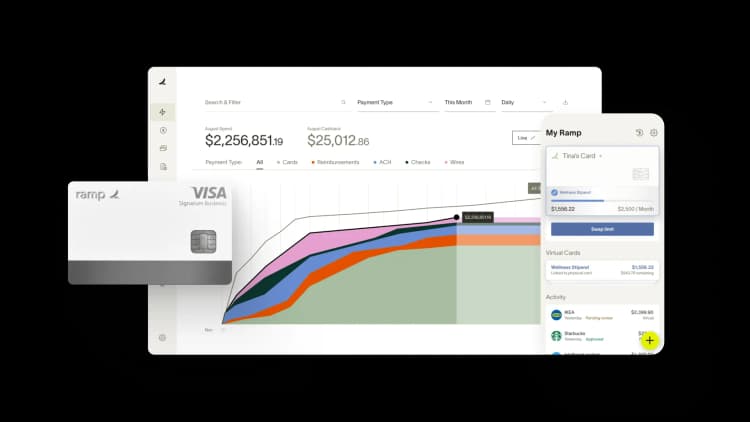
Corporate travel touches every part of your finance operation, from booking and policy enforcement to vendor negotiations and traveler safety. A travel management company (TMC) handles these tasks end-to-end, giving your finance team centralized visibility into business travel expenses and the tools to control costs.
What is a travel management company (TMC)?
A travel management company is a specialized B2B service provider that helps you plan, book, and manage corporate travel while enforcing policy and controlling costs. The abbreviation "TMC" is standard shorthand in the corporate travel industry, and you'll see it used across RFPs, vendor comparisons, and internal travel program discussions. Whether TMC travel services make sense for your program depends on your travel volume, policy needs, and how much visibility your finance team requires.
Today's TMCs have evolved far beyond traditional travel agencies. They combine industry expertise with modern technology, offering centralized booking tools, automated expense tracking, real-time reporting, and 24/7 traveler support. This tech-driven approach saves time, cuts costs, and gives finance teams better visibility into companywide travel spending.
Leading TMCs include American Express Global Business Travel (Amex GBT), CWT, Egencia, and BCD Travel, which serve companies across industries and help them optimize every stage of business travel. Global business travel spending reached $1.57 trillion in 2025, according to the Global Business Travel Association. and was projected to hit $1.57 trillion in 2025, according to the Global Business Travel Association.
With that much money flowing through corporate travel programs, choosing the right partner for booking, policy enforcement, and spend management can have a measurable impact on your bottom line.
TMC vs. corporate travel agency vs. online booking tools
These three terms often get used interchangeably, but they refer to different things. Understanding the distinctions helps you pick the right fit for your travel program.
| Feature | Traditional corporate travel agency | Travel management company | Online booking tool |
|---|---|---|---|
| Level of service | Full-service, agent-handled bookings | Full-service with technology, reporting, and policy tools | Self-service booking platform |
| Cost management | Limited spend visibility | Consolidated reporting and negotiated rates | Basic cost tracking |
| Policy enforcement | Manual, post-trip review | Automated, enforced at booking | Limited or no policy controls |
| Best suited for | Companies wanting hands-on service | Companies needing integrated travel management | Simple travel needs, cost-conscious teams |
Traditional corporate travel agencies
Corporate travel agencies provide full-service booking for flights, hotels, and ground transportation. An agent handles reservations on your behalf, often with a personal touch and destination expertise. The trade-off is that most traditional agencies lack technology for policy enforcement or spend analytics. They're best for companies that want hands-on service and don't need automated expense management or consolidated reporting.
Travel management companies
TMCs combine booking services with technology, reporting, policy tools, and duty of care. They act as a true partner for your travel program, not just a booking agent.
Because TMCs integrate with your expense and HR systems, they give finance teams real-time visibility into spending and compliance. They also negotiate corporate rates, enforce travel policies at the point of booking, and provide 24/7 traveler support.
Online booking tools and travel platforms
Online booking tools (OBTs) are self-service platforms where employees search and book business travel directly. They're typically lower cost and easy to adopt, making them a good option for simple travel needs.
The downside is limited support, weaker policy controls, and fragmented spend visibility. If employees book across multiple platforms, you lose the consolidated view that makes travel budgets manageable. For a comparison of leading options, see our roundup of travel management software.
What services do travel management companies provide?
TMCs handle the full travel lifecycle, from the moment an employee needs to book a trip through post-trip expense reconciliation:
Booking and trip management
TMCs manage flight, hotel, rental car, and ground transportation bookings through a centralized platform. Employees or dedicated travel managers can search options that align with your company's preferred vendors and policies. When plans change (and they always do), TMCs handle rebookings, cancellations, and itinerary adjustments so your travelers don't have to navigate it alone.
Travel policy creation and enforcement
TMCs help you build clear travel and expense policies and enforce them automatically during booking. You can block out-of-policy options entirely or flag them for manager approval. This means policy compliance happens before money is spent, not weeks later during expense review.
Spend management and reporting
TMCs consolidate all travel and expense management into a single view. You can see who's spending what, where the money goes, and how actual costs compare to budget in real time. Detailed reports help you identify savings opportunities, track trends across departments, and make smarter decisions about vendor contracts and travel budgets.
Traveler safety and duty of care
Duty of care is your obligation to protect employees while they travel. TMCs help you meet that obligation by tracking traveler locations, sending alerts during disruptions, and coordinating emergency assistance. Whether it's a natural disaster, civil disturbance, or health emergency, your TMC gives you the tools to locate and support your people quickly.
Supplier negotiations and rate management
TMCs aggregate travel volume across their client base to negotiate corporate rates with airlines, hotels, and car rental companies. These discounts typically aren't available to you on your own, especially if you're a smaller company. Beyond negotiated rates, TMCs monitor pricing trends and recommend when to lock in deals or shift to alternative suppliers.
24/7 traveler support
Around-the-clock access to live agents is critical for international business travel. When a flight gets canceled after hours or an employee needs an emergency rebooking, they can reach someone immediately. Many TMCs also store traveler preferences like seat selection and dietary needs to create a more consistent experience across every trip.
Travel data reporting and analytics
TMC reporting dashboards break down spend by department, traveler, vendor, category, and time period. You can benchmark average airfare or hotel rates against prior periods to spot cost creep, identify booking-behavior trends like last-minute flight purchases, and build a stronger negotiating position when vendor contracts come up for renewal.
Business travel management technology and tools
Today's TMCs differentiate themselves through business travel management technology. These tools work together to automate travel operations and connect to your existing systems.
Booking platforms and mobile tools
Web portals let employees search and book travel within policy. These platforms surface compliant options first, making it easy for travelers to stay within guidelines without extra effort. Most platforms also show preferred vendor options and negotiated rates prominently, steering bookings toward the best deals.
Mobile apps extend that functionality on the go, providing access to itineraries, real-time flight updates, and the ability to make changes while traveling. If a meeting runs long or a connection gets tight, employees can rebook from their phone without calling an agent.
Expense management integration
TMCs can connect to your expense management software so travel bookings automatically flow into expense reports. This eliminates manual data entry and reduces the errors that come with it. Ramp takes this a step further by combining travel and expense management in one platform, so bookings, receipt matching, and reconciliation happen in a single system.
Reporting, analytics, and policy automation
Dashboards show travel spend by department, traveler, vendor, and category. Finance teams can spot trends, benchmark against prior periods, and identify where to negotiate better rates. Some platforms also let you export data for deeper analysis or to share with leadership to support budget conversations.
On the policy side, technology enforces your rules automatically. The platform flags out-of-policy bookings, routes exceptions to the right manager for approval, and creates an audit trail for every decision. This removes the guesswork from compliance and gives finance teams confidence that policies are enforced consistently.
Why use a travel management company for business travel?
If you're managing travel manually or across multiple platforms, a TMC solves several problems at once:
Centralized visibility into travel spend
Scattered bookings across different sites make it nearly impossible to know your true travel costs. A TMC consolidates all your travel spend into one view: flights, hotels, ground transportation, and meals. That visibility is the foundation for better budgeting, smarter negotiations, and faster month-end close.
Time savings through automation
Automation eliminates the manual tasks that eat into your team's week: chasing receipts, reconciling bookings against credit card statements, and building travel reports from scratch. Finance teams often reclaim hours each week when they move from manual travel management to a TMC-supported workflow.
Improved travel policy compliance
Policy enforcement at booking time prevents overspending before it happens. Instead of catching a $500 hotel upgrade during expense review, the TMC blocks it or routes it for approval when the employee tries to book. This proactive approach saves money and eliminates awkward conversations about expense reimbursement denials after the fact.
Better traveler experience
Employees benefit from easier booking, consistent support when things go wrong, and a smoother overall travel experience. When booking is simple and help is always available, travelers can focus on the purpose of their trip. Stored preferences, loyalty program integration, and mobile access all create a travel experience that employees appreciate.
Risk management and traveler safety
TMCs help you know where your travelers are at all times and respond quickly to emergencies or disruptions. Real-time tracking, safety alerts, and emergency hotlines protect your people and reduce your liability. For companies with international travel or employees in high-risk regions, this capability is essential.
How travel management companies save you money
TMCs reduce travel costs through a few specific methods. Understanding these helps you evaluate whether your investment will pay for itself:
Negotiated corporate rates with suppliers
TMCs aggregate travel volume across all their clients to negotiate discounts with airlines, hotels, and car rental companies. Because they bring significant booking volume to the table, they secure rates you couldn't get on your own. These negotiated rates often include perks like free upgrades, waived fees, or flexible cancellation terms.
Policy enforcement reduces out-of-policy bookings
When you block premium bookings or require justification for exceptions, you prevent unnecessary spending at the source. When employees can only see options that are compliant with your travel expense policy, spend drops significantly. Over time, this shifts your travel culture toward cost-conscious booking habits.
Consolidated reporting identifies savings opportunities
Seeing all your spend data in one place reveals patterns you'd otherwise miss. Maybe your team consistently books flights at the last minute, driving up costs. Or maybe you're paying rack rates at hotels where you could negotiate a preferred rate. TMC reporting surfaces these opportunities so you can act on them.
Unused ticket tracking and credit recovery
When employees cancel flights, the airline credits often go unused because no one tracks them. TMCs monitor these credits and apply them to future bookings before they expire. This is one of the most overlooked sources of travel cost recovery, and one of the easiest wins a TMC provides.
Top travel management companies
The right TMC for your program depends on your company's size, travel volume, and program complexity.
American Express Global Business Travel (Amex GBT)
Amex GBT is the largest TMC globally by booking volume, serving enterprise clients across virtually every industry. Its Neo platform provides booking, reporting, and traveler management in a single interface. Amex GBT's supplier network is among the broadest in the industry, and its duty of care capabilities include real-time traveler tracking and emergency response coordination.
CWT (formerly Carlson Wagonlit Travel)
CWT focuses on enterprise clients with complex, global travel programs. The company has a strong presence in Europe and Asia-Pacific, making it a common choice for multinational organizations. Its myCWT platform handles booking, itinerary management, and expense integration, and CWT is known for its data analytics capabilities that help clients identify spending patterns and savings opportunities.
BCD Travel
BCD Travel serves mid-market to enterprise clients and is one of the largest privately held TMCs. Its TripSource platform combines booking, itinerary management, and traveler communication. BCD has invested heavily in sustainability reporting, helping companies track and reduce the carbon footprint of their travel programs.
Egencia (now part of Amex GBT)
Egencia historically served mid-market companies with a technology-forward approach to corporate travel planning. Amex GBT acquired Egencia in 2021, though the brand continues to operate in certain markets. Egencia's platform was known for its user-friendly interface and self-service booking tools, which appealed to companies scaling their travel programs without adding dedicated travel managers.
This list isn't exhaustive. Dozens of regional and specialty TMCs serve specific industries and company sizes. The factors in the "how to choose" section below can help you evaluate which provider fits your needs.
How much does a TMC cost?
TMC pricing varies based on the fee model, your travel volume, and the level of service you need. Most providers use one of four common structures.
Transaction fee model
Under this model, you pay a flat fee for each booking the TMC processes. Transaction fees are straightforward and predictable, making them easy to budget. They work well for companies with consistent, moderate travel volume where cost-per-booking transparency matters.
Management fee model
Some TMCs charge a fixed monthly or annual retainer that covers a defined scope of services. This model gives you cost predictability regardless of how many bookings you make in a given period. It's common among enterprise clients with high volume who want bundled services, including reporting, account management, and dedicated support.
Hybrid model
A hybrid approach combines a lower base retainer with reduced per-transaction fees. This structure balances predictability with usage-based pricing. It can be a good fit for companies whose travel volume fluctuates seasonally or by project.
Cost-plus model
In a cost-plus arrangement, the TMC marks up supplier rates (airfare, hotel, car rental) by a set percentage rather than charging a separate service fee. The markup is built into the price you see at booking. This model is less common but still used by some TMCs, particularly for leisure-adjacent corporate travel.
Many TMCs also earn supplier commissions or override payments from airlines and hotels when they hit volume targets. These payments don't typically add to your costs directly, but they can influence which options a TMC recommends. Ask potential vendors for a full breakdown of their fee structure, including any supplier-side revenue, before signing a contract.
4 signs your company needs a travel management company
These four common signs suggest you've outgrown manual travel management and could benefit from a TMC:
- You lack visibility into travel spend: If you can't quickly answer how much you spent on travel last quarter, or who your top spenders are, you're flying blind. A TMC gives you the consolidated data you need to manage travel as a real budget line.
- Employees book travel inconsistently across platforms: When some employees use one booking site and others use another, you end up with fragmented data and zero policy control. A TMC centralizes booking so every trip flows through one system.
- Travel expenses are growing faster than revenue: Uncontrolled travel costs often signal a need for centralized management and better policies. If your travel spend keeps climbing without a clear return, a TMC can help you regain control.
- You need to track travelers for safety or compliance: Regulatory requirements, duty of care obligations, or operations in high-risk regions all make real-time traveler tracking essential. If you can't locate your travelers during a disruption, you need a TMC.
How to choose the right travel management company
Choosing the right TMC depends on your company's size, travel patterns, and priorities. The best partner will align with your goals, offer the right mix of technology and service, and scale as your business grows.
When evaluating potential partners, focus on these factors:
- Company size and travel volume: Select a TMC that can handle your current and projected travel needs without reducing service quality
- Geographic coverage and supplier network: Look for a partner with global reach and strong relationships with airlines, hotels, and transportation providers
- Technology and integrations: Make sure the platform connects with your existing travel, expense, and HR systems for smooth data sharing
- Service levels and support: Review support hours, escalation procedures, and response times so employees have help when issues arise
Questions to ask potential TMCs
Before committing, confirm fit and transparency by asking:
- Implementation and onboarding: How long will setup take, and what support is included?
- Pricing and fees: What costs are covered, and are there additional charges for premium services or international bookings?
- Reporting and data ownership: What reporting tools are available, and who owns the data generated through your account?
- Policy customization: Can the platform accommodate your travel policies, approval workflows, and spending limits?
What to expect during TMC implementation
TMC implementations typically take 4 to 12 weeks depending on the complexity of your travel program and the number of system integrations involved.
Most implementations follow a similar sequence. The TMC configures your travel policies in the platform first, then connects to your expense management, HR, and single sign-on systems. After the technical setup, the focus shifts to traveler onboarding: loading employee profiles, setting up approval workflows, and training your team on how to book through the new system.
The quality of the onboarding experience is often a leading indicator of how the TMC relationship will go long-term. Solutions that invest in dedicated onboarding teams, clear timelines, and hands-on training tend to deliver faster adoption and fewer support issues in the first few months.
Before you sign a contract, ask the TMC for a detailed project timeline with milestones and a named point-of-contact who will own your implementation. If a vendor can't provide both, consider that a red flag.
How Ramp Travel simplifies corporate travel management
If you're evaluating TMCs primarily for booking, policy enforcement, and expense visibility, Ramp Travel may be all you need. Ramp Travel is a native online booking tool built into the same platform you already use for corporate cards and expenses, giving you integrated travel and expense management without a separate system.
Policy enforcement happens at the point of booking, not after the fact. Set custom rules for airfare, lodging, per diem allowances, or rental car bookings, and Ramp applies them the moment an employee searches for travel. Flight Savings surfaces a comparable lower-fare option at booking with a one-click switch, and Hotel Price Drop automatically rebooks refundable hotels when the price drops by $50 or more.
There are no platform fees and no per-booking fees. Ramp captures receipts instantly, matches them to transactions, and handles reconciliation automatically, so there's no expense report when your travelers land.
More than 85,000 businesses use Ramp to save over $1 billion a month. Watch a demo to see how Ramp Travel can simplify your corporate travel program.

FAQs
A TMC manages corporate travel end-to-end, including booking flights, hotels, and ground transportation, enforcing travel policies, tracking expenses, negotiating supplier rates, and providing 24/7 traveler support. Unlike a traditional travel agency, a TMC integrates with your expense and HR systems to give finance teams real-time visibility into travel spending and compliance.
A traditional travel agency focuses on booking travel on your behalf, often with a personal touch but limited technology. A TMC combines booking with policy management, real-time reporting, expense system integrations, and duty of care tools. TMCs act as a strategic partner for your travel program, not just a booking service.
TMCs earn revenue through transaction fees charged per booking, monthly or annual management retainers, or a hybrid of both. Some TMCs also earn supplier commissions or override payments from airlines and hotels for hitting volume targets. Fee structures vary by provider, so you should ask for a full breakdown before signing.
It depends on your travel volume and complexity. If you have fewer than 50 travelers with simple domestic trips, an online booking tool may cover your needs. TMCs become cost-effective when you have enough volume to benefit from negotiated corporate rates and need policy enforcement, consolidated reporting, and duty of care tools.
Duty of care is your legal and ethical obligation to protect employees while they travel for work. It includes knowing where your travelers are, responding to disruptions or emergencies, and providing access to support. TMCs help you meet this obligation through real-time traveler tracking, safety alerts, and 24/7 emergency assistance.


“I assumed I would have to choose between speed and control. What I found is that you can have both. A well-designed system takes friction out, for the finance function and for everyone else.”
Justin Webster
CFO, Denver Broncos

“A well-run district should not have to choose between getting work done at the school site and keeping control of the dollars behind it. We're not hiring more people to do more jobs, so we have to be smarter about the process. With Ramp, the purchase, the receipt, and the record stay together from the start. ”
Nick Brizeno
Director of Purchasing, San Marcos Unified School District

“In senior living, scale only works if the communities still feel personal. We needed the back office to carry more of the complexity, not the people serving residents. Ramp helped us build that infrastructure, so the experience in the community could stay human.”
Ryan Cole
CFO, Agemark Senior Living

“AI is moving faster than the finance context around it. Prices change, models change, and the value is not always obvious from an invoice. We needed enough detail to know which bets deserved more investment — and which ones did not.”
Greg Cooley
Controller, AngelList

“Invoices, cards, tokens. The categories change but the principle doesn't: know where the money is going, remove the work around it, and make sure the spend is worth it.”
Maciej Mylik. Finance
ElevenLabs

“We weren’t trying to retrofit an old finance system. We had a blank canvas, and Ramp gave us the foundation to build a global finance function of the future.”
Justin Dourado
Director of Finance, Othership

“There's just no surprises anymore. No more waiting two months to find out how a job did. We know how it's doing as it's happening.”
Erich Kuss
Financial Systems Manager, Infinity Home Services

“More token spend isn’t proof that AI is working. Less isn’t proof that it isn’t. What matters is whether we’re buying the right level of intelligence for the work. Ramp lets us make that judgment in the same place we manage every other type of spend.”
Cody Nutt
Senior Director of Business Systems, Daxko
