
- What an annual operating budget covers for healthcare practices
- How to build a healthcare annual operating budget
- Common budgeting mistakes for healthcare practices
- How to track budget vs. actual throughout the year
- How Ramp supports budget tracking for healthcare practices
An annual operating budget is a 12-month financial plan that forecasts your practice's expected revenue and expenditures. It gives your leadership team a baseline for evaluating actual performance—when revenue falls short or expenses run over, the budget is the benchmark that signals where to investigate. Without one, you're managing against a moving target.
For healthcare practices, budgeting is more complex than in most industries. Revenue timing is unpredictable—insurance reimbursement lag, denial rates, and payer mix shifts create consistent variance.
Your operating costs also include categories most businesses don't manage: continuing medical education (CME) budgets per provider, supply budgets per location, and capital equipment planning cycles.
What an annual operating budget covers for healthcare practices
A complete healthcare operating budget has four components:
Revenue budget. Forecast revenue by payer (Medicare, Medicaid, commercial insurance, self-pay), by service line (primary care visits, specialist procedures, ancillary services), and by location if you operate multiple sites. Start with prior-year actuals and adjust for changes in patient volume, fee schedule updates, and payer contract renewals.
Operating expense budget. The largest line items: staffing (typically 50–60% of revenue for physician practices), medical supplies and drugs, occupancy, and technology. Break supplies and drugs into categories that map to your actual purchasing—by vendor type or supply category—so variance reporting is actionable.
CME and provider development budget. Per-provider CME allocations ($3,000–$10,000 per licensed provider annually, depending on specialty and state requirements) plus any practice-sponsored CE programs. Track separately from general operating expenses so provider-level budget tracking is straightforward at year-end.
Capital budget. Major equipment purchases, facility renovations, and technology infrastructure investments planned for the year. Capital items have different cash flow timing than operating expenses—a $200,000 imaging system purchase affects cash differently than $200,000 in annual supply costs—so the capital budget lives alongside but separate from the operating budget.
How to build a healthcare annual operating budget
The standard approach for physician practices is a zero-based or prior-year-plus method:
Step 1: Pull prior-year actuals. Start with last year's income statement: actual revenue by payer and service line, actual expenses by category. This is your baseline.
Step 2: Identify changes for the coming year. Adjust for known changes: new providers joining the practice, new service lines, lease renewals, fee schedule updates from Medicare and commercial payers, planned equipment purchases. Each change has a revenue or expense impact that flows into the budget.
Step 3: Model revenue by payer. Estimate patient volume by payer type. Apply expected reimbursement rates per visit by payer. Calculate expected gross revenue, then apply an expected collection rate by payer to get net revenue. Your revenue cycle team should own this step.
Step 4: Budget expenses by category. Build expense budgets for staffing, supplies, occupancy, and technology using prior-year actuals plus any planned changes. For multi-location groups, build by location and consolidate.
Step 5: Build the CME budget separately. Allocate CME budgets per provider. Check state licensing requirements for CME minimums—they vary by specialty and license type.
Step 6: Review and approve. Share the draft budget with clinical leadership and the board (if applicable). Get sign-off before the fiscal year begins.
Common budgeting mistakes for healthcare practices
Building one budget for the whole group. If your multi-location group budgets at the entity level, you'll miss location-level variance. A location running 20% over budget on supplies won't show up until it hits the consolidated numbers.
Ignoring payer mix shifts. Medicare's share of your revenue is increasing annually as your patient population ages. Budget models that assume a constant payer mix will overestimate your revenue if commercial insurance share declines.
Underestimating capital equipment timing. Equipment acquisitions take longer than expected—from vendor selection to delivery to staff training. Treating capital equipment spending as a line item in the operating budget (rather than a separate capital plan with a timeline) creates cash flow surprises mid-year.
Not budgeting CME per provider. Lumping CME into a general "professional development" line item makes per-provider tracking impossible. When a provider exceeds their CME budget at month three, there's no mechanism to flag it until year-end reconciliation.
How to track budget vs. actual throughout the year
A budget only produces value if you compare it to actuals consistently. Monthly budget-to-actual review should cover:
- Revenue: actual vs. budgeted by payer and service line
- Staffing costs: actual vs. budgeted, including overtime and locum tenens costs
- Supply costs: actual vs. budgeted by category and location
- CME spend: actual vs. budgeted per provider, updated monthly
- Operating overhead: occupancy, technology, and administrative costs vs. budget
When variance exceeds 5–10% in a category, investigate the cause before it compounds. A supply cost variance in month one might be a one-time bulk purchase. A month-three supply variance at the same location probably signals a purchasing process problem.
How Ramp supports budget tracking for healthcare practices
Tracking budget vs. actual for supply costs and CME requires visibility into real-time spending across cards, reimbursements, and vendor payments in one view.
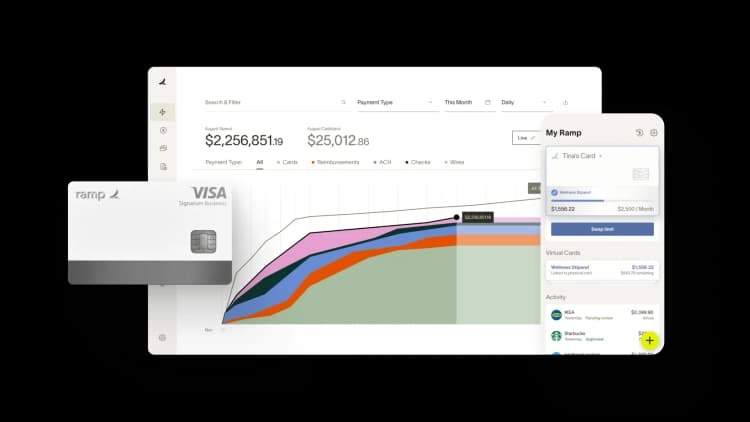
Ramp tracks spend against CME budgets per provider and supply budgets per location in real time—across cards, reimbursements, and bill payments together. Alerts fire at 75%, 90%, and 100% of budget, so your finance team sees overruns before they compound rather than at month-end close.
- For CME: issue a virtual card per provider with their annual CME limit built in. Conference fees, travel, and course materials code to the right provider automatically. Your practice administrator sees each provider's CME spend and remaining budget in a single dashboard, updated as transactions clear.
- For supply budgets: physical cards issued per location with monthly supply limits enforce the budget at the point of purchase. When a location manager tries to purchase beyond the location's supply budget, the card declines before the transaction happens.
See how Ramp tracks CME and supply budgets for healthcare practices.

FAQs
Build the annual budget once, before the fiscal year starts. Review it against actuals monthly and adjust your internal forecasts as conditions change—but don't reopen and revise the budget mid-year unless there's a material change in practice structure (a major provider departure, acquisition of a new location, loss of a significant payer contract). Revising the budget in response to normal variance makes year-end performance measurement meaningless.
An operating budget covers the ongoing costs of running your practice: staffing, supplies, occupancy, and technology subscriptions. A capital budget covers major investments in long-term assets: equipment purchases, facility improvements, significant technology upgrades. Capital expenditures are often depreciated over several years rather than expensed in the year of purchase, which affects how they flow through your income statement. Most practices build both together during the annual planning cycle.
Pro-rate the CME budget for providers who join or leave during the year based on the number of months they're with the practice. For departing providers: document CME expenses submitted before their departure date and close out their budget line. For new providers: issue their virtual card with a pro-rated CME limit based on the months remaining in the fiscal year.


“I assumed I would have to choose between speed and control. What I found is that you can have both. A well-designed system takes friction out, for the finance function and for everyone else.”
Justin Webster
CFO, Denver Broncos

“A well-run district should not have to choose between getting work done at the school site and keeping control of the dollars behind it. We're not hiring more people to do more jobs, so we have to be smarter about the process. With Ramp, the purchase, the receipt, and the record stay together from the start. ”
Nick Brizeno
Director of Purchasing, San Marcos Unified School District

“In senior living, scale only works if the communities still feel personal. We needed the back office to carry more of the complexity, not the people serving residents. Ramp helped us build that infrastructure, so the experience in the community could stay human.”
Ryan Cole
CFO, Agemark Senior Living

“AI is moving faster than the finance context around it. Prices change, models change, and the value is not always obvious from an invoice. We needed enough detail to know which bets deserved more investment — and which ones did not.”
Greg Cooley
Controller, AngelList

“Invoices, cards, tokens. The categories change but the principle doesn't: know where the money is going, remove the work around it, and make sure the spend is worth it.”
Maciej Mylik. Finance
ElevenLabs

“We weren’t trying to retrofit an old finance system. We had a blank canvas, and Ramp gave us the foundation to build a global finance function of the future.”
Justin Dourado
Director of Finance, Othership

“There's just no surprises anymore. No more waiting two months to find out how a job did. We know how it's doing as it's happening.”
Erich Kuss
Financial Systems Manager, Infinity Home Services

“More token spend isn’t proof that AI is working. Less isn’t proof that it isn’t. What matters is whether we’re buying the right level of intelligence for the work. Ramp lets us make that judgment in the same place we manage every other type of spend.”
Cody Nutt
Senior Director of Business Systems, Daxko
