
- Why finance teams are moving beyond Expensify
- Snapdocs: from 3 tools to 1
- Notion: scaling expenses across a global team
- Brandt: eliminated month-end spreadsheet chaos
- Common reasons companies switch from Expensify
- Choose a finance platform that scales with you
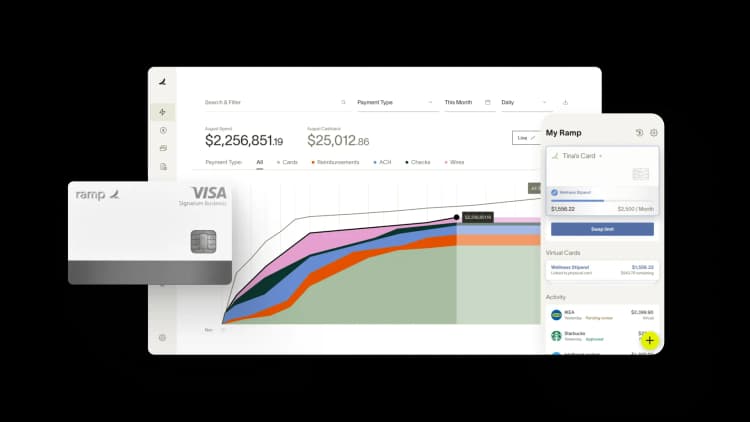
Expensify built its name on receipt scanning, and for years that's been exactly what growing teams needed. But as finance operations get more complex — managing cards, paying vendors, enforcing budgets in real time — teams start looking for a platform that covers the full picture, not just expense reports.
The shift isn't about finding a slightly better expense app. It's about consolidating cards, expenses, accounts payable, and accounting into one platform, and the companies below explain exactly why they made that move.
Why finance teams are moving beyond Expensify
Expensify is expense management software that helps employees submit receipts and get reimbursed for work purchases. It's been around since 2008 and built its reputation on receipt scanning — you snap a photo, the app reads it, and the data populates into an expense report.
For small teams with simple expense tracking, that works fine. But here's what happens as companies grow: you end up with Expensify for expenses, a separate corporate card program from your bank, another tool for paying vendor invoices, and maybe a fourth system for travel booking. Suddenly, your finance team is logging into four different platforms and manually reconciling data across them.
That's the pattern we've seen over and over. Finance leaders start asking a reasonable question: why are we paying for multiple tools that don't talk to each other when we could consolidate everything into one platform?
The companies below all made that switch. Their stories illustrate what changes when you move from a standalone expense tool to a unified spend management platform.
Snapdocs: from 3 tools to 1
| Company | Size & Industry | Description | Pain Point |
|---|---|---|---|
| Snapdocs | Mid-size, Banking & Financial Services | Connects people, processes, and technologies powering mortgage closings through automation | Three disconnected spend tools requiring constant manual syncing |
The challenge
Snapdocs was running three separate systems — Expensify for employee reimbursements, a separate corporate card provider for executives and frequent travelers, and a standalone bill pay tool for vendor payments. Every month, the finance team had to manually sync all three into QuickBooks line by line.
The friction showed up in a few specific ways:
- Reconciliation ate up hours: Monthly reconciliation across three systems took 5–6 hours, pulling the team away from higher-value tasks
- No streamlined approvals: Routing approvals to the correct personnel caused backlogs and delays
- Constant tool-toggling: The team was switching between three platforms for every approval and reconciliation task
- Manual month-end syncing: Expenses had to be manually synced into QuickBooks at month-end, a tedious and error-prone process
How Ramp solved it
Snapdocs moved their corporate cards and expense management onto Ramp, consolidating three disparate systems into a single platform.
- Full QuickBooks integration: Transactions sync automatically — no more manual month-end exports
- Customizable approval workflows: Approvals route to the right person based on team-specific rules
- Automated bill processing: OCR technology captures invoice data so AP staff don't type it manually
- Virtual card programs: Creative card issuance for subscriptions, travel, and team-specific spending
The results
Snapdocs consolidated three systems into one and cut monthly reconciliation from 5–6 hours to under 30 minutes. The accounting team now spends just 10–15 minutes a day in Ramp, and moving vendors to virtual cards increased their cash back.
"In all aspects, Ramp has been a massive improvement for our company, full stop." — Fahem Islam, Accounting Associate
Read the full Snapdocs story →
Notion: scaling expenses across a global team
| Company | Size & Industry | Description | Pain Point |
|---|---|---|---|
| Notion | 1,000+ employees across 10+ countries, Software | AI-powered workspace used by 100+ million people globally | Fragmented spend tools couldn't keep pace with rapid global expansion |
The challenge
Notion grew fast. What worked when they were a small startup stopped working as they expanded to over 1,000 employees across 10+ countries. Their existing expense management setup, which included Expensify alongside other spend tools, couldn't keep pace with a rapidly expanding global workforce.
- Fragmented spend tools: Multiple platforms for expenses, corporate cards, and travel created data silos across countries
- Out-of-policy spending: Without real-time controls, policy violations were caught after the fact rather than prevented
- Manual reconciliation across currencies: Global transactions in different currencies required manual work to reconcile
- Low receipt compliance: Employees weren't submitting receipts consistently, creating audit risk
How Ramp solved it
Notion moved all expenses for its global workforce — including Expensify, a separate corporate card provider, and their travel platform — onto Ramp. For the first time, every dollar across 10+ countries was visible in a single system.
- Global card support: Ramp's corporate cards work internationally with spending controls built in for every country
- Real-time policy enforcement: Ramp's rules engine flags or blocks out-of-policy spending at the point of purchase
- Automated receipt compliance: AI-powered reminders and matching drove receipt compliance from 80% to 95%
- Automatic coding: 88% of transactions are auto-coded, eliminating hours of manual categorization
The results
Notion achieved 94% compliant transactions, saved $1M+, and reclaimed 75 hours per month across the finance team. Receipt compliance jumped from 80% to 95%, and 88% of transactions are now auto-coded without manual intervention.
"Ramp is the only vendor that can service all of our employees across the globe in one unified system." — Brandon Zell, Head of IT
When evaluating expense platforms, ask whether the tool handles just expenses or the full spend picture. The time you save by eliminating reconciliation between systems often matters more than any single feature.
Brandt: eliminated month-end spreadsheet chaos
| Company | Size & Industry | Description | Pain Point |
|---|---|---|---|
| Brandt | Mid-size, Software & Technology | Outdoor recreation management software for public agencies (licensing, registration, reservations) | Month-end close collapsed into spreadsheets, requiring staff to chase missing coding and receipts |
The challenge
Brandt's finance team was stuck in a painful month-end cycle. They used Expensify for certain expense categories — at over $800/month — but the tool still required spreadsheet exports and manual chasing at close. Their other expense tool had a fragile sync that constantly created exceptions.
- Spreadsheet-driven close: Month-end collapsed into emailing cardholders, compiling data, and chasing missing receipts manually
- Growing costs without growing impact: At over $800/month, Expensify wasn't reducing the manual work enough to justify the spend
- Fragile integrations: Their other expense system's sync was unreliable, requiring constant monitoring
- Couldn't scale: With only ~24 cardholders supported, the process broke as the company grew
How Ramp solved it
Brandt brought employee expenses onto Ramp with a native Sage Intacct integration that eliminated the manual sync entirely. Instead of reconciling at month-end, spending gets coded as it happens.
- Native Sage Intacct integration: Clean syncing without constant monitoring or manual exports
- Virtual cards on demand: Immediate issuance for new hires, supporting travel and subscriptions — grew from ~24 to 70+ cardholders with zero added accounting headcount
- Spend controls with approvals: Limits and approval workflows reduced incomplete transactions
- Continuous reconciliation: Coding happens as spending occurs, not in a month-end crunch
The results
Brandt's month-end close is now 15–20 hours faster. They went from ~24 cardholders to 70+ with zero added accounting headcount, saving 46 hours per month across the company and $450K+ in combined savings (eliminated software fees + cashback earnings).
"With Ramp, we haven't had to add accounting headcount to keep up with growth. The biggest takeaway is that instead of hiring our way through it, we fixed the workflow so we can keep supporting the organization as we scale." — Melissa M., VP of Accounting
Common reasons companies switch from Expensify
After working with hundreds of finance teams who've made this move, a few patterns keep coming up.
| Common challenge | What teams look for instead |
|---|---|
| Expense-only focus | Unified platform covering cards, expenses, AP, and accounting |
| Manual receipt matching | AI that matches receipts to transactions automatically |
| Reactive policy enforcement | Controls that prevent out-of-policy spending before it happens |
| Delayed spend visibility | Real-time dashboards showing purchases as they occur |
| Separate card programs | Integrated corporate cards with built-in expense management |
| Manual accounting sync | Native integrations that automate the close process |
The conversation isn't really about finding a "better Expensify alternative." It's about recognizing that expense reports are just one piece of a larger financial operations puzzle.
Choose a finance platform that scales with you
Snapdocs, Notion, and Brandt all started in similar places. They'd outgrown basic expense tracking and wanted a platform that could handle growing complexity without adding headcount to finance.
What they found with Ramp went beyond replacing Expensify. They consolidated corporate cards, expense management, accounts payable, and accounting automation into one system. The outcome: faster closes, better visibility, and finance teams that spend time on analysis instead of data entry.
If you're evaluating what comes after Expensify, the biggest question isn't which features to compare — it's whether you want another point solution or a platform that handles the full picture. Try an interactive demo to see how Ramp works, or explore more customer stories to see how other finance teams have made the switch.


“I assumed I would have to choose between speed and control. What I found is that you can have both. A well-designed system takes friction out, for the finance function and for everyone else.”
Justin Webster
CFO, Denver Broncos

“A well-run district should not have to choose between getting work done at the school site and keeping control of the dollars behind it. We're not hiring more people to do more jobs, so we have to be smarter about the process. With Ramp, the purchase, the receipt, and the record stay together from the start. ”
Nick Brizeno
Director of Purchasing, San Marcos Unified School District

“In senior living, scale only works if the communities still feel personal. We needed the back office to carry more of the complexity, not the people serving residents. Ramp helped us build that infrastructure, so the experience in the community could stay human.”
Ryan Cole
CFO, Agemark Senior Living

“AI is moving faster than the finance context around it. Prices change, models change, and the value is not always obvious from an invoice. We needed enough detail to know which bets deserved more investment — and which ones did not.”
Greg Cooley
Controller, AngelList

“Invoices, cards, tokens. The categories change but the principle doesn't: know where the money is going, remove the work around it, and make sure the spend is worth it.”
Maciej Mylik. Finance
ElevenLabs

“We weren’t trying to retrofit an old finance system. We had a blank canvas, and Ramp gave us the foundation to build a global finance function of the future.”
Justin Dourado
Director of Finance, Othership

“There's just no surprises anymore. No more waiting two months to find out how a job did. We know how it's doing as it's happening.”
Erich Kuss
Financial Systems Manager, Infinity Home Services

“More token spend isn’t proof that AI is working. Less isn’t proof that it isn’t. What matters is whether we’re buying the right level of intelligence for the work. Ramp lets us make that judgment in the same place we manage every other type of spend.”
Cody Nutt
Senior Director of Business Systems, Daxko
