
- Why nonprofit financial management is structurally different
- Managing restricted vs. unrestricted funds
- Grant budget vs. actual reporting
- Closing the books before board meetings
- Cash flow management for nonprofit organizations
- Staying audit-ready year-round
- How Ramp supports nonprofit financial management
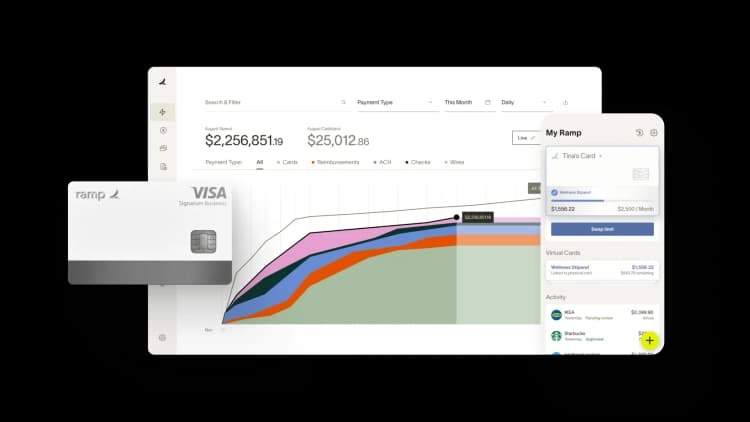
Financial management for nonprofits covers budgeting, fund tracking, grant reporting, expense management, cash flow planning, and compliance. It's more complex than for-profit finance because every dollar carries donor restrictions, reporting obligations, and accountability to your board. This guide breaks down what nonprofit financial management actually involves and how to do it well.
Why nonprofit financial management is structurally different
A for-profit organization manages one set of books. Revenue comes in, expenses go out, and you report the difference. A nonprofit organization manages multiple overlapping dimensions:
Dimension | What it means | Why it's hard |
|---|---|---|
Fund tracking | Separate balances for restricted and unrestricted money | Each dollar has rules about how it can be spent per donor intent |
Program reporting | Expenses categorized by functional expense category for Form 990 | Every transaction needs a program code, not just a GL code |
Grant compliance | Budget vs. actual tracking per grant | Each funder has different rules, timelines, and reporting formats |
Board accountability | Financial summaries for non-finance board members | Reports must be clear enough for a board treasurer who isn't an accountant |
Cash flow timing | Revenue arrives in lumps (grants, donations) | You can't predict when the next grant check arrives |
Most financial software assumes a single-dimension structure. Nonprofit organizations need all five dimensions tracked simultaneously.
Managing restricted vs. unrestricted funds
When a donor gives $50,000 designated for your after-school program, that money can only be spent on the after-school program. Spend it on rent, and you've violated the restriction. This isn't a suggestion: it's a legal obligation under ASC 958 accounting standards.
The two categories:
- With donor restrictions: Money designated for a specific purpose, time period, or both
- Without donor restrictions: Money you can spend on anything the organization needs
The operational challenge: every transaction needs to code to the correct fund type. When program staff swipe a corporate card for program supplies, that purchase needs to hit the restricted program fund, not the general operating fund.
Organizations that track this manually make errors. Transactions land in the wrong fund. Fund balances don't reconcile. The auditor finds the discrepancies. The fix is coding every dollar to the right fund at the point of purchase, not reclassifying it at month-end.
Grant budget vs. actual reporting
Each grant has a budget with line items (personnel, travel, supplies, contractual, indirect costs), and your actuals need to tie to those line items precisely.
Federal grants under OMB Uniform Guidance add compliance requirements: documented procurement processes, allowable cost determinations, and time-and-effort reporting for personnel charged to grants.
Without automated tracking, each reporting cycle means exporting transactions, filtering by date and fund, matching to budget categories, and building the report in a spreadsheet. For organizations managing five or more active grants, this process consumes days per cycle.
Spend management platforms that map every transaction (card, bill payment, reimbursement, or PO) to a grant budget in real time eliminate most of this manual work. Program directors track and approve within their own limits, while finance focuses on exceptions and funder reporting.
Closing the books before board meetings
Nonprofit boards typically meet quarterly. The finance team's hard deadline is the board packet: a statement of activities, a statement of financial position, and program-level spending summaries.
The typical close at a small nonprofit organization takes four weeks. Wait for bank transactions to clear, categorize uncategorized transactions, reconcile accounts, allocate shared costs, run reports, build the board packet. By the time the board sees the data, it's six weeks old.
The solution is coding transactions to funds and functional expense categories as they post, not in a batch at month-end. When your accounting system stays current throughout the month, close becomes a verification step instead of a reconstruction project.
Not sure how to set up expense policies, track restricted grants, or stay audit-ready? Watch how real nonprofit finance professionals use Ramp to automate nonprofit accounting →
Cash flow management for nonprofit organizations
Nonprofit cash flow has structural patterns that for-profit organizations don't face:
- Donation seasonality: 30-40% of individual giving happens in November and December
- Grant timing gaps: When one grant ends and the next hasn't started, you're funding programs from reserves
- Reimbursement-based grants: Some grants reimburse expenses after the fact, meaning you front the money
- Capital campaign pledges: Pledged donations arrive on the donor's timeline, not yours
Smart cash management means maintaining operating reserves (most governance experts recommend 3-6 months of operating expenses) and earning yield on idle cash between grant cycles. Some spend management platforms offer treasury features that let you hold operating reserves in high-yield accounts while keeping funds accessible for grant drawdowns.
Staying audit-ready year-round
The annual audit shouldn't be a scramble. If you're spending weeks gathering documentation, the problem isn't the audit: it's your financial management system.
Audit-readiness means every transaction is categorized by fund, program, and functional expense category at the time it happens. Every payment has documentation. Fund balances are current. Board financial reports are consistent with your general ledger.
The right spend management system captures receipts, memos, fund codes, approval records, and functional expense classifications at the point of spend. When Form 990 reporting or single audit season arrives, the documentation is already done.
How Ramp supports nonprofit financial management
Ramp replaces the disconnected tools most nonprofit finance teams juggle: corporate cards with fund-level controls, reimbursements, bill pay with multi-approver workflows, and real-time sync to your accounting system.
- Fund-level coding: Every card transaction and bill payment codes to a specific fund, program, and grant at the point of spend
- QuickBooks and Sage Intacct sync: Transactions sync to your accounting system in real time with fund and functional expense category codes already applied
- No personal guarantee: Corporate cards without personal guarantees, so your ED's credit isn't at risk
- Reimbursements in two days or less: Program staff and volunteers get reimbursed quickly without paper forms
- Multi-approver bill pay: Approval workflows that match your board's signing authority requirements
- Real-time visibility: Real-time spend tracking across every fund and program, not weeks after reconciliation
- Treasury: Business Account¹ for instant-access liquidity and Managed Investments² for higher-yield reserves on idle cash between grant cycles, with no minimums
1. Ramp Business Corporation is a financial technology company, not a bank. Bank deposit services are provided by First Internet Bank of Indiana, Member FDIC.
2. Portfolios managed by Moment Advisors, LLC. Investing involves risk, including possible loss of principal. The Investment Account is not a deposit product, is not insured by the FDIC, and may lose value. Securities products offered by Apex Clearing Corporation, member FINRA, SIPC.

FAQs
Financial management for nonprofit organizations covers budgeting, fund tracking (restricted vs. unrestricted), grant reporting, expense categorization by functional expense category, board financial reporting, and compliance activities like Form 990 preparation and audit readiness.
Most nonprofit organizations use a combination of accounting software (QuickBooks, Sage Intacct, or Blackbaud) and spend management tools (for corporate cards, expense management, and bill pay). Ramp handles the spend management layer and syncs to your accounting system automatically.
Restricted funds are tracked through fund accounting, where each fund maintains its own balance and spending rules. The most efficient approach is coding transactions to the correct fund at the point of purchase, then syncing those codes to your accounting software.
Monthly is standard practice. Board packets typically require quarterly financial statements, which means monthly closes are necessary to stay current. Organizations using real-time spend tracking can close within days of month-end rather than weeks.
Multi-dimensional tracking: every transaction needs a fund code, program code, and functional expense category, and they all need to reconcile. Organizations that track these dimensions manually spend disproportionate time on reconciliation and are more likely to have audit findings.
Don't miss these


“I assumed I would have to choose between speed and control. What I found is that you can have both. A well-designed system takes friction out, for the finance function and for everyone else.”
Justin Webster
CFO, Denver Broncos

“A well-run district should not have to choose between getting work done at the school site and keeping control of the dollars behind it. We're not hiring more people to do more jobs, so we have to be smarter about the process. With Ramp, the purchase, the receipt, and the record stay together from the start. ”
Nick Brizeno
Director of Purchasing, San Marcos Unified School District

“In senior living, scale only works if the communities still feel personal. We needed the back office to carry more of the complexity, not the people serving residents. Ramp helped us build that infrastructure, so the experience in the community could stay human.”
Ryan Cole
CFO, Agemark Senior Living

“AI is moving faster than the finance context around it. Prices change, models change, and the value is not always obvious from an invoice. We needed enough detail to know which bets deserved more investment — and which ones did not.”
Greg Cooley
Controller, AngelList

“Invoices, cards, tokens. The categories change but the principle doesn't: know where the money is going, remove the work around it, and make sure the spend is worth it.”
Maciej Mylik. Finance
ElevenLabs

“We weren’t trying to retrofit an old finance system. We had a blank canvas, and Ramp gave us the foundation to build a global finance function of the future.”
Justin Dourado
Director of Finance, Othership

“There's just no surprises anymore. No more waiting two months to find out how a job did. We know how it's doing as it's happening.”
Erich Kuss
Financial Systems Manager, Infinity Home Services

“More token spend isn’t proof that AI is working. Less isn’t proof that it isn’t. What matters is whether we’re buying the right level of intelligence for the work. Ramp lets us make that judgment in the same place we manage every other type of spend.”
Cody Nutt
Senior Director of Business Systems, Daxko
