

- The 13x problem
- Your provider dashboard shows tokens. Your CFO needs dollars.
- Introducing Ramp AI Spend Intelligence
- What finance leaders are saying
- Your fastest-growing cost deserves more than a spreadsheet
The best companies know it. They're investing aggressively in AI, and it's working. Ramp data shows the top quartile of AI spenders on our platform have more than doubled their revenue since 2023. A roofing company in Texas grew 24% after adopting AI for estimates. A five-person construction firm in Florida grew 65%. The gap between companies that embrace AI and companies that don't is compounding every quarter.
So you're spending. You should be.
But here's the problem nobody's talking about: the same force driving your growth is your least-governed cost. You can tell me your AWS bill to the penny. You can break it down by service, by team, by environment. You've been doing it for a decade.
Your AI bill? You're guessing.
I know because I hear it every week. A Series D CFO reconciling 50 invoices a month with no way to tell what’s a seat charge versus overage. A finance lead at an AI startup who only finds out what they spent on models when the bill arrives.
Every conversation starts the same way: “How much are we spending on AI, and on what?” It takes days stitching together multiple dashboards, different invoice formats, and credits that don't reconcile. Yet no answer to follow-ups: what's COGS versus R&D? What are the drivers?
The 13x problem
Since January 2025, average monthly AI token spend across Ramp customers has increased 13x. Read that again. Not 13%. Thirteen times.

And it's accelerating. Ramp data shows that the biggest AI spenders see costs jump 50% or more roughly one in four months. This isn't a line item anymore. It's the line item.
But here's what makes AI spend fundamentally different from every other cost category your finance team manages:
- A single prompt template change can triple your bill overnight.
- A junior engineer experimenting on a Friday can blow through a quarterly budget by Monday.
- An agent stuck in a loop can burn through $50K before anyone notices.
A SaaS contract has a fixed price. Cloud infra has a decade of cost allocation tooling. AI spend has neither. It grew 13x, and the finance stack around it grew zero.
Your provider dashboard shows tokens. Your CFO needs dollars.
You might think the providers have this covered. They don't.
Anthropic's dashboard shows you usage by API key. OpenAI's shows you token counts by model. But that's developer telemetry, not financial intelligence. It doesn't tell your controller whether a given API key's spend is COGS or OpEx. It doesn't help FP&A forecast next quarter when a single feature launch moves the number by 40%.
Then there's the spend that no dashboard sees at all. The 14 ChatGPT Team subscriptions on employee cards. The two teams paying for the same vector database. One Ramp customer found $120K in annual AI spend that never appeared on a single provider dashboard. It was all on cards.
No tool in the market connects token-level usage, invoice data, and card-level spend. So we built one.
Introducing Ramp AI Spend Intelligence
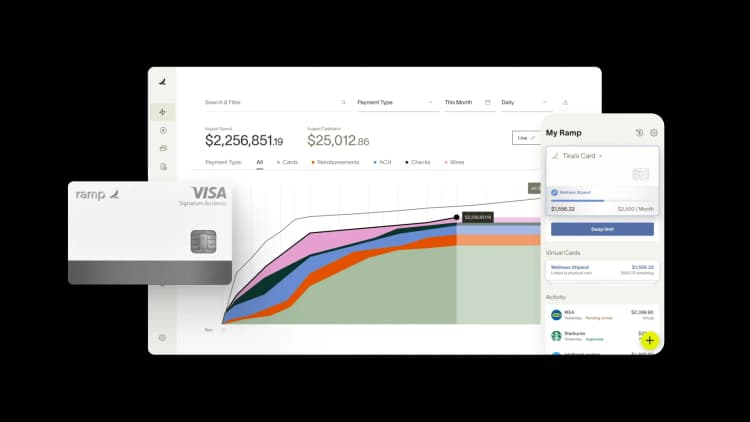
We already process your AI invoices, your team cards, and your approval chains. Now your token-level usage data flows through Ramp, too. Pulled directly from Anthropic, OpenAI, and OpenRouter, with more providers shipping soon.
One view. Every AI dollar. API spend, SaaS subscriptions, individual tool licenses, and card-level purchases. From the $400K Anthropic invoice to the $30/month Perplexity Pro subscription on an employee card.
Ramp customers can get early access today.
New to Ramp? Learn how 70,000+ companies get visibility into every category of spend.
See what's actually driving your costs
Not "we spent $800K on Anthropic last month,” but "the search team spent $340K on Claude Sonnet for the recommendation engine, up 40% since the last deploy, driven by a prompt change that doubled average token count."
Every dollar attributed to a team, a project, a model, and a use case. Your finance team gets data they can close the books with. Not a spreadsheet that's stale by the time it's finished.

Catch problems before they hit your P&L
Set budgets by team or project. Get alerts when spend deviates from plan. Catch runaway costs before they show up on next month’s invoice. You should know about problems before they hit your bottom line.

Match what you’re billed against what you used
Usage data and invoices in the same platform means reconciliation closes itself. Billed $47,312 by OpenAI? Ramp shows $47,308 consumed — you see the $4 delta, not a mystery. Spend flows to your GL with the right coding the same way your card transactions and bill payments already do.

What finance leaders are saying
"We have 20-plus tools that all have their own way of billing, whether it's seat-based, license-based, API-based. And it's a mess.”
— Head of procurement, Public tech company
"There's no way for me to look at the data and know how much is spent on internal development versus our products. I have to look at multiple dashboards and chase teams to estimate the costs.
— Head of FP&A, Late-stage internet company
"We are not even close to being audit-ready, so we haven't thought about bifurcating between cost of revenue. We don't even call it cost of revenue right now. We categorize all of it as infra spend.”
— Head of finance, Growth-stage AI company
"I have seven minimum spend commitments, and I have no idea right now where we are relative to required utilization. We had a PTU commitment for a bunch of tokens that we weren't using — we probably wasted a couple million dollars on that.”
— Head of finance, Series C AI company
Your fastest-growing cost deserves more than a spreadsheet
The companies that build financial discipline around AI now will know where to invest, where to cut, and how to price their own products.
The ones that don't will be explaining to their board why AI spend tripled and nobody saw it coming.
And it's about to get harder. Agentic AI is the next wave: autonomous systems that spin up workloads and spawn sub-tasks without a human in the loop. It's less predictable and higher volume. The companies that don't have financial infrastructure around AI spend now will be buried when agents start writing the checks.
Ramp gives finance teams control over every category of corporate spend. AI shouldn't be the exception. It should be the starting point.
Ramp customers can get early access today.
New to Ramp? Learn how 70,000+ companies get visibility into every category of spend.
“I assumed I would have to choose between speed and control. What I found is that you can have both. A well-designed system takes friction out, for the finance function and for everyone else.”
Justin Webster
CFO, Denver Broncos

“A well-run district should not have to choose between getting work done at the school site and keeping control of the dollars behind it. We're not hiring more people to do more jobs, so we have to be smarter about the process. With Ramp, the purchase, the receipt, and the record stay together from the start. ”
Nick Brizeno
Director of Purchasing, San Marcos Unified School District

“AI is moving faster than the finance context around it. Prices change, models change, and the value is not always obvious from an invoice. We needed enough detail to know which bets deserved more investment — and which ones did not.”
Greg Cooley
Controller, AngelList

“Invoices, cards, tokens. The categories change but the principle doesn't: know where the money is going, remove the work around it, and make sure the spend is worth it.”
Maciej Mylik. Finance
ElevenLabs

“We weren’t trying to retrofit an old finance system. We had a blank canvas, and Ramp gave us the foundation to build a global finance function of the future.”
Justin Dourado
Director of Finance, Othership

“There's just no surprises anymore. No more waiting two months to find out how a job did. We know how it's doing as it's happening.”
Erich Kuss
Financial Systems Manager, Infinity Home Services

“More token spend isn’t proof that AI is working. Less isn’t proof that it isn’t. What matters is whether we’re buying the right level of intelligence for the work. Ramp lets us make that judgment in the same place we manage every other type of spend.”
Cody Nutt
Senior Director of Business Systems, Daxko

“Most banks treat the back office as a cost to keep down. We treat ours as a return to compound, which is why we run it on Ramp. Now we put our clients on Ramp, too.”
Patrick Gaughen
President & COO, Hingham Institution for Savings
