

How the family-owned business behind 28 senior living communities rebuilt finance to close 19 days faster
“In senior living, scale only works if the communities still feel personal. We needed the back office to carry more of the complexity, not the people serving residents. Ramp helped us build that infrastructure, so the experience in the community could stay human.”
CFO, Agemark Senior Living

Agemark wasn’t always a network of communities. It started with an old hotel in Vancouver, Washington and a contrarian idea about what senior living should feel like.

Nearly four decades later, the company remains family-owned, with communities built around a standard closer to hospitality than institutional care: residents gathering over hearty meals, socializing at evening happy hours, and walking their dogs along the lawn. It’s the same consideration they would find in a favorite restaurant or hotel.
That standard depends on the people running each community, and the work of a director can change by the minute: a family arrives for a tour, a maintenance issue needs attention, a team member needs a decision. The best directors keep all of it moving without letting the experience feel rushed or impersonal.
That is the operating standard Agemark set for itself as it grew to roughly 30 independent businesses across the United States. The question for Agemark wasn't simply whether finance could close faster. It was whether the company could keep growing without asking its community leaders and accounting team to absorb the complexity by hand.
Ryan Cole joined to answer that question. Instantly, he found hardworking people arranged around a workflow that was asking too much of them: generalists processing thousands of bills, routing approvals through email, and reconstructing financial truth after the month had already moved on.
But he didn’t see the 25-day close as an accounting problem. It was just the clearest symptom that Agemark was ready for an operating-design upgrade.
A personal care model, an impersonal finance process
The contradiction was hard to miss. Agemark had built its reputation on attention — to residents, families, meals, activities, buildings, and the thousand small signals that make a community feel like home. But behind that operating model, finance was relying on a process that scattered attention across inboxes.
Agemark’s finance team was doing the work of roughly 30 independent businesses at once. Each month brought 4,000 to 5,000 invoices.
Each invoice began a manual chain. A team member received the bill, entered and coded it, then sent it by email to the person who needed to approve it. Once that person replied, finance had to confirm the approval and move the bill forward for payment. “At minimum, I’ve got 15,000 emails per month,” Ryan says. “It’s completely crazy.”
The problem was not simply the volume. The steps lived in different places, leaving no clear view of a bill from entry through approval and payment. Finance lacked a consistent control structure around posting an invoice, approving it, and releasing payment. The employees responsible for manually keeping the process moving were working 12 to 15 hour days, leaving little room for vendor maintenance, 1099 preparation, or spend analysis.
Ashley Gloystein-Klatt, Agemark’s SVP of Marketing, saw the same pattern from another angle. Marketing spend was not abstract at Agemark; it helped communities reach families making urgent, emotional decisions about care. But the mechanics of managing that spend were blunt.
Ad spend that spanned multiple accounts across Google and Meta all tied back to a single card. Reconciling that activity took Ashley over six hours every month, without a clean account-by-account view of what each campaign was spending.
By the time the books were closed, 25 days had passed. The business had moved on.
“The team was working hard, but the workflow was asking them to be the control system. At our volume, that was never going to scale.”
— Ryan Cole, CFO, Agemark Senior Living
One consolidated platform for 30 independent communities
Ryan spent his first weeks at Agemark mapping how work moved through finance and deciding where the rebuild needed to begin. Accounts payable quickly rose to the top of the list.
He brought invoice intake, coding, approvals, and payment release into Ramp. Incoming invoices populated in the platform, where Ramp’s AP Agent handled the first pass of intake and coding before finance stepped in to review.
Ryan configured 145 approval conditions, including rules for entity, amount, vendor, payment type, and accounting category, so each bill could follow the right path before it reached payment. Finance could see each bill’s status along every stage without reconstructing it from an email thread.
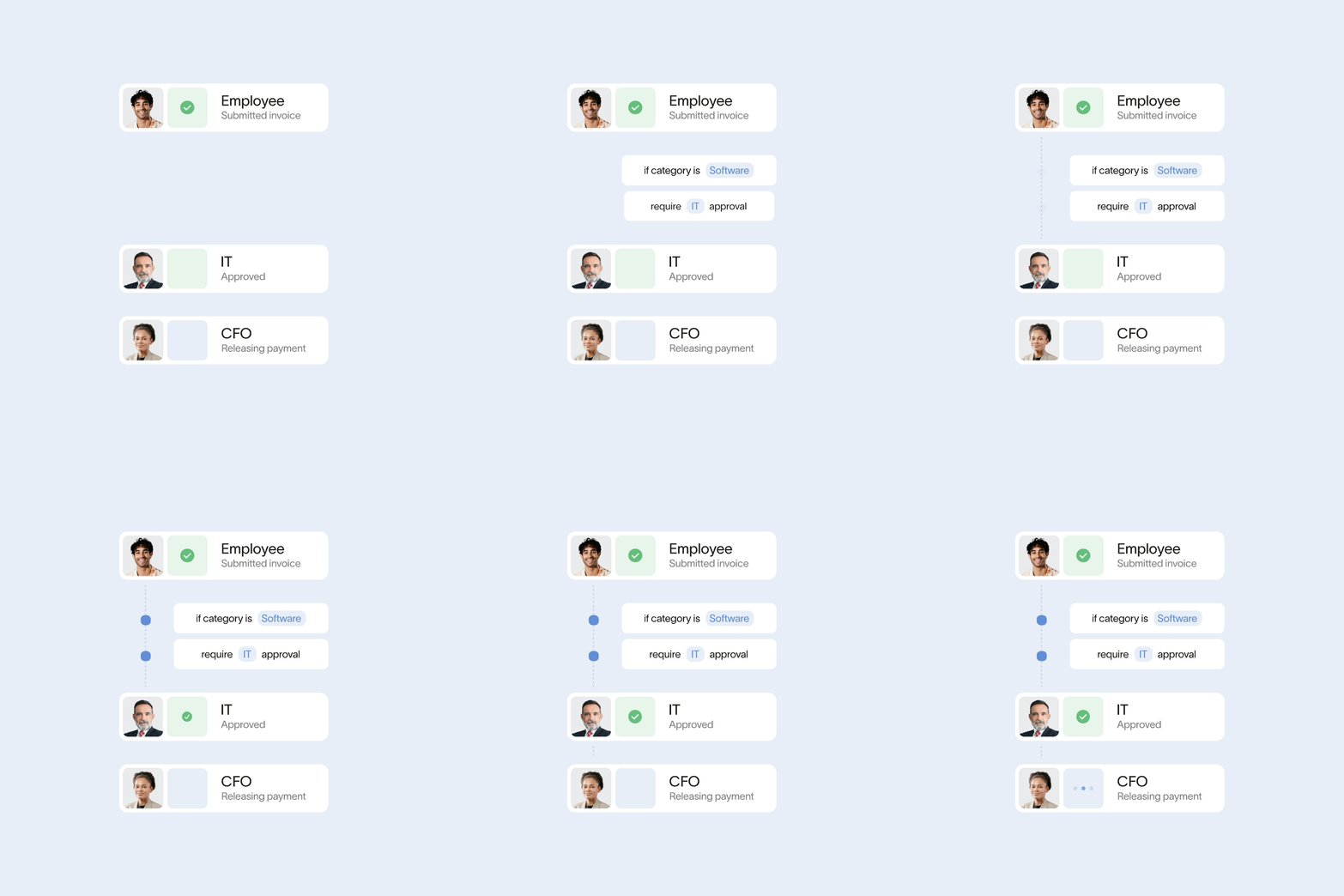
Payment releases became its own control point. “I separate the lock from key in terms of payment releases,” Ryan says, giving Agemark together controls, a stronger risk posture, and a complete audit trail for every invoice.
Next, Ashley restructured how Agemark managed advertising spend. She assigned each Google and Facebook account its own virtual card, with a defined limit, lock date, and GL code.
As charges came in, Ashley could see the percentage of each card’s limit already used. She set an 85% threshold for the point when she needed to check in with her team, giving marketing time to adjust before a campaign outran its planned spend.
The next step was migrating Agemark’s accounting software. By the time Ryan landed on NetSuite, the finance foundation was already in place. The new ERP would inherit a cleaner system for how money moved through the business, with bills and card transactions syncing automatically into it with their coding and accounting context attached.
“Approving a bill and releasing money are two different decisions. I wanted a cleaner separation between the two. The lock and key should not sit in the same place.”
— Ryan Cole, CFO, Agemark Senior Living
19 days of breathing room
Ryan’s rebuild had a simple premise: the system should know enough about Agemark’s business to route work correctly before a person had to chase it.
With that context, the close that once took 25 days now takes six. That 19-day difference gives leadership a dependable view of the previous month in the first week of the next one.
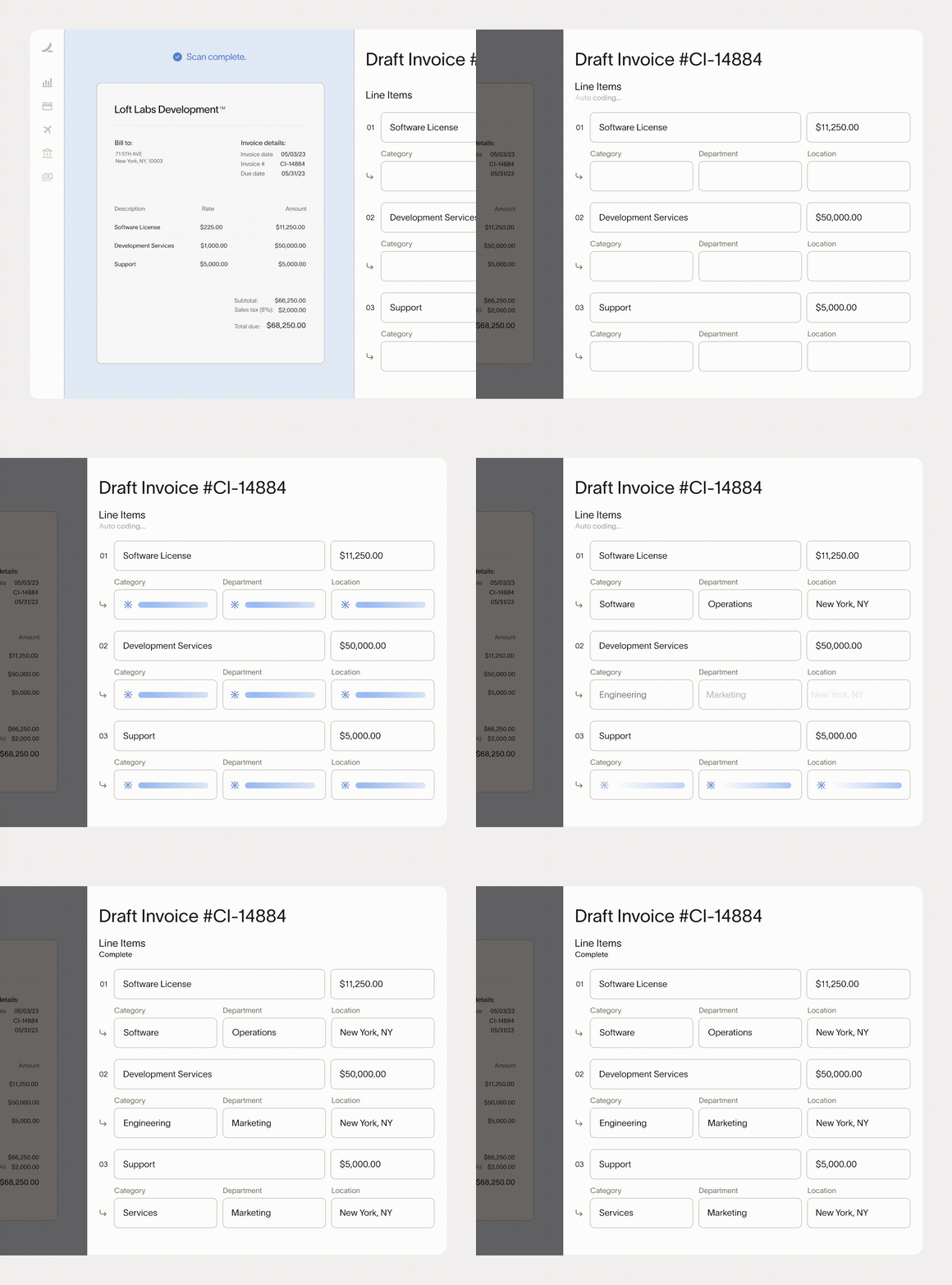
The 145 approval conditions Ryan built to route bills by entity, vendor, payment type, and other key details, now removes 122 hours of routine approval work from Agemark’s monthly queue. Meanwhile, 85% of invoice coding now happens zero-touch, saving finance another 42 hours while sparing them from rekeying every invoice.
For finance, that meant more time for work that used to get pushed aside: maintaining vendor records, reviewing payment patterns, moving more vendors to ACH, and capturing early-payment incentives.
More importantly, it bought the team room to breathe.
“After our first month closing with Ramp, they started telling me they felt like they’d gotten their life back.”
— Ryan Cole, CFO, Agemark Senior Living
For community directors, it meant a finance system that respected the reality of their days. They were already stretched thin between family tours, resident needs, staffing decisions, and the unpredictable work of a running a care environment. They were never supposed to become finance administrators too.

That capacity changed what Agemark could take on next. The company could now add as many as five more communities, an expansion that once would have made the team anxious.
“Now the team’s telling me, ‘Sure, bring on communities. We’re okay. We can handle scale,’” Ryan says. “That’s the kind of growth we wanted: more communities, without asking residents or the teams serving them to accept less care.”


