

Fit for the work: How Daxko turns AI token spend management into better model choices
“More token spend isn’t proof that AI is working. Less isn’t proof that it isn’t. What matters is whether we’re buying the right level of intelligence for the work. Ramp lets us make that judgment in the same place we manage every other type of spend.”
Senior Director of Business Systems, Daxko

One line in Daxko’s software spend was beginning to outrun its explanation. When Cody Nutt reviewed the company’s Claude usage, token costs had grown more than 2.5× in the last two months. That could be evidence of useful adoption. It could also mean Anthropic’s latest, greatest, and most expensive model had become the default for basic tasks like drafting emails and summarizing documents.
Daxko, a leading software provider for health, fitness, and wellness organizations, has rolled out an AI-first strategy, embedding artificial intelligence into the foundation of its own platform architecture, operating model, and partner ecosystem. Helping put that strategy into practice is Cody, Senior Director of Business Systems, who oversees the systems behind Daxko’s software purchasing, payments, and AI adoption.
As its AI footprint passed over 1,000 licenses, Cody needed to preserve the company’s appetite for experimentation while giving finance and leadership a clearer answer to a basic question: was Daxko paying for the level of intelligence the work actually required?
Daxko was already using Ramp to consolidate financial operations into one connected platform. Now, its AI spend was coming into view, too.
AI spend became one more finance silo
The Claude bill was a new kind of blind spot. The underlying problem was familiar: Daxko’s financial operations were spread across too many tools. Cody saw Daxko's systems from above. Rachel Selkirk, on the other hand, lived inside the financial processes those systems support. She was the senior accountant responsible for the spending side of the business, dealing with the consequences of every disconnected handoff: a legacy corporate card program, a separate expense-reporting tool, and invoices keyed and coded manually in the ERP.
Expense reporting was time-consuming for employees, while loose controls on the legacy card program meant people could spend willy nilly. One card alone was carrying nearly $200,000 in monthly spend. AP meant Rachel spent tens of hours each month inside the ERP, and as Daxko began formalizing procurement, it added yet another tool to manage software purchase requests and approvals.
With cards, expenses, invoices, and purchase requests living in separate systems, Daxko had no single source of truth connecting the entire process. To bring them together, the company turned to Ramp.
A rising AI bill did not always mean more value
Eventually, the same challenge had surfaced in AI. Usage had scaled across Daxko, but the visibility needed to manage it had not. Anthropic's admin console could show Cody what the company owed; it couldn't readily explain what was driving the bill.
When leadership needed a clear view of AI spend, Cody had no export to pull. “I was going page by page in the console, stitching together screenshots just to build a useable report,” he said. Breaking the total down by department was even harder: a $142 line here or a $1,700 line there was not enough to answer an executive’s questions.
Pulling the data through the API was no faster. To build an executive-level view, Cody would have had to make hundreds of individual calls, one user at a time, then query again for more detail. A full day could disappear before he had an answer.
But a cleaner report would solve only part of the problem. Most business spending carries a purpose finance can understand: Figma licenses support design, travel can be tied to a sales kickoff, and advertising spend maps to a channel or campaign. Token spend arrived without the same context. A rising bill could reflect broader adoption, a valuable new use case, or routine work running through a more expensive model than it required.
To manage AI spend, Daxko needed to connect usage to the people, teams, models, and business activity behind it. They needed to understand why costs were moving before deciding what, if anything, to change.
“We didn’t want leaders judging AI adoption from a dollar amount alone. A team can be using AI extensively and effectively while spending less simply because it’s choosing the right model.”
— Cody Nutt, Senior Director of Business Systems
First, Daxko gave company spend a backbone
Daxko started with Ramp cards, each issued for specific purchases with clear limits already attached. Once a software request cleared Daxko’s approval process, Rachel could create the corresponding virtual card instead of giving an employee open-ended spending power. Even on busy days, she could issue as many as 30 cards in just a few effortless clicks.
Controls no longer arrived after the statement. They traveled with the spending from the moment the card was created.
AP stopped consuming a week of Rachel’s month
Once the card program gained momentum, Daxko brought its bills into Ramp. When the company moved its accounting to NetSuite, Ramp’s integration carried completed AP work into the ERP instead of leaving Rachel to key and code every invoice manually.
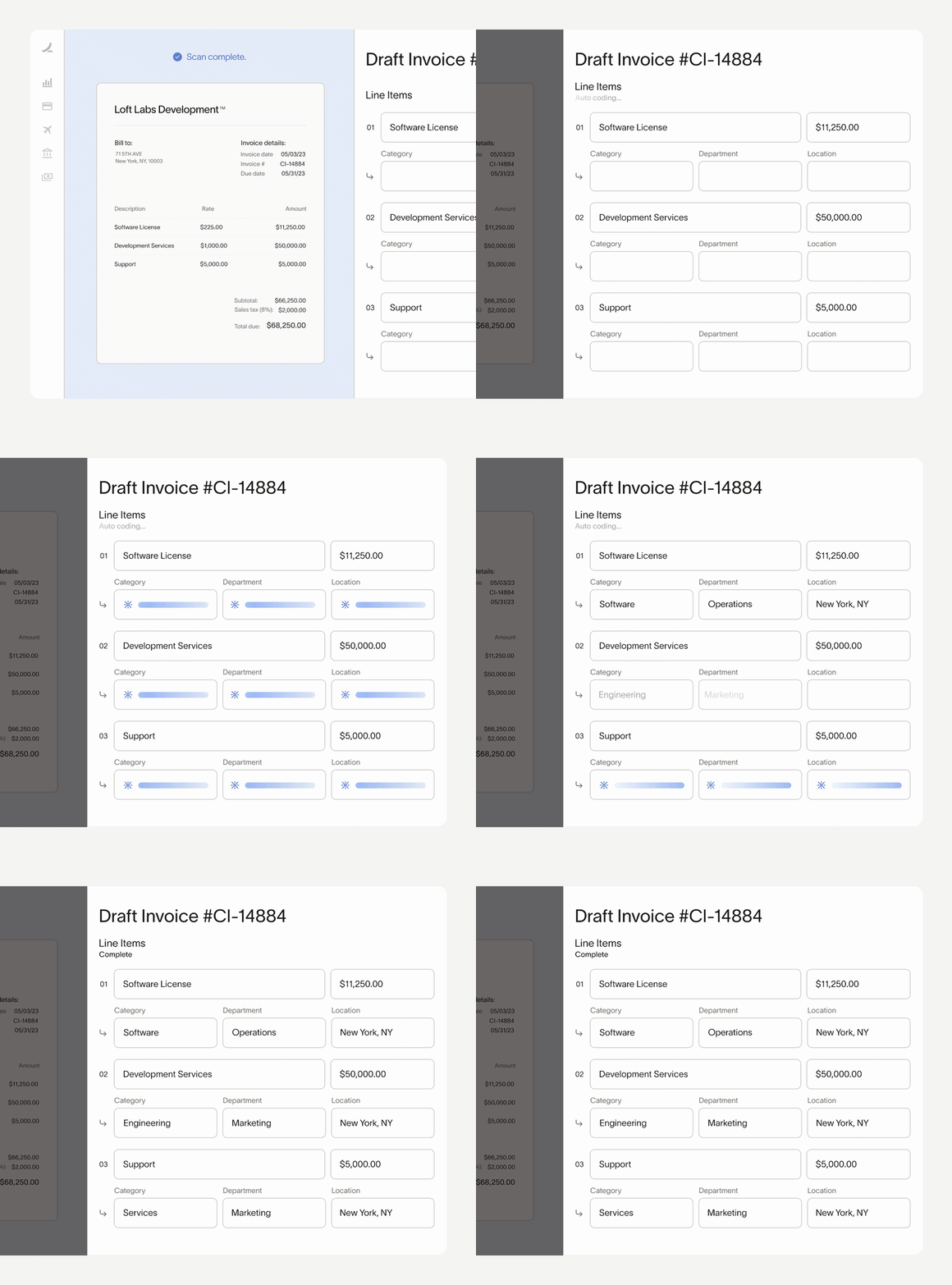
AP went from something Rachel spent 5 full days per month managing to something she could check roughly twice a week for an hour at a time. Outside of cash management, she now barely touches NetSuite for spending.
Control moved upstream, before the money moved
Procurement started with a narrow use case: tracking approvals for invoices from Daxko’s India entity without posting them to the main general ledger. As more spending moved onto Ramp, that workaround grew into a formal purchasing process.
Daxko has since created 11 purchase-order programs and processed 668 procurement requests, with 591 purchase orders approved. Three-way matching connects each purchase order, receipt, and bill before the transaction reaches NetSuite.
AI was already doing work inside finance
Daxko was not only managing what it spent on external AI tools. Inside Ramp, AI was already removing repetitive work from finance.
Ramp’s AP Agent reads invoices, prepares bill drafts, routes them for approval, and sends completed work to NetSuite, while the Accounting Agent handles routine coding and surfaces exceptions for review.

Daxko has also activated Policy and Procurement Agents, extending AI into the controls and purchasing workflows that shape spend before money moves.
Daxko used TSM to turn the AI bill into a model decision
The Claude usage Cody had been piecing together through screenshots could now sit alongside the financial workflows his team already managed on Ramp with Token Spend Management (TSM).
Instead of reconstructing the story from Anthropic’s admin console, Daxko could see usage by model, user, API key, team, and time period, while briefings surfaced trends, savings opportunities, and unusual activity.
AI spend was no longer an exception. It became another category Daxko could see and manage alongside cards, AP, and procurement.
“We got scared when Fable 5 pricing came out — our users naturally gravitate toward the more expensive models. Seeing AI spend by model in Ramp means we can let that experimentation happen while understanding what it costs.”
— Cody Nutt, Senior Director of Business Systems
The default model changed. Access did not.
In one weekly AI spend briefing, Cody found that over 20% of Daxko’s Claude spend was going to Opus for work better suited to Sonnet. “I went and took that action based off of what I found in the briefing,” he says. Once he changed the default, the excess spend stopped accumulating.

Cody's win was seeing across the system. Rachel's was no longer having to carry it by hand. Smart OCR turns invoices into prepared drafts, Ramp sends them to the right approvers, and approved bills sync directly to NetSuite. More than 40 hours of monthly AP work now takes just a few clicks.
Accounting rules handle routine card coding without a touch, while AI suggestions help with the exceptions, returning nearly 20 more hours each month.
Control also begins earlier than ever. Instead of giving employees open-ended purchasing power and auditing it later, Daxko routes each request through approval before it becomes a purchase order tied to a single virtual card. In six months, that gate declined nearly $25,000 in procurement requests before the money moved, while proactive card controls and cashback save Daxko roughly $8,000 more each month.
Daxko’s next step is to take AI spend visibility from the company level to the employee level. Companywide reporting can show Daxko where AI spend is going. It cannot, on its own, explain what that spend unlocked for the person using it.
The company plans to survey employees about their AI use, asking a simple question: did the value of the output exceed the cost? By pairing individual usage with employee feedback, Daxko hopes to turn a spend insights into a more useful conversation about the work AI makes possible.
With cards, AP, and procurement already running through Ramp, AI no longer felt like a separate problem to solve. “We’re true Ramp power users — we’ve moved anything and everything we can into Ramp,” Cody says. “Now, AI spend is one more thing we can see, manage, and act on in the same place.”


