What is the American Express Platinum Card credit limit?

- What is the American Express Business Platinum credit limit?
- How no preset spending limit works on the Amex platinum
- How much you can actually spend and typical starting limits
- How charge cards differ from credit cards
- Factors that determine your Amex platinum spending power
- How to check your Amex Business Platinum spending limit
- How to increase your Amex platinum card limit
- Amex Business Platinum annual fee and card benefits
- Who should get the Amex Business Platinum card
- Amex Business Platinum requirements and approval criteria
- Amex Business Platinum vs. other business cards
- Why businesses choose Ramp for transparent credit limits
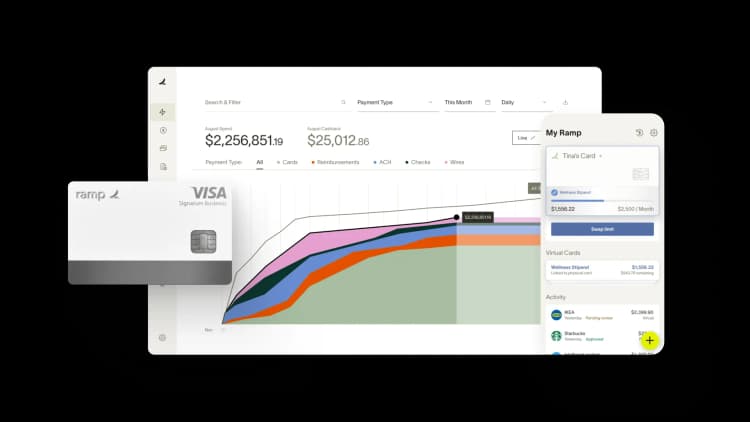
The American Express Business Platinum Card has no preset spending limit. Instead of a fixed dollar cap, your purchasing power adjusts dynamically based on your business's financial profile, payment history, and spending patterns.
Note: The cashback percentages, limits, fees, and other figures mentioned in this article are for illustrative purposes only. They do not represent guaranteed or expected rates. Actual terms, credit limits, rewards, and approval criteria vary by card issuer and may change at any time. Readers should verify current details directly with each issuer before applying.
What is the American Express Business Platinum credit limit?
The Business Platinum Card from American Express doesn't have a traditional credit limit. It operates as a charge card with no preset spending limit (NPSL), which means American Express evaluates your purchasing power dynamically based on your business's financial profile, payment history, credit record, and spending patterns. Your available spending power can grow over time as you build a stronger relationship with American Express.
However, "no preset spending limit" doesn't mean unlimited spending. American Express regularly reviews your account activity and may approve or decline charges depending on your current financial standing. For larger purchases, you can use the Check Spending Power feature in your American Express account to confirm whether a transaction amount is likely to be approved before completing it.
Does the Amex Business Platinum have a credit limit?
The Amex Business Platinum Card doesn't come with a fixed credit limit the way a traditional credit card does. Instead, it uses a no preset spending limit (NPSL) model. You won't see a specific dollar amount listed as your credit limit in your account details.
That said, NPSL doesn't mean you can charge anything you want. American Express evaluates each purchase based on factors like your spending patterns, payment history, and financial resources to determine your real-time buying power. A transaction that falls well within your typical spending range will likely sail through, while an unusually large purchase could get declined if it exceeds what Amex considers your current capacity.
This flexible structure is one of the key reasons the Business Platinum appeals to high-spending businesses. Your purchasing power can scale with your business rather than being locked to a number set at approval.
How no preset spending limit works on the Amex platinum
No preset spending limit means your spending capacity is flexible and adjusts based on real-time factors rather than a fixed number. For each transaction, American Express reviews your account activity, payment behavior, and overall creditworthiness. This dynamic approach means large purchases may still be declined if they significantly exceed your current buying power as determined by Amex.
How it works in practice:
- Real-time evaluation: Amex assesses each purchase individually at the point of sale, weighing your current account standing against the transaction amount
- Dynamic spending power: Your effective limit can increase or decrease from month to month based on your usage and payment history
- No hard cap disclosed: You won't find a specific dollar amount for your credit limit anywhere in your account details
This model gives you more flexibility than a fixed-limit credit card, but it also means you need to maintain strong financial habits to keep your spending power high.
How much you can actually spend and typical starting limits
There is no published or guaranteed starting spending limit on the Amex Business Platinum. American Express sets and adjusts your spending power dynamically, so two businesses approved on the same day can have very different purchasing capacity.
The biggest misconception around an "American Express Platinum starting limit" is the "250k" or "300k" figure you'll see in searches. That number refers to the welcome offer: up to 300,000 Membership Rewards points after $20,000 in purchases in the first 3 months. It's a points bonus, not a dollar spending limit.
What actually shapes your early spending power:
- Welcome offer points ≠ spending limit: The 300,000-point offer is earned by spending $20,000, not a guarantee you can spend that much
- No disclosed starting number: Amex doesn't publish a minimum or maximum opening limit
- Power grows with history: New cardholders often start conservatively; your purchasing capacity rises as you demonstrate on-time payments and consistent usage
Your reported business revenue, personal credit score, and any existing relationship with American Express all influence what Amex will approve on day one.
How charge cards differ from credit cards
The primary difference between a charge card and a credit card comes down to how you handle the balance. Charge cards like the Amex Platinum require you to pay your balance in full each billing cycle. Credit cards let you carry a balance from one month to the next, making at least a minimum payment while incurring interest on the remaining amount.
This distinction is why the Amex Platinum doesn't have a traditional credit limit. Because you're required to pay in full, American Express can let your spending flex with your financial capacity rather than locking you into a fixed number.
| Feature | Charge card (Amex Platinum) | Credit card |
|---|---|---|
| Spending limit | No preset limit (adjusts to your financial profile) | Fixed credit limit |
| Balance requirement | Pay in full monthly | Minimum payment allowed |
| Interest charges | Late fees, no revolving APR | APR on carried balances |
| Credit utilization impact | Doesn't report utilization | Directly affects credit score |
The Pay Over Time feature on the Business Platinum does add some flexibility by allowing you to revolve certain charges at a variable APR of 17.74% to 28.49%. But you'll typically get the most value by paying in full each month to avoid interest.
Factors that determine your Amex platinum spending power
American Express considers several key factors when approving transactions and determining your overall spending power. Understanding these factors helps you take control of your purchasing capacity.
Payment history and account standing
Paying your balance in full and on time is the single most important factor in building trust with American Express. A history of prompt payments can increase your buying power significantly, while late or missed payments will likely reduce it. Amex weighs this factor more heavily than almost anything else.
Business revenue and cash flow
The financial health of your business plays a major role in your spending power. American Express considers your reported business revenue and cash flow, with higher and more consistent figures typically leading to greater spending capacity. If your revenue grows, your purchasing power often follows. Staying on top of your profit and loss management gives you a clearer picture of the financial metrics Amex is likely to evaluate.
Personal and business credit scores
Your personal and business credit profiles are key indicators of risk that affect both your initial approval and ongoing spending limits. The Business Platinum Card reports activity to commercial credit bureaus such as Dun & Bradstreet, Experian Business, and Equifax Business. Regular on-time payments help you build business credit separate from your personal credit profile, which can make it easier to negotiate favorable vendor terms and qualify for higher limits on other accounts.
American Express checks your personal credit when you apply, resulting in a hard pull on your personal report. Missed payments or defaults can appear on your personal credit, but your ongoing monthly spending generally doesn't, so high business use won't raise your personal utilization ratio.
Spending patterns and card usage
Consistent, regular spending that you pay off each month helps build your spending power over time. Amex looks at your typical transaction sizes and frequency to establish a baseline. Sudden, unusually large purchases without a prior history of similar spending may trigger a decline, even if your account is otherwise in good standing.
Length of relationship with American Express
A longer account history with American Express generally leads to higher spending power as you build a track record of responsible use. New cardholders often start with more conservative buying power that grows over time with consistent on-time payments.
How to check your Amex Business Platinum spending limit
You can check your current buying power using the Check Spending Power tool in your American Express online account or mobile app. This feature lets you enter a specific purchase amount to see if it would likely be approved, without impacting your credit score.
To use it:
- Log in to your American Express account online or open the Amex mobile app
- Navigate to the Check Spending Power tool under your account details
- Enter the dollar amount of the purchase you're considering
- Review the result to see whether the transaction is likely to be approved
For very large purchases that fall outside your normal spending pattern, you can also call the number on the back of your card to pre-approve the transaction. This is especially useful for one-time expenses like equipment purchases or large vendor payments where a decline could disrupt your operations.
How to increase your Amex platinum card limit
You can take several actionable steps to increase your spending power on the Amex Platinum card. Since your purchasing capacity is dynamic, the actions you take directly influence how much Amex is willing to approve.
1. Pay your balance in full before the due date
Consistently making on-time, full payments is the most effective way to build trust with Amex and demonstrate your creditworthiness. This single habit has the biggest impact on your spending power over time. Even paying a few days early can signal strong financial management.
2. Request a spending limit review
You can proactively ask American Express to review your spending power. Call customer service or check your online portal for options to request a review. If your business revenue has grown or your financial profile has improved since you opened the account, a review can result in a meaningful increase.
3. Pre-authorize large purchases in advance
If you plan to make a large purchase that's outside your normal spending pattern, contact Amex beforehand. Pre-authorizing the expense helps avoid a decline and shows responsible financial planning. This is especially important for major capital expenditures or seasonal inventory purchases.
4. Add to your Amex account history
Strengthening your overall relationship with American Express can also help increase your spending power. You can do this by opening other Amex products, maintaining your existing accounts in good standing over a longer period, or gradually increasing your spending volume as your business grows.
Amex Business Platinum annual fee and card benefits
The Amex Business Platinum card's $895 annual fee is one of the highest in the business card market. Whether it's worthwhile depends entirely on your ability to maximize the card's statement credits and perks.
Annual fee breakdown
The primary card costs $895 per year. Additional Platinum Employee Cards with full benefits cost $400 each per year, while standard Expense Cards for team members have no additional fee. That premium pricing only makes sense for businesses that can fully leverage the card's benefits. If you're not using the travel credits and perks, you're overpaying.
The card itself is made of metal, underscoring its premium positioning.
Travel credits and statement credits
Several statement credits can quickly offset the annual fee if you use them strategically:
| Credit/benefit | Annual value | Notes |
|---|---|---|
| Dell Technologies credit | Up to $1,150 | $150 base credit, plus $1,000 after $5,000 in annual Dell purchases; enrollment required |
| Hotel credit | $600 | Up to $300 twice per year via Fine Hotels + Resorts or The Hotel Collection |
| Indeed credit | $360 | Up to $90 per quarter for recruiting and hiring |
| ChatGPT Business credit | $300 | For ChatGPT Team or Enterprise subscriptions |
| Adobe credit | $250 | After $600 in U.S. Adobe purchases per calendar year |
| Airline fee credit | $200 | Covers incidental fees like checked bags and seat upgrades |
| CLEAR Plus credit | Up to $219 | Covers a CLEAR Plus membership |
| Hilton credit | Up to $200 | Up to $50 per quarter on eligible Hilton purchases |
| Wireless credit | Up to $120 | Monthly credit for wireless service providers |
| Total of credits shown | ~$3,400 | A selection of the card's annual credits, not the full list |
Credit amounts confirmed on the American Express benefits page; terms and enrollment requirements apply.
These are just the headline credits. If you use the $600 hotel credit, $200 airline credit, the Dell credit, and even half of the others, you're well past the $895 fee, and Amex promotes more than $4,000 in total annual value across all benefits.
High-spending cardholders who exceed $250,000 annually can unlock an additional $3,600 in credits for the following year: $1,200 for flights booked through Amex Travel and $2,400 for One AP, American Express's accounts payable platform.
The card also includes access to the American Express Global Lounge Collection, covering more than 1,550 airport lounges across 140 countries. This includes Centurion Lounges, Priority Pass Select membership, and up to ten complimentary Delta Sky Club visits per year when flying Delta.
Membership Rewards earning structure
The card's earning structure targets business travel and large purchases:
- 5x points per dollar on flights and prepaid hotels booked through American Express Travel
- 2x points per dollar on eligible purchases of $5,000 or more (up to $2 million annually)
- 2x points per dollar at select business merchants, including construction materials and hardware suppliers, electronic goods retailers, software and cloud providers, and shipping companies
- 1x point per dollar on all other eligible purchases
Points never expire as long as your account remains open. Travel redemptions typically deliver the most value: transferring to airline partners can yield roughly 2¢ per point, while statement credits provide around 0.6¢ per point.
Employee card spending limits
Although the primary card has no preset spending limit, you can set individual, fixed spending limits for each employee card. You can issue up to 99 Expense Cards for employees at no additional cost, with custom spending limits by day, transaction, or merchant category. This gives you control over team business expenses while still benefiting from the card's overall flexibility.
Employee cards are how budget-conscious finance teams impose predictable limits on top of an NPSL account. If your concern is controlling spend across a growing team, setting per-card limits lets you keep tighter control without sacrificing the flexibility the primary card offers.
Transactions sync automatically with your accounting software, which cuts down the manual data entry and reconciliation your finance team handles each month.
Who should get the Amex Business Platinum card
The American Express Business Platinum Card delivers exceptional value, but only for the right kind of business. The $895 annual fee means you need to use the benefits actively to come out ahead.
For many businesses, the tipping point comes around $30,000 in annual spend, especially if a large portion goes toward travel or business services. At that level, the combination of lounge access, credits, and point multipliers can easily outweigh the fee.
For example, a consulting firm with three partners who travel regularly for client meetings could spend $15,000 on flights, $8,000 on hotels, $5,000 on client meals, and $10,000 on advertising each year. With the card's earning rates and benefits, that firm could see more than $2,000 in annual value.
| Annual spend level | Estimated rewards and credits | Covers $895 fee? |
|---|---|---|
| $20,000 (low) | ~$400 | ❌ No |
| $40,000 (moderate) | ~$950–$1,100 | ✅ Barely |
| $80,000+ (high) | ~$1,800–$2,500 | ✅ Yes |
Best for high-spending business travelers
This card is ideal for businesses whose owners or employees travel frequently. Companies sending employees on regular trips benefit from airport lounge access, airline fee credits, and hotel perks. Professional services firms with high travel and client entertainment expenses often find the strongest fit.
Best for businesses maximizing premium rewards
It's a strong fit if you want to earn flexible Membership Rewards points on large purchases and take advantage of premium statement credits. Companies with large ad or software budgets can rack up points fast while using the Dell, Adobe, and Indeed credits.
Not ideal for budget-conscious or low-volume spenders
Some business scenarios make this card a poor financial choice, regardless of the attractive benefits:
- Businesses spending under $25,000 annually: Low spend makes it difficult to recover the annual fee value
- Companies with minimal travel needs: The card's premium perks lose impact if you rarely fly or stay in hotels
- Startups or cash-strapped firms: Businesses managing tight cash flow should prioritize flexibility over premium benefits
- Companies preferring fixed credit limits: The no preset spending limit structure can be unpredictable for organizations needing precise budgeting
- Businesses carrying monthly balances: Paying interest wipes out much of the value the card provides
For these situations, a business cashback card or a travel card with a lower annual fee delivers better value.
Amex Business Platinum requirements and approval criteria
Is the Amex Business Platinum hard to get? For most established businesses with good credit, no. Applying takes about 10–15 minutes and can be completed entirely online. Most applicants receive an instant decision, though some cases may go to manual review for up to 10 business days.
Credit score requirements
What credit score do you need for the Amex Business Platinum? American Express doesn't publish exact cutoffs, but a strong credit history with consistent on-time payments is essential. A score of 690+ is generally recommended, and 740+ typically receives instant approval if other factors are strong. You'll also need no recent bankruptcies or serious negative marks on your credit report.
Business revenue and operating history
You'll need to provide information about your business, including its legal name, entity type, employer identification number (EIN), revenue, and time in operation. Many successful applicants report $50,000+ in annual revenue, though high personal income can offset lower business revenue. Newer businesses or those with lower revenue may face more scrutiny during the application process. Keeping thorough financial records, including knowing how long to keep business tax records, can help you present a clean, credible financial picture during the application process.
Personal guarantee considerations
Most applicants need to provide a personal guarantee. This means you're personally liable for the debt on the card if your business can't pay, putting your personal credit and assets on the hook. This is an important consideration for newer businesses or sole proprietors, since a default could affect your personal finances beyond the business itself.
Application tips
- Be accurate: Report revenue and business details honestly; inconsistencies can cause denial or later account closure
- Time your application: Space out Amex applications by at least 90 days to avoid multiple recent inquiries
- Leverage existing relationships: Current Amex customers with strong payment history often receive preferential review
Common reasons for denial
Applications are most often declined due to:
- Low credit score (below 690)
- Too many recent inquiries
- High utilization across existing cards
- Short or limited credit history
- Unverified or inconsistent business information
If you're denied, you can call the Amex reconsideration line at 1-800-567-1083 within 30 days. Be ready to discuss your business operations, explain any negative marks on your credit report, or provide updated documentation.
Amex Business Platinum vs. other business cards
The American Express Business Platinum Card sits at the top of the premium business card market, but it's far from your only option. The right choice depends on your specific spending patterns, travel habits, and how much predictability you need from your credit limit structure.
Amex Business Platinum vs. personal platinum spending limit
Both the Business and personal Platinum cards are NPSL charge cards with the same $895 annual fee, so neither has a fixed dollar limit. The difference is in how spending power and controls are structured for a business vs. an individual.
The Business Platinum adds roughly $2,180+ in business-focused credits (Dell, Indeed, Adobe, wireless, and ChatGPT Business), supports up to 99 employee cards at $400 each with individual spending controls, and includes a 35% award-flight points rebate on flights with your one selected qualifying airline booked through Amex Travel, which the personal Platinum doesn't offer. The personal Platinum focuses instead on lifestyle credits geared toward dining, entertainment, and personal travel.
| Feature | Business Platinum | Personal Platinum |
|---|---|---|
| Annual fee | $895 | $895 |
| Spending limit | No preset limit (NPSL) | No preset limit (NPSL) |
| Credits focus | Business (Dell, Indeed, Adobe, wireless, ChatGPT) | Lifestyle (dining, entertainment, Uber) |
| Employee/additional cards | Up to 99 at $400 each | Additional Platinum cards $195 each |
| Award-flight rebate | 35% points back (up to 1M points/year) | Not offered |
If you're managing team spend and large business purchases, the Business Platinum is the better fit. If you're blending personal and business travel without a team, the personal Platinum may be simpler.
Amex Business Platinum vs. Ramp business card
The Amex Platinum's no preset spending limit can be unpredictable. You won't know your exact purchasing power until you check or attempt a transaction. Ramp takes a different approach by offering transparent credit limits based directly on your business's real-time cash balance, so you always know where you stand.
That transparency often means higher limits, too. Ramp can offer up to 20x higher credit limits than traditional business credit cards because underwriting is tied to your actual cash position, not just credit history.
Ramp also doesn't require a personal guarantee, which means your personal credit and assets aren't on the line. And while Amex's expense management tools are often separate from the card itself, Ramp combines its corporate card with built-in expense management software, automated receipt matching, and real-time spend visibility, all in one platform.
The biggest difference is when policy enforcement happens. Amex relies on after-the-fact expense reviews. Ramp enforces policy before spend happens, blocking 3.5% of transactions that would otherwise violate policy at swipe. That means fewer surprises for your finance team.
| Feature | Ramp Business Card | Amex Business Platinum |
|---|---|---|
| Annual fee | $0 | $895 |
| Credit limit structure | Transparent, based on cash balance | No preset limit (charge card model) |
| Personal guarantee | Not required | Required |
| Personal credit check | Not required | Required (hard pull) |
| Spend management tools | Built-in, pre-spend enforcement | Limited/separate |
| Rewards | Ramp offers cashback rewards on purchases | Tiered points (up to 5x) |
Amex Business Platinum vs. Chase Ink business preferred
The Chase Ink Business Preferred is a traditional credit card with a fixed credit limit, making it more predictable for budgeting. Its $95 annual fee is a fraction of the Platinum's $895, and its rewards structure focuses on common business categories like advertising, shipping, and travel, earning 3x on the first $150,000 in select categories.
The trade-off is that Chase offers no lounge access, no travel credits, and no statement credits. If you're a heavy traveler who values premium perks, the Platinum wins. If you want straightforward rewards at a lower cost, Chase is worth considering.
Amex Business Platinum vs. Amex business gold
Both the Platinum and Gold cards are charge cards with no preset spending limit. The Business Gold has a lower $375 annual fee and earns 4x points on your top two spending categories (up to $150,000 annually), making it a strong choice for businesses with heavy category spending like advertising, software, or gas.
The Gold card lacks the Platinum's premium travel perks: no lounge access, no hotel or airline credits, and no travel insurance. If travel benefits drive most of your value, the Platinum is the better pick. If you're optimizing for category-based rewards at a lower cost, the Gold card delivers.
Why businesses choose Ramp for transparent credit limits
If you're looking for a high-limit business credit card, the Ramp Business Credit Card is a compelling alternative.
While the American Express Business Platinum offers exceptional travel benefits, Ramp provides a simpler, more cost-effective solution for businesses focused on spend control and financial efficiency. See the comparison below:
| Feature | Ramp Business Credit Card | American Express Business Platinum |
|---|---|---|
| Annual fee | $0 | $895 |
| Rewards | Cashback | Tiered points (up to 5x) |
| Credit limit structure | No preset limit (adapts to business finances) | No preset limit (charge card model) |
| Spend management tools | Built-in | Limited |
With Ramp, you can expect:
- Spending controls: Set proactive limits, category restrictions, and vendor-level receipt requirements to prevent unauthorized spending
- Real-time visibility: Get instant insight into company spending with customizable daily limits and card programs
- Accounting integrations: Connect with systems like NetSuite, QuickBooks, Xero, and Sage Intacct for faster close and reconciliation
- No annual fee: Enjoy zero annual or hidden fees, plus straightforward cashback rewards without complex categories
Try an interactive demo to see how Ramp gives you control over company spending.
The information provided in this article has not been officially confirmed by American Express and is subject to change.

FAQs
There's no published maximum spending amount. Your spending power is dynamic and depends on your account history, payment behavior, and financial profile. It can change over time as your relationship with American Express evolves.
Yes. American Express can decline a purchase if it exceeds your current buying power, even though there's no fixed, preset limit on the account. This is why it's worth using the Check Spending Power tool before making large purchases.
American Express typically reports account activity to business credit bureaus. However, it may report to personal credit bureaus if you default on your payments or the account becomes seriously delinquent. Your regular monthly spending generally doesn't affect your personal credit utilization.
Yes. As the primary account holder, you can set individual spending limits for each employee card through your American Express account settings. You can customize limits by day, transaction amount, or merchant category.
Building higher spending power typically takes several months of consistent, on-time payments and regular card usage. New cardholders often start with more conservative buying power that grows as they establish a positive track record with American Express.


“I assumed I would have to choose between speed and control. What I found is that you can have both. A well-designed system takes friction out, for the finance function and for everyone else.”
Justin Webster
CFO, Denver Broncos

“A well-run district should not have to choose between getting work done at the school site and keeping control of the dollars behind it. We're not hiring more people to do more jobs, so we have to be smarter about the process. With Ramp, the purchase, the receipt, and the record stay together from the start. ”
Nick Brizeno
Director of Purchasing, San Marcos Unified School District

“In senior living, scale only works if the communities still feel personal. We needed the back office to carry more of the complexity, not the people serving residents. Ramp helped us build that infrastructure, so the experience in the community could stay human.”
Ryan Cole
CFO, Agemark Senior Living

“AI is moving faster than the finance context around it. Prices change, models change, and the value is not always obvious from an invoice. We needed enough detail to know which bets deserved more investment — and which ones did not.”
Greg Cooley
Controller, AngelList

“Invoices, cards, tokens. The categories change but the principle doesn't: know where the money is going, remove the work around it, and make sure the spend is worth it.”
Maciej Mylik. Finance
ElevenLabs

“We weren’t trying to retrofit an old finance system. We had a blank canvas, and Ramp gave us the foundation to build a global finance function of the future.”
Justin Dourado
Director of Finance, Othership

“There's just no surprises anymore. No more waiting two months to find out how a job did. We know how it's doing as it's happening.”
Erich Kuss
Financial Systems Manager, Infinity Home Services

“More token spend isn’t proof that AI is working. Less isn’t proof that it isn’t. What matters is whether we’re buying the right level of intelligence for the work. Ramp lets us make that judgment in the same place we manage every other type of spend.”
Cody Nutt
Senior Director of Business Systems, Daxko
