Best corporate card expense management software in 2026

- What is corporate credit card expense management software?
- At a glance: Comparing the best corporate card platforms
- The 8 best corporate card expense management platforms
- Bring-your-own-cards vs. proprietary cards
- Why use corporate card expense management software
- Essential features to look for
- How to choose the right solution for your business
- Best practices for managing corporate card expenses
- Start simplifying expense management with Ramp

Managing corporate credit cards feels like a juggling act for any finance leader. You're constantly chasing down receipts, trying to enforce spending policies, and reconciling statements, all while battling data entry errors.
These challenges waste your time and lead to overspending, compliance issues, and financial discrepancies that can be difficult to track and correct. But that's where corporate credit card management software can help.
The best tools will automate expense tracking, enforce travel and expense (T&E) policies, and provide real-time insights into employee expenses. By adopting the right software, you can replace manual processes with efficient, accurate management, giving you greater control over your organization's finances.
Note: The cashback percentages, limits, fees, and other figures mentioned in this article are for illustrative purposes only. They do not represent guaranteed or expected rates. Actual terms, credit limits, rewards, and approval criteria vary by card issuer and may change at any time. Readers should verify current details directly with each issuer before applying.
What is corporate credit card expense management software?
Corporate card expense management software automates tracking, categorizing, and reconciling business card transactions in real time, so finance teams stop chasing receipts and reconciling statements by hand. Credit card expense management software helps businesses track and manage spending on company credit cards. These tools simplify the process of recording, categorizing, and approving corporate credit card expenses.
Corporate credit card expense management software makes it easier for you to stay on top of your finances and ensure your employees are spending responsibly. By automating key pieces of the expense management process, including expense policy enforcement, expense reporting, and employee expense reimbursements, these tools help you take control of corporate credit card spending and reduce the hassle of managing expenses.
Ready to take control of your finances?
Learn about Ramp’s pricing plans and start saving today.
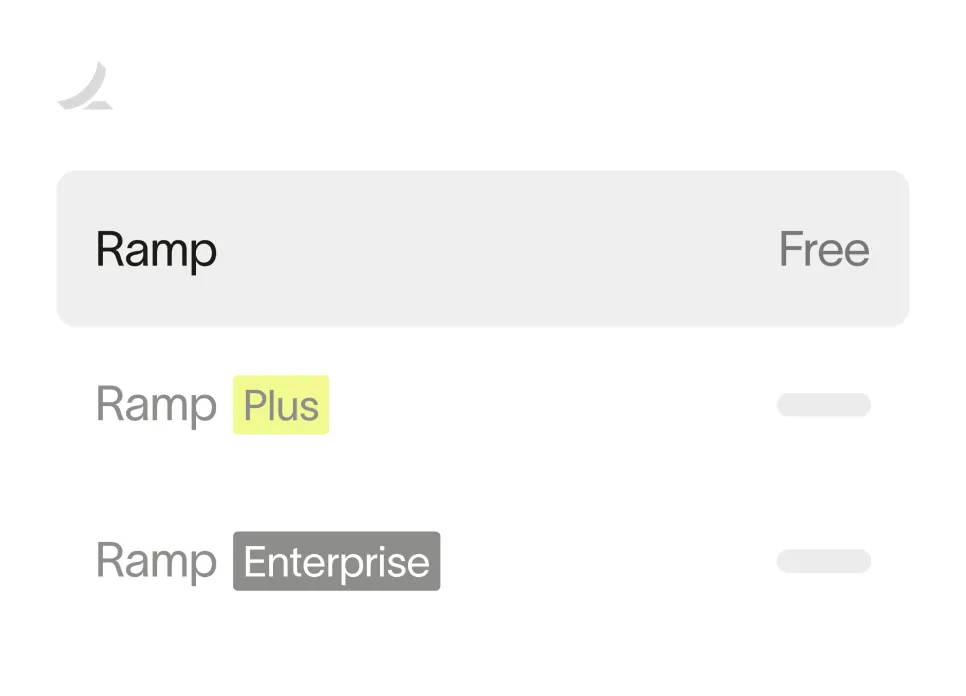
At a glance: Comparing the best corporate card platforms
Software comparison

- Customizable spend controls: Ramp’s corporate cards let you set specific spend limits and rules for each card. Meet your budgets without the hassle of micromanaging.
- Automated expense reporting: Say goodbye to manual data entry. Ramp captures and categorizes expenses automatically, saving time and reducing errors.
- Real-time spend tracking: Monitor company spending as it happens. Gain instant insights to make more informed financial decisions.
- Seamless integrations: Connect Ramp with the tools that are already in your tech stack, like QuickBooks, Slack, and Excel.
- Easy receipt capture: Snap a photo of your receipt, and Ramp’s OCR technology does the rest. No more missing paperwork or tedious expense matching.
Starting at
$0/mo.
Additional pricing tiers
$15 per user/mo. for Ramp Plus. Enterprise pricing available.
Promotion
Unlimited free tier
Availability
Web, iOS, Android
 Navan (formerly TripActions)
- Integrated travel and expense management: Navan combines travel booking and expense tracking in one platform.
- AI-powered booking: Get personalized travel recommendations with Navan's AI-driven search that finds the best options based on your preferences and company policies.
- Real-time expense tracking: Monitor spending as it happens with real-time updates to help you manage budgets and ensure compliance.
- Easy-to-use mobile app: Book flights, submit receipts, and approve expenses on the go.
Starting at
$0/mo.
Additional pricing tiers
$15 per user/mo. for more than 15 users
Promotion
Free tier with seat limits
Availability
Web, iOS, Android
 SAP Concur
- Corporate card integration: Integrate corporate credit cards and automatically capture and reconcile transactions.
- Comprehensive expense management: Track, approve, manage, and report on all types of expenses.
- Mobile access: Manage expenses, capture receipts, and book travel on the go.
- Automated workflow approvals: SAP Concur routes expense reports and travel requests to the right approvers, speeding up reimbursement.
Starting at
N/A
Additional pricing tiers
All pricing is quote-based
Promotion
15-day trial
Availability
Web, iOS, iPadOS, Android
 Expensify
- Global currency support: Expensify supports multiple currencies and automatically converts transactions.
- Flexible approval workflows: Multi-level approvals ensure expenses are reviewed and approved by the right people.
- Mobile accessibility: Capture receipts, submit reports, and approve expenses from your smartphone.
- Automated expense reports: Create and submit expense reports with just a few clicks.
- Corporate card integration: Sync with your corporate credit cards or Expensify cards to automatically reconcile transactions with receipts.
Starting at
$0 for individuals
Additional pricing tiers
$5 per user/mo. for Collect, $9 per user/mo. for Control
Promotion
Free tier for individuals
Availability
Web, iOS, Android
 BILL Spend & Expense (formerly Divvy)
- Corporate card integration: Easily integrate business credit cards to automatically match transactions with relevant bills and receipts.
- Real-time expense tracking: Monitor expenses as they happen to maintain control over budgets and cash flow.
- Custom approval workflows: Whether it’s a single approval or a multi-level process, tailor approval workflows to fit your company’s needs.
- Rewards system: Earn rewards and redeem them for cashback, travel, or gift cards.
Starting at
$0/mo.
Additional pricing tiers
N/A
Promotion
Unlimited free tier
Availability
Web, iOS, Android
 Emburse
- Flexible spend management: Choose from solutions tailored to different company sizes.
- Corporate cards with customizable controls: Set spend limits and enforce policies in real time.
- Automated expense reporting: Capture and categorize transactions instantly.
- Global support: Multi-currency and international compliance built in.
- ERP & accounting integrations: Works with NetSuite, Sage Intacct, QuickBooks, and more.
Starting at
N/A
Additional pricing tiers
All pricing is quote-based
Promotion
N/A
Availability
Web, iOS, Android
 Zoho Expense
- Integrated expense management system: Track, manage, and report business expenses in one place.
- Corporate card reconciliation: Integrates with Visa, Mastercard, and Amex corporate credit cards.
- SmartScan receipt capture: Capture receipts on the go while the app automatically extracts and categorizes the data.
- Customizable approval workflows: Set up multi-level approval workflows to review and approve expenses.
- Multi-currency support: Record expenses and manage reimbursements in various currencies with automatic conversions.
Starting at
$0 for up to 3 users and 20 scans/mo.
Additional pricing tiers
$5 per user/mo. for Standard, $9 per user/mo. for Premium
Promotion
Free tier with seat and usage limits
Availability
Web, iOS, iPadOS, Apple Watch, Android, Desktop
 Fyle (now Sage Expense Management)
- Works with existing cards: Connect to any Visa, Mastercard, or Amex corporate card without switching issuers
- Real-time text notifications: Cardholders get an instant text message at point of purchase to submit receipts
- AI-powered receipt extraction: Automatically extract, code, and categorize receipt data
- Two-way accounting integrations: Syncs with QuickBooks, Xero, NetSuite, and Sage Intacct
Starting at
$11.99/active user/mo.
Additional pricing tiers
$14.99/active user/mo. for Business. Enterprise pricing available.
Availability
Web, iOS, Android
The 8 best corporate card expense management platforms
These eight platforms stood out for their features, accounting and ERP integrations, ease of use, and pricing:
1. Ramp: Best overall for corporate card expense management
Ramp doesn't make expense reports easier—it makes them unnecessary. Because the card, expenses, reimbursements, and approvals share one data model, your policy is enforced before spend happens instead of audited weeks later.
That shared data model is what powers the automation: 90% of transactions are auto-coded on receipt and out-of-policy spend is blocked at swipe. Employees submit receipts by SMS, app, email, or Slack, and coded transactions sync to your ERP in real time.
You can issue unlimited physical and virtual cards with merchant, category, and amount limits built into each one. Ramp offers cashback rewards on purchases, with no points tiers or blackout dates to manage.
Key features:
- Customizable spend controls: Set per-merchant, per-category, and time-bound limits on every card. Controls apply at the point of sale, not during review.
- Automated expense reporting: Transactions code themselves from context and sync to your accounting system. No one assembles a report.
- Real-time spend tracking: Watch spend by cardholder, department, vendor, and category as it happens, without waiting for a statement.
2. Navan: Best for travel-heavy businesses
Navan (formerly TripActions) is an all-in-one travel and expense management platform designed to simplify corporate travel booking and expense tracking. Navan integrates travel arrangements, expense reporting, and payment processing into a single expense reimbursement software platform. It offers real-time expense tracking, automatically categorizing and reconciling expenses.
Navan's mobile app supports features like smart receipt capture, automated expense categorization, and real-time notifications, reducing administrative burdens. Additionally, Navan's platform integrates with existing enterprise systems, including ERP and accounting software.
Key features:
- Integrated travel and expense management: Booking and spend data live in the same system, so trip costs reconcile without a separate upload.
- Mobile app for on-the-go booking and receipt capture: Travelers book, rebook, and photograph receipts from their phones.
- AI-powered travel booking: Search results reflect your travel policy and negotiated rates.
3. SAP Concur: Best for legacy enterprise
SAP Concur is a travel and expense management solution that offers integration with corporate credit cards and credit card reconciliation software. The platform's corporate expense tracking capabilities enable you to track, approve, manage, and report on spending while ensuring compliance with expense policies.
The SAP Concur mobile app allows employees to manage expenses, capture receipts, and book travel on the go. Its automated workflow approvals route expense reports and travel requests to the appropriate approvers, expediting the reimbursement process and improving operational efficiency.
SAP Concur doesn't publish list pricing. You'll get a quote based on your entity count, user count, and modules. For a direct platform comparison, see how SAP Concur stacks up against BILL and Ramp.
Key features:
- Corporate card integration: Feeds card transactions from your existing issuers into Concur for reconciliation
- Workflow approvals automation: Routes reports and travel requests through multi-level approval chains by entity or cost center
- Comprehensive expense management: Covers travel, expense, and invoice processing for large, multi-country finance teams
4. Expensify: Best for simple use cases
Expensify provides flexible approval workflows, ensuring that expenses are reviewed and approved by the appropriate people. With corporate card integration and corporate credit card receipt management, transactions are automatically reconciled with your budget. One of Expensify's standout features is its global currency support, which automatically converts currencies using daily exchange rates for more accurate international expense reporting.
The easy-to-use mobile app enhances accessibility, allowing employees to submit and approve expense reports directly from their smartphones. Expensify also supports bring-your-own-cards (BYOC), so you can keep your existing cards and card program in place.
Key features:
- Global currency support: Converts foreign spend at daily exchange rates for more accurate reporting
- Flexible approval workflows: Route expenses to the right reviewer by amount, category, or team
- Bring-your-own-card support: Connect the cards you already use instead of switching issuers
5. BILL Spend & Expense: Best for SMBs with lower cash flow
BILL Spend & Expense (formerly Divvy) is an all-in-one financial platform that integrates corporate credit card receipt management and corporate expense tracking. The platform also provides real-time visibility into company spending, enabling finance teams to monitor budgets and cash flow effectively.
BILL Spend & Expense provides flexible approval workflows that can be tailored to fit a company's specific needs. It also features a rewards system that allows businesses to earn points on their spending, which can be redeemed for cashback, travel, or gift cards.
Key features:
- Integrated corporate cards: Cards and software come from the same vendor, so transactions arrive already linked to a budget.
- Approval workflow customization: Adjust reviewers and thresholds to match how your team actually approves spend.
- Rewards system: Earn points that convert to cashback, travel, or gift cards.
6. Emburse: Best for global organizations
Emburse offers a suite of expense management and corporate credit card solutions designed to help businesses automate spend and maintain tighter control over expenses. Its platform supports both physical and virtual cards, with customizable controls to enforce policies and prevent unauthorized spending.
Emburse's software provides real-time expense tracking, receipt capture, and automated expense reporting, reducing manual work for finance teams. With integrations across popular ERP and accounting systems, it enables smooth reconciliation and accurate financial reporting.
Emburse is best for global and multi-entity organizations that need multi-currency support and enterprise-grade controls. If you close books across several legal entities and currencies, Emburse is built for that complexity. Pricing is quote-based.
Key features:
- Physical and virtual card support: Issue both card types under one set of policy controls.
- Customizable policy controls: Restrict merchants, categories, and amounts per cardholder.
- Real-time expense tracking and receipt capture: Employees capture receipts as they spend, and finance sees transactions immediately.
- ERP and accounting integrations: Sync coded transactions to your general ledger for reconciliation.
7. Zoho Expense: Best for existing Zoho customers
Zoho Expense is a comprehensive expense reimbursement software solution that simplifies the tracking, management, and reporting of business expenses. It offers integration with corporate credit card programs, and the platform's SmartScan feature enables users to capture receipts on the go. Zoho Expense also provides customizable approval workflows and a user-friendly mobile app, enabling employees to submit expenses, capture receipts, and manage approvals from anywhere.
If your team already runs on Zoho Books or Zoho CRM, Zoho Expense gives you native data flow across those apps without a middleware layer. The free tier covers up to three users and 20 scans/mo., and SmartScan auto-extracts receipt data the moment someone captures it.
Key features:
- SmartScan receipt capture: Pulls merchant, amount, and date off a receipt photo automatically
- Customizable approval workflows: Set approvers by amount, department, or expense type
- Corporate card program integration: Import card feeds and match them to submitted receipts
8. Sage Expense Management (formerly Fyle): Best for keeping existing cards
Fyle, now Sage Expense Management, connects directly to your existing Visa, Mastercard, or American Express corporate cards. You don't need to switch card providers to get automated expense tracking. When a cardholder swipes their card, Fyle sends a real-time text notification prompting them to snap a photo of the receipt on the spot.
Fyle's OCR engine automatically extracts, codes, and categorizes receipt data, eliminating manual entry. The platform integrates with QuickBooks, Xero, NetSuite, and Sage Intacct, and supports multi-currency expense tracking with automatic conversions.
Key features:
- Works with your existing cards: Keep your Visa, Mastercard, or Amex program and add automation on top
- Real-time text receipt prompts: Cardholders get a text at swipe and reply with a photo
- AI-powered OCR coding: Extracts and categorizes receipt data without manual entry
- Multi-currency tracking: Converts foreign spend automatically for reporting
Bring-your-own-cards vs. proprietary cards
Bring-your-own-card (BYOC) tools connect to your existing Visa, Mastercard, or Amex cards, while proprietary-card platforms issue their own card and use it as the data engine for automation. The choice shapes how much control you get and how much reconciliation you keep doing by hand.
BYOC tools like Expensify and Fyle (Sage) let you keep your current issuer, credit line, and banking relationship. That matters if you're locked into a card program or earning rewards you don't want to give up. If you're weighing business credit card options for your company, understanding the BYOC trade-offs is a useful starting point.
Proprietary-card platforms like Ramp and BILL issue the corporate cards and virtual cards themselves, so the card and the software share one system. That gives you richer transaction data, tighter automation, and pre-spend control: Ramp blocks out-of-policy purchases at swipe, before spend happens. BYOC overlays generally can't do that, because they sit on top of someone else's card data and only see a transaction after it clears.
Why use corporate card expense management software
Beyond simplifying expense claims, approvals, and receipt matching, credit card expense management software helps you:
Access real-time data
Most business credit card expense management solutions give you instant access to spending data as credit card transactions occur. Real-time visibility enables you to make informed decisions quickly, identify trends, and stay on top of budgets without waiting for monthly statements.
In fact, a 2023 CPA.com spend management survey found that 97% of sMBs using card-based spend management tools say it helps them stay within budget, compared with just 71% of those relying on traditional processes. This gap highlights how real-time controls directly translate into stronger financial discipline.
Reduce paperwork and admin tasks
Credit card expense management software eliminates tedious manual data entry and paper receipt filing. Your software should offer automation features for repetitive tasks like tracking and reporting, freeing up your finance team to focus on more important work.
Based on Ramp customer data, businesses save an average of 4 hours each month on accounting tasks thanks to automated transaction coding.
Simplify reconciliation
Expense management software automatically matches transactions with receipts, making reconciliation faster and more accurate. It eliminates the hassle of manual matching and ensures your records are always up to date.
Improve budgeting and forecasting
With accurate, real-time data, credit card expense management software helps you track spending patterns and stay within budget. Clear visibility allows for better forecasting, ensuring your financial plans are aligned with actual expenses. A solid cash flow analysis pairs well with this kind of spend visibility to sharpen your forward-looking projections.
Ensure policy compliance
The best solutions automatically enforce your company's expense policy by flagging out-of-policy spending, or blocking it before it even happens. You can see that all expenses are compliant, reducing the risk of unauthorized charges and simplifying the approval process.
Ramp's Policy Agent, an always-on AI reviewer trained on your actual policy, catches 7x more out-of-policy spend than traditional rule-based systems at 99%+ accuracy. Because it reviews transactions against your real policy language, questionable spend gets blocked at swipe instead of surfacing in a month-end audit.
Eliminate the reimbursement process
If you're using the right credit card reconciliation software, it will simplify your reimbursement processes. No longer will your team need to keep track of receipts and expense reports because everything happens automatically within the software. And when they are using your issued card, employees don't need to be reimbursed for expenses.
For example, instead of having your sales team front their own money for client dinners, a corporate card handles the charge at the point of sale. There's no out-of-pocket cost for the employee and no reimbursement workflow for your finance team.
Save time and money
Before corporate credit card management software, you had to track down expenses, reconcile receipts, and follow approval processes that could take up a lot of your time. And that time could better be spent working on your business.
Essential features to look for
The features that matter most are real-time transaction feeds, automated receipt matching, spend controls, and native accounting integrations. Each one plays a distinct role in reducing manual work and keeping your books accurate, so it's worth evaluating how well each platform delivers on all four before you commit.
- Mobile accessibility: Look for a tool with a mobile app that offers OCR-powered receipt capture, so your team can photograph and submit receipts at the point of purchase.
- Expense categorization and tagging: Choose a platform that automatically categorizes expenses and tags them for specific projects or departments.
- Role-based access control: Look for admin tools that set access levels by user role, so only authorized team members can view, approve, or manage expenses.
- Policy compliance: The platform should flag or block out-of-policy spending before it hits your books. Look for configurable rules matching your thresholds and category restrictions.
- Customizable spend controls: Your chosen tool should make it easy to set spending limits and rules tailored to your business needs, controlling how much employees can spend and where.
- Automated receipt matching: The best platforms match receipts to transactions automatically, saving time and reducing errors. With a card-linked platform, receipts submitted by SMS or app auto-match and code themselves.
- Fraud detection and alerts: Beyond spending limits, you need instant alerts for suspicious transactions to catch expense fraud early.
How to choose the right solution for your business
Once you narrow your options, make sure to consider these key factors before making your final decision. The right platform isn't just about features—it's about how well those features fit your team's size, workflows, and growth trajectory.
Scalability
Choose software that can grow with your business. As your company expands, your expense management needs will, too. Make sure the software can handle more users, cardholders, transactions, and features as you scale. Check for multi-entity support and unlimited physical and virtual cards without per-card fees.
Customer support and training
Reliable customer support across multiple channels is crucial. Look for software that offers responsive support and training resources to help your team get up to speed quickly. Good support ensures that you can resolve issues quickly and keep things running well. Ask about hands-on implementation support and named SLAs, like 24/7 coverage and guaranteed response times.
Security and compliance
Your software should give you peace of mind that any sensitive financial data is safe. Look for a platform that offers robust security features and guarantees compliance with industry standards. Require SOC two Type II and PCI DSS compliance at minimum, plus SSO and role-based access control for your admin layer.
Integrations
Make sure your chosen software supports the necessary ERP and accounting integrations. Good integrations save time, reduce errors, and help maintain consistent expense data across systems. Look for native connections to QuickBooks, NetSuite, Xero, and Sage Intacct, plus your HR and payroll systems and Slack. Two-way sync matters more than one-way export, since it keeps both systems current without re-uploads.
Cost and budget
Ensure the software aligns with your budget while providing the necessary features and functionalities. Look for transparent pricing with no hidden fees so you know exactly what you're paying for. Many expense management solutions charge a monthly fee per user, so always check and compare different platform billing options.
Models range from free tiers to per-user fees of $5 to $15/user/mo. to quote-based enterprise plans, so check the at-a-glance comparison above for where each platform lands. Compare total cost of ownership, including implementation and integration fees.
Customization options
Choose software that allows you to customize features to your business needs. This ensures the platform works the way you do, helping you create workflows, settings, reports, and dashboards that fit your unique processes. Look for approval workflows configurable by amount and department, plus custom spend rules set per card or merchant category.
Best practices for managing corporate card expenses
Effective corporate credit card management starts with the right habits, not just the right software. Once your platform is in place, these six practices help your finance team stay in control:
- Set per-employee spending limits: Tailor card limits by role or seniority, since a sales rep booking travel needs different limits than an office manager ordering supplies. Most platforms let you adjust limits per card in real time.
- Create a clear expense policy: Define what counts as a reimbursable expense, what requires pre-approval, and what's off-limits. Publish it where every cardholder can find it, and configure your software to enforce it automatically.
- Establish departmental budgets: Assign budget caps by team or cost center so you can track spending at the macro level without micromanaging individual transactions.
- Separate personal and business expenses: Issue dedicated corporate cards instead of letting employees use personal cards. This eliminates reimbursement delays and keeps your books clean.
- Set up expense categories: Configure categories that match your chart of accounts. Consistent categorization makes month-end reconciliation faster and reporting more accurate.
- Monitor spending patterns regularly: Use your platform's dashboards to review spend by department, vendor, and category on a weekly or monthly cadence. Spot anomalies early, before they become budget problems.
Start simplifying expense management with Ramp
Ramp doesn't improve the expense report workflow; it eliminates it. Your cards, expenses, reimbursements, and approvals share one data model, so policy is enforced before spend happens rather than audited after the fact.
Physical and virtual cards link directly to the expense management platform. Transactions appear instantly, with the merchant, amount, date, and category captured automatically, so nobody has to key in data. Employees can photograph receipts on their phones, submit them via text, email, or mobile app, and each one matches itself to the right transaction.
That's why over 85,000 finance teams choose Ramp for their expense management needs:
- Unlimited physical and virtual cards: Issue corporate charge cards to every employee with limits built into each one.
- No fees or interest: Balances auto-debit from your bank account each period.
- Automated expense management: Transactions code themselves and sync to your accounting system in real time.
- Enforce your T&E policy: Ramp Travel applies your booking rules at checkout, not after the trip.
Try an interactive demo and see how 85,000 customers use Ramp to save over $1 billion a month and over a year’s worth of work every hour.
Sources
¹ CPA.com, The State of Spend Management for SMBs, 2023.
² Ramp internal customer usage data, 2024.

FAQs
Ramp is the best overall pick for most finance teams because it combines corporate cards, spend controls, and automation in one platform. The right choice depends on your needs: Navan fits travel-heavy teams, and SAP Concur fits enterprise scale.
No. Corporate cards are issued for business spending, and most expense policies prohibit personal charges. Keep personal purchases on a personal card so your reconciliation and audit trail stay clean.
Lenders issue business credit cards based on your personal credit, so they're easier for startups to qualify for and often carry points or cashback perks. Corporate cards are issued on company creditworthiness and pair with built-in expense management software.
Pricing runs from free tiers, including Ramp and BILL Spend & Expense, to $5 to $15/user/mo. for paid plans. Enterprise pricing is typically quote-based, so include implementation and integration fees in your total cost of ownership.
At minimum, your ERP (NetSuite, Sage Intacct) or accounting software (QuickBooks, Xero). Look for HR and payroll integrations plus Slack, so receipt requests and approvals reach employees where they already work.


“I assumed I would have to choose between speed and control. What I found is that you can have both. A well-designed system takes friction out, for the finance function and for everyone else.”
Justin Webster
CFO, Denver Broncos

“A well-run district should not have to choose between getting work done at the school site and keeping control of the dollars behind it. We're not hiring more people to do more jobs, so we have to be smarter about the process. With Ramp, the purchase, the receipt, and the record stay together from the start. ”
Nick Brizeno
Director of Purchasing, San Marcos Unified School District

“In senior living, scale only works if the communities still feel personal. We needed the back office to carry more of the complexity, not the people serving residents. Ramp helped us build that infrastructure, so the experience in the community could stay human.”
Ryan Cole
CFO, Agemark Senior Living

“AI is moving faster than the finance context around it. Prices change, models change, and the value is not always obvious from an invoice. We needed enough detail to know which bets deserved more investment — and which ones did not.”
Greg Cooley
Controller, AngelList

“Invoices, cards, tokens. The categories change but the principle doesn't: know where the money is going, remove the work around it, and make sure the spend is worth it.”
Maciej Mylik. Finance
ElevenLabs

“We weren’t trying to retrofit an old finance system. We had a blank canvas, and Ramp gave us the foundation to build a global finance function of the future.”
Justin Dourado
Director of Finance, Othership

“There's just no surprises anymore. No more waiting two months to find out how a job did. We know how it's doing as it's happening.”
Erich Kuss
Financial Systems Manager, Infinity Home Services

“More token spend isn’t proof that AI is working. Less isn’t proof that it isn’t. What matters is whether we’re buying the right level of intelligence for the work. Ramp lets us make that judgment in the same place we manage every other type of spend.”
Cody Nutt
Senior Director of Business Systems, Daxko
