

How Baked by Melissa built a big-business back office for its bite-sized empire
“Our cupcakes are handmade. Our back office doesn’t need to be. Ramp gives us the automation to run a big business without losing the personal touch that made us who we are.”
Controller, Baked by Melissa

At Baked by Melissa, a tray holds exactly 176 cupcakes, nestled close enough to touch. Melissa Ben-Ishay calls it “hugging.” Without paper wrappers, the cupcakes keep one another warm on their way to the icing line. It’s one of the countless details Melissa still checks herself when she visits the bakery.
Since its beginnings at a holiday-market table in 2008, Baked by Melissa has sold more than 400 million cupcakes. Today, the business spans 13 retail stores, nationwide ecommerce, and corporate gifting, all built around a product that remains painstakingly handmade. The cupcakes may be little, but the operation behind them is anything but.
For Controller Amanda Tedeschi, managing the finances of that growing business requires its own attention to detail. With hundreds of vendors, multiple sales channels, and a constant flow of purchases and payments, the challenge isn’t simply keeping the books accurate. It’s building a financial operation that can keep pace with the business without requiring her team to manage every detail by hand.
A national business with too many places to manage the money
A business selling cupcakes across storefronts, ecommerce, and corporate gifting generates far more than bakery orders. There are supplies to buy, vendors to pay, and approvals to chase. Each transaction has to find its way into the books. At Baked by Melissa, too much of that journey depended on someone knowing which inbox or portal to check next.
Every invoice followed a familiar, labor-intensive path. It arrived in a shared inbox, was forwarded by email for approval, and then had to be entered twice: first into the accounting system, then into a bank or vendor portal for payment. Vendors that billed weekly were easier to keep track of. Those that invoiced every few months sent the team digging through past transactions to reconstruct how an expense had been coded and who had approved it.
The fragmentation extended beyond invoices. Amanda described it as “juggling as many as 10 to 20 different portals and logins to keep spending and payments straight.”
After eight years at PwC examining controls and processes, Amanda knew how easily a business could come to depend on what a few people remembered. At Baked by Melissa, even an ordinary vendor bill could send the team back through old transactions to recover a coding decision or approval history. She wanted that knowledge built into the process, not rediscovered with every invoice.
A better way to spend became a better way to run finance
When Amanda joined Baked by Melissa, Ramp was already part of the business. Its corporate cards and expense management had taken a familiar burden off employees: paying for company purchases themselves and waiting to be reimbursed. Amanda inherited that advantage, along with a clearer view of card spending as it happened.
Eligible card purchases earned cashback on spending the company was already doing. Amanda could also adjust card funds from her phone without waiting to get back to her desk. Cards had shown her what finance could look like when spending was visible and manageable in the moment — and what she saw next was a chance to bring vendor payments onto the same footing.
“Yes, I'm a controller, but I spend a good amount of time away from my desk — at the bakery, or wherever the business needs me. I was at the DMV once when somebody needed more funds on their card. I could've been there all day. Instead, I just pulled up the Ramp app and took care of it right there.”— Amanda Tedeschi, Controller
Bringing the same control to hundreds of vendor bills
Invoices still needed to be captured, coded, routed, reviewed, and paid. Rather than add another standalone tool for one of those steps, Amanda brought accounts payable into Ramp. Bill Pay captures incoming invoices and prepares them using the vendor coding and approval rules her team has established.
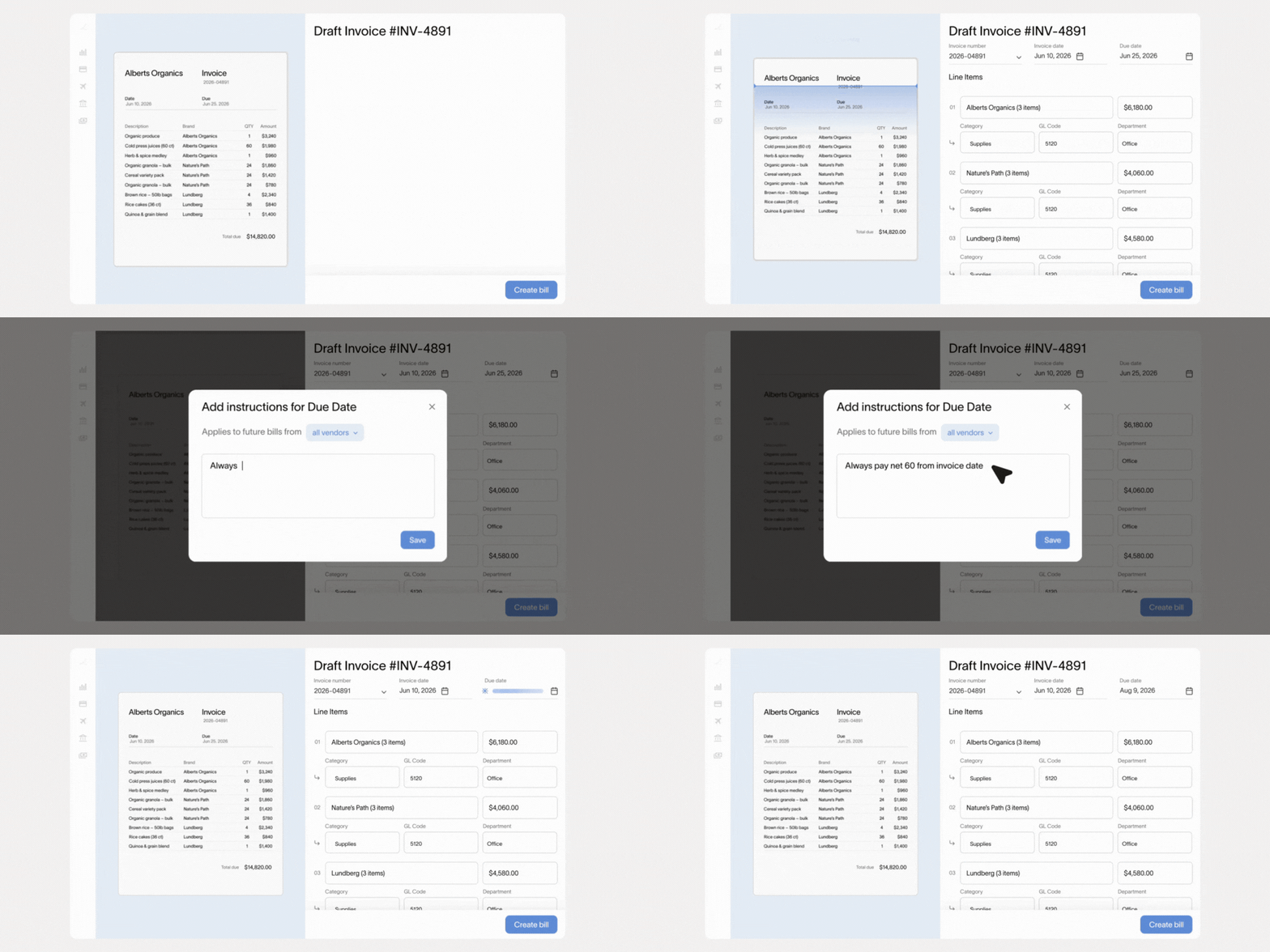
An accountant still reviews the bill and handles exceptions, but no longer has to begin by re-entering its details or reconstructing the approval path.
“We were keying every invoice into the system, checking the figures and coding, then manually entering it again to pay. Now it's basically a click of a button. I don't have to direct anyone elsewhere for approvals — everything's in Ramp.”— Amanda Tedeschi, Controller
Amanda wasn't adding a second system. She was asking more of the one she already used. With Bill Pay in Ramp, invoices followed the coding and approval rules her team had already built, rather than a separate process. Cards, expenses, and payables no longer sent her team in three different directions.
Rules that keep the accounting system in sync
That coding work isn't limited to invoices — it runs across every type of spend. Amanda's team has built out more than 40 rules inside Ramp that route and code cards, expenses, and bills alike, syncing straight into QuickBooks instead of requiring someone to redo that work by hand. For anything the rules haven't seen before, Ramp's Accounting Agent codes it instead.
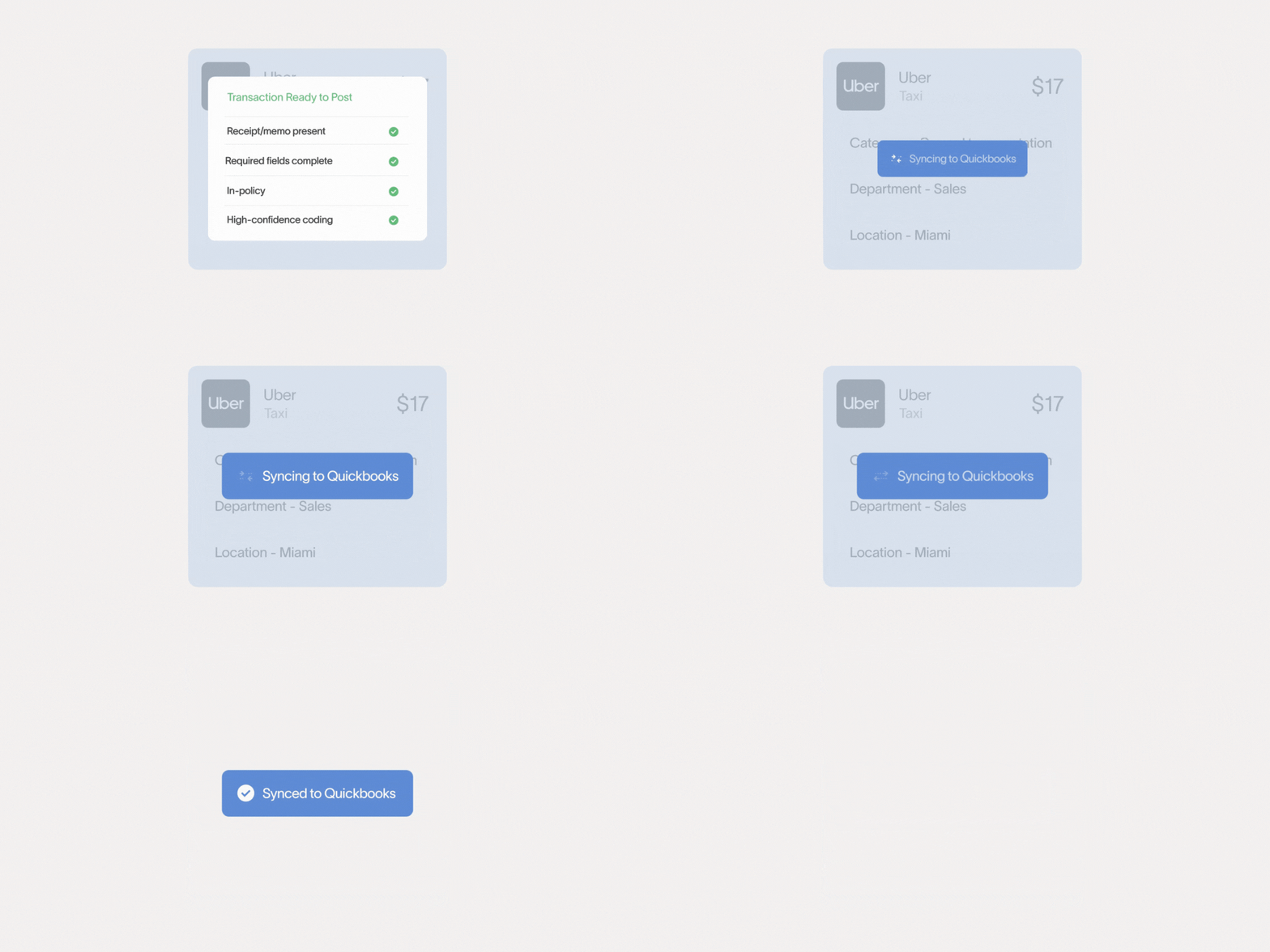
The accounting system hasn't changed. What has is how much of that work now happens without anyone touching it, across every kind of transaction the business makes.
Spending, bills, approvals, and the accounting logic tying them together all run through the same system now. For Amanda, Ramp isn't one tool among several anymore — it's become the operating system underneath how the business's money moves.
A back office built for the scale of the business, not the size of the cupcakes
Streamlining a back office is usually a private win. A finance team moves faster, closes its books a day sooner, and nobody outside the department notices. At Baked by Melissa, it didn't happen all at once, and it didn't stay inside finance either. Card spend alone is now earning thousands of dollars in cashback every month, and that’s just the start of the return.
The bigger change is time, and it shows up everywhere: in how fast an approval comes through, how quickly an expense gets reimbursed, how soon a vendor gets paid. Finance feels it most of all, with more capacity to show up for the rest of the business instead of just processing it.
More than 99% of invoices captured without manual entry
Every bill arrives with a head start now — captured and coded automatically, so what used to take minutes takes just seconds. Those seconds add up to hours back every month. Since adopting Bill Pay, the team has paid more than 640 bills to more than 80 vendors, with Ramp's OCR capturing nearly 100% of incoming invoices without manual entry.
Accounts payable isn't something Amanda's team does by hand anymore: a person still approves and sends the payment, but getting an invoice to that point, once the most time-consuming part of the job, now happens on its own.
“Ramp gives me a second set of eyes. I don't have to check the coding on every invoice anymore. I can ask: what does vendor spend look like? Where does it make sense to switch to a card?”— Amanda Tedeschi, Controller
Time back that compounds
An average of over 10 hours a month is what AP and accounting get back once nobody has to chase down what a bill means or where a transaction belongs, and that number doesn't stay put for long. The rules Amanda's team built don't care whether the business processes fifty bills or five hundred, and the Accounting Agent picks up whatever they miss.
Most finance teams buy more time by hiring; this one chose automation, which scales without adding headcount. The real value isn't this month's ten hours. It's the hires that growth won't require, and the time Amanda's team already has to decide where the company's money should go instead of tracking where it went.
One financial view across a business with many moving parts
A store buying supplies, an online operation preparing shipments, and a corporate-gifting team fulfilling orders have different spending needs. The finance team still has to account for all of them, with enough visibility to know what is happening across the business.
Amanda once navigated as many as 10 to 20 portals and logins to keep spending and payments moving. Now she can handle cards, bills, and approvals through Ramp while continuing to use the company's accounting system. Ramp hasn't replaced the accounting system. It has given Amanda a more consistent way to manage the spending and payment workflows that feed into it.
Melissa sees the value beyond the accounting team, too.
“I think you'd assume that introducing a new finance platform into the business wasn't necessarily going to make everyone feel happy — but it did. It made everyone's job easier. It also gave our executive leadership team transparency into the business, which is essential.”— Melissa Ben-Ishay, Co-Founder & President
The cupcakes still come 176 to a tray, packed close enough to touch, keeping each other warm the way they always have. Melissa still checks the arrangement when she visits. These days, Amanda has time to notice it too.


