

The accounting team that cut its close from 30 days to five with Stack, making more room for the strategic advisory its clients count on
“Claude could help me prepare an entry, but switching clients meant resetting the QuickBooks connection and giving it context all over again. The skills I’d built didn’t carry over easily, and I still had to post the entry myself.”
Senior Finance and Accounting Associate, Sandbox

Sandbox's work runs in two directions: back through the books to understand what happened, and forward to help clients decide what comes next.
The firm started by helping startups raise capital, then added accounting and reporting as clients’ needs grew. Today Sandbox serves small to mid-sized businesses and nonprofits with everything from bookkeeping and accounts payable to financial modeling and forecasting.
Brody Owens, Sandbox's Senior Manager of Finance and Accounting, oversees client relationships and the financial work behind them. Jay Wilmouth, a Senior Finance and Accounting Associate, lives closer to the transactions, preparing the books that Brody reviews.
Both are responsible for more than finishing the month. But the work required to explain the past was taking up the time they needed to help clients plan ahead.
The close sent finance across systems
Before Sandbox could send a client its monthly financials, the team had to work through a chain of handoffs.
Jay's Google Sheets checklist showed who owned each task and what was done, but the work itself happened across payroll systems, bills, bank accounts, QuickBooks, and other files the team had to gather. Jay had to pull that information together, prepare journal entries, and reconcile the accounts before Brody could review the books.
That work became more demanding as a client's accounting grew more complex. For a nonprofit, a single employee's payroll might need to be allocated across five classes. Jay had to assemble the supporting data, calculate the split, build each journal entry, and double-check it before posting. An entry could take 30 minutes to an hour on its own. Then came the next entry, the next account, and the next client.
Jay was already looking for ways to speed up the work. He had built Claude skills to help with individual tasks, but they hadn't given him one continuous way to work across clients.
“Every time I switched between clients, I felt like I was starting all over again,” Jay explains, “and at the end I still had to post the entry myself.”
From there, Jay still had to review the books for accuracy, then prepare the client's monthly financial statements. A close could stretch to 30 days, with those statements arriving later still.
“No investor, owner, or operator wants to see that kind of lag. By the time you get the financials, the information is almost too old to be useful.”— Jay Wilmouth, Senior Finance and Accounting Associate
Stack helped put the checklist to work
Brody and Jay started their Stack pilot with a client whose books demanded more than a standard close.
Jay brought the Google Sheets checklist he used to track it into Stack, turning its rows into recurring tasks with owners, deadlines, and instructions.
Before Stack prepared the work, Jay could see and change how each task would be handled, whether the job was preparing a journal entry or reconciling an account. The checklist was no longer just a record of pending tasks; it could set the next step in motion.
“Stack brings payroll, bank activity, and QuickBooks history into the task, so I don’t have to piece it all together myself.”— Jay Wilmouth, Senior Finance and Accounting Associate
What Jay builds for one client gives the next a head start
To carry out the task list, Stack worked with the systems and files Jay already relied on to close each client’s books: payroll data, bank statements, prior ERP entries.

Gusto could feed payroll data directly into Stack, where Jay's instructions determined how to allocate each employee's costs. If a client's payroll system wasn't connected, Jay could drop in its report and keep going. Reconciliations could draw on external bank activity directly through Plaid, while QuickBooks provided the accounting history behind similar entries.
“It knows what's in your books from prior months,” Jay said. “It can look at how you've done it the last five times and repeat that.”
Alongside that accounting history, Jay could build skills that spelled out how he wanted recurring tasks handled. He used them to check loan balances, record interest, tie equity to purchase documents, and prepare payroll entries. For nonprofits, he built a skill to allocate expenses by function, adjusting the percentages for each client.
“The first time you do it is the longest it should ever take you. Once I’d built the skills, I saved around 13 hours of hands-on close work the following month. Tailoring them to another set of books takes just a couple of edits.”— Jay Wilmouth, Senior Finance and Accounting Associate
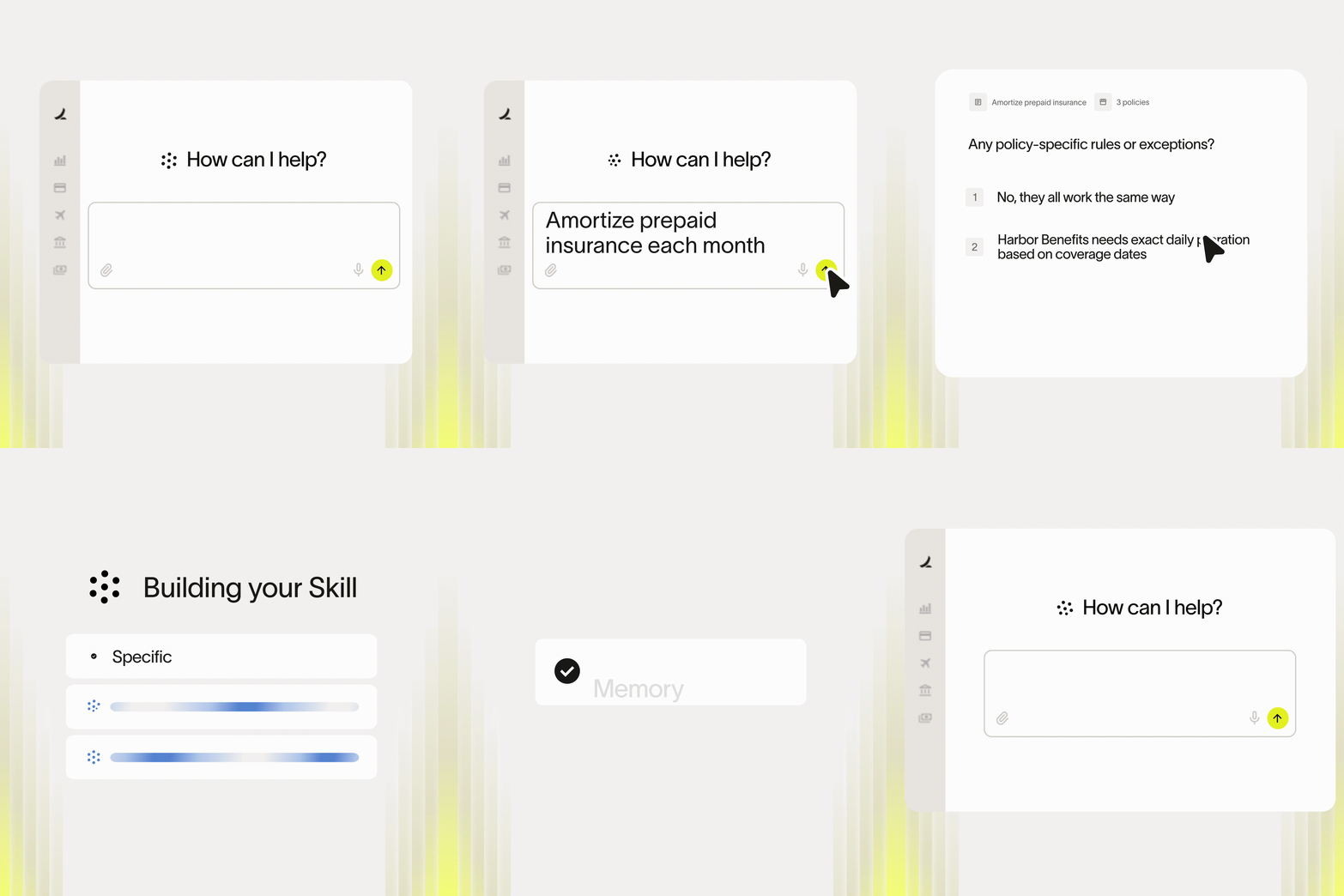
Stack handled the routine steps. Jay kept the judgment.
Once Stack drafted a journal entry, Jay reviewed its support, made any needed changes, and approved it; Stack then posted the entry directly to QuickBooks without Jay having to enter each line by hand.
When the next month came around, the tasks and skills Jay had set up were ready to use again.
“With Stack, I just drop in the support, review the entry it prepares, and approve it for QuickBooks. I'm still responsible for getting it right, I'm just able to spend more time checking the work than putting it together.”— Jay Wilmouth, Senior Finance and Accounting Associate
The next close took an afternoon
In his first month using Stack, Jay cut one client’s close from 25–30 days to about 15. The next month, Stack already had Jay’s instructions and the client’s prior books to work from. He had the same client’s books closed by the fifth business day, 6x faster than before Stack.
That second close came together on a single Friday afternoon. Jay sat down at 3:00pm to work through the entries, reconciliations, and review. By 4:30pm, he’d finished the hands-on work that had taken him about 15 hours the month before — 10% of the time it would have taken him previously.
Sandbox has since brought three more clients onto Stack. As the firm scales Stack across the rest of its client book, Jay can reuse the skills he built for the first client and tailor them to each client’s books, rather than starting from scratch.
That capacity changes the work Sandbox can take on between closes. Brody can go deeper on modeling and forecasting and get to the one-off analyses clients have asked the team to turn around faster.
Jay gets more time in the conversations those reports are meant to support.
“I’m not spending all my time putting the information together. I get to spend more time talking with CEOs and CFOs about what’s going on in their businesses, and I can come to those meetings more prepared.”— Jay Wilmouth, Senior Finance and Accounting Associate
The books still need to be closed. Now Brody and Jay have more of the month to focus on what comes next, both for clients and Sandbox.


