Agentic payments explained: Use cases, risks, and how to get started

- What are agentic payments?
- How agentic AI executes payments in real time
- Guardrails that keep agentic payments compliant and auditable
- Business use cases for agentic payments
- Benefits of agentic AI in payments for finance teams
- Challenges with agentic payments and how to reduce risk
- Ramp Agent Cards: Purpose-built for agentic payments
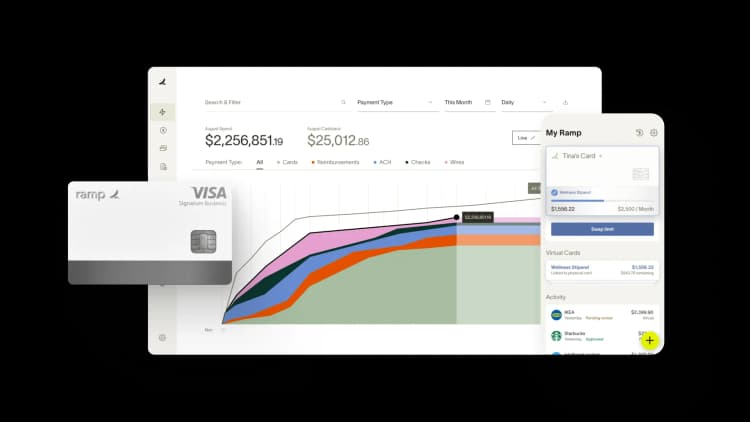
Agentic payments are transactions initiated and completed by an autonomous AI agent without human intervention. The agent uses its own judgment to decide what to buy, when, and from whom, all bound by guardrails you set.
Instead of following rigid schedules or waiting for a human to click "approve," AI agents autonomously evaluate context, apply your policies, and execute payments in real time. You stay in control by setting the rules and monitoring outcomes, not by reviewing and approving every transaction.
This shift will directly impact processing costs, close times, compliance, and cash flow. Below, you'll learn exactly how agentic payments work, where they're already showing up, what risks to watch for, and how you can start building toward them today.
What are agentic payments?
Agentic payments are transactions that AI agents complete on your behalf. Each agent operates within rules you define, like approved vendors, spend limits, and payment methods, so the agent can move money without a human approving every step.
That's a meaningful departure from what most finance teams do today. Traditional autopay runs on fixed schedules: pay this vendor $5,000 on the 15th of every month, no questions asked. Human-assisted payments require someone to review, approve, and trigger each transaction.
Agentic payments sit between full automation and full human control, combining the speed of the former with the judgment of the latter. The key distinction is human in the loop vs. human on the loop:
- Human in the loop: A person must approve each step before the payment moves forward. This is how most business spending works today.
- Human on the loop: A person sets policies, monitors outcomes, and intervenes on exceptions. The agent handles routine decisions and execution independently.
Agent cards are built for the second model. You define the rules once, and every transaction the agent makes is automatically scoped to those constraints.
How agentic AI executes payments in real time
An agentic payment isn't scoped to a single action. It's a multi-step process that moves from trigger to settlement in seconds. Each stage involves the agent gathering information, making decisions, and executing with precision. Here's how the process works:
1. Event detection and context gathering
Every agentic payment starts with a trigger. Agents continuously monitor signals across your systems to identify when they need to make a payment. These signals include:
- Incoming invoices landing in your AP inbox
- Inventory levels dropping below reorder thresholds
- Contract milestones being marked complete
- Service-level data indicating a deliverable has been met
- Market conditions shifting (e.g., favorable FX rates)
The agent then enriches that signal with context pulled from your ERP, procurement platform, CRM, bank feeds, and third-party data sources. If an invoice arrives from a supplier, the agent doesn't just see the amount due; it sees the original PO, the delivery confirmation, the vendor's payment terms, your current cash position, and whether an early-pay discount is available.
This context-gathering step is what separates agentic payments from simple rule-based automation. The agent builds a complete picture before it acts.
2. Decision logic and policy evaluation
Once it has the full context, the agent evaluates your company's spending rules to determine the best course of action. The agent weighs multiple factors simultaneously:
- Spending policies: Is this transaction within budget? Does it require additional approval based on your approval matrix?
- Pricing optimization: Is there an early-pay discount worth capturing? Can the agent negotiate better terms?
- Risk assessment: Is the vendor financially healthy? Does anything about this transaction look anomalous?
- Cash flow targets: Does paying now align with your cash management goals, or should the agent schedule payment closer to the due date?
Based on this evaluation, the agent decides whether to pay immediately, schedule the payment for a future date, attempt to negotiate better terms, or escalate to a human for review. The decision logic is transparent and tied directly to the policies you've defined.
3. Dynamic routing and settlement
Once the agent decides to pay, it selects the best payment method. This is a real-time evaluation based on:
- Cost: Interchange fees, ACH costs, wire fees, processing charges
- Speed: Same-day ACH, real-time payments (RTP), next-day settlement
- FX impact: Exchange rates for cross-border payments, hedging opportunities
- Acceptance: Which rails the vendor accepts, preferred payment methods
The agent routes through multiple providers, optimizes for fees and exchange rates, and handles retries and fallbacks if a payment method fails. Once settlement completes, an agent can update your ledger, reconcile the transaction, and notify the relevant stakeholders with no human intervention.
Guardrails that keep agentic payments compliant and auditable
Giving an AI agent the ability to move money sounds risky if you don't have the right controls in place. A layered control framework ensures security, compliance, and transparency while still enabling the speed and autonomy that make agentic payments valuable.
Spending limits and velocity controls
Agents enforce the same financial guardrails your team would, just faster and more consistently. These controls include:
- Transaction caps: Maximum amounts per payment, per vendor, or per category
- Merchant and category restrictions: Blocking spend with unapproved vendors or in restricted expense categories
- Frequency limits: Preventing duplicate or unusually frequent payments to the same recipient
- Cumulative spend thresholds: Flagging when total spend in a period approaches budget limits
When a transaction approaches or breaches a limit, the agent applies dynamic escalation rules. It might trigger a temporary hold, request human approval, or reduce the payment amount to stay within bounds. The agent can also adapt rules dynamically based on context, so a $10,000 payment to a trusted long-term vendor gets treated differently than a $10,000 payment to a brand-new supplier.
Multi-layer identity and fraud controls
Agentic payments don't operate in the open. Every transaction passes through multiple layers of verification before it's authorized:
- Scoped credentials: Whether it's a tokenized virtual card locked to a specific merchant or an ACH payment tied to a known vendor, the agent's payment authority is constrained before it ever executes a transaction. Major card networks are already building for this: Visa's Trusted Agent Protocol and Mastercard's AP2 platform both support agent-initiated transactions with restrictions enforced at the network level.
- Network-level fraud scoring: At the moment of authorization, payment networks and processors run device fingerprinting, geolocation checks, and anomaly detection against the transaction. This happens automatically, whether the payment was initiated by a person or an agent.
- Behavioral monitoring: Pattern recognition flags deviations from normal spending activity. An agent that suddenly attempts a transaction outside its established pattern triggers a review the same way an unusual employee expense would.
These controls are risk-proportional. A monthly $200 software fee clears instantly against preset rules. A $50,000 payment to a new vendor hits tighter constraints, requiring human review before the agent can proceed.
Immutable audit trails for accounting
Every action an agent takes is logged in detail, creating a complete decision trail that captures:
- The data inputs the agent used
- The model outputs and reasoning behind each decision
- The policy version that was active at the time
- Every approval, escalation, and override
- Timestamps for each step in the workflow
These logs use cryptographic hashes or append-only storage to ensure no one can alter them after the fact. For your team, this means full traceability that supports SOX compliance, internal audits, and regulatory inquiries. When an auditor asks why a payment was made, you can show them exactly what the agent saw, what rules it applied, and why it chose the action it did.
Business use cases for agentic payments
Agentic payments are already reducing friction and improving outcomes across core finance operations. Here's where they deliver the most value today:
Automated invoice and supplier payments
An agent monitors your AP pipeline and handles supplier payments from end to end. When an invoice arrives, the agent kicks off a verification workflow:
- Runs a 3-way match between the PO, the invoice, and the receiving report
- Checks the invoice against the original contract terms
- Evaluates whether an early-pay discount is available and worth capturing
- Optimizes payment timing based on your cash flow position and available forecasting data
- Selects the lowest-cost payment rail (ACH, wire, virtual card) and executes settlement
Ramp's Agents for AP already work this way. They auto-code line items, check invoices against 60-plus fraud signals, surface card-eligible bills to capture cashback, and recommend approvals with full vendor context, cutting invoice processing to 7x fewer clicks than legacy tools.
Subscription and usage-based billing
SaaS subscriptions and usage-based services are notoriously hard to manage at scale. An agentic payment system monitors your usage data in real time and takes action before costs spiral:
- Overage prevention: The agent tracks consumption against your current tier and alerts you when you're on pace to exceed it, giving your team time to adjust usage or authorize an upgrade before overage charges hit
- Renewal optimization: At renewal time, the agent benchmarks pricing against market rates and your historical usage, then flags opportunities to renegotiate terms or consolidate redundant subscriptions
- Spend enforcement: If a vendor misses SLA targets or costs exceed predefined thresholds, the agent can pause scheduled payments and route the vendor to your procurement team for review before the next payment cycle
Visibility is the first step. For example, Ramp's AI Spend Intelligence gives finance teams real-time attribution of AI token spend by team, model, and use case, with budget alerts that flag runaway costs before they hit your P&L. Across Ramp customers, average monthly AI token spend has increased 13x since January 2025, making this kind of granular cost tracking a prerequisite for any agentic controls built on top.
Real-time treasury and FX optimization
For companies making international payments, timing and routing decisions directly impact the bottom line. An agentic payment system adds a layer of continuous monitoring that manual treasury workflows can't match:
- FX exposure alerts: The agent tracks exchange rate movements across your active currency pairs and flags favorable windows for upcoming payments, giving your treasury team time to act before rates shift
- Payment timing optimization: Rather than processing cross-border payments on a fixed schedule, the agent recommends timing based on rate trends, payment terms, and cash position, capturing savings that a team checking rates once or twice a day would miss
- Spend consolidation: The agent identifies opportunities to batch payments by currency or region, reducing the total number of FX transactions and the conversion fees that come with them
Deeper treasury functions like intercompany netting, automated hedging, and cross-border corridor routing are evolving fast across specialized platforms. But even at the spend management layer, an agent that continuously monitors FX exposure and recommends payment timing closes a gap that most finance teams manage with spreadsheets and calendar reminders today.
Agent-assisted procurement and travel booking
Procurement and travel are two areas where policy compliance and cost control often clash with speed. An agentic approach resolves that tension:
- Procurement: For routine categories like office supplies and SaaS renewals, the agent compares quotes against historical pricing, validates against your procurement policies, issues a PO, and triggers payment once the invoice clears a 3-way match. Strategic or high-value purchases get flagged for human review with a recommended shortlist already assembled.
- Travel: The agent books flights, hotels, and ground transportation through your managed travel platform, filtering options against your T&E policy and budget limits. Each trip is paid with a scoped virtual card locked to specific merchants and spend limits, and receipts and cost allocations are captured automatically at the point of transaction.
In both cases, employees get what they need faster, and your finance team gets clean data without reclassifying expenses after the fact.
Benefits of agentic AI in payments for finance teams
The value of agentic payments isn't abstract. Finance teams stand to gain measurable improvements across cost, speed, and control:
Lower processing costs
Every manual touchpoint in a payment workflow costs money: data entry, approval routing, exception handling, vendor communication. Agentic payments reduce or eliminate these touchpoints. Specific cost savings come from:
- Fewer staff hours spent on routine AP tasks
- Optimized payment routing that minimizes interchange and processing fees
- Agent-led vendor negotiations that capture early-pay discounts and better pricing
- Reduced FX costs through real-time rate optimization
Faster close and fewer exceptions
Month-end close is painful largely because of reconciliation backlogs and exception queues. Agents address both by automatically categorizing transactions, coding them to the correct GL accounts, and matching them to POs and receipts as they occur—not in a batch at month-end.
Ramp's Accounting Agent automates this workflow from end to end. It codes every transaction at the point of swipe, auto-syncs routine spend to your ERP, and accrues anything that isn't ready so the expense lands in the right period. Early adopters have seen 3.5x more transactions coded automatically compared to legacy tools, with 98% accuracy on transactions flagged ready to sync.
Stronger policy compliance
Agents don't forget policies, skip steps, or make exceptions. Always-on policy enforcement means every transaction is evaluated against the same rules every time. This level of consistency:
- Curbs maverick spend by blocking out-of-policy purchases before they happen
- Standardizes vendor usage across departments and locations
- Applies controls uniformly, which auditors and regulators appreciate
Ramp's Policy Agent already does this. It reviews every transaction against your expense policy, auto-approves spend that's clearly in bounds, and escalates exceptions to the right reviewer with full context. Teams that use it are catching 7x more out-of-policy spend while reclaiming 4–5 hours per week from manual reviews.
Challenges with agentic payments and how to reduce risk
Agentic payments introduce real risks you need to address before scaling. The good news is that each risk has a clear mitigation path:
Data quality and model drift
An agent is only as good as the data it works with. Dirty, delayed, or incomplete data leads to bad payment decisions.
Even with clean data, the models powering your agents can drift over time as business conditions change. According to a recent Gartner survey, 74% of procurement leaders say their data isn't AI-ready, and fragmented data is the most common reason agentic deployments stall.
To mitigate this:
- Implement data contracts between systems to enforce quality standards at the source
- Monitor model performance with dashboards that track accuracy, latency, and exception rates
- Retrain models on a regular cadence using recent transaction data
- Run new models in shadow mode, letting them make decisions alongside your existing process without executing, before granting full autonomy
Regulatory uncertainty
Regulators haven't fully caught up with agentic payments. Rules around AI-driven financial decisions vary by region and are evolving quickly; what's compliant today may not be tomorrow.
Protect yourself by maintaining configurable controls you can adjust as regulations change. Preserve human oversight for high-risk actions like large international wires or payments to sanctioned jurisdictions. Most importantly, document every decision the agent makes and the logic behind it. When regulators ask questions, a clear audit trail is your best defense.
Liability frameworks for agent-initiated transactions are still being defined. Until they're settled, the safest posture is to treat your audit trail as your primary protection.
Human-in-the-loop escalation
Not every payment should be fully autonomous. You need clear thresholds that tell the agent when to stop and ask a human. Common escalation triggers include:
- Payments above a defined dollar amount
- Transactions with new or unverified vendors
- Anomalous patterns that deviate from historical norms
- Payments to high-risk geos or sanctioned entities
Design your escalation workflows to be fast and audit-ready. When an agent escalates, reviewers should see the full context—what the agent detected, what policies it applied, and why it flagged the transaction—so they can make a quick, informed decision.
Ramp Agent Cards: Purpose-built for agentic payments
If you're looking to deploy agents to handle purchases, they'll need payment credentials that enforce your policies at the moment of transaction. Traditional corporate cards can't do this. They weren't designed for autonomous, high-frequency purchasing where no one is reviewing every swipe.
Ramp Agent Cards, currently in early access, solve this with single-use credentials issued through Visa Intelligent Commerce. When your agent needs to pay a vendor, renew a subscription, or top up an ad account, it requests a token from Ramp that's locked to that exact transaction at the network level. The token completes the purchase and expires—it can't be reused, redirected, or charged for a different amount.
Here's what agentic payments look like with Ramp Agent Cards:
- Enforce limits at the credential level: Set per-transaction, daily, monthly, or per-project caps so agents never exceed what you've authorized
- Lock spending to approved merchants: Restrict each agent's purchasing to pre-approved vendors or categories, with every transaction validated against policy in real time
- Require approvals for exceptions: Route high-value or out-of-policy requests to the right approver automatically, while routine purchases flow through uninterrupted
- Credentials that self-destruct: Each VIC token is single-use and scoped at the Visa network level, so even an intercepted token is useless
- Track every dollar in real time: Agent transactions appear in the Ramp dashboard alongside human spend, with the same reporting, categorization, and accounting sync
Learn how Ramp for Agents gives your agents purchasing power without giving up control.

FAQs
McKinsey predicts up to $5 trillion in agentic commerce sales by 2030. As AI agents become more sophisticated and enterprise adoption accelerates, analysts expect agentic transactions to grow rapidly across both consumer and B2B use cases.
Picture an agent monitoring your office supply inventory. When paper stock drops below a set threshold, the agent automatically compares paper vendors based on price, delivery speed, and past performance. It applies your procurement policies, selects the best option, and executes payment via the lowest-cost rail, all without anyone submitting a purchase request or approving an invoice.
You don't need to go from zero to full autonomy overnight. Most teams start with the automation features available today, like policy controls, auto-matching, smart routing, and expand to more autonomous capabilities over time. The pace depends on your internal readiness, data quality, and how quickly regulatory frameworks in your industry mature.


“I assumed I would have to choose between speed and control. What I found is that you can have both. A well-designed system takes friction out, for the finance function and for everyone else.”
Justin Webster
CFO, Denver Broncos

“A well-run district should not have to choose between getting work done at the school site and keeping control of the dollars behind it. We're not hiring more people to do more jobs, so we have to be smarter about the process. With Ramp, the purchase, the receipt, and the record stay together from the start. ”
Nick Brizeno
Director of Purchasing, San Marcos Unified School District

“In senior living, scale only works if the communities still feel personal. We needed the back office to carry more of the complexity, not the people serving residents. Ramp helped us build that infrastructure, so the experience in the community could stay human.”
Ryan Cole
CFO, Agemark Senior Living

“AI is moving faster than the finance context around it. Prices change, models change, and the value is not always obvious from an invoice. We needed enough detail to know which bets deserved more investment — and which ones did not.”
Greg Cooley
Controller, AngelList

“Invoices, cards, tokens. The categories change but the principle doesn't: know where the money is going, remove the work around it, and make sure the spend is worth it.”
Maciej Mylik. Finance
ElevenLabs

“We weren’t trying to retrofit an old finance system. We had a blank canvas, and Ramp gave us the foundation to build a global finance function of the future.”
Justin Dourado
Director of Finance, Othership

“There's just no surprises anymore. No more waiting two months to find out how a job did. We know how it's doing as it's happening.”
Erich Kuss
Financial Systems Manager, Infinity Home Services

“More token spend isn’t proof that AI is working. Less isn’t proof that it isn’t. What matters is whether we’re buying the right level of intelligence for the work. Ramp lets us make that judgment in the same place we manage every other type of spend.”
Cody Nutt
Senior Director of Business Systems, Daxko
