AI agents in finance: Complete guide for 2026

- What are AI agents in finance?
- How AI finance agents differ from bots and RPA
- Where finance teams use agents today
- Benefits finance teams can expect in 2026
- Risks and controls for finance agents
- How to implement an AI agent for finance tasks
- How to choose a software partner for autonomous finance
- The future of AI agents in finance
- Ramp's approach: Finance agents for the full spend lifecycle
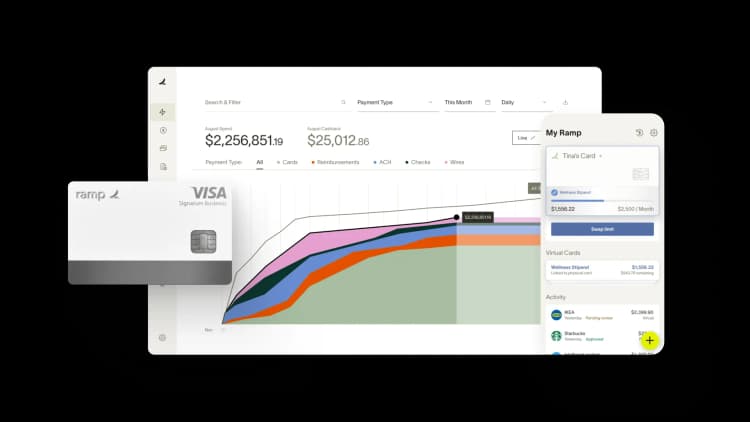
AI agents in finance are autonomous software systems that interpret context, make decisions, and execute multi-step tasks across your financial workflows without waiting for human input on every action.
Unlike the automation tools that came before them, agents don't follow rigid rules. These autonomous digital workers adapt to each unique scenario and keep working after you close your laptop. That distinction changes how you staff your team, how you design controls, and how you think about the finance function itself.
What are AI agents in finance?
AI agents in finance are self-directed software programs that complete multi-step financial workflows without following a fixed script. They interpret context, connect inputs and outputs across multiple systems, and complete tasks with minimal input.
Consider the difference between a tool that simply flags a duplicate invoice and one that flags it, cross-references the vendor's payment history, applies your policy, and resolves the issue, all before you open your laptop. These are the gaps agents close:
- Autonomous decision-making: Agents execute complex workflows without human input, handling exceptions and edge cases that would stall traditional automation
- Context awareness: They understand nuanced financial scenarios, like distinguishing a legitimate large purchase from a policy violation, and adapt their responses accordingly
- Continuous learning: Performance improves over time through continuous data analysis and pattern recognition, meaning the agent handling your Q2 close will produce better results than the one that handled Q1
- Multi-step action execution: Agents chain tasks across systems within a single workflow, like pulling data from your ERP, matching it against bank feeds, coding it to the right GL account, and flagging anomalies. This is the defining quality that separates agents from AI assistants.
Unlike simple automation tools that follow rigid if-then rules, agents learn from data and adapt over time. They operate continuously, processing information and making decisions around the clock.
How AI finance agents differ from bots and RPA
The term "AI" is often applied loosely, so it's worth drawing clear lines between agents, robotic process automation (RPA), and chatbots. Understanding the distinctions helps you evaluate what your team actually needs:
| Capability | AI agents | RPA | Chatbots |
|---|---|---|---|
| Decision-making | Contextual, autonomous | Rule-based, scripted | Limited to conversation flow |
| Data handling | Structured and unstructured | Structured only | Text-based inputs |
| Adaptability | Learns and improves over time | Breaks when inputs change | Requires manual script updates |
| Scope of action | Multi-step, cross-system workflows | Single-task automation | Conversational responses |
| Exception handling | Resolves or escalates intelligently | Stops or errors out | Redirects to a human |
Here's how they compare in detail:
- RPA follows defined rules to automate repetitive, structured tasks. It's effective for high-volume processes with predictable inputs, like syncing data between systems or generating standard reports. But when the format changes or an exception appears, RPA breaks.
- Chatbots handle conversational interactions using preset scripts or basic natural language processing (NLP). They're useful for answering common questions or routing requests, but they don't take action beyond the conversation.
- Agents don’t need rigid rules or predefined scripts to take action. They can process unstructured data (like a PDF invoice with an unusual layout), make contextual decisions (like whether a charge violates policy given the employee's role), and adapt when conditions change.
RPA and chatbots still have their place, but they handle the predictable work. Agents handle the work that used to require human judgment.
Where finance teams use agents today
AI agents are already delivering value across several core finance functions:
Fraud detection and risk management
Agents monitor transaction streams in real time, scanning for anomalies that rules-based systems miss. Instead of flagging every transaction over a set threshold, they evaluate patterns, such as a vendor's billing frequency or an employee's typical spend behavior, and identify suspicious activity that could indicate expense fraud.
When they detect a potential issue, agents can freeze a card or escalate to a reviewer with full context attached. This results in fewer false positives and quicker intervention when something actually looks wrong.
Accounts payable and expense management
AP is a natural fit for AI finance agents. The work is high-volume and full of unstructured data, exactly the kind of challenge agents are built to solve. AP agents can pull data from invoices regardless of format, run a 3-way match against POs and receiving reports, and code expenses to the correct GL accounts.
They also handle reconciliation in real time, surfacing discrepancies as they come up instead of waiting for someone to catch them in a month-end review. For expense management, agents categorize transactions as they occur and proactively flag policy violations, which cuts down on the back-and-forth that drags out your reimbursement cycles.
Forecasting and scenario planning
Static forecasts built on last quarter's assumptions quickly go stale. AI agents can analyze historical context alongside real-time market trends and internal performance data to build dynamic forecasts that update as the underlying variables change.
Say you want to model the impact of a 15% tariff increase on supply chain costs. An agent can pull the relevant data, run the scenarios, and account for things like seasonality and vendor concentration in a fraction of the time it would take you to build the model in a spreadsheet.
Procurement and vendor management
Manual procurement workflows are slow and resource-intensive. Agents can take on vendor discovery by scanning supplier databases and scoring potential partners against your criteria.
They can also issue RFPs, normalize the responses as they come in, and deliver a ranked shortlist. For lean finance teams where procurement often falls to someone with a full plate, that frees up real time for higher-leverage work.
Credit underwriting and lending
Agents can assess creditworthiness by pulling from financial statements, credit bureau data, transaction history, and market conditions at the same time. They combine these inputs into a lending recommendation with a risk score and supporting rationale. A human reviewer can evaluate the recommendation quickly, with all the underlying data available for audit.
Customer service and collections
Agents can take on the high-volume work of answering routine customer questions like balance inquiries and payment status updates, which frees up your team for complex cases. Responses are personalized based on account history rather than pulled from a generic script.
For collections, agents manage outreach and adjust communication timing based on payment patterns, escalating accounts that need a human. They can also negotiate payment plans within parameters you set, which helps preserve customer relationships while improving recovery rates.
Benefits finance teams can expect in 2026
AI agents can improve the day-to-day work of your finance team in concrete ways:
- Fewer manual errors: Agents cut down the kinds of mistakes that result from manual data entry and expense coding. When your close process runs through an agent instead of a spreadsheet, transposition errors and miscoded expenses drop sharply.
- Faster processing times: Invoice matching and expense reconciliation that used to take hours or days now finish in minutes, which gives your team more time for work that actually requires judgment
- Better decision-making: Real-time analysis means you're working from current numbers instead of last month’s reports. Agents surface trends and anomalies as they happen, so your read on your financial position is always up to date.
- Stronger compliance: Agents enforce your policy consistently across every transaction. Ramp's research across 50,000+ businesses found that companies using agents for expense management saw out-of-policy spend event rates fall by 62% and policy flag rates drop by 60% over two years.
But none of these benefits show up overnight. They build as your team learns what to delegate and what to handle themselves.
Risks and controls for finance agents
Autonomous systems need guardrails. Deploying agents without the right controls creates new risks that can undermine their benefits:
- Data quality: Dirty or incomplete data leads to unreliable outputs. Before deploying an agent, audit your data sources and set quality standards.
- Human oversight: You shouldn't automate every decision. Set clear thresholds for when agents can act on their own and when they need human approval.
- Audit trails: Every agent action should be logged with the decision made, the data behind it, and the policy that governed it. Auditors and regulators need to be able to trace any action back to its source.
- Security: Agents access sensitive financial data and interact with external systems. Scope their permissions tightly, encrypt data in transit and at rest, and review access controls regularly.
- Cost control: An agent that retries or re-plans in a loop can multiply token spend overnight, and nobody notices until the invoice arrives. AI token spend management software shows what your agents actually cost, and LLM gateways like Ramp Router cut that cost by routing each request to the cheapest model that clears your quality bar.
The goal here isn't to constrain agents so much that they become useless. It's to give them enough room to do real work while keeping your team in the loop on the decisions that need their judgment.
How to implement an AI agent for finance tasks
You don't need to overhaul your finance stack on day one. A phased rollout lets you prove value and build trust before you scale.
Step 1: Assess data readiness
Start by checking your data quality and integrations. Ask yourself:
- Is your data clean and consistently formatted across systems?
- Can your ERP, accounting software, and banking platforms share data via API?
- Do you have enough historical data for the agent to learn from?
If the answer to any of these is "not yet," address those gaps first. Deploying an agent on top of unreliable data creates more problems than it solves.
Step 2: Define a high-value pilot
Pick a high-volume manual workflow where success is easy to measure. Expense categorization, invoice matching, and vendor qualification are common starting points because they're painful enough to justify the effort and contained enough to limit risk. Define what success looks like before you start, whether that's hours saved or error rates reduced.
Step 3: Build human-in-the-loop controls
Before you expand, set the approval workflows and controls that will govern your agents. Decide which actions require human review and set dollar thresholds for the ones agents can handle on their own. Build escalation paths for the exceptions.
Skipping this step in the name of speed creates compliance exposure and erodes trust with your team. Build the guardrails first, then let the agent run within them.
Step 4: Measure ROI and iterate
Track performance against the success metrics you defined in step two. Compare processing times, error rates, and your team’s capacity before and after deployment.
Be honest about what’s working and what isn’t. If the agent is miscategorizing a specific expense type, retrain it. If the approval thresholds are too tight and creating bottlenecks, adjust them. The goal is continuous improvement, not perfection on day one.
Step 5: Scale across workflows
Once your pilot proves value, expand to adjacent workflows. If you started with expense categorization, for example, move to invoice processing. Every agent you add takes manual work off your team’s plate, and the standards you’ve already set will make your next deployments faster.
How to choose a software partner for autonomous finance
Not all AI agents are built for finance. When evaluating vendors, focus on criteria that matter specifically for your function:
- Finance domain expertise: A general-purpose AI tool won't understand the nuances of GL coding, 3-way matching, or spend policy enforcement the way a finance-native platform will. Look for providers with deep finance experience and models trained on real transaction data.
- Integration depth: Your agents need to work with your accounting software and banking systems. Ask about pre-built integrations, API flexibility, and how the platform handles data syncing across systems. If it can't play nice with your stack, it can't deliver value.
- Compliance posture: Audit trails, data retention, SOC 2 compliance, encryption, and access controls aren’t optional. Ask vendors for specifics on how they handle each one.
- Implementation and support: A powerful platform that's hard to configure won't deliver what you're expecting. Look at the onboarding process, the ongoing support model, and the training resources available to your team.
- Agent transparency: Ask how the platform handles uncertainty. A good agent should recognize when it's not sure and route those cases to a human, with its full reasoning visible to whoever picks them up. You can’t audit what you can’t see, and finance work needs to be auditable.
Use these as a checklist when scoping vendors, but don't expect any one platform to ace all four. Ultimately, you should base your pick on the criteria that matter most for your business.
The future of AI agents in finance
You can already see where finance agents are headed in what’s being built today. Three capabilities in particular are worth watching: multi-agent coordination, delegated authorization, and payment infrastructure built for machines.
Multi-agent coordination across finance functions
Today, most AI agents operate within a single lane: AP has its own agent, procurement has another, expense management has a third, and so on. The next step is for these agents to coordinate with each other across functions.
Imagine your procurement agent negotiating a vendor contract, your AP agent setting up the payment terms, and your forecasting agent adjusting cash flow projections, all triggered by a single event. The hand-offs that used to require human coordination happen automatically.
Identity and authorization for agents acting on behalf of employees
As agents take more autonomous actions, a new problem emerges: proving who authorized what. When an agent books a flight or renews a subscription, there needs to be a clear chain of accountability from the employee who delegated the task to the agent that executed it.
Scoped credentials solve this at the payment layer. Each transaction is tied to a specific agent, a specific employee, and a specific policy, creating an auditable record that holds up to both internal review and external compliance checks. Expect this pattern to expand beyond payments into other areas where agents act on behalf of employees.
How agentic commerce is changing B2B payments infrastructure
Today's payment card infrastructure was built around humans typing fixed details like card numbers and CVVs into a checkout form.
Emerging models like Visa Intelligent Commerce replace static credentials with single-use tokens that agents request and use on demand. Ramp is already building on this through its partnership with Visa, issuing scoped virtual cards that external AI agents can create and use to transact within policy guardrails.
This infrastructure is being built right now. Finance teams that adopt it early will have an advantage when machine-to-machine commerce becomes mainstream.
Ramp's approach: Finance agents for the full spend lifecycle
These capabilities aren't theoretical. Ramp is already shipping agents that span expense review, accounts payable, accounting, and agent-to-agent commerce, building a connected system for the full spend lifecycle. For the AI work that happens outside those workflows, Ramp Glass gives the whole team a shared workspace.
Policy Agent: Autonomous expense review
Ramp's Policy Agent reads your expense policy, evaluates every card transaction and reimbursement, and recommends approval, rejection, or escalation. It handles the gray areas in your policy language and cites the exact policy text behind each recommendation, so reviewers can audit its reasoning.
The results speak for themselves. Policy Agent catches 7x more out-of-policy spend than rules-based AI, with 99% accuracy when determining in-policy transactions. Early adopters report reclaiming 4–5 hours per week from manual expense reviews. It starts in review-only mode by default, so you can build trust before enabling auto-approval.
AP Agent: Autonomous accounts payable
The AP Agent handles invoice processing from ingestion to payment. It auto-codes GL fields by learning your historical coding patterns with 85% accuracy on its first attempt, flags potential invoice fraud before routing for approval, and generates contextual approval recommendations.
It also identifies vendors eligible for card payment and auto-applies Ramp card details in their portals, capturing cashback rewards you’d otherwise leave on the table. Compared to legacy AP platforms, Ramp's AP Agent processes invoices 2.4x faster with 7x fewer clicks per invoice.
Accounting Agent: Autonomous transaction coding and close
Ramp's Accounting Agent automates the path from card swipe to ERP sync. It auto-codes transactions across GL account, department, class, and location fields using transaction details and historical patterns, then assigns a suggested next action to every transaction.
High-confidence, routine transactions get auto-marked "Ready to Sync" and post to your ERP on schedule; exceptions stay in "Needs Review." The agent codes 3.5x more transactions automatically than legacy tools, with 98% accuracy on items it marks ready to sync.
Agent Cards: Payment infrastructure for external AI agents
As AI agents start acting on behalf of employees to book travel, renew software, order supplies, and more, they need their own payment credentials. But handing a traditional card number to an autonomous system creates authorization and compliance concerns.
Ramp's Agent Cards, currently in early access, solve this. Each credential is a tokenized virtual card with its own spending limit tied to a specific agent and task. You set the rules for merchant categories and transaction caps, and the agent operates within them. Every dollar is traceable back to a specific agent and workflow, with the same spend controls that govern your human cardholders.
Ramp Glass: An AI workspace for the whole company
Finance agents handle the transaction work. A lot of a finance team's other AI work still happens in a chat window. Your FP&A lead builds a workflow that catches every budget variance before it hits the board deck, and it lives in one person's chat history. It disappears when they close a tab, go on vacation, or leave.
Ramp Glass is the AI workspace where knowledge compounds. It connects to your company's knowledge in tools like Linear, Notion, Google, Slack, and Gong, and skills turn one person's best work into everyone's starting point. Every request runs through Ramp Router, which picks the right model for the job, and every project has a meter, so you see what AI work costs while it's happening, not when the invoice arrives.
Put Ramp's finance agents to work
You don't need to wait for the full agentic future to start seeing results. Finance teams are already running Ramp's Policy Agent, AP Agent, and Accounting Agent in production.
See Ramp's AI agents in action and learn how much time your team could save.

FAQs
You'll need data analysis skills to interpret agent outputs and enough tech literacy to configure and oversee AI systems. But the most important skill is judgment: knowing when to trust an agent's recommendation and when to escalate.
Most finance teams see initial time savings within the first month, especially for high-volume tasks like expense categorization and invoice processing. Full ROI typically arrives within 3–6 months, depending on your data quality, use case complexity, and how quickly your team adopts the new workflow.
Agentic AI takes autonomous action across systems without waiting for you to approve every step. AI-assisted tools surface recommendations and insights, but a human still acts on them. With agentic AI, you set the guardrails up front; with AI-assisted tools, you review each output individually.
Don't miss these


“I assumed I would have to choose between speed and control. What I found is that you can have both. A well-designed system takes friction out, for the finance function and for everyone else.”
Justin Webster
CFO, Denver Broncos

“A well-run district should not have to choose between getting work done at the school site and keeping control of the dollars behind it. We're not hiring more people to do more jobs, so we have to be smarter about the process. With Ramp, the purchase, the receipt, and the record stay together from the start. ”
Nick Brizeno
Director of Purchasing, San Marcos Unified School District

“In senior living, scale only works if the communities still feel personal. We needed the back office to carry more of the complexity, not the people serving residents. Ramp helped us build that infrastructure, so the experience in the community could stay human.”
Ryan Cole
CFO, Agemark Senior Living

“AI is moving faster than the finance context around it. Prices change, models change, and the value is not always obvious from an invoice. We needed enough detail to know which bets deserved more investment — and which ones did not.”
Greg Cooley
Controller, AngelList

“Invoices, cards, tokens. The categories change but the principle doesn't: know where the money is going, remove the work around it, and make sure the spend is worth it.”
Maciej Mylik. Finance
ElevenLabs

“We weren’t trying to retrofit an old finance system. We had a blank canvas, and Ramp gave us the foundation to build a global finance function of the future.”
Justin Dourado
Director of Finance, Othership

“There's just no surprises anymore. No more waiting two months to find out how a job did. We know how it's doing as it's happening.”
Erich Kuss
Financial Systems Manager, Infinity Home Services

“More token spend isn’t proof that AI is working. Less isn’t proof that it isn’t. What matters is whether we’re buying the right level of intelligence for the work. Ramp lets us make that judgment in the same place we manage every other type of spend.”
Cody Nutt
Senior Director of Business Systems, Daxko
