
- What is a cashback business credit card?
- At a glance: Comparing the best cashback business credit cards
- How we evaluated the best cashback business credit cards
- 8 best cashback business credit cards of 2026
- How to choose the best cashback business card for your business
- How to maximize your business cashback rewards
- How to redeem your cashback rewards
- Are business cashback rewards taxable?
- Turn everyday spending into savings with Ramp
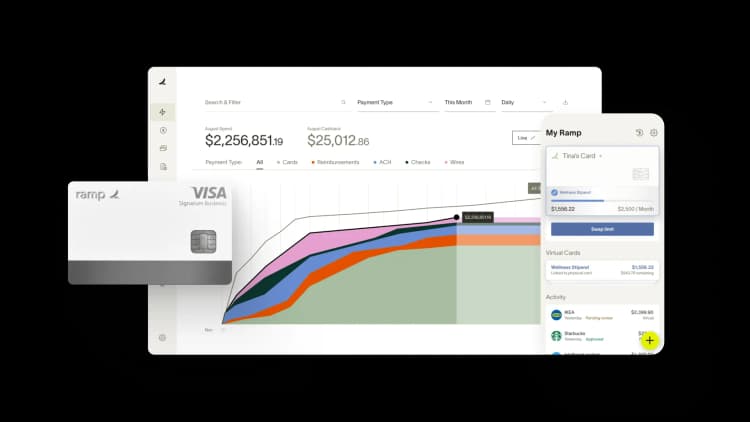
The best cashback business credit cards help your company earn money back on everyday spending — from software and advertising to travel and office supplies. The right card turns routine costs into predictable savings without changing how your business operates.
But not all cashback cards work the same way. The best one for your business depends on how you spend, how much control you need, and whether simplicity or maximum returns matter more. This guide covers what to prioritize when comparing business credit cards, how cashback actually affects your bottom line, and which options stand out for different types of businesses.
Note: The cashback percentages, limits, fees, and other figures mentioned in this article are for illustrative purposes only. They do not represent guaranteed or expected rates. Actual terms, credit limits, rewards, and approval criteria vary by card issuer and may change at any time. Readers should verify current details directly with each issuer before applying.
What is a cashback business credit card?
A cashback business credit card returns a percentage of eligible business purchases as cash, typically applied as a statement credit or deposited to your account. It's the simplest business rewards type because there are no points to manage or redemption hoops to jump through.
If you're looking for a business cash back card with a straightforward flat rate, the Chase Ink Business Unlimited (1.5%) and Wells Fargo Signify Business Cash (2%) both charge $0 annual fees. For category-focused rewards, the Chase Ink Business Cash offers 5% on select categories, also with no annual fee.
How cashback affects your bottom line
Cashback rewards act like an automatic discount on your operating expenses. Every eligible purchase earns money back, which directly improves your bottom line without requiring changes to how your business spends.
For businesses with regular monthly expenses, a cashback credit card ensures you earn returns on spending you already incur. Those rewards can help offset operating costs, reinvest in growth, improve cash flow flexibility, or build a buffer for unexpected expenses.
As an example, a business spending $20,000 per month could earn more than $1,000 annually with a modest flat-rate cashback card. Over time, those savings become a predictable and low-effort contribution to your bottom line.
At a glance: Comparing the best cashback business credit cards
| Card | Best for | Cashback structure | Annual fee |
|---|---|---|---|
| Ramp Business Credit Card | Automated cashback and spend control | Cashback rewards on purchases | $0 |
| Chase Ink Business Unlimited | Large welcome bonus | Flat-rate cashback | $0 |
| Capital One Spark Cash Plus | High-volume spend | Unlimited flat-rate cashback | $150 (waived with spend) |
| American Express Blue Business Cash | Smaller businesses | Tiered cash back with annual cap | $0 |
| Bank of America Business Advantage Unlimited Cash Rewards | Simple, unlimited | Flat-rate cashback | $0 |
| Wells Fargo Signify Business Cash | Unlimited flat 2% | Flat-rate cashback | $0 |
| U.S. Bank Triple Cash Rewards Visa | Category bonuses plus software credit | Category cashback | $0 |
| Chase Ink Business Cash | 5% category cap | Category cashback | $0 |
Cashback rates, fees, and terms vary by issuer and may change. Verify details with the card issuer before applying.
How we evaluated the best cashback business credit cards
To identify the best business credit cards with cashback, we evaluated each card based on rewards structure, fees, redemption flexibility, and how well it supports real-world business spending. Cards were selected to represent a range of use cases, from simple flat-rate rewards to higher-spend businesses that benefit from bonus structures or added controls.
8 best cashback business credit cards of 2026
Here are the top picks for businesses looking to earn cashback on their spending, ranked by overall value and fit for different use cases:
Ramp Business Credit Card

- Cashback rewards on purchases
- Built-in expense management software
- No personal guarantee or credit check required
- Only available to corporations, LLCs, or LPs; sole proprietors are ineligible
- U.S. applicants must have $25,000 in a business bank account
The Ramp Corporate Card is a strong option for teams that value simplicity and operational control alongside cashback.
Ramp enforces policy before spend happens: 3.5% of transactions that would violate policy are blocked at swipe, and 90% of transactions are auto-coded. This pre-spend control eliminates the overhead of after-the-fact expense audits and receipt chasing.
Why it wins for automation and oversight: Cashback is applied automatically with no redemption steps, and spending data flows directly into integrated accounting software. That combination reduces admin work and ensures rewards aren't left unused.
Ideal for: Growing businesses that want straightforward cashback, strong expense controls, and clean accounting without managing categories or points.
Chase Ink Business Unlimited Credit Card

- Unlimited 1.5% cashback on all business purchases
- Rewards never expire
- Welcome bonus if you spend enough in the first 3 months of account opening
- No bonus reward categories
- Not the best card for balance transfers
The Chase Ink Business Unlimited Credit Card is a strong choice for business owners who want straightforward rewards paired with a generous introductory offer. In addition to ongoing cashback, the welcome bonus of $750 to $1,000 after $8,000 in the first 4 months can deliver significant short-term value if your business can meet the spending requirement using normal operating expenses.
Why it wins for upfront value: The combination of unlimited cashback and a sizable welcome bonus makes this card especially attractive in the first year, when many businesses are looking to offset startup or expansion costs. The 0% intro APR for 12 months adds flexibility for planned purchases.
The tradeoffs are long-term differentiation and controls. After the welcome bonus, rewards are similar to other flat-rate cards, and the card doesn't offer the same level of expense management or automation found in newer business card platforms.
Ideal for: Businesses that can meet the welcome bonus spending requirement and want simple, unlimited cashback without paying an annual fee.
Capital One Spark 2% Cash Plus

- Unlimited cashback rewards
- Offers $150 statement credit to cover annual fee
- 0% interest when used as intended
- $1,200 early spending bonus
- 2.99% monthly fee to carry a balance
- Must spend $30,000 in your first 3 months to access $1,200 bonus cash
- Must spend $150,000 per year to access the $150 annual cash bonus
- Limited spend management features
The Capital One Spark Cash Plus card is designed for companies that spend heavily and can pay their balance in full each month.
This card stands out for scale. There's no preset spending limit, so purchasing power adjusts based on your business's spending patterns and payment history. That flexibility can be valuable for companies with large or fluctuating monthly expenses.
Why it wins for high-volume cashback: Unlimited flat-rate cashback means rewards continue to accumulate without caps, and the ability to offset the annual fee through high spend makes it appealing for larger businesses.
The tradeoff is commitment. Because it's a charge card, balances must be paid in full each month, and the annual fee only makes sense if your spending volume is high enough to justify it.
Ideal for: Established businesses with significant monthly expenses that want unlimited cashback and can reliably pay balances in full.
American Express Blue Business Cash Card

- Earns cash back on every purchase without category restrictions
- Includes valuable purchase protection and extended warranty benefits
- Allows for easy management of employee spending
- High APR after the introductory period
- Cashback rate may not compete with specialized category cards for specific expenses
- Lacks travel perks like airport lounge access or free checked bags which are common in other business cards
The American Express Blue Business Cash Card is a solid option for companies that want predictable rewards without paying an annual fee or managing complex categories. For businesses with moderate annual spend, this simplicity often outweighs more aggressive rewards programs with caps or fees.
Why it wins for simplicity: Cashback is applied automatically as a statement credit, and there's no annual fee to offset. That makes it easy to capture value without added friction.
The main limitation is the rewards cap. Once spending exceeds the annual threshold for higher cashback, rewards drop to a lower rate, which can limit upside for faster-growing businesses.
Ideal for: Small businesses with moderate spending that want easy, automatic cashback and no annual fee.
Bank of America Business Advantage Unlimited Cash Rewards Mastercard

- The card offers a straightforward, unlimited 1.5% cash back on all purchases
- No annual fee
- If you have a business checking account with Bank of America, you can qualify for boosted cashback earnings
- The base reward rate of 1.5% is relatively low
- No introductory bonus
- Few frills or extra perks
The Bank of America Business Advantage Unlimited Cash Rewards card is built for simplicity. This card is especially appealing for businesses that want steady rewards and short-term financing flexibility. The introductory 0% APR period can help smooth cash flow for planned purchases, while the lack of an annual fee keeps ongoing costs low.
Why it wins for straightforward value: Unlimited cashback and no annual fee make this card easy to justify, particularly for businesses that want reliable rewards without complexity.
The main tradeoff is upside. While simple, the cashback rate is lower than some premium cards, and advanced expense controls or automation features are limited compared to newer fintech options.
Ideal for: Businesses that want predictable, unlimited cashback, no annual fee, and minimal management overhead.
Wells Fargo Signify Business Cash Card
- 0% intro APR on purchases and balance transfers for nine months
- No annual fee and free employee cards
- $500 cash rewards bonus when you spend $5,000 for your business in the first 3 months
- Earn 2% unlimited cash rewards without caps or spending categories
- No special category multipliers
- Limited travel and premium benefits
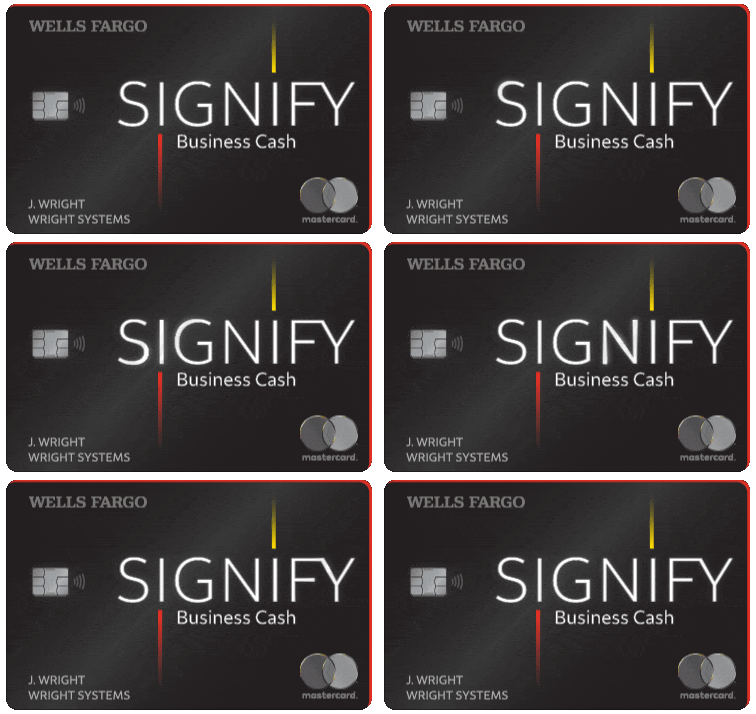
The Wells Fargo Signify Business Cash Card delivers a high flat-rate cashback option among no-annual-fee business cards. You earn on every purchase without tracking bonus categories or worrying about spending caps.
Why it wins for flat-rate simplicity: A flat 2% return on all purchases is compelling for businesses with diverse spending. A current welcome offer and introductory APR period can add upfront value, while cell phone protection is a practical perk for teams with company devices.
The tradeoff is lack of advanced controls. Wells Fargo doesn't offer the built-in spend management, automated receipt capture, or real-time policy enforcement that newer platforms provide.
Ideal for: Businesses that want the simplest high flat rate without tracking categories and don't need integrated expense management software.
U.S. Bank Business Triple Cash Rewards Visa Business Credit Card

- High cashback potential on qualifying purchases
- No annual fee
- Statement credit for software subscriptions
- Foreign transaction fees apply
- Bonus categories may not suit all businesses
The U.S. Bank Triple Cash Rewards Visa combines category bonuses with a practical software credit. The 3% categories cover common business expenses, and the $100 annual credit toward accounting or business software offsets tool costs you're likely already paying.
Why it wins for category bonuses plus SaaS credit: The combination of elevated category cashback and a recurring software rebate makes this card stand out for businesses that spend heavily on gas, dining, office supplies, or phone service while also paying for accounting tools.
The tradeoff is complexity. You need to ensure spending aligns with the 3% categories to maximize value, and the card lacks integrated expense management.
Ideal for: Businesses with concentrated category spend that also pay for SaaS tools like FreshBooks or QuickBooks.
Chase Ink Business Cash Credit Card

- If you spend a lot on office supplies or on internet, phone and cable services, this card caters to that
- Cardholders are automatically checked for a credit line increase every 6 months or sooner
- The card offers 5% cash back on Lyft rides through September 2027
- Earn 1% cash back on all other purchases with no limit
- Bonus cash back categories are capped at $25,000 in combined purchases per account anniversary year
- A foreign transaction fee of 3% is charged on purchases made outside the U.S.
- Cash back rewards are limited to 1% on all purchases outside the bonus categories
- 10% Business Relationship Bonus is only available if you have a Chase Business Checking account on your first card anniversary
The Chase Ink Business Cash Credit Card is the strongest category-based option for businesses with heavy office supply or telecom expenses. The 5% tier covers purchases at office stores like Staples and Office Depot, plus internet, cable, and phone services, a combination that aligns well with everyday business needs.
Why it wins for high category cash back: Few cards match 5% on these categories, and the $0 annual fee means you capture value without a fee to offset. The 0% intro APR for 12 months helps with planned purchases.
The tradeoff is the annual cap. Once you exceed $25,000 in combined 5% category spend, rewards drop to 1%. Businesses with very high telecom or office expenses may hit this limit.
Ideal for: Businesses with heavy office-supply and telecom spend that can maximize the 5% tier without hitting the annual cap.
How to choose the best cashback business card for your business
The cashback percentage matters, but it's only one part of the decision. To choose a card that delivers value, evaluate how rewards are earned, redeemed, and supported by the card's broader features.
Cashback structure
Business cashback cards typically use one of three reward structures:
- Flat-rate cashback: Earns the same percentage on every purchase, regardless of category. This works well for businesses with diverse spending patterns that don't want to track bonus categories.
- Category-based cashback: Offers higher rewards in specific categories such as travel, advertising, or software. These cards can be lucrative if your spending aligns with the bonus categories.
- Rotating categories: Provides elevated cashback in categories that change periodically. While potentially rewarding, these cards require more active management and planning.
To figure out which structure fits, review your expenses over the last three to six months. Most businesses concentrate spending in a few core areas — office supplies, telecommunications, and travel and dining. If more than half of your spend falls into one or two categories that a card rewards at an elevated rate, a category card will likely deliver more value. If it's spread across many types of purchases, a flat-rate card offers simplicity and consistent returns.
Annual fees vs. rewards potential
Cards with annual fees often offer higher cashback rates or additional benefits. To decide whether a fee is worth it, calculate your break-even point:
Spending required to break even = Annual fee / Cashback percentage
For example, a $95 annual fee paired with a 0.5% flat-rate cashback card would require about $19,000 in annual spending to break even. Spending beyond that threshold generates net returns.
At higher cashback rates, the break-even drops significantly. A $95 fee at 1.5% cashback breaks even at about $6,333 in annual spending.
| Annual fee | Cashback rate | Break-even spend |
|---|---|---|
| $95 | 0.5% | ~$19,000 |
| $95 | 1.5% | ~$6,333 |
| $95 | 2% | $4,750 |
Welcome bonuses and introductory offers
Many cashback business cards offer welcome bonuses after meeting a minimum spend requirement. These can provide immediate value if the spending threshold aligns with your normal expenses.
Look for offers with:
- Realistic spending requirements
- Introductory 0% APR periods for planned purchases
- First-year fee waivers that improve early value
Redemption options and flexibility
Redemption rules affect how easily you can access rewards. Common options include statement credits, direct deposits, or transfers through issuer portals.
Cards with automatic redemption and no minimum thresholds simplify accounting and reduce the risk of unused rewards. Running a cash flow analysis alongside your rewards review can help you see exactly how much those credits contribute to your monthly position.
Additional benefits beyond cashback
Beyond rewards, card features can significantly impact overall value:
- Expense tracking and reporting tools
- Employee card controls
- Purchase protection and extended warranties
- No foreign transaction fees
For many businesses, these operational benefits can save more time and money than cashback alone.
Automation compounds cashback value in less obvious ways. A card that automatically captures receipts and codes transactions to the right GL accounts eliminates hours of month-end reconciliation work, freeing your team to focus on higher-value tasks.
Credit requirements
Traditional cashback business cards often require good to excellent personal credit. Newer businesses or owners with limited credit history may need to consider secured cards or options that evaluate business performance instead of personal credit scores.
Some modern business cards approve companies based on factors like cash flow and bank balances rather than founder credit history. This approach can make higher credit limits accessible without a personal guarantee. Understanding liquidity forecasting can help you demonstrate the kind of financial health that supports approval for these programs.
Ramp takes this approach: no personal guarantee and no personal credit check, with applications approved in under 48 hours and up to 20x higher credit limits than traditional business cards by underwriting on cash flow and bank balances.
How to maximize your business cashback rewards
To maximize cashback, start by reviewing your expense reports from the past six to twelve months. Understanding where your business spends the most helps you choose cards that consistently reward those purchases.
If spending is concentrated in a few categories, a category-based cashback card may deliver higher returns. If expenses are spread across many vendors or categories, a flat-rate card often provides more reliable value with less effort.
Some businesses increase rewards by timing large purchases around welcome bonus requirements or introductory offers. Others use multiple cards to earn higher cashback on specific categories. While these approaches can boost returns, they also add complexity and administrative overhead.
As businesses grow, simplicity often matters more than optimization. Straightforward cashback structures with automatic redemption are easier to manage and less likely to leave rewards unused.
Here's a quick checklist to maximize cashback:
- Align your card to your top spending categories
- Hit welcome-bonus thresholds with planned purchases you'd make anyway
- Avoid carrying a balance, which erodes rewards through interest charges
- Distribute cards to key employees who frequently incur business expenses
- Consolidate your business expenses onto your card
Where businesses earn the most cashback
Understanding where businesses tend to earn the most cashback can help set realistic expectations when choosing a card. Some categories generate higher returns not because they dominate spending, but because reward structures align well with how those purchases are classified.
Based on Ramp customer data from June 2025, the following categories generated the highest average annualized cashback per business:
- Advertising: $5,217
- General merchandise: $2,440
- SaaS and software: $1,642
- Cloud computing: $1,503
- Lodging: $1,428
While these categories may not represent your largest expense lines, they often deliver outsized cashback returns. Reviewing your own spending mix can help determine whether a flat-rate or category-based cashback card is likely to perform better for your business.
Discover Ramp's corporate card for modern finance
How to redeem your cashback rewards
How you redeem cashback depends on the card issuer's rewards program. The most common option is applying rewards as a statement credit, which directly reduces your balance. Some issuers also allow direct deposits into a business checking account, giving you more flexibility in how funds are used.
Other cards offer redemption through issuer portals for travel, gift cards, or merchandise. While these options add choice, they often provide less value than straightforward cash redemption and can require additional steps.
Redemption friction is a meaningful consideration when choosing a card. Automatic statement credits and direct deposits can make rewards easier to use, while minimum redemption thresholds, expiration policies, and portal-only redemptions can add avoidable work.
Ramp takes a simpler approach: cashback is applied automatically as a statement credit, with no minimum thresholds or manual redemption required. That reduces administrative work and ensures rewards aren't forgotten or left unused.
Before choosing a card, review redemption rules carefully. Some issuers require minimum balances to redeem cashback or impose expiration policies tied to account activity or product changes. Keeping business tax records that document your rewards redemptions is also worth building into your year-end routine.
Are business cashback rewards taxable?
Business cashback earned on purchases is generally treated by the IRS as a rebate or reduction in the purchase price, not as taxable income. This means it usually isn't taxable.
- Expense adjustment: Because cashback reduces the effective cost of the purchase, you should net the cashback against the related business expense. Deducting the full pre-cashback cost while keeping the rebate can overstate a deduction.
- Exception for non-spend rewards: Rewards not tied to spending, such as a sign-up bonus with no spend requirement, may be treated differently and could be taxable
This isn't tax advice. Confirm treatment with your accountant or tax advisor based on your specific situation.
Turn everyday spending into savings with Ramp
The best cashback business credit cards help you earn while you spend. Whether you're covering software subscriptions, travel, or everyday operations, the right card can return a portion of that spend to your bottom line.
Ramp's business credit card stands out for businesses that value automation, speed, and control. Ramp offers cashback rewards on purchases, with no interest or foreign transaction fees. You don't need to manage points or activate categories. Cashback is applied automatically, with no redemption steps. Ramp also requires no personal guarantee and integrates directly with accounting tools, helping you streamline spend and compliance in one place.
Get started with a Ramp business credit card.
At Ramp, transparency and integrity are core values guiding our content. We believe in the exceptional value of our products, which may shape our perspective. Our methodical approach involves competitor analysis, comparison of credit cards, and frequent reviews to maintain reliability. Review our full methodology for choosing the best business credit cards.
1 These figures represent historical averages across Ramp customers and are not indicative of individual results or future performance.

FAQs
Yes, but approval depends on your business's financial profile. Some cards may require established revenue or time in business. If you're just starting out, consider cards that evaluate cash flow over credit history, like Ramp.
Many business cards report only to business credit bureaus, but some also report to personal credit bureaus if you miss payments or carry a balance. Ramp does not report to personal credit bureaus at all.
Most business credit cards, including those from Chase, Capital One, and Ramp allow you to issue employee cards at no additional cost. All purchases made on those cards typically earn cashback for the primary account.
Compare how much you spend in a card's bonus categories against what you'd earn with a flat-rate card. If most of your spending falls into one or two bonus categories, a category card can deliver higher returns. If your spending is spread across many categories, a flat-rate cashback card is usually the simpler and more reliable choice.
Besides cashback, some business credit cards earn points or miles that can be redeemed for travel, merchandise, or statement credits through issuer portals. Others offer cash equivalents that must be redeemed in specific ways, such as travel bookings, or provide partner discounts on services like shipping, software, or advertising. Cashback remains the simplest option because it delivers predictable value without redemption friction, which is why many businesses prefer it over points-based programs.


“I assumed I would have to choose between speed and control. What I found is that you can have both. A well-designed system takes friction out, for the finance function and for everyone else.”
Justin Webster
CFO, Denver Broncos

“A well-run district should not have to choose between getting work done at the school site and keeping control of the dollars behind it. We're not hiring more people to do more jobs, so we have to be smarter about the process. With Ramp, the purchase, the receipt, and the record stay together from the start. ”
Nick Brizeno
Director of Purchasing, San Marcos Unified School District

“In senior living, scale only works if the communities still feel personal. We needed the back office to carry more of the complexity, not the people serving residents. Ramp helped us build that infrastructure, so the experience in the community could stay human.”
Ryan Cole
CFO, Agemark Senior Living

“AI is moving faster than the finance context around it. Prices change, models change, and the value is not always obvious from an invoice. We needed enough detail to know which bets deserved more investment — and which ones did not.”
Greg Cooley
Controller, AngelList

“Invoices, cards, tokens. The categories change but the principle doesn't: know where the money is going, remove the work around it, and make sure the spend is worth it.”
Maciej Mylik. Finance
ElevenLabs

“We weren’t trying to retrofit an old finance system. We had a blank canvas, and Ramp gave us the foundation to build a global finance function of the future.”
Justin Dourado
Director of Finance, Othership

“There's just no surprises anymore. No more waiting two months to find out how a job did. We know how it's doing as it's happening.”
Erich Kuss
Financial Systems Manager, Infinity Home Services

“More token spend isn’t proof that AI is working. Less isn’t proof that it isn’t. What matters is whether we’re buying the right level of intelligence for the work. Ramp lets us make that judgment in the same place we manage every other type of spend.”
Cody Nutt
Senior Director of Business Systems, Daxko
