
- Why enterprise spend management matters for CFOs
- What CFOs should look for in enterprise spend management
- Key metrics CFOs should track for spend management
- How to evaluate enterprise spend management platforms
- The cost of staying with legacy spend management
- Building the CFO business case for spend management
- Where to go from here
- How Ramp Enterprise helps CFOs take control of spend
- Built for enterprise CFOs
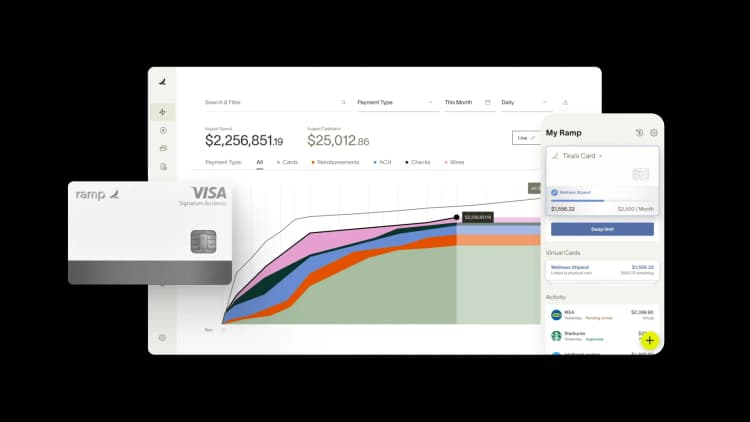
Spend management isn't always top-of-mind for CFOs at large enterprises. Between board prep, M&A integration, and capital allocation decisions, the mechanics of how employees spend money can feel like someone else's problem.
That changed in 2026. Enterprise CFOs are now personally owning vendor rationalization—52% of CFOs cite cost management as their #1 internal concern according to the Deloitte CFO Signals in Q1 2026. Cost pressure has also moved procurement authority up to the CFO level and every spend management platform is now in the line of sight of the person who controls the budget.
But once an organization crosses 5,000 employees with dozens of entities across multiple countries, uncontrolled spend starts showing up where it hurts, in slower closes, stale board data, and audit gaps that no one saw coming.
This guide covers what CFOs need to evaluate. The strategic case for spend management, what to look for in a platform, how to build the business case, and where the cost of inaction hides.
Why enterprise spend management matters for CFOs
For CFOs at 5,000+ employee organizations, enterprise spend management directly affects close speed, audit readiness, margin, and how fast finance can move without losing control. The decisions CFOs make now about their spend management infrastructure determine what their finance team can and can't do in the months and years to come.
1. Real-time visibility for faster decisions
Real-time visibility means seeing spend across every entity, department, and geography as transactions happen, not days or weeks later during reconciliation. Without it, the board gets a cash position that's two weeks stale, capital allocation decisions are based on incomplete data, and M&A integrations add complexity without visibility.
Enterprise spend management closes that gap by consolidating spend data across every channel, from cards and expenses to bill pay and procurement, into a single live view integrated with your ERP.
2. Margin protection and cost optimization
Enterprise spend management protects margin by giving you direct control over where money goes before it's spent, not after. Well-governed programs typically deliver 5–10% cost savings in year one through tighter controls, vendor consolidation, and better payment timing.
Beyond direct savings, it improves working capital. Cash forecasting becomes more accurate, and finance teams can time payments to extend cash cycles.
3. Reduced compliance risk and faster close
Compliance risk drops and close accelerates when every transaction carries a complete audit trail by default, from receipt capture through coding, approval, reconciliation, and ERP sync. For public companies, SOX Section 404 requires preventive controls, detective controls, documented evidence, and traceable activity. Most enterprise finance teams still assemble this manually.
Spend management platforms that build the audit trail automatically make continuous compliance the default operating state.
4. Operational leverage across a growing entity footprint
Every acquisition adds entities, GL structures, approval chains, and local compliance requirements. Without automation, each new entity multiplies manual work across invoice processing, receipt collection, reconciliation, and policy enforcement. Enterprise spend management absorbs that complexity so your finance team can integrate new entities without proportionally growing headcount.
For CFOs managing 10, 20, or 50+ entities across acquisitions and international offices, the question is whether your systems can handle the next acquisition without adding headcount.
What CFOs should look for in enterprise spend management
Enterprise spend management platforms vary widely, but CFOs should consistently prioritize the same capabilities: unified architecture, pre-transaction controls, deep ERP integration, multi-entity support, and auditable AI.
AI is increasingly central to how modern enterprise spend management platforms operate. Agentic controls handle policy enforcement, transaction coding, and anomaly detection in real time.
What this means for CFOs in practice is that embedded AI evaluates 100% of transactions against policy, surfaces the exceptions that need human judgment, and produces audit-ready documentation automatically. For enterprise adoption, the bar is explainability and governance.
Unified platform architecture
A unified platform puts corporate cards, expense management, bill pay, procurement, and accounting automation on one shared data layer, eliminating the reconciliation work that comes from stitching together point solutions. One system of record means one close process, not five reconciliations.
For enterprises, employee adoption drives compliance. If submitting an expense takes more than two minutes, finance teams spend the rest of the month chasing what didn't get submitted
The platforms that win enterprise evaluations tend to be the ones employees use. Good controls only work if people don't route around them.
Pre-transaction spend controls and policy enforcement
The typical enterprise setup is a bank-issued corporate card from an issuer, feeding transaction data into a legacy platform like Concur. The card and the software are separate systems, which means policy enforcement happens after the money is already spent.
When the card itself is part of the platform, controls are enforced at the point of purchase. Merchant restrictions, category blocks, and spending limits are built into the card rather than layered on after the fact.
With embedded AI policy enforcement, up to 85% of routine, compliant transactions are removed from manual review entirely, freeing your team to focus on the exceptions that need human judgment.
Deep ERP integration for enterprise accounting
At the enterprise level, this means entity-level GL mapping, custom export schemas, bi-directional real-time sync, and support for the specific configurations your accounting team has built over years.
Integration depth is often the deciding factor in enterprise spend management evaluations. A platform that integrates with NetSuite, Sage Intacct, Workday, Oracle Fusion, or Microsoft Dynamics at the entity and field level removes the most persistent source of manual close work.
Multi-entity and global spend management
This requires a platform that treats multiple entities as a core design principle. Each entity needs its own billing, local bank account funding, expense policies, and accounting settings, all visible from a single consolidated view.
At the scale of 10, 20, or 50+ entities across acquisitions and international offices, this also means card issuing in local currencies, international reimbursements, multi-currency spend limits, entity-level compliance across jurisdictions, and the ability to handle local tax requirements and regulatory obligations in each country of operation.
AI and intelligent automation
54% of enterprise CFOs are already deploying AI agents in finance, according to Deloitte's Q4 2025 CFO Signals survey. The pressure to move fast is real, but the playbook hasn't caught up. Regulators are still writing the rules, auditors are still figuring out what to ask, and CFOs are signing off on AI controls before the industry has agreed on what those controls should look like.
A good spend management platform shouldn't add to that uncertainty. It should come with explainable, auditable AI decisions, human-in-the-loop controls, and model risk management built in.
Want to impress your C-suite? These 5 AI strategies for finance leaders will get leadership's attention →
Key metrics CFOs should track for spend management
Selecting the right enterprise spend management platform is half the decision. The other half is knowing whether it's working. These are the metrics CFOs should track to measure platform performance and financial impact.
| Category | What to track | Why it matters |
|---|---|---|
| Spend visibility and coverage | • Percentage of total spend on-platform with policy coverage • Real-time vs. forecasted spend variance by business unit • Percentage of spend in controlled channels vs. unmanaged | Tells you how much of your organization's spend you can actually see and control. Gaps here mean blind spots in forecasting and governance. |
| Operational efficiency | • Month-end close time (days) • Invoices processed per FTE • Approval turnaround time • Auto-coded transaction rate • Receipt compliance rate | Measures whether the platform is reducing manual work or just moving it. Connects directly to whether finance is spending time on processing or analysis. |
| Financial impact | • Cost savings from vendor consolidation and spend prevention • Working capital improvement (DPO, cash forecast accuracy) • Card rebate income as percentage of addressable spend, audit cost reduction | Quantifies hard-dollar return. These are the numbers that show up in your board presentation. |
| Risk and compliance | • Out-of-policy transaction rate • Exception rate • Documentation completeness for audit trails • Time-to-produce for auditor requests | Tracks governance posture. For public companies, maps directly to SOX compliance readiness and external audit costs. |
How to evaluate enterprise spend management platforms
The trigger for evaluating spend management platforms varies. It might be a contract renewal, a post-acquisition systems integration, an ERP migration, or an inherited mandate to modernize. Whatever the catalyst, the evaluation is an opportunity to rethink what your spend infrastructure should look like.
A contract renewal gives you time for a thorough RFP; an acquisition may demand speed and flexibility. Either way, the capabilities you prioritize should reflect where your organization is headed, not just where it is today.
1. Build the right buying committee early
Enterprise spend management evaluations involve more stakeholders than most software purchases. The CFO, Controller or VP of Finance, CIO, procurement, and end users who determine adoption all play a role. The most common mistake is not engaging IT early enough.
Evaluations frequently stall when the CIO's team raises security, integration, or data governance concerns late in the process. Getting an internal champion involved early keeps the process moving. That person should be able to build the business case, run the technical evaluation, and communicate platform value to the board.
2. Define success criteria beyond the feature list
Before evaluating platforms, map your current state. Document how many systems are involved, what they cost to maintain including IT overhead and manual workarounds, and where the biggest pain points are in close, audit prep, and daily operations.
Then frame the evaluation around outcomes rather than features.
3. Insist on an honest implementation plan
Phased rollouts by entity, region, or department are standard for enterprise spend management implementations. Any vendor that promises an all-at-once migration for a 5,000-person organization either hasn't done it at that scale or isn't being straightforward about the complexity. Ask where implementations typically get bumpy and how they handle it.
What's the difference between a CFO and a CIO in enterprise spend management?
The CFO owns the financial strategy and is typically the final decision-maker on spend management platforms. The CIO owns security, architecture, and data governance, and is responsible for evaluating whether a platform meets enterprise IT requirements. Both roles are critical to a successful evaluation.
The cost of staying with legacy spend management
Most enterprise CFOs overestimate the cost of switching spend management platforms and underestimate the cost of staying. The status quo has real, measurable costs that tend to go unquantified because they're spread across teams.
Consider what disconnected systems cost you.
- 10+ days of month-end close time due to manual reconciliation
- Audit prep hours that automated documentation would eliminate
- IT staff dedicated to maintaining legacy platforms
- Policy violations and duplicate payments that slip through retroactive controls
- Board-ready reporting that takes days to assemble across five different systems
Once you add those up, the switching cost is almost always smaller than what you're already absorbing.
Building the CFO business case for spend management
A board-level business case for enterprise spend management should address four areas.
- Risk reduction: How the new platform strengthens governance, audit readiness, and fraud prevention. For public companies, this maps directly to SOX compliance and external audit costs, which run into millions annually.
- Operational efficiency: How automation reduces manual work across the finance team. Close time reduction, receipt and reconciliation automation, and the ability to scale transaction volume without scaling headcount.
- Visibility and decision speed: How real-time spend data improves cash forecasting, budget management, and strategic planning. CFOs who can answer the board's spend questions in real time have a stronger position than those waiting on a two-week close.
- Total cost of ownership: The fully loaded comparison, not just platform cost. Include IT maintenance, integration fees, manual process costs, and the opportunity cost of finance hours spent on work automation could handle.
The strongest business case shows what the current approach costs, what changes with the new platform, and how you'll measure whether it worked.
Where to go from here
Early in the evaluation process, the frameworks above help you map your current state and define what to look for. Further along, the ROI framing and evaluation criteria give you a structure for the business case.
The core question for any enterprise CFO is whether your finance organization spends more time processing transactions than analyzing them. If it does, the architecture needs to change.
Ramp Enterprise was built around this architecture.
How Ramp Enterprise helps CFOs take control of spend
Ramp Enterprise is an AI-powered global spend management platform built for multi-entity organizations, unifying corporate cards, expense management, bill pay, procurement, travel, and accounting automation on a single platform with a shared data layer.
With local currency issuing across 30+ markets and coverage in 190+ countries, Ramp’s agentic AI controls span from policy, fraud, and accounting to proactively prevent out-of-policy spend before it happens.
Ramp's Policy Agent uses agentic AI to evaluate every transaction against organizational policy in real time, auto-approving compliant spend and surfacing exceptions for review. Early customers are catching 7x more out-of-policy spend with the Policy Agent compared to before.
Here's what that looks like across the capabilities CFOs care about most.
Consolidated visibility and governance across the organization
Ramp gives CFOs a single, real-time view of spend across every entity, channel, and geography updated as transactions happen, not in batch exports. 95% of businesses report improved visibility after switching. Specifically, Ramp Enterprise provides:
- Continuous reconciliation across all entities and subsidiaries, no waiting for month-end to see where you stand
- Entity-level dashboards that surface spend trends, budget variance, and policy exceptions across the entire organization
AI-powered controls that prevent waste before it happens
Ramp's AI layer is built into every transaction, not bolted on after the fact.
- Policy Agent reviews every transaction against organizational policy and historical context, auto-approving low-risk items, flagging anomalies, and providing explainable reasoning, with 99% accuracy on in-policy determinations
- Fraud detection quarantines duplicate receipts, repeated merchant anomalies, and patterns consistent with policy circumvention
- Accounting Agent auto-codes transactions to entity-specific GL accounts using rules and ML, with real-time posting that removes end-of-month bulk work
- Up to 8.5% of total card spend prevented through Ramp's proactive controls and workflows
- Up to 85% of transactions removed from manual review through Ramp's AI, freeing finance teams to focus on exceptions that need human judgment
Multi-entity, multi-currency global operations
Every acquisition adds entities, GL structures, and local compliance requirements, which only increase in complexity with geographic expansion. On legacy platforms, integration is a multi-month project that finance teams absorb while the next deal is already closing.
Ramp Enterprise supports global finance teams with multi-entity management built into the core platform.
- Entity-level billing, local bank account funding, expense policies, and accounting configuration from a single platform
- Local currency card issuing in 30+ countries, with coverage across 190+ countries
- International reimbursements paid in local currency in most countries globally
- Phased, risk-managed global rollouts with dedicated implementation support
Deep ERP and ecosystem integration
Ramp integrates at the depth enterprise accounting teams require, not surface-level connectors.
- Real-time bi-directional sync with NetSuite, Sage Intacct, Oracle Fusion, Acumatica, Microsoft Dynamics (F&O and Business Central), Workday, and more
- Entity-level GL mapping, custom export schemas, and SFTP support for legacy systems
- HRIS continuous sync for automated provisioning and manager mapping
- 200+ integrations across ERP, HRIS, travel, and operational tools
Enterprise-grade security and compliance
Ramp Enterprise meets the security and compliance standards enterprise CFOs and CIOs require.
- SOC 2 Type II, ISO 27001, PCI DSS certified
- SSO/SAML and SCIM provisioning for automated user lifecycle management
- Role-based access controls with segregation of duties
- Immutable audit trails for every transaction and action
What this means for CFOs
Ramp Enterprise drives results across five areas enterprise companies are evaluated on the most:
- Reduce SG&A: Autonomous expense coding, policy-embedded automation, and continuous reconciliation lower finance operations costs
- Eliminate wasteful spend: Real-time card controls and AI policy auditing across 100% of transactions retain cash that would otherwise be spent
- Reduce FTE time: Zero-touch expense creation, AI receipt capture, and autonomous low-risk approval eliminate manual entry and review
- Strengthen compliance: Continuous policy auditing with full audit trails moves from random-sample audits to full-coverage auditability
- Improve working capital: Shifting vendor payments to card extends cash float, while automated duplicate detection and real-time spend data improve forecasting
Ramp Enterprise gives CFOs a single platform to control spend, close faster, and scale finance operations without scaling headcount, so your team spends less time processing and more time on the decisions that move the business.
Built for enterprise CFOs
Enterprise CFOs need a spend management platform that matches the complexity they're actually managing: multiple entities, global operations, fast close timelines, and a board that expects real-time answers. Ramp Enterprise was built for exactly that.
Thousands of finance teams have already moved from fragmented tools and manual reconciliation to a single platform with real-time visibility and controls across every entity and channel. If you want to see how Ramp Enterprise fits your specific entity structure, ERP environment, and close process, our team will walk you through it using your actual use case.
Explore Ramp Enterprise.


“I assumed I would have to choose between speed and control. What I found is that you can have both. A well-designed system takes friction out, for the finance function and for everyone else.”
Justin Webster
CFO, Denver Broncos

“A well-run district should not have to choose between getting work done at the school site and keeping control of the dollars behind it. We're not hiring more people to do more jobs, so we have to be smarter about the process. With Ramp, the purchase, the receipt, and the record stay together from the start. ”
Nick Brizeno
Director of Purchasing, San Marcos Unified School District

“AI is moving faster than the finance context around it. Prices change, models change, and the value is not always obvious from an invoice. We needed enough detail to know which bets deserved more investment — and which ones did not.”
Greg Cooley
Controller, AngelList

“Invoices, cards, tokens. The categories change but the principle doesn't: know where the money is going, remove the work around it, and make sure the spend is worth it.”
Maciej Mylik. Finance
ElevenLabs

“We weren’t trying to retrofit an old finance system. We had a blank canvas, and Ramp gave us the foundation to build a global finance function of the future.”
Justin Dourado
Director of Finance, Othership

“There's just no surprises anymore. No more waiting two months to find out how a job did. We know how it's doing as it's happening.”
Erich Kuss
Financial Systems Manager, Infinity Home Services

“More token spend isn’t proof that AI is working. Less isn’t proof that it isn’t. What matters is whether we’re buying the right level of intelligence for the work. Ramp lets us make that judgment in the same place we manage every other type of spend.”
Cody Nutt
Senior Director of Business Systems, Daxko

“Most banks treat the back office as a cost to keep down. We treat ours as a return to compound, which is why we run it on Ramp. Now we put our clients on Ramp, too.”
Patrick Gaughen
President & COO, Hingham Institution for Savings
