Expensify vs. Zoho Expense: Evaluating the right platform

- Expensify at a glance
- Zoho Expense at a glance
- Expensify vs. Zoho Expense: How the features compare
- Key considerations when comparing Expensify and Zoho Expense
- Pricing: What you’ll actually pay
- Ramp: Built to scale without compromises
- Bottom line
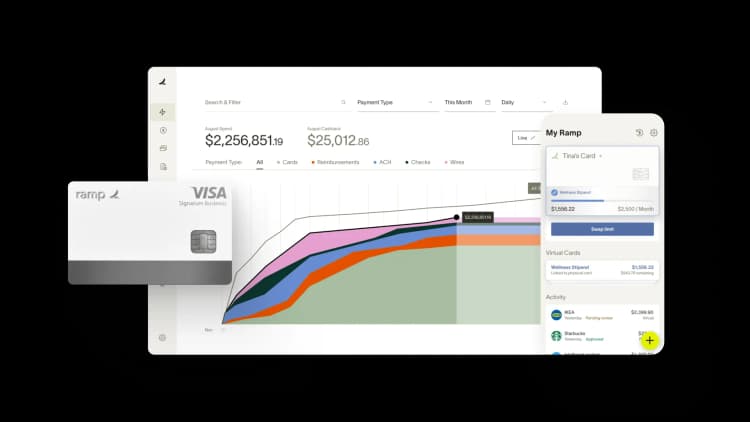
Expensify and Zoho Expense are two familiar names in expense management. Both promise to streamline reporting and reimbursement—but they cater to different use cases. Expensify is focused and mobile-first; Zoho Expense offers deeper integration if you're already using Zoho apps.
Still, many finance leaders end up dealing with trade-offs: a tool that’s too basic or one tied into a broader system you don’t fully use. Below we’ll compare Expensify and Zoho Expense on core features, pricing, and user sentiment — then show why Ramp offers a more balanced alternative.
Expensify at a glance
Expensify is best known for mobile receipt scanning and reimbursements. Employees can snap photos of receipts, log mileage, and get reimbursed quickly. Its simplicity makes it a favorite among small teams and startups.
Where Expensify falls short is in scalability. Approval workflows are limited, advanced features come with higher tiers, and integrations are mostly geared toward SMB accounting platforms. As complexity grows, Expensify often struggles to keep up.
Zoho Expense at a glance
Zoho Expense is part of the larger Zoho suite, which includes CRM, HR, and finance applications. Its biggest appeal is tight integration with Zoho’s other tools — making it attractive for businesses already committed to that ecosystem.
On its own, Zoho Expense provides mileage tracking, receipt capture, approval workflows, and reporting. But the trade-off is that it can feel less flexible for companies outside Zoho, and the interface is often described as less intuitive than modern standalone tools.
Expensify vs. Zoho Expense: How the features compare
Expensify emphasizes simplicity, while Zoho Expense leans into its suite connections. Ramp takes a different path, combining automation, cards, and integrations in a single platform that scales.
Feature | Expensify | Zoho Expense | Ramp |
|---|---|---|---|
Expense capture and reporting | ✓ | ✓ | ✓ |
Corporate/virtual cards | Limited | No | ✓ |
Approval workflows | ✓ | ✓ | ✓ |
Integrations | ✓ | ✓ | ✓ |
Analytics and visibility | ✓ | ✓ | ✓ |
Pricing model | Per-user Add-ons for advanced features | Free for 3 users, then per-user tiers | $0 per user for free tier |
Customer support | Limited | Limited | ✓ |
Key considerations when comparing Expensify and Zoho Expense
Feature and pricing comparisons highlight how both tools serve their purpose, but also expose their limitations. For finance leaders making a decision, the choice often comes down to a few bigger-picture questions about fit, growth, and flexibility.
Ecosystem dependency vs. flexibility
Zoho Expense shines when it’s used alongside the broader Zoho suite. The integration with other Zoho apps can be powerful — but for teams not invested in that ecosystem, the tool can feel disconnected from the rest of their finance stack. Expensify, on the other hand, is more agnostic, but its integrations are lighter and focused mostly on SMB accounting.
Simplicity vs. completeness
Expensify is designed to be lean and easy to use, which works well for small teams but can quickly feel restrictive as needs evolve. Zoho Expense offers more layered functionality, but that added breadth can introduce extra complexity, especially for businesses not already standardized on Zoho tools.
Long-term scalability and lock-in
For growing companies, Expensify risks becoming too basic once headcount and approval needs increase. Zoho Expense can scale within its suite, but that often requires deeper buy-in across multiple Zoho products. Businesses weighing the two are essentially choosing between outgrowing their system or committing to a single vendor’s ecosystem.
Pricing: What you’ll actually pay
Pricing models can be just as important as features when evaluating expense tools. While both Expensify and Zoho Expense start with per-user fees, the way pricing scales—and what’s included—looks very different.
Expensify
Collect starts at $5 per member/month; the Control plan is custom-priced per active member. Discounts may apply based on commitment and card usage.
Zoho Expense
A Free plan covers up to 3 users. Paid tiers are Standard (from $5 per active user/month, 3-user minimum) and Premium (from $9 per active user/month, 3-user minimum), with additional enterprise options.
Ramp offers a free plan at $0/mo/user that includes unlimited cards, auto-receipt matching, and core integrations, with paid tiers available as you scale.
Ramp: Built to scale without compromises
Expensify is lightweight but limited, and Zoho Expense delivers the most value only when paired with the broader Zoho ecosystem. Ramp takes a different approach: one platform that combines corporate cards, bill pay, travel, and automation in a way that’s flexible enough for any stack and powerful enough to scale.
On G2, Ramp holds a 4.8/5 rating. Finance leaders consistently point to Ramp's intuitive design, ease of onboarding, and integrated cards.
Expense management without the busywork
With Ramp, receipts are automatically matched to transactions, policies are enforced in real time, and expenses sync directly into accounting. Finance teams spend less time chasing down employees and more time focusing on strategy.
Cards designed for control
Ramp includes unlimited virtual and physical cards with built-in limits and controls. Unlike Expensify, which is limited to its own card, and Zoho Expense, which doesn’t offer native cards, Ramp makes proactive spend management part of the platform itself.
Integrations beyond a single ecosystem
Ramp works with QuickBooks, Xero, NetSuite, and Sage, as well as HRIS and collaboration tools. Unlike Zoho Expense, which is strongest when bundled with other Zoho apps, Ramp integrates across different systems so finance teams aren’t locked into one vendor’s ecosystem.
Real savings you can measure
On average, Ramp customers save 7.5% annually by uncovering duplicate subscriptions, negotiating vendor contracts, and surfacing spend inefficiencies. These savings directly improve your bottom line.
Fast to implement, easy to use
Teams can get Ramp live in days rather than months, with an intuitive interface that finance teams consistently praise for ease of use. Finance leaders highlight fast onboarding and lower ongoing admin as key reasons for switching.
Together, these differences make Ramp the rare alternative that combines usability, flexibility, and scalability without hidden costs or ecosystem lock-in.
Bottom line
Expensify is simple but struggles with scale. Zoho Expense is affordable and fits best if you’re already tied into the Zoho ecosystem.
Ramp gives finance leaders the best of both worlds: automation, scalability, and visibility — without hidden costs or lock-in. That’s why more than 85,000 finance teams trust Ramp to modernize spend management. With Ramp, you don’t have to choose between simplicity and flexibility. You get both in one spend management platform.


“I assumed I would have to choose between speed and control. What I found is that you can have both. A well-designed system takes friction out, for the finance function and for everyone else.”
Justin Webster
CFO, Denver Broncos

“A well-run district should not have to choose between getting work done at the school site and keeping control of the dollars behind it. We're not hiring more people to do more jobs, so we have to be smarter about the process. With Ramp, the purchase, the receipt, and the record stay together from the start. ”
Nick Brizeno
Director of Purchasing, San Marcos Unified School District

“In senior living, scale only works if the communities still feel personal. We needed the back office to carry more of the complexity, not the people serving residents. Ramp helped us build that infrastructure, so the experience in the community could stay human.”
Ryan Cole
CFO, Agemark Senior Living

“AI is moving faster than the finance context around it. Prices change, models change, and the value is not always obvious from an invoice. We needed enough detail to know which bets deserved more investment — and which ones did not.”
Greg Cooley
Controller, AngelList

“Invoices, cards, tokens. The categories change but the principle doesn't: know where the money is going, remove the work around it, and make sure the spend is worth it.”
Maciej Mylik. Finance
ElevenLabs

“We weren’t trying to retrofit an old finance system. We had a blank canvas, and Ramp gave us the foundation to build a global finance function of the future.”
Justin Dourado
Director of Finance, Othership

“There's just no surprises anymore. No more waiting two months to find out how a job did. We know how it's doing as it's happening.”
Erich Kuss
Financial Systems Manager, Infinity Home Services

“More token spend isn’t proof that AI is working. Less isn’t proof that it isn’t. What matters is whether we’re buying the right level of intelligence for the work. Ramp lets us make that judgment in the same place we manage every other type of spend.”
Cody Nutt
Senior Director of Business Systems, Daxko
