Virtual cards for AI agents: How they work and what to look for

- What is a virtual card for AI agents?
- How virtual cards for agents work under the hood
- Key spending controls that keep agents in check
- Security features and tokenization
- Top use cases driving adoption of virtual cards for AI agents
- How to evaluate virtual card providers for AI agents
- Integrating agent cards with engineering and finance workflows
- Ramp Agent Cards: Tokenized virtual cards for AI agents
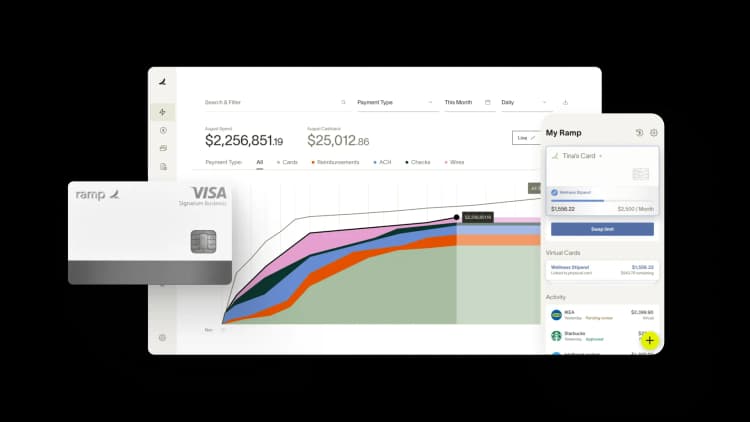
AI agents have moved beyond simply researching products for your business to buying them for you. Whether it's cloud storage, renewing a SaaS license, paying a vendor, or ordering coffee for the office, autonomous software increasingly needs a way to pay. Virtual cards for AI agents make that possible.
These programmable payment credentials give agents the ability to transact independently within guardrails you define. They combine the flexibility of virtual cards with the control and auditability that finance teams require. And with network-level standards like Visa Intelligent Commerce now live, this infrastructure is available today.
This post breaks down how agent cards work, the controls that keep spend in check, the security architecture behind them, and what to look for when choosing a provider.
What is a virtual card for AI agents?
A virtual card for AI agents is a programmable payment credential built specifically for autonomous agents to make purchases.
Instead of giving an agent your corporate card number, you issue a scoped, revokable virtual card configured for that agent's specific task. The agent only gets the access it needs: a card number with defined spend limits, merchant restrictions, and an expiration window. If something goes wrong, you can revoke the credential instantly without affecting any other payment methods on file.
Think of it as giving your agent a company card with preset rules that are enforced automatically, not by a human reviewing expense reports after the fact.
How does it differ from traditional virtual cards?
Traditional virtual cards are designed for people. You generate one in a dashboard, copy the number, and use it for an online purchase. Virtual cards for agents are designed for machines.
| Feature | Traditional virtual card | Agent virtual card |
|---|---|---|
| Issued by | Human via dashboard or app | API call from software agent |
| Policy enforcement | Manual review or basic rules | Automated, real-time policy evaluation |
| Integration | Browser-based checkout | API-first, orchestration-layer compatible |
| Transaction metadata | Standard merchant data | Enriched with agent IDs, cost centers, GL tags |
| Lifecycle management | Manual activation/deactivation | Programmatic issuance, expiration, and revocation |
The key differences come down to programmability and autonomy. Agent cards expose granular controls through APIs or CLI servers, integrate with orchestration layers like Model Context Protocol (MCP) servers, and operate without a human in the loop. They enable fully agentic commerce with autonomous policy evaluation, real-time decisioning, and telemetry built for machine-driven workflows.
How virtual cards for agents work under the hood
Agent cards have a predictable lifecycle: The agent requests a credential, receives transaction-scoped card details, executes a transaction with real-time authorization checks, and the card network posts settled charges to your funding account, complete with metadata for reconciliation.
Here's what each stage looks like:
1. Agent requests a card via API or MCP
The process starts when an agent needs to make a payment. It calls the card issuer's API or invokes an MCP server to mint a virtual card.
The request includes policy parameters like spend limits, allowed merchant category codes (MCCs), and expiration rules. The issuer's service validates the request against your organization's policies and returns tokenized credentials the agent can use at checkout.
MCP is worth noting here because it's becoming the standard way AI agents interact with external tools. Instead of building custom integrations for every payment provider, an agent using MCP can call a standardized card-issuance tool the same way it calls any other service. This is exactly how agent card issuing works with Ramp’s MCP.
2. Payment authorization and real-time limits
When the agent uses the card at checkout, the transaction hits the card network and issuer for authorization. Multiple checks happen in milliseconds:
- Spend caps: Is this transaction within the card's per-transaction or cumulative limit?
- Merchant category rules: Is this merchant on the approved MCC list?
- Velocity limits: Has the agent exceeded a defined number of transactions in a given time window?
- Geofencing: Is the merchant in an approved region?
If any check fails, the transaction is auto-declined. Anomaly detectors can also trigger step-up verification or immediately revoke the card if something looks off, like a sudden burst of rapid-fire purchases.
3. Transaction settlement and posting
Approved transactions settle through the card network just like any other card payment. Funds are debited from your selected funding source (a bank account, credit line, or prepaid balance).
Depending on your agent card issuing platform, you'll see each line item with tags for cost centers, GL accounts, and the specific agent ID that initiated the purchase. This metadata is what makes account reconciliation possible at scale without manual intervention.
Key spending controls that keep agents in check
Giving an AI agent a payment method without guardrails is a recipe for trouble. Agent cards expose fine-grained controls that limit your exposure, enforce budgets, and prevent unauthorized purchases before they happen.
Scoped transactions and spend limits
Depending on your issuer, the agent's virtual card may be scoped to just a single transaction. This eliminates any risk of error or overspending; the agent knows exactly what it's allowed to buy, from whom, and for how much. Any other attempted transaction will be blocked at the network level.
Some issuers may allow you to set a per-transaction spend limit on any one authorization. If an agent tries to make a purchase above the threshold, the transaction is automatically declined. These controls represent your first line of defense against costly mistakes, whether it's a bug, a misconfigured workflow, or an unexpected price change from a vendor.
Merchant category blocking
MCC-based policies restrict where an agent can spend. You define an allowlist of approved merchant categories or specific vendors, and any purchase outside that list gets blocked.
This prevents off-policy purchases like gift cards, consumer marketplaces, or expense categories that have no business showing up in your agent's workflow. It's a simple control, but it eliminates entire classes of misuse.
Time-bound expiration
Cards can auto-deactivate after a defined window. You set the expiration based on the task, whether you expect it to complete in minutes, hours, days, or months.
A card issued for a one-time purchase of office supplies might expire in an hour; a card for a monthly SaaS subscription might last a year. Time-bound expiration reduces the risk from stored credentials and forgotten recurring tasks that could otherwise keep spending indefinitely.
Security features and tokenization
Agent cards rely on a defense-in-depth strategy that spans tokenization, encryption, and scoped identity controls. The goal is to keep raw card data and your accounts safe, even if one layer is compromised.
Tokenization flow
When a virtual card is issued, the primary account number (PAN) is replaced with a non-reversible token. This token is mapped securely by the issuer or card network, and only they can resolve it back to the real number.
Tokens are scoped to a specific merchant or domain. If a token leaks, it's useless outside its original context. An attacker can't take a token from one merchant and use it at another.
AES-256 encryption standards
Card data at rest and in transit is protected with AES-256 encryption and TLS 1.2 or higher. Encryption keys are rotated on schedule and stored in hardware security modules (HSMs) with strict access controls.
Every access event is logged for audit purposes. This isn't optional. It's the baseline for any provider handling card data in a PCI-compliant environment.
API key scoping and agent identity verification
Each agent receives narrow-scoped API credentials tied to specific card policies. An agent authorized to issue cards for cloud storage can't suddenly start issuing cards for office supplies.
Authentication relies on OAuth2 token-based authorization, and webhook signature verification ensures that only authenticated agents can request credentials or receive authorization events. This layered identity model means that even if one agent's credentials are compromised, the impact is contained.
Top use cases driving adoption of virtual cards for AI agents
AI agents in finance need payment capabilities to close the loop on end-to-end automation. Without a way to pay, an agent can recommend an action but can't execute it. Here are the use cases where agent cards are already making an impact.
Cloud resource auto-scaling
Infrastructure agents add compute instances, storage, or bandwidth in real time to meet demand spikes. They pay per usage with preset caps, scaling resources up or down without waiting for you to approve a purchase order.
Transaction-scoped credentials and velocity controls ensure the agent can't accidentally spin up a six-figure cloud bill overnight.
Domain and SaaS subscriptions
Agents register domains, renew SSL certificates, and subscribe to APIs or developer tools on behalf of your team. Multi-use cards with recurring limits handle these ongoing charges cleanly.
Because the card carries metadata identifying the agent and the project, your finance team can trace every subscription back to the workflow that initiated it.
Autonomous procurement and AP
AP agents issue payments to approved vendors, pay for software licenses, and handle contract renewals, all within policy and without manual accounts payable intervention.
This is where agent cards start to replace entire manual workflows. For example, Ramp's AP Agent identifies vendors that accept card payments and auto-applies Ramp card details in their portals, capturing cashback your team would otherwise leave on the table.
In autonomous procurement, instead of a traditional cycle that starts with a purchase request and goes through approval, PO creation, invoice processing, and finally payment, the agent handles the transaction in seconds, with every control enforced programmatically.
How to evaluate virtual card providers for AI agents
Not all virtual card platforms are built for agentic workflows. The right provider depends on your control requirements, integration complexity, reconciliation needs, and compliance posture.
API maturity and MCP support
Start with the API. Does the provider expose card issuance, lifecycle management, and event webhooks through well-documented, production-ready APIs? Can you programmatically create, modify, freeze, and revoke cards?
MCP server support is increasingly important as agent orchestration frameworks standardize around it. A provider with MCP compatibility reduces the integration burden for your engineering team.
Programmatic controls and policy automation
Look for controls you can set programmatically, not just through a dashboard. The essentials include:
- Per-transaction credentials
- Per-card spend limits
- MCC allowlists and blocklists
- Velocity rules (max transactions per window)
- Expiration controls (time-bound deactivation)
- Vendor-level restrictions
If you have to log into a UI to adjust a policy, it's not built for agents.
Reconciliation and ERP integration
Enterprise deployments need more than raw transaction data. You need transactions tagged with cost center, GL account, department, and other metadata.
Look for native integrations with your ERP and accounting systems like NetSuite, QuickBooks, Sage, and Xero. The less manual mapping your finance team has to do, the faster you close the books.
Network standards and compliance
The major card networks have launched infrastructure specifically for agentic commerce, and this matters more than most buyers realize:
- Visa Intelligent Commerce (VIC) provides network-level tokenized credentials with lifecycle management and developer-friendly APIs. Ramp Agent Cards are built on the VIC standard, giving them native access to these capabilities from day one.
- Mastercard Agent Pay offers similar standards for autonomous payments with network-integrated policy controls
Providers built on these network standards offer deeper compliance and interoperability than proprietary issuance-only platforms. When you're evaluating providers, ask whether they're building on top of network infrastructure or around it.
What to look for when evaluating providers
Every platform makes different trade-offs between control depth, developer experience, reconciliation features, and network standards. Match the evaluation criteria to your team's priorities.
| Criteria | What to evaluate |
|---|---|
| Primary focus | Is the platform built for B2B spend management, developer tooling, or a specialized use case (e.g., digital assets)? Match to your team's core need. |
| Agent card support | Does the provider offer purpose-built agent card infrastructure, or repurposed consumer/developer card issuance? |
| Spending controls | Can you set MCC allowlists, velocity limits, and per-transaction caps programmatically—not just via a dashboard? |
| Network standards | Is the provider building on Visa Intelligent Commerce, Mastercard Agent Pay, or proprietary infrastructure? Network-based standards offer deeper compliance and interoperability. |
| ERP integration | Does the platform offer native integrations with your accounting stack, or does your team need to build the reconciliation layer? |
| Best for | Finance teams managing autonomous B2B agent spend need different capabilities than product teams embedding card issuance into software. Define your use case before comparing features. |
Ramp is built specifically for B2B agentic finance workflows, with enterprise-grade spending controls, native ERP integrations, and Agent Cards built on the Visa Intelligent Commerce standard.
Integrating agent cards with engineering and finance workflows
Launching virtual cards for agents is a shared responsibility across your engineering, security, and finance teams. It covers secure API integration, policy definition, ongoing observability, and risk mitigation.
Sandbox testing for developers
Start in a test environment. Use sandbox APIs with simulated authorizations and webhooks to validate your flows before going live.
Test the full lifecycle: card creation, authorization, decline handling, expiration, and revocation. Validate error handling and rollback paths so your agents fail gracefully in production.
Policy automation for controllers
Controllers should define the rules that govern agent spend. This includes:
- Budget limits per agent, project, or department
- Approved MCCs and vendor lists
- Approval workflows for spend above certain thresholds
- Lifecycle rules (auto-expire cards when a project closes)
The best implementations auto-issue cards per project or agent, with lifecycle events tied directly to business expense policies. When a project wraps up, its cards deactivate automatically.
Alerting and real-time monitoring
Set up alerts for events that signal something's wrong:
- Rapid retries: An agent attempting the same purchase repeatedly
- MCC drift: Transactions appearing in unexpected merchant categories
- Velocity spikes: A sudden surge in transaction volume
Stream events to your SIEM, Slack, or monitoring tool for visibility. The faster you catch an issue, the smaller the impact.
Ramp Agent Cards: Tokenized virtual cards for AI agents
AI agents can move faster than any finance team, but without the right guardrails, that speed becomes a liability. When an agent can spend freely, you've traded one manual problem for a much bigger financial risk.
Ramp Agent Cards, now in early access, solve this with tokenized credentials issued by Visa Intelligent Commerce. Each card is scoped to a single agent and transaction, so you define exactly what gets purchased—and nothing more.
Here's what securing virtual cards for AI agents looks like with Ramp:
- Instant card issuance: Spin up a new agent card in seconds via API, so your team can move at the same pace as your AI workflows
- Merchant-level controls: Lock each card to a specific vendor so agents can only transact where you've explicitly approved
- Spend limits: Set a hard cap per transaction so no single agent can exceed what the task actually requires
- Real-time visibility: Every agent transaction appears in Ramp's dashboard the moment it posts, giving you a live audit trail without digging through statements
- Credentials that self-destruct: Each VIC token is single-use and scoped at the Visa network level, so even an intercepted token is useless
Learn how Ramp for Agents enables you to safely issue virtual cards to your agents.

FAQs
Regular virtual cards are designed for human use: you generate one for a purchase, then discard or store it. Agent cards are built for machine-initiated workflows. They expose API-first issuance, integrate with orchestration layers, support autonomous policy evaluation, and generate machine-readable transaction metadata. The control model is fundamentally different because the "user" is software, not a person.
Refunds route back to the original funding source, even if the single-use card has been deactivated. They appear with the original transaction metadata, so your reconciliation stays clean, and the refund is traceable to the original charge.
Yes, virtual cards for agents are issued on major card networks, so they work anywhere the network is accepted. For example, Ramp Agent Cards (currently available in early access) run on the Visa network, which is accepted at merchants worldwide. Every cross-border transaction is governed by the same spend limits, approval workflows, and VIC-tokenized security as domestic purchases.
You receive standard receipts and transaction records, plus metadata identifying the initiating agent. This enriched data supports audit trails, expense reporting, and tax documentation requirements, giving your finance team the same (or better) visibility they'd have with human-initiated purchases.


“I assumed I would have to choose between speed and control. What I found is that you can have both. A well-designed system takes friction out, for the finance function and for everyone else.”
Justin Webster
CFO, Denver Broncos

“A well-run district should not have to choose between getting work done at the school site and keeping control of the dollars behind it. We're not hiring more people to do more jobs, so we have to be smarter about the process. With Ramp, the purchase, the receipt, and the record stay together from the start. ”
Nick Brizeno
Director of Purchasing, San Marcos Unified School District

“In senior living, scale only works if the communities still feel personal. We needed the back office to carry more of the complexity, not the people serving residents. Ramp helped us build that infrastructure, so the experience in the community could stay human.”
Ryan Cole
CFO, Agemark Senior Living

“AI is moving faster than the finance context around it. Prices change, models change, and the value is not always obvious from an invoice. We needed enough detail to know which bets deserved more investment — and which ones did not.”
Greg Cooley
Controller, AngelList

“Invoices, cards, tokens. The categories change but the principle doesn't: know where the money is going, remove the work around it, and make sure the spend is worth it.”
Maciej Mylik. Finance
ElevenLabs

“We weren’t trying to retrofit an old finance system. We had a blank canvas, and Ramp gave us the foundation to build a global finance function of the future.”
Justin Dourado
Director of Finance, Othership

“There's just no surprises anymore. No more waiting two months to find out how a job did. We know how it's doing as it's happening.”
Erich Kuss
Financial Systems Manager, Infinity Home Services

“More token spend isn’t proof that AI is working. Less isn’t proof that it isn’t. What matters is whether we’re buying the right level of intelligence for the work. Ramp lets us make that judgment in the same place we manage every other type of spend.”
Cody Nutt
Senior Director of Business Systems, Daxko
