What is Sage Intacct? Features, pricing, and who uses it

- What is Sage Intacct and is it an ERP?
- Who uses Sage Intacct?
- How does Sage Intacct work?
- Features of Sage Intacct
- Sage Intacct pricing
- Sage Intacct vs. the competition
- Why Sage Intacct integrations matter
- How Ramp works with Sage Intacct
- How integrating Ramp and Sage Intacct closed Marqeta's books 88% faster
- Maximize efficiency with Ramp and Sage Intacct
If you're consolidating several subsidiaries in spreadsheets every month-end, you've likely outgrown entry-level accounting software.
Sage Intacct is a cloud-based financial management platform built for mid-market businesses that need multi-entity accounting, real-time reporting, and compliance-grade audit trails.
Sage Intacct software pairs core accounting with AI agents and modular add-ons on a quote-based annual subscription. It competes most directly with NetSuite and QuickBooks, and it's a step up from Sage 50.
What is Sage Intacct and is it an ERP?
Sage Intacct is a cloud-based ERP platform built specifically for financial management and accounting. Sage acquired Intacct in 2017, and the platform gives finance teams a modern, browser-based system for managing general ledger, AP, AR, cash management, revenue recognition, and multi-entity consolidations.
Unlike on-premise Sage products such as Sage 50, Sage Intacct runs entirely in the cloud. There's no hardware to maintain and no manual version upgrades. That distinction matters if you're evaluating Sage Intacct against other products in the Sage family.
Is Sage Intacct an ERP? Yes, though it's a finance-focused one. Full-suite ERPs bundle CRM, inventory, and e-commerce alongside accounting.
Sage Intacct concentrates on core financial workflows and extends its reach through a marketplace of integrations. Sage describes Intacct as "the only AICPA-preferred finance solution." If you need deep financial management without the overhead of a monolithic ERP, Sage Intacct's focused approach is often the better fit for your team.
A faster close starts with tools that actually sync.
One team cut their month-end close by 3 days after connecting Ramp and Sage Intacct. So can yours.

Who uses Sage Intacct?
Sage Intacct is built for growing and mid-sized businesses that have outgrown entry-level accounting software. Sage's own guidance is that it's ideal for businesses "typically with over $4 million in annual revenue or more than 20 employees."
Industries that rely on Sage Intacct include:
- Accountants and CPA firms: Dimensions and multi-entity management let firms keep client and practice books organized in one system.
- Biotech and life sciences: Project and grant spending can be tracked with dimensions instead of extra GL accounts.
- Construction: Project accounting ties costs and billing to individual jobs.
- Financial services: Multi-entity consolidation and audit trails support complex reporting structures.
- Healthcare: Multi-location organizations can consolidate entities and report by location.
- Hospitality: Dimensions let you compare performance across properties and locations.
- Nonprofits: Dimensions make fund and grant tracking possible without restructuring the chart of accounts.
- SaaS and subscription businesses: Built-in revenue recognition automates contract-based schedules.
- Wholesale distribution: Order entry, purchasing, and inventory management modules support high-volume operations.
If pricing is a concern, or if a full-scale ERP offers more functionality than your business needs, Sage has other software that may be a better fit. For example, Sage 50 (which isn't an ERP) is ideal for small businesses with straightforward financial workflows.
How does Sage Intacct work?
Sage Intacct's intelligent general ledger (GL) audits transactions in real time and flags anomalies automatically. Instead of waiting for month-end to catch errors, you get continuous oversight built into every entry. Sage's Financial Assurance agent drives this oversight by scanning journal entries for anomalies, duplicates, and unusual transactions as they post.
The platform also integrates into key workflows like accounts payable and receivable, automating processes such as bill entry and payment tracking. Sage Intacct's multi-entity capabilities let you consolidate financials across subsidiaries, simplifying inter-entity transactions.
What you get with Sage Intacct:
- Faster operations: Sage Intacct's AP automation reduces repetitive tasks and speeds up general ledger management.
- Real-time reporting: Pull live financial dashboards and custom reports without exporting to Excel first.
- Scales with your business: Add multi-entity management and other advanced modules as your operations grow.
- Improved accuracy: AI-powered auditing helps catch errors before they post.
Because Sage Intacct is a true cloud-native platform, no on-premise hardware is required. Updates roll out automatically, so you're always on the latest version without scheduling downtime or managing patches.
You can access your financials from any browser, and SOC 1 and SOC 2 compliance covers your enterprise security and audit requirements.
If you're evaluating cloud-based accounting options, that combination of browser access, automatic updates, and audit-grade security removes most of the infrastructure burden you'd face with on-premise alternatives.
Sage Intacct accounts payable workflow
A typical AP workflow in Sage Intacct moves through five steps:
- A vendor invoice arrives.
- Optical character recognition (OCR) captures the invoice data and populates the relevant fields. Sage's AP Automation agent reads the bill, matches it to a PO, codes accounts and dimensions, and flags duplicates.
- The system routes the invoice through your configured approval workflow.
- Once approved, Sage Intacct schedules payment based on your payment terms.
- The transaction posts automatically to the general ledger with the correct coding.
Features of Sage Intacct
Sage Intacct organizes its functionality into core financials and advanced modules:
Core accounting and general ledger
Sage Intacct's intelligent general ledger is the foundation of the platform. It records transactions in real time, flags anomalies automatically, and maintains a complete audit trail for every entry. You don't need to wait until month-end to catch errors.
On the AP side, the platform automates bill entry, approval routing, and payment scheduling. Accounts receivable handles invoicing, payment tracking, and collections workflows. Cash management features include bank feed integrations, giving you visibility into your cash flow and liquidity position without manual spreadsheet work.
Multi-entity and global consolidations
If you manage multiple subsidiaries, divisions, or legal entities, Sage Intacct handles inter-entity transactions in a single system. You can consolidate financials across entities in minutes rather than days.
The platform supports multi-currency transactions, which is critical if you operate across borders. If you're outgrowing entry-level software, multi-entity accounting is often the feature that triggers the move to Sage Intacct.
Revenue recognition
Sage Intacct includes built-in revenue recognition capabilities designed for compliance with ASC 606 and IFRS 15 standards. You can set up automated revenue schedules tied to contract terms, milestones, or delivery-based triggers.
For SaaS and subscription businesses, this is particularly valuable. Instead of managing revenue recognition in spreadsheets, you get contract-based recognition with a full audit trail. That reduces misstatement risk during reporting periods.
Reporting, dashboards, and dimensions
Sage Intacct's reporting engine gives you real-time dashboards and a custom report builder that pulls live data without exporting to Excel first. You can build financial statements, variance reports, and operational dashboards that update as transactions post.
One of Sage Intacct's most distinctive features is its dimensions. Dimensions are user-defined tags, such as department, location, project, customer, or item, that you can attach to any transaction.
They let you slice and analyze your financial data across multiple axes without restructuring your chart of accounts. If you need to see revenue by region, by product line, and by sales rep simultaneously, Sage Intacct dimensions make that possible without creating dozens of GL accounts.
AI and automation
Sage Intacct's AI features help you catch problems earlier and reduce manual review. Automated anomaly detection flags unusual transactions before they reach your financial statements.
Sage's current AI agents each handle a specific part of the finance workflow:
- Close agent: Tracks close tasks, flags issues, and guides your team through month-end.
- Financial Assurance agent: Scans every journal entry for anomalies, duplicates, and unusual transactions.
- AP Automation agent: Reads incoming bills, matches them to purchase orders, codes accounts, and flags duplicates.
- Finance Intelligence agent: Answers plain-language questions about reports and transactions.
- Time agent: Auto-populates timesheets from meetings, emails, and docs.
Sage Intacct modules
Sage Intacct is built on a modular architecture. You start with core financials and add modules as your needs grow.
Core modules included in a standard implementation:
- General ledger
- Accounts payable
- Accounts receivable
- Cash management
- Order entry
- Purchasing
- Reporting and dashboards
Advanced and add-on modules available for purchase:
- Project accounting and time tracking
- Inventory management
- Fixed assets
- Revenue recognition
- Contract billing
- Multi-entity and global consolidations
- Budgeting and planning
This modular approach means you're not paying for functionality you don't need. You can also phase implementation, starting with core financials and adding modules as your requirements evolve.
Sage Intacct pricing
Sage doesn't publish fixed pricing for Intacct. Costs are quote-based and vary depending on the modules you select, your user count, and your contract term.
Implementation partners publish their own estimates, and they vary widely with users, modules, and complexity. Pricing is subject to change, so contact Sage directly or work with a certified partner for a current quote tailored to your needs.
The primary factors that influence your Sage Intacct pricing include:
- Number of users: More seats increase your annual license cost.
- Modules selected: Core financials cost less than a configuration that adds project accounting, inventory, fixed assets, and revenue recognition.
- Implementation services: Configuration, data migration, training, and go-live support are typically billed separately from the subscription.
- Add-ons and integrations: Third-party connectors or premium support tiers may carry additional fees.
Implementation is a separate line item worth planning for. According to Sage, a typical Sage Intacct implementation takes 3–6 months, depending on complexity, data migration scope, and the number of modules being deployed.
The investment scales with the complexity of your financial operations. If you've outgrown entry-level accounting software, you often offset the cost through time saved on manual processes, faster closes, and better reporting accuracy.
Sage Intacct vs. the competition
Sage Intacct's closest competitors are NetSuite and QuickBooks, but the three platforms target different stages of growth. Your choice depends on how complex your financial operations are today and where you expect them to be in 2–3 years.
Sage Intacct vs. NetSuite
Sage Intacct and NetSuite are both cloud platforms, but they serve different priorities. Sage Intacct is built for finance teams that want deep accounting and financial management without the complexity of a full operational ERP. NetSuite takes a broader approach: Oracle describes NetSuite ERP as a single suite for accounting, orders, inventory, projects, production, supply chain, and warehouse operations.
| Category | Sage Intacct | NetSuite |
|---|---|---|
| Best for | Finance-first mid-market organizations | Organizations needing a unified operational ERP |
| Core scope | Financial management, multi-entity consolidation, and dimensional reporting | Accounting plus orders, inventory, supply chain, and warehouse operations |
| Pricing model | Quote-based annual subscription | Annual license fee based on platform, modules, and users, plus a one-time implementation fee |
| Implementation | 3–6 months typical, per Sage | Varies by scope; confirm with NetSuite or a partner |
If your primary need is strong financial management with the flexibility to integrate best-of-breed tools for CRM, HR, and other functions, Sage Intacct is typically the better fit. If you need a single platform to manage operations across multiple departments, NetSuite may be worth evaluating.
Sage Intacct vs. QuickBooks
This comparison comes down to scale. QuickBooks targets smaller businesses, and Intuit positions QuickBooks Online Advanced, its top plan, for growing businesses with roughly 10–99 employees. Sage Intacct is built for growing organizations that need more depth, more entities, and more reporting flexibility.
| Category | Sage Intacct | QuickBooks |
|---|---|---|
| Best for | Mid-market and growing businesses with complex financial needs | Small and growing businesses (Advanced plan: roughly 10–99 employees) |
| User capacity | Priced by user count within a quote-based subscription | QuickBooks Online Advanced supports up to 25 billable users |
| Revenue recognition | Built-in ASC 606 / IFRS 15 support | Deferred revenue schedules available on QuickBooks Online Advanced |
| Dimensional reporting | User-defined dimensions for multi-axis analysis | Unlimited classes and locations on QuickBooks Online Advanced, per Intuit |
If your business is hitting QuickBooks' limits on entities, users, or reporting depth, Sage Intacct is the natural upgrade path. The transition typically makes sense when you're managing multiple entities, need dimensional reporting, or require compliance-grade revenue recognition.
Sage Intacct vs. Sage 50 and other Sage products
Sage 50 is a desktop, on-premise accounting product for smaller businesses with simpler needs. Sage Intacct is cloud-native and built for growing, multi-entity finance teams.
| Category | Sage 50 | Sage Intacct |
|---|---|---|
| Deployment | Desktop, on-premise | Cloud-native |
| Best for | Smaller businesses with simpler accounting | Scaling and mid-sized businesses with complex accounting |
Per Sage, common reasons companies move from Sage 50 to Sage Intacct include:
- Deeper financial insights
- Managing multiple business entities
- Integration with other systems
- Stronger financial controls
- Automating and customizing business processes
Sage also sells Sage 100, Sage 300, and other products for different business needs, so it's worth comparing the full lineup before you commit.
Why Sage Intacct integrations matter
Sage Intacct integrations let you connect best-of-breed tools to your core financials without custom development. Adding Ramp, for example, automates spend management and brings card transaction data directly into your GL.
The Sage Intacct Marketplace offers 350+ pre-built integrations spanning CRM, payroll, HR, expense management, and more. Rather than building custom connections for every tool in your stack, you can often find a ready-made integration that's been tested and maintained.
Key Sage Intacct integration categories include:
- CRM: Salesforce
- HR and payroll: ADP
- Expense management: Ramp
For use cases that fall outside the marketplace, Sage Intacct offers open APIs that support custom integrations with proprietary or niche systems.
How Ramp works with Sage Intacct
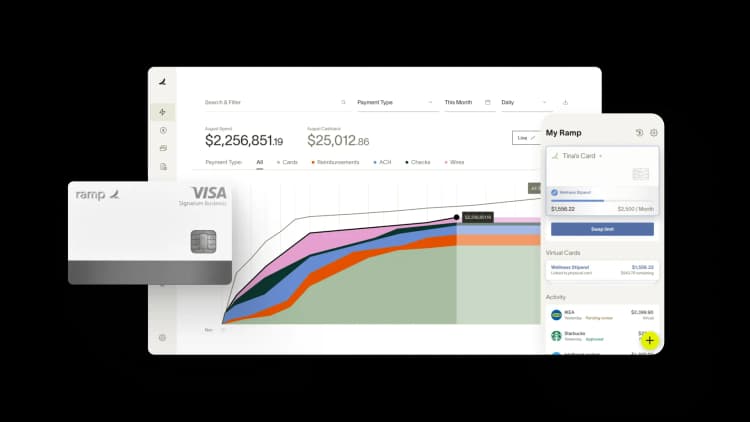
Pairing Ramp with Sage Intacct automates spend management, simplifies expense tracking, and gives you more control over your financial operations.
Ramp connects with Sage Intacct in four ways that cut manual work:
- Sync data in real time: Update vendor data, bill payment details, and tracking categories in Ramp, and see those changes reflected in Sage Intacct instantly.
- Manage multiple subsidiaries: Handle financial activity for multiple entities, including bill payments, reimbursements, and transaction coding, all in one platform.
- Classify transactions your way: Use Sage Intacct's tracking categories, custom fields, and UDD directly in Ramp for easy and consistent transaction coding.
- Audit every transaction: Access your complete transaction history in Ramp, from initiation to sync, with direct links to specific reimbursements or payments.
Ramp's Accounting Agent auto-codes GL, department, class, location, and custom fields as transactions post, then moves routine, in-policy spend through Auto Mark Ready and Auto Sync. At period-end, it generates cards-side automated accruals for Sage Intacct. Teams using it can close their books 3x faster, and every AI decision shows its confidence level and rationale so you can review or override it.
Together, Ramp helps you close your books faster with less manual work on spend and expense management.
How integrating Ramp and Sage Intacct closed Marqeta's books 88% faster
Integrating Ramp with Sage Intacct cut Marqeta's close time by 88% and saved their AP specialist 7 hours a month. Before the integration, Marqeta's finance team spent too much time on manual corporate card reconciliation, which slowed their close and left little room for analysis.
For Marqeta, the impact of integrating Ramp with Sage Intacct included:
- 88% faster close: Marqeta dramatically reduced its close time by syncing Ramp and Sage Intacct.
- 7 hours saved monthly: Marqeta's AP specialist cut time spent on corporate card processing from 8 hours per month to 1 hour.
- Automatic transaction syncing: Transactions flow directly from Ramp to Sage Intacct, removing the need for manual uploads.
- Consistent transaction coding: Merchant category rules in Ramp help keep transaction coding consistent.
- Faster insights: Real-time syncing allows the finance team to analyze business performance before the month ends, accelerating learning and decision-making.
"We're able to review our expenses much faster in the close process and analyze them," says Megan Gemoll, Marqeta's Senior Director of Corporate Accounting. "We're able to start those analytics in our month-over-month analytics even before the month ends, because those transactions are importing over regularly."
Marqeta's experience shows how the Ramp integration, one of many Sage Intacct integrations, cuts manual steps and speeds up reconciliation.
Maximize efficiency with Ramp and Sage Intacct
Ramp and Sage Intacct work together to speed up financial workflows, give you real-time visibility, and help you scale without adding headcount. Pair Sage Intacct's financial management depth with Ramp's spend management tools, and you'll close faster with less manual work.

FAQs
Yes, Sage Intacct is a cloud-based ERP focused specifically on financial management and accounting. It concentrates on core financial workflows like general ledger, accounts payable, revenue recognition, and multi-entity consolidations rather than bundling CRM, HR, and supply chain modules.
Sage Intacct uses quote-based pricing that varies by modules selected, user count, and contract term. Contact Sage or a certified partner for a current quote.
QuickBooks serves small and growing businesses, with its Advanced plan aimed at roughly 10–99 employees, while Sage Intacct targets growing mid-market organizations that need multi-entity consolidation, dimensional reporting, and ASC 606 revenue recognition.
Sage is the company behind a family of accounting products, including Sage 50, a desktop product for smaller businesses with simpler needs. Sage Intacct is its cloud-native financial management platform for growing, multi-entity finance teams.
Yes, Ramp integrates directly with Sage Intacct for real-time data syncing, multi-entity support, and automated transaction coding. You can use Sage Intacct's tracking categories and custom fields directly in Ramp, and transactions sync without manual uploads.


“I assumed I would have to choose between speed and control. What I found is that you can have both. A well-designed system takes friction out, for the finance function and for everyone else.”
Justin Webster
CFO, Denver Broncos

“A well-run district should not have to choose between getting work done at the school site and keeping control of the dollars behind it. We're not hiring more people to do more jobs, so we have to be smarter about the process. With Ramp, the purchase, the receipt, and the record stay together from the start. ”
Nick Brizeno
Director of Purchasing, San Marcos Unified School District

“In senior living, scale only works if the communities still feel personal. We needed the back office to carry more of the complexity, not the people serving residents. Ramp helped us build that infrastructure, so the experience in the community could stay human.”
Ryan Cole
CFO, Agemark Senior Living

“AI is moving faster than the finance context around it. Prices change, models change, and the value is not always obvious from an invoice. We needed enough detail to know which bets deserved more investment — and which ones did not.”
Greg Cooley
Controller, AngelList

“Invoices, cards, tokens. The categories change but the principle doesn't: know where the money is going, remove the work around it, and make sure the spend is worth it.”
Maciej Mylik. Finance
ElevenLabs

“We weren’t trying to retrofit an old finance system. We had a blank canvas, and Ramp gave us the foundation to build a global finance function of the future.”
Justin Dourado
Director of Finance, Othership

“There's just no surprises anymore. No more waiting two months to find out how a job did. We know how it's doing as it's happening.”
Erich Kuss
Financial Systems Manager, Infinity Home Services

“More token spend isn’t proof that AI is working. Less isn’t proof that it isn’t. What matters is whether we’re buying the right level of intelligence for the work. Ramp lets us make that judgment in the same place we manage every other type of spend.”
Cody Nutt
Senior Director of Business Systems, Daxko
