What is Xero ERP? A full guide to Xero accounting software

- What is Xero, and is it an ERP?
- How does Xero accounting software work?
- Features of Xero accounting software
- Who uses Xero?
- Xero integrations and why they matter
- Building an ERP-like stack with Xero
- How Ramp powers real-time spend management with Xero
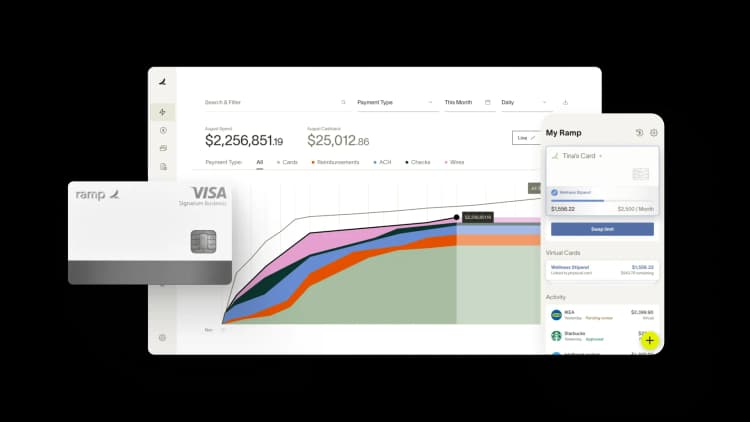
Managing a business without the right tools often means juggling countless spreadsheets, slogging through manual tasks, and missing growth opportunities. Xero can help you here: It's a cloud-based accounting solution built to simplify financial management for small businesses.
When paired with Ramp, Xero's features and functionality expand even further, helping you streamline expense management and automate tedious processes like invoice management.
This post explores what Xero is, what it does, and how its integration with Ramp can further streamline your financial operations.
What is Xero, and is it an ERP?
Xero isn't a traditional ERP. It's cloud-based accounting software that can extend toward ERP-like capability by connecting with over 1,000 third-party apps.
Xero offers cloud-based accounting software designed for small and medium-sized businesses. It offers user-friendly tools for bookkeeping, invoicing, bank reconciliation, and more.
While it's technically not an ERP, Xero's ERP-like features support a broad range of business needs, with a strong focus on simplifying essential accounting tasks.
Xero's purpose is clear: to help businesses maintain accurate financial records while reducing time-consuming manual work. By centralizing financial data in a secure cloud environment, Xero ensures small business owners and finance teams can access real-time data and make informed decisions wherever they work.
This accessibility helps businesses stay agile, adapt to challenges, and focus on growth instead of getting bogged down by administrative details.
Is Xero an ERP, or just accounting software?
Xero is accounting software, not a traditional ERP, but it can act as the financial core of an ERP-like stack.
The difference comes down to scope. A traditional ERP like NetSuite, Microsoft Dynamics, or Sage Intacct covers company-wide operations: finance, inventory, HR, and supply chain, all in one system. Xero focuses on cloud accounting and finance, then extends its reach through integrations.
| Dimension | Xero | Traditional ERP (e.g., NetSuite) |
|---|---|---|
| Primary scope | Cloud accounting + finance | Company-wide operations (finance, inventory, HR, supply chain) |
| Best-fit company size | Startups to lower mid-market | Mid-market to enterprise |
| Cost | Low monthly subscription | High license + implementation |
| Implementation | Quick, self-serve | Lengthy, often months |
| How you extend it | 1,000+ app integrations | Built-in modules |
When does a business genuinely need a full ERP? If you're running complex multi-entity structures, global supply chains, or need real-time cross-region consolidation, a traditional ERP may be the better fit. For most small and lower mid-market businesses, Xero plus a few targeted integrations covers the bases.
How does Xero accounting software work?
Improving your finance operations often requires a system that works quietly in the background, with minimal intervention. Xero achieves this by automating core business accounting tasks, saving time and improving accuracy.
Xero works by connecting directly to your business's bank accounts through secure, cloud-based bank feeds. These connections allow Xero to automatically import and organize transactions, ensuring your books stay up to date without constant oversight. From there, Xero applies smart automation to key accounting workflows:
- Bank reconciliation: Xero matches bank transactions to payments and invoices in real time, using past data to suggest matches. This minimizes errors and keeps your accounts accurate with just a few clicks.
- Invoicing and payments: Businesses can send professional invoices, automate payment reminders, and track payments from any device, helping you simplify accounts receivable and optimize cash flow
- Expense data capture: With integrations like Hubdoc for OCR capabilities, Xero pulls bills and expense receipts directly into the platform, eliminating tedious data entry and giving you a comprehensive view of your financial situation
With these automation features, Xero not only saves time, but also reduces the stress and complexity often associated with accounting. By centralizing financial workflows and making them accessible anytime, anywhere, Xero turns accounting into a faster, less manual function.
Features of Xero accounting software
Xero's extensive feature set makes it a valuable tool for small businesses looking to simplify their accounting processes. As bookkeeping software, it handles core financial workflows while offering room to grow. Key features include:
- Online invoicing: Send, track, and automate reminders for faster payment cycles
- Multi-currency support: Manage transactions in over 160 currencies to simplify international business
- Inventory management: Keep stock levels updated and integrate inventory details into your invoicing and ordering processes
- Customizable reporting: Create tailored financial reports for deeper insight into business performance
- Analytics and dashboards: Monitor cash flow, project future trends, and track key financial metrics in real time
On top of Xero's core features, you can extend its functionality by integrating with other third-party apps:
- Payroll integration with Gusto: Automatically calculate wages and deductions to simplify payroll and tax compliance
- Sales tax automation: Integrate with Avalara to handle sales tax calculations and reporting
- Expense management: Integrate with tools like Ramp to capture receipts and bills, simplifying expense reporting and reimbursements
These features and add-ons tackle common pain points, such as managing cash flow, reducing manual errors, and staying on top of financial tasks. For example, Xero's AP automation tools not only ensure timely payments, but also free up valuable time that you and your team can use to focus on higher-value work like vendor negotiations.
Xero pricing breakdown
Xero's U.S. plans come in three tiers: Early at $25/month, Growing at $55/month, and Established at $90/month. All plans include unlimited users. Early has invoice and bill caps that Growing and Established remove; Established additionally unlocks features like multi-currency support and project tracking.
Who uses Xero?
Xero is tailored for small businesses, from startups to growing companies, that need a reliable, easy-to-use solution for managing their finances. Its scalability and simplicity make it a great choice for businesses that prioritize automation and real-time access to financial information without the complexity (or higher pricing) of a full-on ERP system.
Industries that commonly use Xero include:
- Construction and trades
- Real estate
- Retail and ecommerce
- Professional services
- Hospitality
- Nonprofits
- Marketing and creative agencies
Xero's adoption across industries highlights its ability to solve diverse accounting challenges. By providing the tools you need to manage your finances effectively, Xero helps you spend less time on admin and more time on building optimized systems.
Xero integrations and why they matter
Xero is a robust accounting system on its own, and third-party integrations help extend its functionality and cater to unique business needs, offering flexibility without overcomplicating its core purpose. By connecting to tools like Ramp, Xero smoothly incorporates spend management, expense reporting automation, and deeper financial insights.
Those 1,000-plus integrations turn Xero into an ERP-like ecosystem. Integration categories include:
- Inventory: Apps like Cin7 and Unleashed handle stock management
- CRM: Connect HubSpot or Salesforce to link sales data with financials
- Payroll: Gusto runs U.S. payroll through a direct integration
- Point-of-sale: Square and Shopify sync retail transactions to your books
- Spend management: Ramp captures corporate card transactions, bill payments, and expenses in one place, then syncs them to Xero automatically
This flexibility not only helps businesses save time but also enhances overall efficiency and creates a connected, customized ecosystem tailored to their operations.
Sync your transactions to Xero with one click
Automate busywork and close your books faster with Ramp's robust, no-code Xero integration, included with your Ramp Account

Building an ERP-like stack with Xero
You can get most of an ERP's value by pairing Xero with a few focused integrations, without the cost or disruption of a full ERP implementation.
Think of it in two layers. Xero acts as the financial core: invoicing, bank reconciliation, reporting, and expense claims all live here. Around that core, you add the operational layers your business needs.
Core (Xero):
- Invoicing and accounts receivable
- Bank feeds and reconciliation
- Financial reporting and dashboards
- Expense claims and basic payroll
Operations layer:
- Inventory and order management (Cin7)
- CRM and sales pipeline
- Payroll and HR
- Point-of-sale
Spend layer:
- Corporate cards, bill payments, and expense management
The spend layer is where Xero's native tools are thinner. For corporate cards, vendor payments, and real-time expense controls, most growing teams add a dedicated spend management platform.
Ramp's no-code, first-party Xero integration syncs vendor data, bill payments, and tracking categories to Xero automatically, included with every Ramp account. Data flows from swipe to sync without manual exports or uploads. Integrate with Ramp to complete your stack.
How Ramp powers real-time spend management with Xero
Combining Xero with Ramp takes your finance operations further. Ramp complements Xero by adding advanced spend controls, real-time expense tracking, and automation that helps you save time and money.
More than 70,000 organizations have saved over $12 billion and 27.5 million hours with Ramp. Pairing Ramp with Xero removes the manual work that slows down month-end: chasing receipts, reconciling card statements, and coding transactions by hand.
Here's how Ramp's features work with Xero:
- Sync data in real time: Vendor data, bill payment details, and tracking categories updated in Ramp automatically sync with Xero, keeping your balance sheet accurate
- Classify transactions your way: Import tracking categories from Xero into Ramp to simplify transaction coding
- Audit every transaction: Access detailed transaction histories in Ramp, from initial payment to syncing, with links to specific reimbursements or payments
- Automate routine workflows: Use Ramp's automation tools to code expenses, route approvals, and pay vendors faster
Together, Ramp and Xero give your business the clarity and control you need.
Integrate with Ramp to see how the integration works with your Xero account.
How mode uses Ramp and Xero to track spend in real time
Mode, a fast-growing analytics company, gives its clients access to data that helps them move at warp speed. However, Mode's legacy corporate card was slow to issue, lacked visibility, and required manual reconciliation with Xero, leading to wasted time and a lot of frustration.
The finance team had to manually track down receipts, reconcile transactions, and upload them into Xero, creating an unsustainable workflow for a fast-paced company.
But with Ramp, Mode now has a modern spend management platform with real-time reporting, first-party Xero integration, and instant card issuance. This integration streamlined onboarding, improved transaction visibility, and automated manual processes, resulting in:
- $10k in cashback: Earned in one year with no upfront investment
- Instant visibility into spend: Real-time transaction tracking allowed better forecasting and decision-making
- Consolidated subscriptions: Identified and reduced duplicate spend, saving costs
- Stronger controls: Instantly issued virtual cards with custom controls to manage spend and mitigate risk
"Switching to Ramp was an immediate success," said Teo Evanick, Financial Controller at Mode. "As far as ROI, we received over $10k in cashback last year with technically no upfront investment."
Ramp and Xero work seamlessly together to give businesses like Mode the agility they need. Learn more about why Ramp is a top Xero integration for businesses like yours.

FAQs
No. Xero is cloud-based accounting software, not a traditional ERP. However, it can act as the financial core of an ERP-like stack through its 1,000+ third-party integrations.
For most small and lower mid-market businesses, yes. By pairing Xero with focused integrations for inventory, payroll, CRM, and spend management, you can get most of an ERP's value without the cost or implementation time.
Startups and small-to-midsize businesses that need solid accounting, invoicing, and bank reconciliation without the complexity or higher cost of a full ERP. Businesses with multi-entity, supply chain, or complex real-time cross-region needs may still require a traditional ERP.
It depends on your priorities. Xero is known for unlimited users on every plan, 160+ currency support, and a flexible integration ecosystem, while QuickBooks is often favored for its large US accountant network. Both integrate with Ramp.
Yes. Ramp's no-code Xero integration syncs vendor data, bill payments, and tracking categories automatically, included with every Ramp account.


“I assumed I would have to choose between speed and control. What I found is that you can have both. A well-designed system takes friction out, for the finance function and for everyone else.”
Justin Webster
CFO, Denver Broncos

“A well-run district should not have to choose between getting work done at the school site and keeping control of the dollars behind it. We're not hiring more people to do more jobs, so we have to be smarter about the process. With Ramp, the purchase, the receipt, and the record stay together from the start. ”
Nick Brizeno
Director of Purchasing, San Marcos Unified School District

“In senior living, scale only works if the communities still feel personal. We needed the back office to carry more of the complexity, not the people serving residents. Ramp helped us build that infrastructure, so the experience in the community could stay human.”
Ryan Cole
CFO, Agemark Senior Living

“AI is moving faster than the finance context around it. Prices change, models change, and the value is not always obvious from an invoice. We needed enough detail to know which bets deserved more investment — and which ones did not.”
Greg Cooley
Controller, AngelList

“Invoices, cards, tokens. The categories change but the principle doesn't: know where the money is going, remove the work around it, and make sure the spend is worth it.”
Maciej Mylik. Finance
ElevenLabs

“We weren’t trying to retrofit an old finance system. We had a blank canvas, and Ramp gave us the foundation to build a global finance function of the future.”
Justin Dourado
Director of Finance, Othership

“There's just no surprises anymore. No more waiting two months to find out how a job did. We know how it's doing as it's happening.”
Erich Kuss
Financial Systems Manager, Infinity Home Services

“More token spend isn’t proof that AI is working. Less isn’t proof that it isn’t. What matters is whether we’re buying the right level of intelligence for the work. Ramp lets us make that judgment in the same place we manage every other type of spend.”
Cody Nutt
Senior Director of Business Systems, Daxko
