How to set spending controls for AI agents

- What are AI agent spending controls?
- Why finance teams need AI agent spending controls now
- What drives AI agent costs
- How to set AI agent spending controls
- Common mistakes when managing AI agent spend
- Control every side of AI agent spending with Ramp
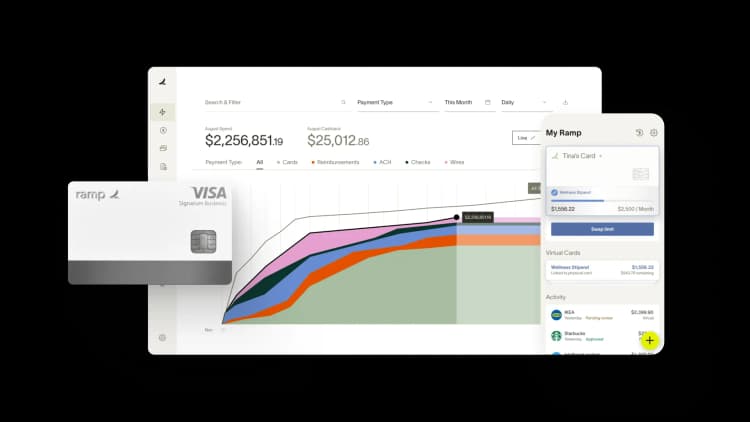
AI agents will soon be placing orders, booking travel, and buying software on your behalf, and the cost of running them is already rising fast. Average monthly token spend by Ramp customers has grown 13x since January 2025. Both sides of that ledger need controls, and most companies don't have either. The good news is that you can get ahead of it without slowing your agents down by setting the right spending controls.
What are AI agent spending controls?
AI agent spending controls are policies, tools, or financial guardrails that govern what autonomous agents can purchase and how much they cost to operate. They're no different from the controls you'd apply to an employee's corporate card, except agents can run 24/7 and execute thousands of transactions before you've even signed on for the day.
There are two distinct types of agent spending that both need controls:
- Transactional spending: Agents buying things on your behalf, like office supplies, SaaS, travel bookings, and vendor payments. As agentic commerce protocols continue to mature, this will become a major governance challenge because real money leaves your accounts with no human in the loop.
- Operational spending: The cost of running the agents themselves, including token consumption, compute, and API fees. Ramp data shows that the biggest AI spenders see costs jump by 50% or more roughly one in four months; a single prompt template change could triple your bill overnight.
The gap between the two is where budget surprises live.
Why finance teams need AI agent spending controls now
Three things are happening at once, and most finance teams are behind on all of them:
Agents are making real purchases
AI agents are placing orders, booking travel, and executing procurement workflows without human oversight. When an agent can spend company money with a vendor, you need the same controls you'd put on a new employee's corporate card, or stronger.
AI token spend is exploding
Average monthly token spend by Ramp customers has increased 13x since January 2025, and the average contract for AI products and services is projected to reach $1 million in 2026, according to Ramp data.
Operational costs can escalate faster than you'd expect. Jason Calacanis reported on the All-In Podcast that his agents hit $300 per day in Claude API costs at just 10–20% utilization. That's roughly $100,000 per year, per agent, before you count what the agent is actually buying.
You probably can't answer "how much are we spending on AI?" because token-level usage, invoice data, and card-level purchases live in different systems.
Without controls, spending is invisible
A 2026 Cloud Security Alliance survey found that 65% of enterprises running AI agents experienced at least one agent-related incident in the past 12 months. Of those, 35% reported direct financial losses.
The risk runs in both directions. An agent can place an unauthorized order with a vendor. A junior engineer experimenting on a Friday can burn through a quarterly token budget by Monday. Both need controls, and most companies have neither.
What drives AI agent costs
Before you can set controls, you need to know what you're controlling. AI agent costs fall into four categories: two transactional, two operational.
| Cost category | What drives it up |
|---|---|
| Purchases and vendor payments | Unrestricted merchant access, no spend limits, no approval chains |
| Token and API usage | Frontier model selection, multi-step reasoning, looping agents, prompt bloat |
| Infrastructure and compute | Self-hosted agents consuming cloud resources, unpredictable agentic workloads |
| Software licensing | Platform subscriptions, per-seat pricing, shadow AI purchases on personal cards |
Purchases and vendor payments
When an agent buys office supplies, books travel, or commits to a SaaS subscription, real money leaves your accounts. Without AI agent controls, these transactions happen with no spend limits, no merchant restrictions, and no approval chain. Agents don't have judgment about what's appropriate to buy. Your controls need to make that determination for them.
Token and API usage costs
Every time an agent queries a large language model (LLM), it incurs a token cost through the provider's API. Frontier models cost significantly more per token than smaller ones, and complex reasoning chains multiply consumption further. An agent stuck in a loop can burn through $50,000 before anyone notices.
Infrastructure and compute costs
Agents need compute and memory to run. Self-hosted agents consume cloud resources; managed agents may bundle this into subscription fees. Agentic workloads are less predictable than traditional compute because agents spawn sub-tasks autonomously, making capacity planning harder.
Software licensing and subscriptions
The agentic AI platform itself costs money through subscription fees, per-seat pricing, or usage-based billing. Then there's the shadow AI spend: employee-purchased ChatGPT Team seats, vector databases, and point tools purchased on employee cards that never appear on a provider dashboard. If you're not tracking it, you're not controlling it.
How to set AI agent spending controls
These eight practices cover both sides of agent spend. Each one stands on its own, so start wherever your biggest exposure is.
1. Issue scoped, single-use cards for agent purchases
If an agent needs to buy something, give it a purpose-built payment credential, not access to a shared card. Single-use virtual cards scoped to a specific merchant and dollar amount prevent overspending at the point of transaction, and an intercepted credential can't be used anywhere else.
Ramp's Agent Cards are tokenized virtual cards issued directly to AI agents via API or MCP. Each card is scoped to a single agent and transaction, with merchant-level controls and full transaction visibility in Ramp's dashboard. Agents inherit the issuing user's approval chain, so no transaction bypasses your existing controls.
2. Track token-level spend across every provider
Token costs, invoices, and card-level purchases live in different systems by default. Pull them into a single view so you can attribute every AI dollar to a team, project, model, and use case.
"We spent $600,000 on Anthropic last quarter" tells you nothing. "The data team spent $280,000 on Claude Sonnet for the pipeline, up 35% since the last prompt change" tells you exactly where to look.
Ramp AI Spend Intelligence connects token-level usage from Anthropic, OpenAI, and other providers into one view alongside your invoices and card transactions. It flags anomalies and savings opportunities automatically, so you get the finding and the recommended action, not just a chart to interpret.
3. Set budget caps per agent, team, or use case
Define spending limits by agent, team, project, or individual API key for both purchasing authority and operational costs. Create separate budget envelopes for each agent's function: procurement, travel, operations, development, and so on.
Set alerts for anomalies alongside those caps. AI costs can spike without warning from a prompt change, a looping agent, or a new use case that takes off faster than expected. You want to know before the invoice arrives, not after.
4. Require approval workflows for high-value actions
Any agent action above a spending threshold should route to a human before execution. That includes the obvious scenarios like purchases and new vendor commitments, but also provisioning decisions that could affect your infrastructure costs.
Define thresholds by action type: procurement over a set dollar amount, first-time vendor payments, infrastructure changes affecting production. The tighter you define the boundaries up front, the less you'll need to intervene after the fact.
5. Lock agents to approved merchants and categories
Setting a cap on how much an agent can spend isn't enough. You need to restrict where agents can spend, too. Without merchant restrictions, an agent capped at $500 per transaction can still buy from a vendor it shouldn't have used.
Merchant category locks close that gap at the point of transaction, so an out-of-policy purchase gets declined before it happens instead of flagged in next month's audit.
6. Implement token quotas and rate limits
Set per-request and per-period token limits to prevent runaway API queries. This is your safety valve against a buggy or looping agent that racks up serious costs before anyone notices.
Scope those quotas to the people and teams using them, not just to all agents in aggregate. A senior engineer shipping production features needs a larger token budget than an intern running experiments. Allocating quotas by individual, team, or role keeps consumption tied to business value.
Hard-code upper limits even if they're generous. The goal is preventing outliers, not throttling normal use.
7. Use lower-cost models for lower-stakes tasks
Not every agent needs the most capable, most expensive model. A customer FAQ agent can run on a smaller, cheaper model, while a complex reasoning task may justify paying more for higher capability.
Match the model to the job. Routing routine work to cheaper models is one of the fastest ways to bring down operational costs without sacrificing the quality of the agent's output.
8. Assign clear ownership and accountability for each agent
Every agent should have a named human owner who's accountable for its spending and output. Don't leave orphaned agents running on stale credentials with open purchasing authority.
Build a simple registry: agent name, owner, purpose, budget, approved merchants, last review date. Review it quarterly. If an agent doesn't have an owner, it doesn't get a budget.
Common mistakes when managing AI agent spend
The most common failures aren't from doing nothing. They're from covering one risk and missing another.
Giving agents open-ended payment credentials
An agent with access to an unrestricted card can buy from any merchant in any amount, with nothing to stop it. No amount of after-the-fact auditing fixes that because the money's already gone. Scoped, single-use cards prevent the problem at the source.
Tracking only one side of agent spend
You might have tight token quotas but no controls on what your agents actually purchase. Or you've locked down purchasing authority while operational costs climb unchecked. Controlling one side while ignoring the other still leaves you exposed.
Ignoring agent sprawl
Someone spins up an agent for a task, it works, and word spreads. Soon, you have a dozen agents running with purchasing authority and token access, and no record of who owns what. Treat agent deployment like IT procurement, with centralized oversight and a named owner for every agent.
Control every side of AI agent spending with Ramp
You need controls on two fronts: Agents that buy things need payment guardrails, and agents that consume tokens need cost visibility. Most companies solve one side or neither.
Ramp Agent Cards are corporate cards issued directly to AI agents with real spend limits, merchant controls, and full transaction visibility. Each card is single-use, scoped to a specific merchant and dollar amount. Agents inherit the issuing user's existing spend limits and approval chains, so no transaction bypasses your controls.
For operational costs, Ramp's AI Spend Intelligence connects token-level usage data from Anthropic, OpenAI, and other providers into one view alongside your invoice- and card-level AI spend. You can attribute every dollar to the team, model, and use case behind it, flag anomalies automatically, and reconcile what you're billed against what you actually used.
With Ramp, you get controls on both sides of agent spend:
- Issue scoped payment credentials to agents: Single-use virtual cards with merchant locks and dollar caps, so agents can only buy what they're authorized to buy
- See every AI dollar in one place: Token-level usage, invoices, and card transactions unified in a single dashboard
- Inherit existing approval chains: Agents follow the same spend policies and approval workflows as your human cardholders
- Catch anomalies before the invoice arrives: Automated alerts flag unexpected spend jumps across both transactional and operational costs
Try an interactive demo to see how Ramp gives you control over every side of AI agent spending.

FAQs
Issue the agent a scoped virtual card with a specific dollar limit and merchant restriction. Use approval workflows so high-value purchases require human sign-off. The agent should inherit the same spend policies as a human cardholder.
Costs vary widely. A general-purpose agent using your most capable models can run $100–$300 per day in token usage alone, while a scoped agent on a smaller model may cost under $10 per day.
Use lower-cost models for low-stakes tasks, set token quotas, cache repeated queries, and audit agent deployments to remove unnecessary ones. For transactional spending, use single-use cards with merchant locks instead of open-ended payment credentials.
Finance and IT should share ownership. Finance owns the budgets, approval thresholds, and merchant restrictions. IT handles the technical side: token quotas, model selection, and the infrastructure agents run on. A named owner for each agent keeps accountability from slipping through the cracks.


“I assumed I would have to choose between speed and control. What I found is that you can have both. A well-designed system takes friction out, for the finance function and for everyone else.”
Justin Webster
CFO, Denver Broncos

“A well-run district should not have to choose between getting work done at the school site and keeping control of the dollars behind it. We're not hiring more people to do more jobs, so we have to be smarter about the process. With Ramp, the purchase, the receipt, and the record stay together from the start. ”
Nick Brizeno
Director of Purchasing, San Marcos Unified School District

“In senior living, scale only works if the communities still feel personal. We needed the back office to carry more of the complexity, not the people serving residents. Ramp helped us build that infrastructure, so the experience in the community could stay human.”
Ryan Cole
CFO, Agemark Senior Living

“AI is moving faster than the finance context around it. Prices change, models change, and the value is not always obvious from an invoice. We needed enough detail to know which bets deserved more investment — and which ones did not.”
Greg Cooley
Controller, AngelList

“Invoices, cards, tokens. The categories change but the principle doesn't: know where the money is going, remove the work around it, and make sure the spend is worth it.”
Maciej Mylik. Finance
ElevenLabs

“We weren’t trying to retrofit an old finance system. We had a blank canvas, and Ramp gave us the foundation to build a global finance function of the future.”
Justin Dourado
Director of Finance, Othership

“There's just no surprises anymore. No more waiting two months to find out how a job did. We know how it's doing as it's happening.”
Erich Kuss
Financial Systems Manager, Infinity Home Services

“More token spend isn’t proof that AI is working. Less isn’t proof that it isn’t. What matters is whether we’re buying the right level of intelligence for the work. Ramp lets us make that judgment in the same place we manage every other type of spend.”
Cody Nutt
Senior Director of Business Systems, Daxko
