Expensify vs. Slash vs. Ramp: Which expense management platform fits your team?

- How Expensify, Slash, and Ramp compare at a glance
- Expense reporting and automation
- Corporate cards and rewards
- Banking and treasury
- Accounts payable and accounting automation
- Pricing and value
- Expensify vs. Slash vs. Ramp: Full comparison
- Which platform fits your team?
- See why teams are choosing Ramp
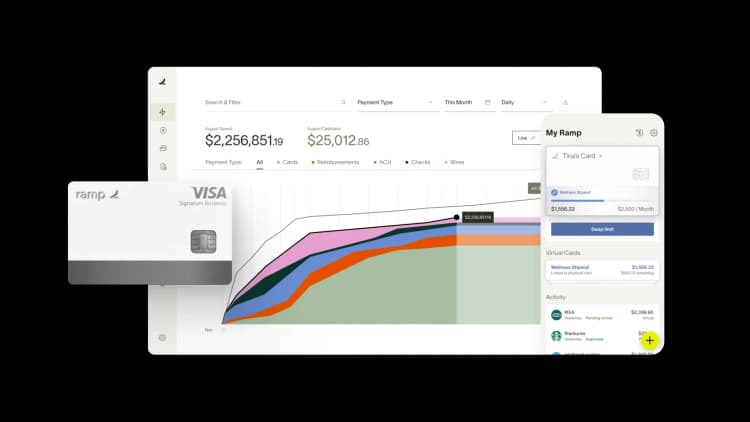
Expensify, Slash, and Ramp all show up in corporate card and expense management evaluations, but they come from very different places. Expensify is an expense reporting tool that also offers cards and travel. Slash is a banking and cards platform with treasury features. Ramp is a finance platform covering cards, expenses, AP, and accounting automation.
The right choice depends on what your finance team actually needs beyond cards. We'll break down how each platform compares across expense management, spend controls, pricing, and the workflows that matter most.
How Expensify, Slash, and Ramp compare at a glance
The table below highlights how the three platforms differ across pricing, features, and capabilities.
| Expensify | Slash | Ramp | |
|---|---|---|---|
| Best for | Companies needing simple expense reporting and receipt scanning | Companies wanting banking, cards, and treasury in one place | Companies managing spend across cards, expenses, and AP |
| Pricing | Free (individual); Collect $5/user/mo; Control $9–36/user/mo (discounted rates require card usage) | Free plan; Pro $25/mo flat | Free tier; Plus $15/user/mo + platform fee; Enterprise custom |
| Corporate cards | Yes (paid plans), basic controls | Yes, unlimited, up to 2% cashback | Yes, physical and virtual with granular controls |
| Banking/Treasury | No | Yes (checking, treasury, FDIC) | Yes (treasury, FDIC, investment accounts) |
| AP and bill pay | Yes (bill pay) | No | Yes |
| Expense management | Full platform (receipt-first) | Basic spend tracking | Full platform (proactive enforcement) |
Next, we break down each feature to show how the platforms differ in practice.
Expense reporting and automation
Each platform takes a fundamentally different approach to tracking, enforcing, and reconciling expenses.
Expensify
Expensify is known for SmartScan, an OCR tool that extracts data from receipt photos and automatically fills expense fields. The mobile app lets employees snap receipts right after a purchase, and you can create group policies and category rules to keep expense reports consistent. The whole system works on a receipt-first model, meaning employees submit expenses and finance reviews them afterward.
Slash
Slash handles expense tracking differently. Since it's primarily a banking platform with corporate cards, transactions are automatically logged when employees swipe their Slash cards. You won't find the same depth of policy enforcement or expense categorization tools here. If your team rarely submits out-of-pocket expenses and mostly relies on cards, the simplicity might be enough.
Ramp
Ramp takes the opposite approach by enforcing policies at the point of purchase rather than after the fact. You can set spending limits by merchant, category, or vendor, and the system flags or blocks transactions that fall outside your rules in real time. AI handles much of the manual work — auto-categorizing transactions, matching receipts to expenses, and flagging anomalies — so you're not chasing employees for documentation at month-end.
The difference shows up in actual time savings for Ramp customers. Snapdocs cut their monthly reconciliation from five to six hours down to 30 minutes after switching to Ramp. Notion achieved 94% transaction compliance and saves over 75 hours per month on expense management.
Corporate cards and rewards
All three platforms offer corporate cards, but the controls and rewards structures differ significantly.
Expensify
Expensify's cards come bundled with the Collect and Control plans. You get basic spending limits and can earn 1% cashback on Collect or up to 2% on Control. However, that higher rate requires spending $250,000 or more per month, which puts it out of reach for most mid-market companies.
Slash
Slash takes a simpler approach to rewards. You can earn up to 2% cashback with no volume threshold, and the flat $25/month pricing means adding more cardholders doesn't increase your bill. If maximizing card rewards without jumping through hoops is a priority, Slash may be a good option.
Ramp
Ramp offers unlimited physical and virtual cards with controls you can customize down to the merchant, category, or individual vendor level. Ramp offers cashback on purchases, and the platform automatically locks cards when receipts are missing or spending exceeds approved limits. The proactive enforcement means fewer policy violations to clean up later.
Banking and treasury
Two of the three platforms offer treasury and cash management features, though they approach it differently.
Expensify
Expensify doesn't offer banking or treasury features. You'll manage cash through your existing bank.
Slash
Slash provides full business checking accounts, treasury management with variable yields, and FDIC insurance through partner banks. If you want traditional banking and spend management in one platform, Slash covers that. The platform also supports crypto on and off ramps for companies that work with digital assets, though most finance teams evaluating expense management tools won't prioritize that feature.
Ramp
Ramp offers treasury with a business account that earns interest on operating cash through FDIC-insured institutions,¹ plus an investment account for higher yields on idle cash.² There are no fees, minimum deposits, or transfer caps. The treasury product handles cash management alongside the rest of the platform — cards, expenses, AP, and accounting all in one place.
Accounts payable and accounting automation
This is where the three platforms diverge most dramatically.
Expensify
Expensify offers accounting integrations, and SmartScan helps with data extraction, but AP isn't the platform's core focus. You can connect to popular accounting tools, though you'll likely still handle bill payments through a separate system.
Slash
Slash isn't built for accounts payable at all. Banking and cards are the core offering, with basic integrations available for syncing transaction data. If your finance team handles significant invoice volume or wants to consolidate AP with expense management, Slash won't cover that workflow.
Ramp
Ramp extends well beyond expense management into full accounts payable automation. AI captures invoice data automatically, routes approvals based on your rules, and auto-codes line items so your team isn't manually keying in GL codes. Native integrations with QuickBooks, NetSuite, Sage, and Xero mean transactions flow into your general ledger without manual data entry. The platform also includes procurement tools for managing vendor relationships and purchase requests.
Pricing and value
Pricing structures vary widely, and the sticker price doesn't always reflect the total cost.
Expensify
Expensify uses per-user pricing that can add up as your team grows. The Collect plan starts at $5 per user per month, and Control ranges from $9 to $36 per user, though both of those rates assume annual billing and routing at least 50% of your spend through Expensify cards. Without those commitments, prices are higher.
Slash
Slash offers a free plan that includes unlimited virtual cards and banking. The Pro plan at $25/month flat (not per user) removes transfer fees and adds premium features. For larger teams, the flat pricing structure often works out cheaper than per-user models. Keep in mind, though, that you're getting banking and cards rather than comprehensive expense management.
Ramp
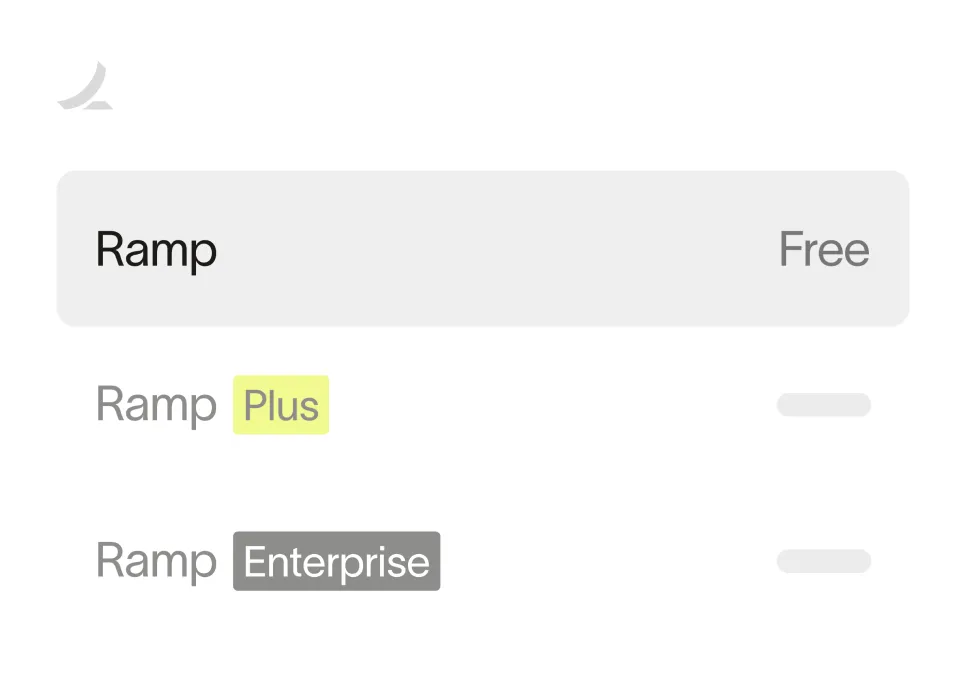
Ramp offers a free tier that includes core expense management and corporate card features. The Plus plan runs $15 per user per month plus a platform fee based on team size, and adds advanced automation — AI-powered expense reviews, auto-coded AP line items, and workflow simulation to test policies before rolling them out. Enterprise pricing is custom. Ramp offers cashback on purchases, helping offset subscription costs, and its breadth of features means you can potentially replace multiple tools with one platform.
Ready to take control of your finances?
Learn about Ramp’s pricing plans and start saving today.
Expensify vs. Slash vs. Ramp: Full comparison
| Decision factor | Expensify | Slash | Ramp |
|---|---|---|---|
| Expense management | SmartScan OCR, receipt-first | Basic spend tracking | Proactive enforcement, AI matching |
| Card controls | Basic (fixed/monthly limits) | Unlimited, basic controls | Granular (merchant/category/vendor) |
| Cashback | 1% (Collect); up to 2% (Control) | Up to 2%, no threshold | Yes |
| Banking/Treasury | No | Yes (checking, treasury, FDIC) | Yes (treasury, FDIC, investment accounts) |
| AP and bill pay | Yes (bill pay) | No | Yes |
| Accounting sync | Available | Basic | Native (QBO, NetSuite, Sage, Xero) |
| Pricing | $5–36/user/mo (discounted) | Free; Pro $25/mo flat | Free tier; $15/user Plus + platform fee |
Which platform fits your team?
Expensify works well if your priority is simple receipt tracking and expense reporting without much complexity. The mobile-first approach and SmartScan technology handle that workflow effectively, and small teams that primarily reimburse employee expenses will find it straightforward to adopt.
Slash makes sense if you want to consolidate business banking with corporate cards and earn competitive cashback without volume requirements. The flat pricing works especially well for larger teams, and the treasury yields add value if you're parking cash reserves.
Ramp fits teams that want to stop juggling separate tools for cards, expenses, AP, and accounting. The proactive spend controls reduce policy violations before they happen, native accounting integrations eliminate manual reconciliation, and treasury handles your idle cash — all from one platform. If you're replacing a patchwork of point solutions or setting up financial discipline for the first time, Ramp covers the most ground.
See why teams are choosing Ramp
Finance teams at companies like Snapdocs and Notion have consolidated their financial operations onto Ramp—cutting reconciliation time by over 90% and achieving near-perfect transaction compliance in the process. Whether you're replacing a patchwork of disconnected tools or building financial discipline for the first time, Ramp gives you one platform for corporate cards, expenses, AP, treasury, and accounting.
Try an interactive demo to see how it works, or explore more customer stories from finance teams that made the switch.
¹ Ramp Business Corporation is a financial technology company and is not a bank. Bank deposit services provided by First Internet Bank of Indiana, Member FDIC.
² Portfolios managed by Moment Advisors, LLC. Investing involves risk, including possible loss of principal. Asset allocation does not guarantee profit or protect against loss. Past performance does not guarantee future results. Securities products offered by Apex Clearing Corporation, member FINRA, SIPC. The Investment Account is not insured by the FDIC, not a deposit product, and may lose value.


“I assumed I would have to choose between speed and control. What I found is that you can have both. A well-designed system takes friction out, for the finance function and for everyone else.”
Justin Webster
CFO, Denver Broncos

“A well-run district should not have to choose between getting work done at the school site and keeping control of the dollars behind it. We're not hiring more people to do more jobs, so we have to be smarter about the process. With Ramp, the purchase, the receipt, and the record stay together from the start. ”
Nick Brizeno
Director of Purchasing, San Marcos Unified School District

“In senior living, scale only works if the communities still feel personal. We needed the back office to carry more of the complexity, not the people serving residents. Ramp helped us build that infrastructure, so the experience in the community could stay human.”
Ryan Cole
CFO, Agemark Senior Living

“AI is moving faster than the finance context around it. Prices change, models change, and the value is not always obvious from an invoice. We needed enough detail to know which bets deserved more investment — and which ones did not.”
Greg Cooley
Controller, AngelList

“Invoices, cards, tokens. The categories change but the principle doesn't: know where the money is going, remove the work around it, and make sure the spend is worth it.”
Maciej Mylik. Finance
ElevenLabs

“We weren’t trying to retrofit an old finance system. We had a blank canvas, and Ramp gave us the foundation to build a global finance function of the future.”
Justin Dourado
Director of Finance, Othership

“There's just no surprises anymore. No more waiting two months to find out how a job did. We know how it's doing as it's happening.”
Erich Kuss
Financial Systems Manager, Infinity Home Services

“More token spend isn’t proof that AI is working. Less isn’t proof that it isn’t. What matters is whether we’re buying the right level of intelligence for the work. Ramp lets us make that judgment in the same place we manage every other type of spend.”
Cody Nutt
Senior Director of Business Systems, Daxko
