How to get a business credit card with an EIN only

- 5 best business credit cards with EIN only
- Summary of the best EIN-only business credit cards
- Alternatives to EIN-only business cards
- Can you get a business credit card without an SSN?
- Why some issuers don’t approve applications with only an EIN
- Pros and cons of credit cards with EIN only
- How to apply for a business credit card with EIN
- How to maximize rewards with your EIN-only business card
- Minimum balance requirements by issuer
- How WizeHire sped up month-end close by 58% using a Ramp card with EIN only
- Sign up for Ramp's corporate business credit card using your EIN
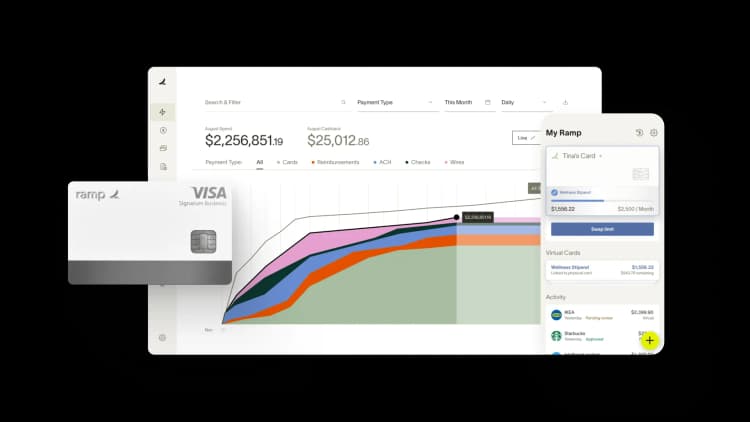
You can use an Employer Identification Number (EIN) instead of a Social Security Number (SSN) to apply for a credit card, as long as it's a business credit card or corporate card.
However, it's important to note that these EIN-only business credit cards tend to come with certain credit, revenue, and cash-on-hand requirements that other business credit cards lack.
Fortunately, there are a number of business credit cards more ideally suited to medium and small businesses—although some may require not just your EIN but your SSN to sign up. Some of the best business credit cards for smaller organizations belong to Ramp, Stripe, and BILL.
EIN-only cards work differently by issuer, and knowing how to go about applying for one can help you find the best fit for your business.
5 best business credit cards with EIN only
It's entirely possible to sign up for a business credit card using only your EIN, but it will have to be what's called a corporate card. If you want to apply primarily with your EIN instead of relying on personal credit, corporate cards are usually the best option. They're intended for established companies and usually come with requirements like high revenue and cash-on-hand.
Major financial institutions like Capital One, Chase, and American Express offer corporate cards, but they're generally designed for large corporations generating millions in revenue. For small to mid-sized businesses and startups, online corporate card providers are a more suitable option.
The following corporate cards focus on your EIN and business finances rather than traditional personal credit checks:
Ramp Business Credit Card

- Higher credit limits: Ramp provides credit limits up to higher than traditional business credit cards by assessing factors like revenue and funds raised, rather than relying solely on your business credit score
- Flexible qualification options: Ramp partners with major commerce platforms such as Stripe, Shopify, and Amazon to determine credit limits for startups using sales data. With just 1 year of sales history on these platforms, your business can qualify and accelerate growth.
- Exclusive partner rewards: Ramp cardholders enjoy access to over $350K in rewards, including discounts, credits, and perks for services like UPS, AWS, QuickBooks, OpenAI, Notion, and more
- Simplified spend control: Customize and enforce expense policies with Ramp’s spend controls. Set limits by vendor, category, or transaction, and automatically flag out-of-policy or suspicious activity.
- Comprehensive financial tools: Ramp’s business credit card includes a suite of finance features such as expense management, financial reporting, accounting integrations, corporate travel booking, and accounts payable automation
- Eligibility: Only available to corporations, LLCs, or LPs; sole proprietors are ineligible
- Cash on hand: U.S. applicants must have $25,000 in a business bank account
- Balance transfers: Balance transfers are not supported
The Ramp Business Credit Card provides cashback on purchases and comes with no annual fee or foreign transaction fees. It includes advanced expense management tools to help you automate financial workflows, control spending, and improve reporting. Ramp doesn't require a personal guarantee and offers a straightforward approval process tailored to your business needs.
Designed for modern businesses, the card emphasizes simplicity and efficiency with features like spend controls, detailed analytics, and smooth integration with accounting software. With no preset spending limits and a focus on optimizing expenses, Ramp helps you manage your finances effectively while earning consistent rewards.
FairFigure Capital Card

- No personal guarantee required
- Reports two monthly tradelines to business credit bureaus, helping you build business credit faster
- Approves based on business bank account activity, not personal credit
- Technically a debit card with funding offers, not a traditional charge card
- Limited rewards compared to cashback or points-based cards
- Less established brand with fewer integrations than larger providers
FairFigure is a business credit-building card designed for you if you want to establish or strengthen your business credit profile. Unlike traditional charge cards, FairFigure is technically a debit card that provides funding offers based on your business's bank account activity rather than your personal credit. The card doesn't require a personal guarantee or personal credit check.
The standout feature is dual tradeline reporting. Each month, FairFigure reports two tradelines to business credit bureaus, which can accelerate your credit-building timeline compared to business credit cards that report only once. You'll need at least three months in business and $2,500 in deposits to qualify, and there's no annual fee, one of the lowest barriers to entry on this list.
BILL Divvy Corporate Card

- No personal guarantee: Approval does not require a personal guarantee
- Rewards program: Earn points on eligible purchases through a points-based rewards system
- Expense management tools: Features built-in tools for tracking expenses and managing budgets
- No annual fee: Access the card without paying an annual fee
- US residency requirement: Restricted to businesses based in the United States
- Card type: Operates as a charge card, requiring full payment each billing cycle
- Redemption delay: Points can't be redeemed until you've held the account for 12 months, even once accrued.
The BILL Divvy Corporate Card provides a points-based rewards program and offers no annual fee, though foreign transaction fees of up to 0.9% apply. It includes budgeting tools to help you manage spend limits by category and align employee expenses with company policies. The card integrates directly with BILL's financial tools for streamlined payment processes.
However, the foreign transaction fee could make this card less ideal for businesses with significant international operations. The points-based rewards program may also require more effort to maximize value compared to simpler cashback cards, and the features are geared more toward companies actively using BILL's ecosystem.
Stripe Corporate Card

- Approval is based on your business’s financial health rather than personal credit
- International purchases won’t incur additional charges, saving money on global spending
- Cashback on eligible purchases without complicated redemption processes
- Eligibility is limited to select businesses with an active Stripe account, not open to all applicants
- Approval depends on your Stripe payment-processing history, so newer businesses or those with thin Stripe activity may not qualify even with an active account
- Cashback is flat-rate by default
The Stripe Corporate Card offers no annual fee, foreign transaction fees, or personal guarantee requirements. It provides cashback rewards on all purchases, making it straightforward for you to earn savings without category restrictions. The card integrates directly with Stripe's payment platform, benefiting you if you're already using its services.
While the card's focus on cashback is straightforward, it lacks category-specific bonuses or additional perks like travel benefits, which some businesses may find limiting. The card is primarily suited for companies that already operate within the Stripe ecosystem, potentially narrowing its appeal to others.
Brex Corporate Card

- Global reach: Supports multi-currency transactions and card acceptance in over 200 countries.
- Credit flexibility: Determines credit limits based on business performance instead of personal credit scores.
- Rewards program: Offers points on key spending categories with flexible redemption options.
- Expense management: Provides automated tools for tracking and managing expenses.
- No personal guarantee: Does not require a personal guarantee for approval.
- Partner perks: Includes discounts on business services and products.
- US-based businesses: Only available to companies with primary operations in the US.
- No cashback option: Rewards are points-based without direct cash-back functionality.
- Cash balance requirement: Requires a minimum cash balance of $50,000 for funded businesses, though this may vary based on referrals or other factors.
The Brex Card doesn't require a personal guarantee if you maintain a qualifying cash balance—$50,000 for funded startups, or higher if you haven't raised funding. Brex sets credit limits dynamically based on your cash balance and business financials, adjusting them as your balance changes.
One tradeoff: You'll need to maintain at least $25,000 in cash to keep any credit limit at all. Capital One completed its acquisition of Brex in April 2026, so it's still worth confirming current terms directly with Brex as the integration continues.
Summary of the best EIN-only business credit cards
Card comparison

- Corporate card and spend management platform
- Cashback rewards on purchases
- Unlimited employee cards with custom spending limits
- Automated receipt matching
- Accounts payable software
- Must have $25,000 in a business bank account to qualify
- Balance must be paid in full each month
Annual Fee
$0
APR
N/A
BILL Divvy Corporate Card- Corporate card available to registered businesses with an EIN number and U.S. business bank account
- Requires an SSN, but only for a soft credit check, so there's no impact on your credit score
- Comes with expense management software
- Points-based rewards with bonus points in different categories
Annual Fee
$0
APR
N/A
Stripe Corporate Card- Requires a Stripe account to request access
- No annual fee
- No foreign transaction fee
- No late payment fee
- Cashback rewards on purchases
- Approval based on Stripe payment-processing history, not personal credit
Annual Fee
$0
Foreign transaction fee
None
Personal Guarantee
Not required
 FairFigure Capital Card
- Business credit-building debit card with funding offers based on bank account activity
- No personal guarantee or personal credit check
- No annual fee
- Reports two monthly tradelines to business credit bureaus
- Requires three months in business and $2,500 in deposits to qualify
- Cashback on vendor purchases
APR
None
Annual Fee
$0
Personal Guarantee
Not required
Brex Corporate Card- No personal guarantee with a qualifying cash balance ($50,000 for funded startups, or higher without funding; $25,000 minimum to maintain any limit)
- Points-based rewards with category multipliers
- No fixed APR
- No annual fee
- No personal credit check during underwriting
- Late fees applied
APR
None
Annual Fee
$0
Personal Guarantee
Not required (with qualifying cash balance)
Alternatives to EIN-only business cards
If you have poor credit or don't meet the requirements for a corporate card, secured cards can be a good alternative. With these cards, you put down a cash deposit that will act as your credit limit. Secured credit cards report to the business credit bureaus, so you can use them to build your credit score.
Although secured credit cards don't come with credit score or capital requirements, you'll have to provide your SSN to qualify. This is necessary for the personal guarantee you agree to with these cards.
Here are a few secured business credit cards:
Bank Of America Business Advantage Unlimited Cash Rewards Secured Mastercard Credit Card
This secured credit card from Bank of America has no annual fee and requires a minimum $1,000 cash deposit. When you're approved, your cash deposit will act as your line of credit. The card offers 1.5% cashback rewards with no annual cap, making it a good option for funding business expenses while improving your credit score.
The First National Bank Business Edition Secured Mastercard Credit Card
The First National Bank Business Edition Secured Mastercard Credit Card requires a cash deposit between $2,200 and $110,000, which acts as its credit limit. The card reports to Dun & Bradstreet, so you can build your business credit score with that bureau. It also comes with some expense management features, like receipt capture for recordkeeping. The card has a $35 annual fee if your balance stays under $500, or $39 if it's $500 or more.
Valley Bank Visa Secured Business Credit Card
The Valley Bank Visa Secured Business Credit Card requires a security deposit of 110% of your desired credit limit, up to $25,000, which acts as your line of credit. The card offers unlimited 1% cashback on every purchase, plus a 0% introductory APR on purchases and balance transfers for the first six billing cycles. There's no annual fee.
Two other options worth a look: fleet cards and prepaid cards. If gas or fleet spend matters more to you than building credit with just an EIN, a dedicated fleet card may be a better fit—most fleet cards evaluate fuel spend and vehicle usage instead of personal credit. Prepaid business cards are another no-credit-check option, though prepaid cards work differently: you're spending against a loaded balance, not a credit line.
Can you get a business credit card without an SSN?
It's possible to get a business credit card using only an Employer Identification Number (EIN) instead of a Social Security Number (SSN), though it isn't easy. If your business doesn't have established credit, you'll need to meet additional requirements to get approved for a card using just your EIN. Those requirements can involve meeting a certain monthly revenue threshold or having a certain amount of capital in the bank.
Discover Ramp's corporate card for modern finance
While sole proprietors can get an EIN, they're typically not eligible for small business credit cards using only their EIN. If you have a large, established business, you can usually get a corporate card without using an individual SSN.
Can you get a business credit card without an SSN?
Yes. With an EIN, though new businesses usually can't avoid a personal credit check and personal guarantee even so. If you don't have an SSN (say, you recently immigrated), you may be able to use an ITIN in the application process instead.
There are a few reasons you might prefer an EIN-only card over one that requires your SSN. Using an EIN instead of an SSN helps separate your personal finances from those of your business, so you can avoid personal liability for your business's debts if it becomes unable to repay them. Cards that use only an EIN are also one of the few types of business credit cards that won't affect your personal credit.
Using an EIN can also help your business build a credit history over time, as long as the card issuer reports payments to business credit-rating agencies—this can give your company access to extra sources of capital later and make it more affordable to borrow money. Once you have your EIN, you can build business credit further by getting a free D-U-N-S Number and opening tradelines, like net-30 vendor accounts, that report to the credit bureaus.
If you have bad personal credit, an EIN-only card also means you won't be denied based on your personal credit history. Just keep in mind that your business credit score is inextricably linked to your EIN, the same way your SSN is tied to your personal credit score—credit bureaus use it to determine your company's creditworthiness.
Why some issuers don’t approve applications with only an EIN
Many card issuers prefer an SSN over an EIN—and many may ask you to provide both—because they require business owners to provide a personal guarantee. That’s because lending money to startups is extremely risky, and most credit cards don’t require collateral. Lenders want to protect themselves from losses by requiring individuals to promise to repay their debts if their business can’t.
Business credit card issuers that require a personal guarantee will look at your personal credit when deciding whether to approve your credit card application. In those cases, your personal credit will also factor into the size of the credit limit you receive and the interest rate, if applicable.
Some, but not all, business credit card issuers that require an SSN will report payments on the card to personal credit bureaus.
Pros and cons of credit cards with EIN only
EIN-only credit cards are a great option if you want a card with no credit check, but they have their drawbacks. Here are the pros and cons of credit cards with EIN only:
Pros | Cons | |
|---|---|---|
Finance separation | Using an EIN rather than your personal SSN keeps your business credit score separate from your personal credit score. | Even though your personal credit score will be separate, as the business owner you’ll still be on the hook for any debt incurred on your card. |
Business credit | Cards that use your EIN usually report to the business credit bureaus, meaning that you can build your business credit score. | If you’re a small business owner or have no business credit history to begin with, it may be harder to find a card that doesn’t require your SSN. |
Credit limits | EIN-only cards often come with higher credit limits, as long as your business can prove it’s bringing in substantial revenue each month. | Higher credit limits open up the possibility of misuse if not managed properly. You can prevent this problem by choosing a card that allows for custom spending limits. |
How to apply for a business credit card with EIN
Here's how to apply for a business credit card with only an EIN, in three steps:
1. Get your EIN
Before you can apply for a business credit card using your EIN, you'll need to get an EIN for your business. You typically get an EIN when you register your business with the state, but if you don't have one, you can apply for an EIN online directly through the IRS.
Already have an EIN number but unsure where to find it?
Read our guide to learn how to perform an EIN lookup.
2. Find EIN-only business credit cards that work for you
Once you have an EIN, you'll need to look for card issuers that will approve you with just an EIN—we've listed a few options below. Usually, your business will need to be registered as a limited liability company (LLC), a partnership, or a corporation. Then, apply for a business credit card as you would any other credit card. If the issuer supports EIN-only applications, they’ll either provide a dedicated corporate card flow or let you complete the business sections without a personal guarantee. Follow the issuer’s instructions—some issuers still require an SSN or ITIN for identity verification or a soft credit check.
3. Apply for a business card with EIN
You'll also need to include other information about your business, like its name and corporate structure, its contact information, the size of your business, its current and projected revenues, and its date of registration. Once you've filled out the application, the card issuer will review and verify the information and then let you know whether you've been approved. Some card issuers will complete the verification process instantly, while others might take a few days.
How to maximize rewards with your EIN-only business card
Getting approved is just the first step. The real value comes from using your card strategically.
- Match your card to your spending patterns: If your business spends heavily on software or advertising, look for cards with multipliers in those categories. Ramp cardholders get access to over $350,000 in partner rewards from vendors like AWS, QuickBooks, and HubSpot—on top of standard cashback.
- Put recurring expenses on your card: Monthly subscriptions, cloud services, and regular vendor payments add up fast. Routing these through your corporate card means you're earning rewards on spend that's already happening.
- Consolidate your business spend: Splitting purchases across multiple cards dilutes rewards and complicates expense tracking. Pick one primary card—you'll earn faster and simplify bookkeeping.
- Stack discounts with cashback: Partner perks and cashback aren't mutually exclusive. If your card offers exclusive vendor discounts, combine those savings with the rewards you're earning on every purchase.
Minimum balance requirements by issuer
Most corporate business credit cards require a business bank account with a certain minimum balance. For the Ramp card, U.S. businesses need a balance of at least $25,000. The Brex Card requires a minimum balance of $50,000 if you own a funded startup business, or higher if you haven't fundraised. BILL Divvy's minimum balance requirement is only $20,000, but they do run a soft credit check. Eligibility for Stripe's corporate card is decided on a case-by-case basis.
Using a corporate business credit card also means your business is responsible for any credit card debt, eliminating the need for a personal guarantee. Many corporate business credit cards let you qualify based primarily on your EIN and business financials rather than your personal credit.
How WizeHire sped up month-end close by 58% using a Ramp card with EIN only
WizeHire, a growing HR-tech firm, needed a better way to manage spend as they scaled, without relying on personal credit. Using Ramp's EIN-only corporate card, they unlocked faster and more secure finance operations, without involving employee Social Security numbers. Before switching, WizeHire funneled all spend through one shared AMEX, resulting in limited control, significant receipt chasing, and expensive net-12 closes.
Ramp allowed WizeHire to issue cards to individuals, impose real-time limits, and enforce automated spend controls. That switch drove a dramatic impact: WizeHire went from a 12-day to a 5-day close, shaving 58% off month-end timeline, and fully automated their reconciliation tied to their enterprise resource planning (ERP) system. "With Ramp, it was all perfectly furnished… it was just an incredible experience," said CEO Sid Upadhyay.
Ramp's automated spend controls delivered:
- Sharpened expense reporting with employees empowered to spend within pre-set budgets
- Full audit readiness, with receipts automatically matched and tied to ERP
- Department-level granularity, enabling near real-time P&L visibility and faster ad-spend analysis
- Streamlined expense-backed contract negotiation, as Ramp-based budgets informed Intercom renewal talks
WizeHire's transition to Ramp checked several boxes for EIN-only financing: no SSN required, corporate spend separated from personal credit, and scalability for issuing multiple cards. The result? A finance stack that supports autonomy, accelerates decisions, and frees up cash flow to reinvest in growth.
Sign up for Ramp's corporate business credit card using your EIN
Ramp's corporate business credit cards offer more flexibility than other types of cards, as well as a range of additional perks for managing your business finances. You can use Ramp at all different types of stores while building your business credit score. Plus, Ramp helps you save more with its rewards and has credit limits higher than traditional banks.
We also make it easy to start an employee card program by allowing you to issue unlimited virtual credit cards. You can place spending limits or restrictions on where your employees can use the cards, empowering your company to spend as necessary while controlling for unnecessary expenses.
Plus, Ramp's cards come packaged with a suite of expense management tools that allow you to track your finances in real time.
The cashback percentages, limits, fees, and other figures mentioned in this article are for illustrative purposes only. They do not represent guaranteed or expected rates. Actual terms, credit limits, rewards, and approval criteria vary by card issuer and may change at any time. Readers should verify current details directly with each issuer before applying.

FAQs
Yes, sometimes—but usually through corporate cards that underwrite based on your business’s cash reserves and revenue rather than your personal credit. Some issuers still require an SSN, ITIN, or other ID for verification.
Open tradelines that report to business credit bureaus, like corporate cards and vendor accounts from suppliers such as Uline or Grainger, and pay them on time. It typically takes 30 to 90 days for new tradelines to appear on your business credit reports.
Usually not. Most corporate cards report only to business credit bureaus, not personal ones, so your personal credit score typically isn't affected by spending or repayment. Some issuers, like BILL Divvy, run a soft credit check during the application—this doesn't create a hard inquiry or impact your score, but it means personal credit isn't entirely out of the picture for every card.
It depends on your stage. Most EIN-only corporate cards require $20,000 to $50,000 in a business bank account. Early-stage startups that don't meet these thresholds can start with secured business credit cards or vendor accounts to build credit first.
Yes. All major EIN-only corporate card providers, including Ramp, BILL Divvy, and Stripe, accept US-incorporated LLCs. You'll need a formal business entity, a US EIN, and a business bank account.
Yes. Corporate charge cards like Ramp and BILL Divvy don't require a personal guarantee. The business itself is liable for card payments, so your personal assets aren't at risk if the business can't repay.
No. Ramp serves businesses in the United States and Canada, and neither application requires a personal guarantee or credit check. U.S. applicants must have a registered corporation, LLC, or LP, an EIN, and at least $25,000 in a business bank account. Canadian applicants must be registered in a supported province with at least CA$25,000 across their connected accounts. See Ramp’s Canadian eligibility requirements for the full details.


“Invoices, cards, tokens. The categories change but the principle doesn't: know where the money is going, remove the work around it, and make sure the spend is worth it.”
Maciej Mylik. Finance
ElevenLabs

“There's just no surprises anymore. No more waiting two months to find out how a job did. We know how it's doing as it's happening.”
Erich Kuss
Financial Systems Manager, Infinity Home Services

“More token spend isn’t proof that AI is working. Less isn’t proof that it isn’t. What matters is whether we’re buying the right level of intelligence for the work. Ramp lets us make that judgment in the same place we manage every other type of spend.”
Cody Nutt
Senior Director of Business Systems, Daxko

“Most banks treat the back office as a cost to keep down. We treat ours as a return to compound, which is why we run it on Ramp. Now we put our clients on Ramp, too.”
Patrick Gaughen
President & COO, Hingham Institution for Savings

“Browserbase builds infrastructure so AI agents can do real work. Ramp is doing the same for finance. It’s not another tool. It’s a system purpose-built for AI-driven finance, and that’s why we chose Ramp as our financial operating system from day one.”
Paul Klein IV
Founder & CEO, Browserbase

“We used to pay up to $20k a year for our AP platform. With Ramp, we’re earning back well over that amount. That's money that belongs to the mission now, not to the back-office software.”
Heidi Coffer
Chief Financial Officer, Boys & Girls Clubs of San Francisco

“The tricky thing about corporate travel policy is timing. We didn't need a stricter policy. We needed the policy to show up earlier. With Ramp Travel, it finally does.”
Keith Frantz
Director of Enterprise Risk Management, Prosper

“We're accountable to our funders, our partners, and the families we serve. That accountability starts with how we manage every dollar. Ramp makes it easy for our team to spend wisely, track in real time, and keep overhead low so more resources reach the families navigating infertility.”
Rachel Fruchtman
CFO, Jewish Fertility Foundation
