Best expense trackers for business in 2026

- What is expense tracking for business
- Best expense trackers for business compared
- 8 best expense trackers for business
- How to choose a business expense tracker
- Best practices for business expense tracking
- Why Ramp is the best expense tracker for business
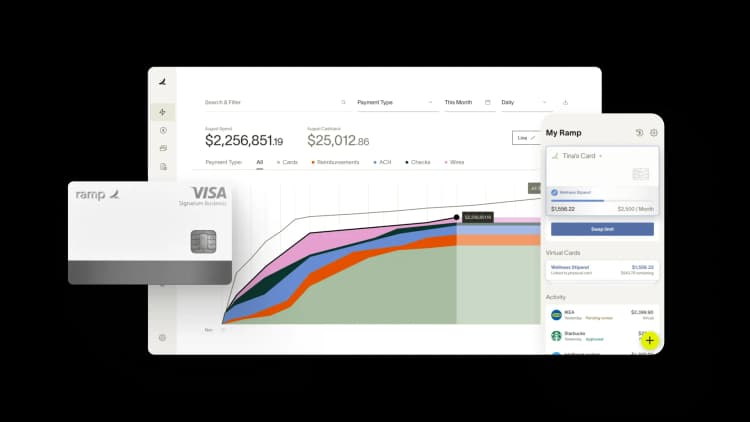
The best expense trackers for business replace spreadsheets and manual receipts with automated categorization, real-time spend visibility, and built-in policy enforcement. This guide compares eight options for 2026, from free tools for solopreneurs to platforms built for growing finance teams.
What is expense tracking for business
Expense tracking for business is the process of recording, categorizing, and monitoring every dollar your company spends. It turns scattered receipts and credit card statements into a clear, auditable record of where your money goes.
The expense tracking process looks the same regardless of your company's size. Here are the basic steps:
- Collect and retain all receipts and invoices related to your business transactions
- Properly categorize each expense to determine whether it's tax-deductible
- Add these details to your financial records regularly
If your team is small, you might get by with manual tracking methods like Excel spreadsheets or other templates. However, using purpose-built expense management software helps simplify your process and is the best way to track business expenses. Automating the process of tracking, managing, and reimbursing expenses helps you reduce errors, improve compliance, and control spending.
For compliance, the IRS explicitly expects you to keep records that substantiate business expenses: see Publication 583 and Publication 463 for what to retain and how.
Why expense tracking matters
Expense tracking protects your bottom line across four areas that compound over time:
- Tax deduction accuracy: You can't deduct what you can't document. Missing or miscategorized receipts mean lost deductions at filing time.
- Cash flow visibility: Consistent tracking helps you spot overspending patterns before they become cash flow problems
- Fraud prevention: Automated expense tracking catches duplicate charges, unauthorized purchases, and policy violations that manual reviews miss
- Audit readiness: The IRS requires you to keep supporting records for three to seven years. A good expense tracker builds that archive automatically.
Tax deductions and IRS compliance
The IRS requires you to keep records of all income and expenses for your business. Deductible business expenses fall into standard categories, and tracking them properly means you claim every tax-deductible dollar you're entitled to.
Common IRS-deductible expense categories include:
- Travel: Airfare, lodging, ground transportation, and related costs for business trips
- Meals: 50% deductible when directly tied to business activity
- Office supplies: Paper, printer ink, postage, and similar consumables
- Software and subscriptions: SaaS tools, cloud storage, and digital services used for business
- Vehicle and mileage: Business use of a personal vehicle, tracked by actual expenses or the IRS standard mileage rate
- Professional services: Legal, accounting, and consulting fees
The right business expense tracker categorizes these automatically, so nothing slips through at tax time.
Types of expense trackers
Expense trackers fall into three categories, each suited to a different stage of your business:
| Type | What it does | Best for |
|---|---|---|
| Expense tracker apps | Mobile-first tools for capturing receipts on the go (e.g., Expensify, Everlance) | Field teams and frequent travelers |
| Expense management software | Full platforms that combine tracking with policy enforcement, approvals, and accounting sync (e.g., Ramp, SAP Concur) | Growing teams that need controls |
| Spreadsheet templates | Excel or Google Sheets templates for manual entry | Solopreneurs with low transaction volume |
Best expense trackers for business compared
Here are the top eight expense trackers for business, compared at a glance:
| Tool | Best for | Starting price | Free tier? | Key differentiator |
|---|---|---|---|---|
| Ramp | Overall best business expense tracker | Free | Yes, unlimited | AI policy enforcement, no expense reports |
| Expensify | Receipt scanning and reimbursements | Free for individuals | Yes, for individuals | One-click receipt scanning |
| QuickBooks Online | Businesses already using QuickBooks | $38/mo. | No | Built-in accounting integration |
| Zoho Expense | Small teams on a budget | Free for 3 users | Yes, with limits | Deep Zoho ecosystem integration |
| Everlance | Mileage tracking and field teams | Free | Yes, with limits | Automatic GPS mileage logging |
| SAP Concur | Complex enterprise expense needs | Quote-based | No | 100+ system integrations |
| FreshBooks | Freelancers and solopreneurs | $23/mo. (Lite) | No, 30-day trial | Invoicing and billable expenses |
| Brex | VC-backed startups | Free (Essentials) | Yes | No personal guarantee, startup underwriting |
Every tool above requires setting up an account before you can see how it fits your workflow. If you're comparing options or just need something running today, download our free expense tracker template—a ready-to-use spreadsheet in Google Sheets or Excel format, no signup required.
8 best expense trackers for business
Each tool below is scored on pricing, ease of use, integrations, and policy enforcement. Ramp ranks first, followed by options for every stage from solo freelancer to global enterprise:
1. Ramp
Best for: Overall best business expense tracker
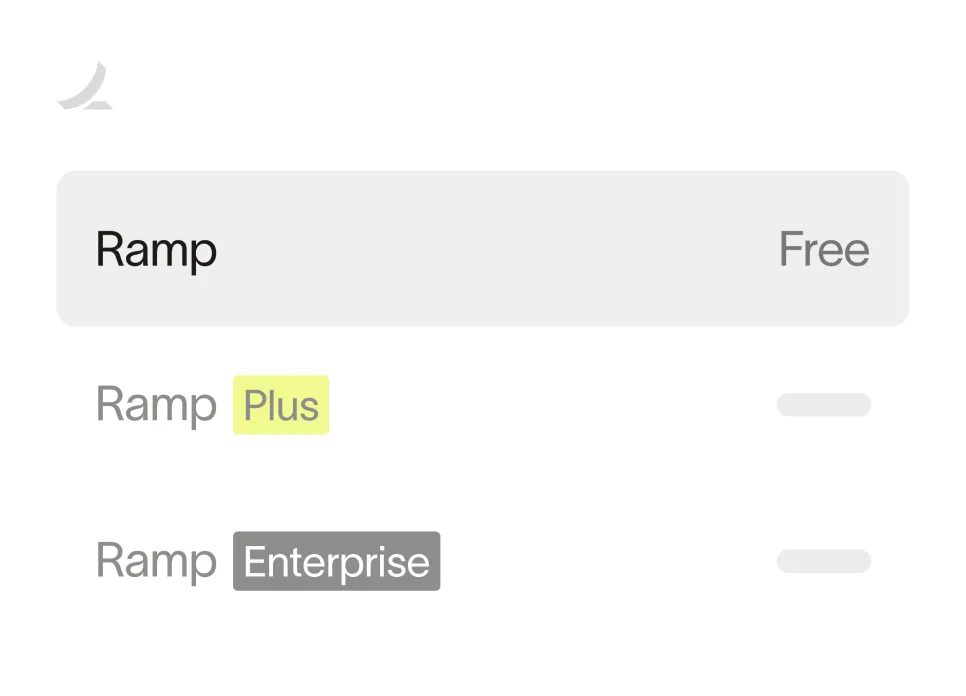
Pricing: Free for Ramp card users; $15/user/mo. for Ramp Plus
G2 rating: 4.8/5
Ramp eliminates expense reports entirely. Instead of chasing receipts and filling out forms after the fact, Ramp's expense management platform captures, categorizes, and reconciles expenses automatically as they happen.
Employees snap a photo of a receipt via mobile app, SMS, or email, and Ramp matches it to the right transaction in real time.
Policy Agent, Ramp's always-on AI reviewer, is trained on your company's real spending policy. It reviews 100% of transactions and blocks out-of-policy purchases at the swipe, before spend happens. Only genuine exceptions require human review.
Ramp integrates with QuickBooks, NetSuite, Xero, and Sage Intacct, syncing expenses to your general ledger with consistent categorization and custom GL mapping.
Pros:
- No expense reports: the workflow is eliminated, not improved
- AI-powered policy enforcement catches 7x more out-of-policy spend than traditional rule-based flags, with 99%+ accuracy when Policy Agent determines a transaction is in policy
- Free for Ramp corporate card users with no per-user fees on the base plan
Cons:
- Requires a Ramp corporate card to access the free tier
Ready to take control of your finances?
Learn about Ramp’s pricing plans and start saving today.
2. Expensify
Best for: Receipt scanning and reimbursement workflows
Pricing: Free for individuals; paid plans from $5/user/mo.
Expensify is a well-known expense tracker focused on receipt scanning and reimbursement. Compare top Expensify alternatives to see how it stacks up. Its one-click receipt scanning (SmartScan) automatically extracts vendor, amount, and category from receipt photos and pulls them into an expense report. Expensify also offers an integrated corporate card and connects with popular accounting and HR platforms.
Pros:
- Fast, accurate receipt scanning with SmartScan
- Extensive integrations with accounting systems, HR platforms, and travel vendors
- Free tier available for individual users
Cons:
- Pricing tops out at $9/user/mo. on the Control plan, plus optional add-on costs
- Policy enforcement is reactive, not proactive: Expensify flags violations after submission, not before spend happens
3. QuickBooks Online
Best for: Businesses already using QuickBooks for accounting
Pricing: Starts at $38/mo.
QuickBooks Online is the most widely used small business accounting platform, and its expense tracking is built directly into the accounting workflow. You can connect bank accounts and credit cards to automatically import transactions, then categorize and reconcile them alongside your books. If you're already in the QuickBooks ecosystem, you don't need a separate expense tool.
Pros:
- Expense tracking is natively integrated with accounting, invoicing, and payroll
- Widely adopted with a large ecosystem of add-ons and accountant support
- Familiar interface for businesses already using QuickBooks
Cons:
- Expense tracking is secondary to accounting—no dedicated policy controls, approval workflows, or corporate card integration
- Receipt capture is basic compared to purpose-built expense management tools
- No free tier; pricing starts at $38/mo. with additional costs for payroll and advanced features
4. Zoho Expense
Best for: Small teams on a budget
Pricing: Free for 3 users + 20 scans; Standard from $5/user/mo.
Zoho Expense is a cloud-based expense tracker that integrates well with Zoho's broader suite of business tools. It covers receipt scanning, mileage tracking, cash advances, and approval workflows. If your team already uses Zoho CRM, Books, or Projects, data flows between products without extra setup.
Pros:
- Free plan available for up to three users with 20 receipt scans per month
- Tight integration with the Zoho ecosystem (CRM, Books, Projects)
- Cash advance requests and delegation features for team expense management
Cons:
- Free plan limits are restrictive for growing teams
- Best value requires commitment to the broader Zoho ecosystem
- Fewer accounting integrations outside the Zoho suite compared to competitors
5. Everlance
Best for: Businesses with mobile or field employees who drive frequently
Pricing: Free (Basic); Premium from $8.99/mo.
Everlance specializes in mileage tracking and per diem expense logging. Automatic GPS tracking runs in the background, detecting drives and generating IRS-compliant mileage logs without manual entry. If your team includes field sales reps, delivery drivers, or frequent travelers, Everlance solves the specific problem of capturing mileage deductions accurately.
Pros:
- Automatic mileage tracking via GPS with IRS-compliant log generation
- Simple, focused interface that's easy for field employees to adopt
- Free tier includes 30 auto-detected trips per month and unlimited receipt uploads
Cons:
- Limited beyond mileage: not a full expense management platform
- No policy enforcement, approval workflows, or corporate card integration
- Business plans require custom pricing for teams
6. SAP Concur
Best for: Enterprises with complex, global expense needs
Pricing: Quote-based
SAP Concur offers a customizable expense management platform built for large organizations. It integrates with over 100 enterprise systems and supports multi-currency, multi-entity workflows. For companies that need to manage travel, expense, and invoice processes across global teams, Concur's breadth of features is hard to match.
Pros:
- Over 100 system integrations with deep enterprise ERP connectivity
- Multi-currency and multi-entity support for global organizations
- ROI calculator helps justify platform investment internally
Cons:
- UI is dated and has a steeper learning curve than newer platforms
- All pricing is quote-based, making cost comparison difficult
- No built-in spend insights or savings recommendations
7. FreshBooks
Best for: Freelancers and solopreneurs
Pricing: From $23/mo. (Lite)
FreshBooks is a cloud-based accounting platform with a heavy emphasis on invoicing and time tracking. Its expense tracking lets you snap receipt photos, categorize purchases, and mark expenses as billable to pass costs directly to clients. For freelancers and small teams whose primary expense workflow is "track it and invoice it," FreshBooks keeps everything in one place.
Pros:
- Mark expenses as billable and convert them directly into client invoices
- Cloud-based receipt storage that syncs across web, iOS, and Android
- Automatic expense categorization simplifies tax filing
Cons:
- Expense tracking is secondary to invoicing—no policy enforcement or approval workflows
- Additional users cost $11/mo. each, which adds up for teams
- Not designed for teams with corporate card programs or complex spend policies
8. Brex
Best for: VC-backed startups
Pricing: Free (Essentials); Premium at $12/user/mo.
Brex offers a corporate card with built-in expense management for venture-backed startups. Because it requires no personal guarantee, early-stage companies without extensive credit history can qualify. The platform combines corporate cards, expense tracking, reimbursements, and bill pay in one place.
Pros:
- No personal guarantee required, with startup-friendly underwriting
- Integrated rewards program tailored to startup spending categories (software, travel, rideshare)
- Free Essentials tier with corporate cards and basic expense management
Cons:
- Narrower accounting integrations compared to Ramp (fewer ERP connectors)
- Policy customization is more limited, especially for complex multi-department rules
- Premium features require $12/user/mo. upgrade
Just want a spreadsheet?
How to choose a business expense tracker
The right expense tracker depends on your team's size, existing tech stack, and whether you need proactive spend controls or just basic receipt capture. Keep these factors in mind:
Cost-effectiveness
Match the tool's pricing to your budget. Check whether you can save on user seats by limiting access to people who actually need it, and whether the free tier covers your requirements. Balance affordability with the features your team uses daily, especially automation capabilities that reduce manual work over time.
Ease of use
Evaluate user-friendliness before committing. Run an online demo to test the interface, and confirm the tool has a mobile app for on-the-go use.
Integration capabilities
Check whether the tracking tool integrates with your existing tech stack, including ERP systems and accounting software. It should sync data across your internal teams and any external accountants or bookkeepers without extra setup.
Scalability and functionality
Choose a tool that can grow with you. Your expense tracker should handle bulk transactions, add new users without extra cost, and automate approval workflows as volume increases.
Security
Your financial data needs strong encryption and multi-factor authentication. Check how the vendor stores and backs up your data. Fraud risk is real: organizations lose ~5% of revenue to fraud each year, which makes pre-spend controls and policy checks essential.
Reporting and tracking
Your business expense tracker should offer detailed, customizable reporting capabilities to give you a complete picture of where your business is spending money. It also lets you budget for business expenses and compare actual spend against your projections. With that visibility, you can adjust spend and spot cost-saving opportunities as they arise.
Customer support
Research the vendor's support reputation before buying. Look for live chat, phone support, and a clear onboarding process.
Best practices for business expense tracking
The best business expense tracker app won't fix a broken process. These five practices keep your data clean, your deductions intact, and your finance team sane.
1. Separate personal and business finances
Open a dedicated business bank account and credit card before you track a single expense. Mixing personal and business purchases creates a categorization nightmare at tax time and raises red flags in an IRS audit. A clean separation also makes it easier to calculate deductible expenses accurately.
2. Digitize receipts immediately
Snap a photo of every receipt the moment you get it. Paper receipts fade, get lost, and pile up in desk drawers. Most expense tracker apps can extract the vendor, amount, and date automatically from a photo, which saves manual entry and builds an auditable digital archive from day one.
3. Categorize expenses into IRS-compliant categories
Use standard IRS expense categories (meals, travel, office supplies, software, professional services) from your first transaction. Consistent categorization from the start makes tax prep faster and helps you claim every deduction you're entitled to. Retroactive re-categorization across a year of transactions is a painful, error-prone process you want to avoid.
4. Set spending policies before you need them
Don't wait for a policy violation to write the rules. Define per-category limits, approval workflows, and restricted vendors before the first out-of-policy charge hits your books. Tools like Ramp can enforce policies automatically at the point of purchase, so violations are blocked before spend happens rather than flagged after the fact.
5. Review and reconcile weekly
A monthly reconciliation is too late to catch problems. Set a weekly cadence to match transactions against receipts, flag anomalies, and close gaps before month-end. Weekly reviews surface duplicate charges, missing receipts, and miscategorized expenses while the details are still fresh.
Why Ramp is the best expense tracker for business
Ramp eliminates the manual work in expense management, from receipt capture through reconciliation, so your team stops chasing paperwork and starts enforcing policy before spend happens.
Ramp's AI-powered software automatically matches receipts to transactions in real time. Employees simply snap a photo, and Ramp extracts key details like merchant, date, and amount and links them to the correct charge. You get full visibility into spend without manual matching, and your employees save time.
Ramp also makes it easy to enforce spending policies. You can set granular controls and limits by employee, department, or merchant category, whether that's restricting daily meal spend or limiting business-class flights. Ramp's Policy Agent blocks out-of-policy purchases at the swipe, before spend happens, so violations never reach your books.
Beyond tracking and controls, Ramp integrates directly with accounting software like QuickBooks, Xero, Sage Intacct, and NetSuite. Expenses sync to your general ledger with consistent categorization and custom GL mapping, making reconciliation and analysis easier.
Ramp also goes beyond basic expense tracking by automating the most time-consuming parts of managing business spend:
- Easy policy enforcement: Automate expense approvals and reimbursement workflows to keep spending aligned with policy
- Accelerated reconciliation: Accurately code, categorize, and map transactions with AI to speed up month-end close
- Accounts payable automation: Manage bills and payments alongside employee expenses in one place
With automation, built-in controls, and direct accounting integrations for QuickBooks, Xero, Sage Intacct, and NetSuite, Ramp saves customers an average of 7.5% a year.

FAQs
Ramp is the top expense tracker for small business if you want automated tracking without expense reports. Zoho Expense is a strong budget alternative with a free tier for up to three users. QuickBooks Online works well for businesses already using QuickBooks for accounting.
Yes. Ramp is free for businesses that use the Ramp corporate card, with no per-user fees on the base plan. Zoho Expense offers a free tier for up to three users with 20 receipt scans per month. Spreadsheet templates in Excel or Google Sheets are also free but fully manual.
Look for automated receipt capture, policy enforcement, budgeting controls, real-time reporting, and integrations with your accounting software. These features help you monitor, analyze, and manage expenses more effectively as your business grows.
Use an expense tracker that automatically categorizes purchases into IRS-deductible categories like travel, meals, office supplies, and software. Keep digital copies of all receipts and maintain records for at least three years. See the IRS compliance section above for the full list of deductible categories.
Yes. Most modern expense trackers sync directly with QuickBooks, Xero, NetSuite, and Sage. Ramp offers two-way sync with all four. Check each tool's integration page for your specific accounting platform.


“I assumed I would have to choose between speed and control. What I found is that you can have both. A well-designed system takes friction out, for the finance function and for everyone else.”
Justin Webster
CFO, Denver Broncos

“A well-run district should not have to choose between getting work done at the school site and keeping control of the dollars behind it. We're not hiring more people to do more jobs, so we have to be smarter about the process. With Ramp, the purchase, the receipt, and the record stay together from the start. ”
Nick Brizeno
Director of Purchasing, San Marcos Unified School District

“In senior living, scale only works if the communities still feel personal. We needed the back office to carry more of the complexity, not the people serving residents. Ramp helped us build that infrastructure, so the experience in the community could stay human.”
Ryan Cole
CFO, Agemark Senior Living

“AI is moving faster than the finance context around it. Prices change, models change, and the value is not always obvious from an invoice. We needed enough detail to know which bets deserved more investment — and which ones did not.”
Greg Cooley
Controller, AngelList

“Invoices, cards, tokens. The categories change but the principle doesn't: know where the money is going, remove the work around it, and make sure the spend is worth it.”
Maciej Mylik. Finance
ElevenLabs

“We weren’t trying to retrofit an old finance system. We had a blank canvas, and Ramp gave us the foundation to build a global finance function of the future.”
Justin Dourado
Director of Finance, Othership

“There's just no surprises anymore. No more waiting two months to find out how a job did. We know how it's doing as it's happening.”
Erich Kuss
Financial Systems Manager, Infinity Home Services

“More token spend isn’t proof that AI is working. Less isn’t proof that it isn’t. What matters is whether we’re buying the right level of intelligence for the work. Ramp lets us make that judgment in the same place we manage every other type of spend.”
Cody Nutt
Senior Director of Business Systems, Daxko
