How to manage a remote finance team in 2026

- Why remote finance teams need a different playbook
- 7 tips to manage a remote finance team
- Essential tech stack for remote finance teams
- Keeping financial data secure and compliant from anywhere
- KPIs that prove your remote finance team is performing
- Communication and culture that stick in a distributed team
- How to prevent burnout and manage time zone differences
- Remote finance pitfalls to avoid
- Move faster and spend smarter with Ramp
Managing a remote finance team isn't just about replacing office routines with Zoom calls. Remote work changes how you handle financial data, maintain compliance, and align team members across time zones.
Finance professionals now rely on cloud-based systems and automation to maintain accuracy and visibility. At the same time, leaders need to balance workloads, set clear expectations, and build engagement so remote employees feel connected without in-person interaction.
Why remote finance teams need a different playbook
Traditional finance management relies on in-person oversight, physical documents, and real-time collaboration. None of that translates cleanly to remote work.
A remote finance team is any group of finance professionals who work primarily outside a shared office. Some teams are fully distributed, with members spread across cities or countries. Others operate in a hybrid model, splitting time between home and a central office. Either way, the management approach needs to change.
Remote finance teams face challenges that in-office teams rarely think about, including:
- Visibility gaps: You can't walk over to check on a task's status, so work-in-progress becomes harder to track without the right tools and habits
- Data security risks: Remote employees handle sensitive financial information from home networks or public Wi-Fi, creating vulnerabilities that don't exist behind an office firewall
- Time zone coordination: Scheduling approvals, handoffs, and real-time discussions get complicated when your team spans multiple time zones
- Control enforcement: Segregation of duties, once verified in person, now relies on digital approvals, finance automation, and audit trails that capture every action
- Isolation and disconnection: Without hallway conversations and shared lunches, remote workers can feel invisible, which erodes engagement and increases turnover
These challenges explain why remote finance teams need a new playbook, one designed for a distributed workforce that must still deliver accuracy and accountability.
7 tips to manage a remote finance team
Leading a distributed finance team requires structure. Clear policies, smart use of automation, and consistent communication help remote employees protect financial data, hit deadlines, and stay engaged. These 7 tips create a foundation for accuracy and efficiency.
Set clear policies and SLAs
Remote finance teams need documented rules for handling financial information, using systems, and staying available across time zones. A service-level agreement (SLA) is a written commitment that defines expected turnaround times and quality standards for specific tasks or processes. In-office teams can clarify expectations through hallway conversations. Remote teams can't.
Essential policies every remote finance team should document include:
- System access: VPNs, MFA, and password managers for all logins
- Close cycle: Timelines for prelim reports, AP reconciliations, and finals
- Expense approvals: 24–48 hours for routine items, same-day for urgent travel
- Escalation paths: Who to contact when an approver is unavailable or a deadline is at risk
- Communication norms: Expected response times by channel (e.g., Slack within 2 hours, email within 24 hours)
Policies should explain which tasks require secure connections, how remote employees protect devices, and what response times apply to critical processes. Keep them in one central place and update quarterly.
Automate repetitive workflows
Automation reduces the back-and-forth that's hardest to manage across locations. When your team is distributed, every manual handoff is a potential delay, and every delay compounds across time zones.
Here are workflows worth automating first:
- Expense approvals workflow: Employees submit expenses via mobile, receipts auto-match to corporate card transactions, and policy checks flag violations before a manager ever reviews them
- Invoice matching workflow: OCR invoice processing captures vendor invoices, rule-based routing sends them to the right approver, and 3-way matching validates against POs and receiving documents automatically
- Receipt capture workflow: Employees photograph receipts at the point of purchase, the system extracts key data, and transactions reconcile to the general ledger without manual entry
- Recurring journal entries workflow: Monthly entries for depreciation expenses, accruals, and allocations post automatically on schedule, reducing close-cycle bottlenecks
Automation also creates audit trails, which matter more when you can't physically verify work. Cloud-based systems capture who did what and when, giving you confidence that processes ran correctly.
Define roles and access levels
Role clarity matters more in remote settings because no one can peek at what others are doing. Without physical proximity, controls need to live in your software.
Key principles to follow:
- Enforce segregation of duties in accounts payable so no single person controls an entire process
- Configure systems to block self-approvals and require dual sign-off above thresholds
- Review access logs monthly and update immediately when team members change roles
Create a responsibility matrix that outlines who can view, edit, approve, and release transactions. Apply the principle of least privilege: Grant each team member only the minimum access needed for their responsibilities.
Track output-based KPIs
Shift your mindset from monitoring hours worked to measuring deliverables. Output-based KPIs track what your team produces, such as closed books, processed invoices, and accurate forecasts, while activity-based metrics track what they do, such as hours logged or meetings attended. For remote teams, output is what matters.
Useful output-based KPIs include:
- Days to close: Break down by sub-process to spot bottlenecks. This is one of the clearest measures of financial performance.
- Error rates: Track journal entry corrections, invoice coding issues, and reconciliation discrepancies
- Forecast accuracy: Compare projections to actuals across revenue and expenses, a key input for cash flow forecasting
This approach builds trust and autonomy. When people know they're measured on results, they focus on getting the work done rather than performing busyness.
Schedule predictable check-ins
Remote teams need consistency, not constant meetings. Predictable check-ins create rhythm without overwhelming calendars.
Here's what a balanced cadence looks like:
- Daily standup: 15 minutes for priorities and blockers. You can run this asynchronously over Slack or Teams, or host a video call. If you choose video, record it for absentees.
- Weekly team sync: 30–45 minutes on KPIs, process updates, and upcoming deadlines, always with a standing agenda shared in advance
- Bi-weekly or monthly one-on-ones: Private space for feedback, workload balance, and professional development
A standing agenda keeps each meeting productive. Without one, check-ins drift into status updates that could've been a Slack message. Define what gets covered before the meeting starts.
Close the books in the cloud
A cloud-based close means your entire month-end process runs on cloud-hosted software that multiple team members can access simultaneously from anywhere. No emailing spreadsheets back and forth, no version control nightmares, no waiting for someone to finish before you can start.
Best practices for a distributed close include:
- Spread tasks across the month instead of cramming at the end
- Automate recurring entries for depreciation, accruals, and allocations
- Use project management tools to assign owners, track dependencies, and share progress dashboards
Your cloud ERP becomes the single source of truth for financial data. Every journal entry, reconciliation, and approval lives in one system with real-time visibility for the whole team.
Build team culture intentionally
Culture doesn't happen organically when your team is remote—you have to create it. Leaders must carve out space for recognition, connection, and informal interaction.
Ideas that actually stick are:
- Monthly lunch-and-learns where team members share expertise
- Peer recognition programs with digital kudos or shoutouts in team channels
- Optional coffee chats, game sessions, or Slack hobby channels for informal bonding
- Celebrating wins publicly (e.g., closed books early, clean audit, successful system migration)
Remote culture thrives when leaders are intentional. Prioritizing recognition, learning, and genuine connection transforms distributed teams into cohesive, engaged communities.
Essential tech stack for remote finance teams
The right tools make or break remote finance operations. Look for cloud-based platforms that automate routine tasks, support digital audit trails, and scale as your business grows.
| Category | What to look for | Why it matters |
|---|---|---|
| Cloud ERP | Multi-user access, strong APIs, audit trails | Keeps books accurate during distributed close cycles |
| Corporate cards and expense management | Spend controls, receipt capture, virtual cards, automatic categorization | Prevents out-of-policy spend and eliminates manual reimbursements |
| AP automation | OCR intake, rule-based routing, 3-way matching | Speeds invoice processing and optimizes cash flow |
| Communication platforms | Async messaging, video calls, dedicated channels | Keeps finance discussions organized and accessible across time zones |
| Cloud document management | Encryption, version control, granular permissions | Protects sensitive financial data and eliminates local file risks |
Expense management and corporate cards
Distributed teams need digital-first expense management—no one is handing in paper receipts from a home office. Look for mobile receipt capture, real-time spend visibility, and automated policy enforcement that flags violations before they reach an approver.
Corporate cards with built-in controls reduce the need for manual oversight. You can set per-employee spend limits, restrict merchant categories, and get instant notifications when a transaction occurs.
Accounting and ERP software
Your ERP needs to be cloud-native so multiple team members can work in the same system simultaneously. Prioritize solutions with strong integrations across your tech stack to avoid manual data entry between tools.
Real-time reporting and configurable dashboards let you monitor close progress and financial performance without waiting for someone to email you a spreadsheet.
Communication and collaboration platforms
Remote finance teams need both synchronous tools (video calls for sensitive discussions and real-time problem-solving) and asynchronous tools (messaging and recorded updates for everything else).
Create dedicated finance channels separate from company-wide noise. This keeps sensitive discussions contained and makes it easier to search for past decisions and context.
Cloud document management
Storing files locally on individual laptops creates version control nightmares and security gaps. A cloud document management system gives you access controls, audit trails, and integration with your accounting systems.
Look for granular permissions so you can control who views, edits, and shares sensitive financial documents. Every access event should be logged for compliance purposes.
Keeping financial data secure and compliant from anywhere
Security and compliance form the foundation of remote finance management. The focus should be on embedding controls into systems so finance teams protect sensitive information without slowing workflows.
Role-based access controls
Grant team members the minimum access needed for their responsibilities. Enforce segregation of duties, separating vendor setup, invoice approval, and payment processing, and require dual approval for high-value transactions. Review permissions quarterly and remove access promptly when roles change.
Encryption standards
Use AES-256 encryption for financial data at rest and TLS 1.2 or higher for data in transit. Require VPN connections for remote employees working from public networks. These measures protect financial information even outside the office firewall.
What are AES-256 and TLS 1.2?
- AES-256: A widely used encryption standard that scrambles financial data so it can't be read without the proper key. The "256" refers to key length: Longer keys mean stronger protection. Banks, governments, and SaaS platforms rely on AES-256 to secure stored data.
- TLS 1.2: A security protocol that protects data as it moves across the internet. It encrypts information sent between browsers, apps, and servers, making it unreadable to anyone intercepting the connection. TLS 1.2 is the minimum recommended version for financial data transfers.
Audit trails and documentation
Automated audit logs should capture who made each change, when it happened, and what was altered. Link approvals directly to source documents so reviewers and auditors don't have to perform any manual detective work.
Vendor security reviews
Third-party SaaS tools need the same scrutiny as internal systems. Request SOC 2 Type II or ISO 27001 certifications, review reports annually, and include right-to-audit clauses in contracts. For payment processors, confirm PCI DSS compliance.
What are SOC 2 Type II, ISO 27001, and PCI DSS?
- SOC 2 Type II: An independent audit that tests whether a vendor's security controls work over time, not just on paper. It's a common requirement for SaaS tools handling financial data.
- ISO 27001: An international standard for information security management. It shows that a company has a structured framework for protecting sensitive information.
- PCI DSS: A global standard for any business that processes credit card transactions. It ensures systems meet strict requirements for data protection, monitoring, and fraud prevention.
KPIs that prove your remote finance team is performing
Remote teams can't rely on visibility from in-person work, so KPIs become essential. Tracking clear, measurable outcomes helps you demonstrate value, optimize workflows, and catch issues early.
Financial close cycle time
The close is the process of finalizing your books at the end of each month, quarter, or year. Tracking days-to-close shows how efficiently your team moves through reconciliations, journal entries, and reviews. A shrinking close cycle signals healthy processes and strong coordination across your distributed team.
Expense report processing speed
Slow expense processing frustrates employees and delays visibility into spend. Measure the time from submission to reimbursement. If expense reports sit in queues for days, it usually points to manual bottlenecks that automation can fix.
Spend policy compliance rate
Your compliance rate is the percentage of expenses that follow company policy without requiring exceptions or manual overrides. A high rate means your policies are clear and your tools enforce them automatically. A low rate signals gaps in training, unclear rules, or tools that aren't configured correctly.
Invoice accuracy and exception rates
Your exception rate is the percentage of invoices that require manual intervention due to errors, mismatches, or missing data. Lower is better. Common causes include incorrect PO numbers, mismatched quantities, and missing approvals. Tracking this KPI helps you identify where upstream processes need tightening.
Communication and culture that stick in a distributed team
Strong team culture doesn't happen by accident in a remote workforce. Without in-person contact, CFOs and controllers need intentional practices that keep employees engaged, aligned, and connected.
Asynchronous documentation first
Written communication should be the default for decisions, process changes, and project updates. Posting updates in shared digital tools gives team members across time zones the full context. Decision logs and searchable SOPs create an institutional memory that survives turnover and helps remote workers solve problems without waiting for live answers.
Virtual standups and office hours
Short, predictable check-ins help maintain alignment without overwhelming calendars. Daily standups keep priorities clear, while weekly team meetings cover KPIs, workflows, and upcoming deadlines. Leaders should also set weekly office hours, blocks of time when remote employees can drop in for quick approvals or questions to cut back on impromptu Zoom calls.
Recognition and social rituals
Remote employees risk feeling invisible without structured recognition. Regular shoutouts in meetings or peer kudos channels keep engagement high. Virtual coffee chats, lunch-and-learns, or light team-building activities give people space to connect beyond spreadsheets and financial reporting. These rituals don't need to be elaborate, but consistency is key to maintaining morale.
Onboarding playbook for new hires
Remote employees can't learn by shadowing, so onboarding needs more structure. A clear playbook helps new finance team members build confidence and start contributing quickly.
Set expectations in 30/60/90-day phases:
- First 30 days: Provide system access, walk through SOPs, and assign low-risk tasks such as reconciliations or recurring journal entries. Pair each hire with a mentor for daily support during week 1 and weekly check-ins afterward.
- Days 31–60: Expand responsibilities to include a defined sub-process, such as expense management or vendor setup, and encourage the new hire to suggest 1 process improvement
- Days 61–90: Have them lead a small part of the month-end close or reporting cycle. By the end of this phase, they should be confident with digital tools, team workflows, and core KPIs.
How to prevent burnout and manage time zone differences
Remote finance teams often face heavy workloads during close cycles, plus the added stress of working across multiple time zones. Leaders need to protect work-life balance while keeping financial reporting accurate and timely.
- Rotate high-pressure tasks: Month-end close, reconciliations, and vendor payments shouldn't fall on the same people every cycle. Rotating responsibilities spreads the workload, prevents burnout, and builds cross-training so no one becomes a single point of failure.
- Define core hours: Establish 3–4 overlapping hours when all team members are available for real-time collaboration. Outside those hours, encourage asynchronous updates in digital tools so remote workers can manage their schedules while keeping workflows moving.
- Model healthy boundaries: Avoid late-night Slack messages or Zoom calls unless circumstances are truly extraordinary. Respect work-life balance and encourage employees to do the same.
- Support wellness proactively: Offer flexible schedules, mental health resources, and paid time off specifically for rest. Regular one-on-ones should include check-ins about stress levels and workload to catch issues before they escalate.
Watch for these warning signs of burnout in remote finance team members:
- Missed close deadlines or slipping quality: Someone who consistently delivered on time starts falling behind or submitting work with uncharacteristic errors
- Decreased communication: A team member who was active in Slack and meetings becomes noticeably quieter or less responsive
- Increased error rates: A spike in journal entry corrections, reconciliation discrepancies, or coding mistakes can signal fatigue, not carelessness
- Resistance to collaboration: Pulling back from team rituals, skipping optional meetings, or avoiding one-on-ones often points to disengagement driven by exhaustion
Remote finance pitfalls to avoid
Even well-structured remote finance teams can stumble if they overlook common risks. These pitfalls don't just hurt efficiency, they can expose financial data and damage employee engagement.
Over-relying on synchronous meetings
Too many meetings create fatigue and penalize team members in less convenient time zones. When every discussion requires a live call, productivity drops and resentment builds.
Instead, do this: Default to asynchronous communication for updates, decisions, and status checks. Reserve live meetings for complex problem-solving, sensitive discussions, and collaborative planning.
Neglecting security awareness training
Remote workers face more phishing and social engineering risks than their in-office counterparts. Home networks lack enterprise-grade protections, and attackers know it.
Instead, do this: Run regular security awareness training, not just a one-time onboarding session. Simulate phishing attacks quarterly, share real-world examples of finance-targeted scams, and make training completion a tracked metric.
Skipping regular one-on-ones
Remote managers often let one-on-ones slip because they feel "always connected" through Slack and email. But chat messages don't replace dedicated face time for career development, feedback, and catching issues early.
Instead, do this: Protect one-on-one time on your calendar. Use a consistent format that covers workload, blockers, professional development, and well-being. These conversations are where you'll spot burnout, disengagement, and growth opportunities.
Ignoring tool adoption and usage
Buying tools isn't enough—you need to confirm people actually use them correctly. A shiny new expense platform doesn't help if half your team still emails spreadsheets.
Instead, do this: Track adoption metrics such as login frequency, feature usage, and submission rates. Address resistance directly with additional training or workflow adjustments. If a tool isn't getting used, find out why before blaming the team.
Move faster and spend smarter with Ramp
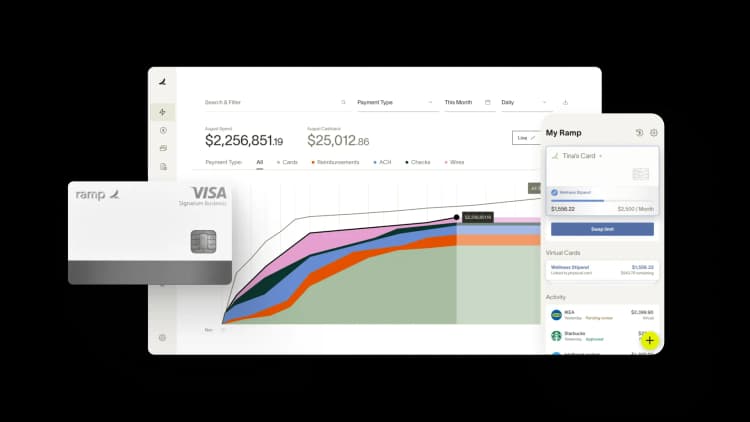
Managing a remote finance team means balancing security, efficiency, and employee engagement. Ramp gives finance professionals the digital tools they need to streamline workflows, enforce controls, and keep financial data secure from anywhere.
With Ramp, remote employees can manage expenses through automated receipt capture, virtual cards, and policy enforcement that stops out-of-policy spend before it happens. Accounts payable automation and bill pay features speed invoice processing, while integrations with your ERP improve financial reporting and shorten close cycles.
Dashboards, real-time visibility, and audit-ready documentation help CFOs and controllers optimize cash flow and maintain compliance. Whether your finance team is distributed across time zones or scaling quickly, Ramp provides the tech stack to keep operations efficient and accountable.
See how Ramp works with an interactive demo.

FAQs
Use encrypted video calls for sensitive topics and secure file sharing for confidential documents. Avoid putting personnel or compensation details in written chat messages where they can be easily screenshotted or forwarded.
Weekly team syncs, bi-weekly or monthly one-on-ones, and quarterly planning sessions work well for most teams. Adjust based on your team size, time zone spread, and current projects like close cycles or audits.
Phase the transition by starting with documentation and tool migration, then gradually reduce in-office days while monitoring productivity and close-cycle metrics to catch issues early.
Yes. With proper controls, automated audit trails, and thorough documentation, many remote teams pass SOX audits successfully, and cloud-based systems often provide better traceability than paper-based processes.
Roles requiring physical document handling or frequent in-person vendor relationships may need hybrid arrangements, while most analytical, transactional, and reporting roles work well fully remote.


“I assumed I would have to choose between speed and control. What I found is that you can have both. A well-designed system takes friction out, for the finance function and for everyone else.”
Justin Webster
CFO, Denver Broncos

“A well-run district should not have to choose between getting work done at the school site and keeping control of the dollars behind it. We're not hiring more people to do more jobs, so we have to be smarter about the process. With Ramp, the purchase, the receipt, and the record stay together from the start. ”
Nick Brizeno
Director of Purchasing, San Marcos Unified School District

“In senior living, scale only works if the communities still feel personal. We needed the back office to carry more of the complexity, not the people serving residents. Ramp helped us build that infrastructure, so the experience in the community could stay human.”
Ryan Cole
CFO, Agemark Senior Living

“AI is moving faster than the finance context around it. Prices change, models change, and the value is not always obvious from an invoice. We needed enough detail to know which bets deserved more investment — and which ones did not.”
Greg Cooley
Controller, AngelList

“Invoices, cards, tokens. The categories change but the principle doesn't: know where the money is going, remove the work around it, and make sure the spend is worth it.”
Maciej Mylik. Finance
ElevenLabs

“We weren’t trying to retrofit an old finance system. We had a blank canvas, and Ramp gave us the foundation to build a global finance function of the future.”
Justin Dourado
Director of Finance, Othership

“There's just no surprises anymore. No more waiting two months to find out how a job did. We know how it's doing as it's happening.”
Erich Kuss
Financial Systems Manager, Infinity Home Services

“More token spend isn’t proof that AI is working. Less isn’t proof that it isn’t. What matters is whether we’re buying the right level of intelligence for the work. Ramp lets us make that judgment in the same place we manage every other type of spend.”
Cody Nutt
Senior Director of Business Systems, Daxko
