
- What counts as a vendor payment
- The vendor payment workflow, step by step
- Common vendor payment problems
- What to look for in vendor payment software
- How Ramp handles vendor payments for healthcare practices
Healthcare practices pay dozens of vendors every month—medical supply distributors, lab services, equipment lessors, and facility vendors. Managing that volume without a documented process means duplicate charges, missed overbills, and a month-end close that takes longer than it should.
A vendor payment is any transfer of money from your practice to an external business for goods or services. When the process works, invoices get verified before they’re paid, approvals route to the right person automatically, and your finance team closes the month without chasing down missing documentation.
When it doesn’t, you’re catching duplicate charges after they clear, waiting on approvers who are out of office, and reconciling a stack of paper invoices against bank statements two weeks after the fact.
What counts as a vendor payment
A vendor payment covers any transaction where your practice owes money to an external business. That includes:
- Medical supply distributors: Henry Schein, McKesson, Patterson
- Lab services: Quest Diagnostics, LabCorp, local reference labs
- Equipment lessors: Imaging equipment, dental chairs, surgical tools
- Facility services: Cleaning, waste disposal, linen services
- Technology vendors: Electronic health record (EHR) systems, billing software, telehealth platforms
- Professional services: Accounting, legal, staffing agencies
The volume grows with every location you add. A single-site practice might manage 15–25 vendor invoices a month. A 10-location group can be pushing 200+.
Volume isn't the only variable. If your complexity comes from departments rather than locations—radiology, lab, and physical therapy under one roof—the same approval problems apply, but AP automation for outpatient care centers routes invoices by department instead.
The vendor payment workflow, step by step
A reliable vendor payment process has five stages. Healthcare practices handle all five—but the compliance requirements around each step are higher than in most industries.
- Invoice receipt. Vendor invoices arrive by email, fax, mail, or through a portal. The first failure point: invoices land in multiple inboxes, get forwarded to the wrong person, or sit in a manager’s email until month-end.
- Invoice verification. Before approval, someone needs to confirm the invoice matches what was ordered and received. For medical supply distributors, this means checking quantities and prices against the purchase order and your contracted formulary rates. Overbilling and unauthorized product substitutions are common—line-item verification catches both before payment clears.
- Approval routing. Who signs off depends on the vendor type, the amount, and the location. A routine supply order routes to the office manager. A lab service contract renewal—or any vendor with a financial relationship to a referring physician—routes to the CFO and compliance review. Without a documented workflow, approvals bottleneck on one person or skip the reviewer who needs to see it for Stark Law documentation purposes.
- Payment scheduling. Once approved, the invoice gets scheduled for payment. Common terms are Net 30 or Net 60. Early payment discounts (2/10 Net 30: pay in 10 days, save 2%) are available from some vendors but rarely captured by practices still running manual payment calendars.
- Reconciliation. Every payment needs to match to the right cost center, location, and accounting category. For healthcare practices, reconciliation also creates the financial documentation required for Stark Law and Anti-Kickback Statute compliance—every vendor payment involving a referring physician relationship needs a clear, auditable record. Manual reconciliation at month-end is where both accounting errors and compliance gaps accumulate.
Common vendor payment problems
Duplicate invoices. A vendor resubmits an invoice your team already paid. Without automated duplicate detection, the second payment clears. Medical supply distributors and lab services are the most common sources—they bill monthly with consistent amounts, so duplicates are easy to miss.
Missing documentation. An auditor asks for the invoice behind a payment. Your team digs through email threads and paper files to find it. Healthcare practices face heightened scrutiny around vendor payments because of Stark Law and Anti-Kickback Statute documentation requirements—every payment needs a clear audit trail.
Approval bottlenecks. An approver is out of office. The invoice sits. The vendor calls about a late payment. Your office manager emails the backup approver. Three days later, the payment finally routes. This happens on 10–15% of invoices at practices without automated routing.
Lack of visibility across locations. If you run multiple locations, you often don’t know the total vendor spend picture until month-end. Office managers purchase locally from preferred vendors without central oversight. Your finance team is flying blind until the bank statement arrives.
What to look for in vendor payment software
Not every AP tool handles healthcare vendor payment complexity well. Evaluate on these criteria:
Invoice capture accuracy. Manual data entry from PDFs introduces errors and takes time. Healthcare vendor invoices are more complex than most—lab services include test-level line items, medical supply distributors bill with formulary codes, and equipment lessors mix service fees with lease payments. Look for optical character recognition (OCR)-based capture that handles these formats and flags exceptions for human review rather than passing errors through.
Approval workflow flexibility. Your approval structure probably isn’t uniform. A multi-location group needs rules by amount, vendor category, and location. The software should mirror your actual approval chain, not force you into a one-size-fits-all model.
Duplicate and fraud detection. The best AP tools flag duplicates and anomalies before payment. Two-way matching (invoice vs. purchase order (PO)) and three-way matching (invoice vs. PO vs. receipt) catch discrepancies before they become reconciliation problems.
ERP integration. If your team re-enters transaction data from your AP tool into QuickBooks, Sage Intacct, or NetSuite, you’re doing the same work twice. Look for real-time sync that maps transactions to your existing chart of accounts automatically.
Multi-entity support. If you operate multiple locations or legal entities, your AP tool needs to handle consolidated reporting and entity-level approval chains in one view.
How Ramp handles vendor payments for healthcare practices
Once your vendor payment workflow is documented, the next question is tooling that actually runs it.
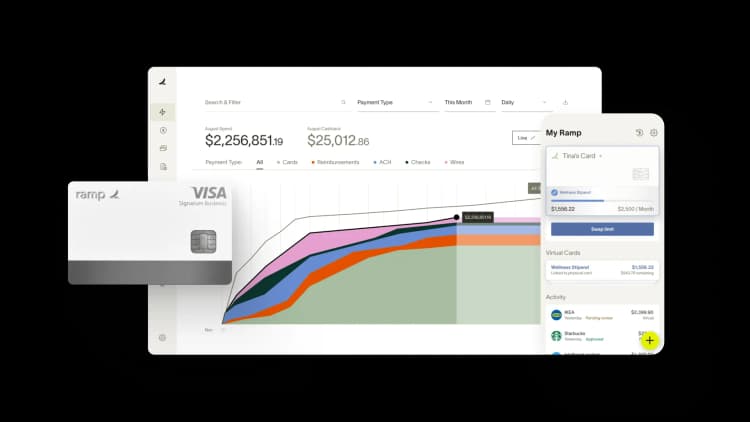
Ramp’s bill pay platform captures vendor invoices with 99% OCR accuracy, extracting line items, payment terms, and amounts without manual entry. It routes each invoice to the right approver—location manager, practice administrator, or CFO—based on rules you set. Before any payment goes out, Ramp runs the invoice against 60 fraud signals, including duplicate detection and two- and three-way matching against purchase orders and receipts.
For healthcare practices specifically, Ramp handles the vendor types you actually pay: medical supply distributors, lab services, equipment lessors, and facility vendors. Approval workflows route by location, vendor category, or dollar amount. When a payment clears, it syncs automatically to your accounting system—no re-keying, no end-of-month reconciliation sprint.
The result, on average: you save 7.5%+ of total spend and your team spends significantly less time on manual AP work. Ramp processes bill pay transactions 2.4x faster than legacy software.
See how the approval and payment flow works for a multi-location healthcare practice with Ramp for Healthcare.

FAQs
Accounts payable (AP) is the accounting category that tracks what your business owes to external vendors. Vendor payments are the actual transfers—the moment money moves from your account to the vendor’s. AP is the obligation. Vendor payments are the fulfillment of that obligation. Most AP automation tools handle both: tracking what’s owed and executing the payment.
The most common methods are ACH transfer, wire transfer, check, and virtual card. ACH is the standard for domestic vendor payments—it typically settles in 1–3 business days and costs less than $1 per transaction. Checks are slower and more expensive to process but still common for vendors that don’t accept electronic payment. Virtual cards work well for one-time vendor purchases because you can set a specific spend limit per transaction.
The most reliable approach is automated duplicate detection before payment. Good AP software flags invoices with the same vendor, amount, and invoice number as a potential duplicate. Manual reviews—scanning your AP log at month-end—catch some duplicates but miss others, especially from vendors who bill consistent amounts every month. Multi-location practices are the most vulnerable because the same vendor may invoice multiple locations for the same service.
For general business purposes: the original invoice, the purchase order (if applicable), proof of delivery or service confirmation, the approval record, and the payment confirmation. For healthcare practices operating under Stark Law or Anti-Kickback Statute scrutiny, documentation standards are higher—every financial relationship with a referring physician or related entity needs a clear paper trail. See our guide to Stark Law compliance in healthcare for the specific documentation requirements.
Don't miss these


“I assumed I would have to choose between speed and control. What I found is that you can have both. A well-designed system takes friction out, for the finance function and for everyone else.”
Justin Webster
CFO, Denver Broncos

“A well-run district should not have to choose between getting work done at the school site and keeping control of the dollars behind it. We're not hiring more people to do more jobs, so we have to be smarter about the process. With Ramp, the purchase, the receipt, and the record stay together from the start. ”
Nick Brizeno
Director of Purchasing, San Marcos Unified School District

“In senior living, scale only works if the communities still feel personal. We needed the back office to carry more of the complexity, not the people serving residents. Ramp helped us build that infrastructure, so the experience in the community could stay human.”
Ryan Cole
CFO, Agemark Senior Living

“AI is moving faster than the finance context around it. Prices change, models change, and the value is not always obvious from an invoice. We needed enough detail to know which bets deserved more investment — and which ones did not.”
Greg Cooley
Controller, AngelList

“Invoices, cards, tokens. The categories change but the principle doesn't: know where the money is going, remove the work around it, and make sure the spend is worth it.”
Maciej Mylik. Finance
ElevenLabs

“We weren’t trying to retrofit an old finance system. We had a blank canvas, and Ramp gave us the foundation to build a global finance function of the future.”
Justin Dourado
Director of Finance, Othership

“There's just no surprises anymore. No more waiting two months to find out how a job did. We know how it's doing as it's happening.”
Erich Kuss
Financial Systems Manager, Infinity Home Services

“More token spend isn’t proof that AI is working. Less isn’t proof that it isn’t. What matters is whether we’re buying the right level of intelligence for the work. Ramp lets us make that judgment in the same place we manage every other type of spend.”
Cody Nutt
Senior Director of Business Systems, Daxko
