What is invoice management? Process and benefits

- What is invoice management?
- Types of invoice management systems
- Why invoice management matters?
- Challenges in invoice management
- How the invoice management process works?
- Benefits of automated invoice management
- Manual vs. automated invoice management
- Key features to look for in invoice management software
- How to implement invoice management automation?
- Invoice management best practices
- Manage invoices end to end with Ramp Bill Pay
Invoice management is the structured process of receiving, validating, approving, paying, and recording bills from vendors and suppliers. It covers the policies, workflows, and controls that decide how money leaves your business.
Get it right and you pay on time, protect cash flow, and keep vendors on your side. Get it wrong and you're chasing approvals over email while late fees pile up.
The difference between a clean AP month and a messy one comes down to how you manage invoices: the process you follow, the system you run it in, and the metrics you watch.
What is invoice management?
Invoice management is the structured process of receiving, validating, approving, paying, and recording bills from vendors and suppliers. It's the system of record for everything your business owes.
Finance and accounts payable (AP) departments usually own it. At smaller companies, the owner or office manager handles it alongside everything else.
The process exists because volume breaks informal habits. Say your AP team handles 300 vendor invoices a month across 80 vendors. Without set routing rules, bills stall in one approver's inbox during a sales trip, early payment discounts expire, and two people pay the same invoice.
A defined process names who validates what, who approves at each threshold, and when payment goes out. That's how you manage invoices at volume without chasing anyone.
Invoice management vs. invoice processing vs. accounts payable
While companies often use the terms invoice management and invoice processing interchangeably, there's a subtle difference worth noting. Invoice processing typically refers to the technical steps of handling individual invoices: scanning, data entry, and moving them through approval workflows.
Invoice management takes a broader view, encompassing the entire system and strategy for how your business handles all invoices, including the policies, procedures, and controls that govern the process.
Similarly, accounts payable is the department or function responsible for paying what your company owes, while invoice management is the specific process of handling the invoices that create those payables. Invoice management is the operational heart of your AP function.
The three terms sit at different levels of your payables operation:
| Dimension | Invoice management | Invoice processing | Accounts payable |
|---|---|---|---|
| Scope | The full system and strategy for all invoices | A single invoice, arrival through approval | The function that pays what your company owes |
| What it covers | Policies, controls, workflows, and performance metrics | Capture, data entry, matching, and approval routing | Invoice handling, vendor terms, payment runs, and the AP ledger |
| Who owns it | Finance leadership, with AP running it day to day | AP specialists and clerks | The AP team, reporting to the controller |
Key responsibilities in invoice management
The invoice management process covers several tasks that work together to keep your business running smoothly. Here are the main responsibilities:
- Receiving: Collecting all incoming bills through various channels: email, physical mail, online portals, or direct delivery. This includes organizing them in a central location so you don't lose or overlook anything.
- Validating: Checking that each invoice is legitimate, accurate, and matches your records. This means verifying vendor information, confirming you received or used the goods or services invoiced, and checking that prices match your agreements.
- Approving: Routing invoices to the appropriate stakeholders responsible for approving payment. This could include department managers, project leaders, or executives, depending on the amount and type of expense.
- Paying: Scheduling payments according to terms, processing payments through methods such as checks, ACH transfers, or credit cards, and maintaining cash flow while taking advantage of any early payment discounts
- Recording: Entering all relevant information into your accounting system, coding expenses to the correct accounts, and maintaining detailed records for invoice audit trails and financial reporting
- Tracking and optimizing: Monitoring invoice processing times, identifying bottlenecks in the approval process, and continuously improving workflows to reduce delays and costs while maintaining quality control
Accuracy and compliance are the foundation of invoice management. Accurate processing prevents duplicate payments and vendor relationship issues. Compliance with internal policies and external regulations protects your business from financial and legal risks while maintaining the integrity of your financial records.
Types of invoice management systems
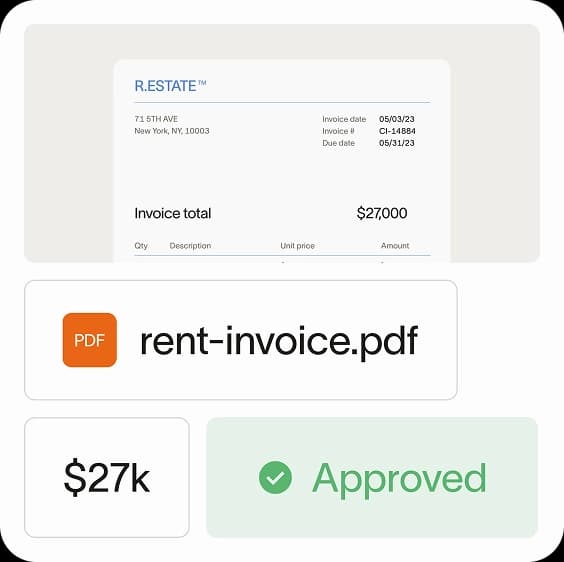
An invoice management system is the software you use to capture, validate, route, approve, pay, and record vendor invoices in one place. Almost every option falls into one of two categories.
Dedicated AP automation platforms treat invoice management as their core job. They pull invoices in from email and vendor portals, extract line items with OCR, and run 2-way and 3-way matching. They also route approvals by rule and pay by ACH, card, check, or wire. If you process hundreds of invoices a month across dozens of vendors, this is the category built for you.
Accounting-native bill pay comes bundled with the platform you already close the books in. QuickBooks and NetSuite both include bill-pay features that hold up at low volume, when a couple of people approve everything and payment methods stay simple. Teams tend to outgrow them once matching, multi-entity coding, or tiered approvals enter the picture.
Vendor invoice management is worth pressure-testing in either category: how the system onboards vendors, collects W-9s, protects payment details, and lets suppliers check status without emailing your team. A well-structured vendor management lifecycle makes a real difference in how smoothly your AP operation runs. Ultimately, the right system depends on your invoice volume and the complexity of your matching and approval requirements.
Why invoice management matters?
Invoice management directly affects your cash flow and your team's capacity. Without a formal process, payments slip, errors multiply, approvals drag, and vendor relationships suffer.
A strong invoice management system fixes the root causes. Speeding up approvals and cutting errors keeps you on top of payables, protects cash flow, and frees your team for higher-value work.
Challenges in invoice management
Many businesses struggle with outdated processes that create more headaches than solutions. The most common pain points include:
- Manual data entry: Hours spent typing invoice details into spreadsheets or accounting systems
- Lengthy approval chains: Invoices sitting in email inboxes waiting for multiple sign-offs
- Inconsistent vendor communication: Mixed messages about payment terms, delivery schedules, and billing requirements
- Lost or duplicate invoices: Documentation gets misplaced or accidentally processed twice
- Lack of visibility: No clear view of where invoices stand in the approval process
These challenges create a domino effect throughout your organization. Late payments can result in service disruptions or unfavorable contract terms. Vendors become frustrated when they can't get clear answers about payment status, leading to strained partnerships that might've taken years to build.
The compliance risks are equally concerning. Missing payment deadlines can trigger penalty fees, while duplicate payments drain cash flow unnecessarily. And poor record-keeping makes audits more complex and time-consuming, potentially exposing your business to regulatory issues or tax complications.
How the invoice management process works?
On its face, invoicing is pretty simple: a vendor sends a bill, and your company pays it. However, invoices don't just land in accounts payable, get approved, and disappear. They move through multiple departments, often hitting roadblocks, especially with manual invoice processing.
Here's a closer look at each stage of the invoice management process, and how to make it more efficient from start to finish:
1. Receive and capture invoices
Invoices arrive through multiple channels, including email, physical mail, vendor portals, and electronic data interchange (EDI) systems. Centralizing intake into one system prevents lost documents and missed payments.
The key at this stage is capturing every single invoice you receive. Set up dedicated email addresses for invoice submissions and train your team to recognize and properly route any invoices that arrive through unexpected channels.
2. Enter invoice data
Once an invoice arrives, the next step is extracting key fields: vendor name, invoice number, line items, amounts, and due date. Manual entry is time-consuming and error-prone, especially at higher volumes.
optical character recognition (OCR) is a faster alternative. AI-powered OCR pulls data from invoices automatically and maps it to the right fields in your system, eliminating most of the typing your AP team would otherwise do. Modern AI accounting software takes this further by learning from corrections and improving accuracy over time.
3. Review and approve invoices
Before paying, you need to confirm the invoice is accurate. A 3-way match compares the invoice against the purchase order and the goods receipt to flag discrepancies in quantity, price, or description.
Common errors to watch for include:
- Duplicate invoices
- Incorrect pricing
- Incorrect tax calculations
- Mismatched shipping addresses
Once validated, invoices route to the appropriate approvers based on amount or department. Smaller invoices might need only one signature, while larger purchases often require multiple sign-offs. Setting up clear escalation procedures and backup approvers keeps things moving when key people are out.
4. Execute payment
After approval, schedule payment based on the agreed terms (e.g., net 30, net 60, or due on receipt). Common payment methods include ACH, wire transfer, virtual cards, and checks.
Timing matters here. Paying too early can strain cash flow, while late payments rack up fees and damage vendor trust. Build in buffer time to account for weekends, holidays, and any technical issues with your banking systems.
5. Record and reconcile transactions
Once payment goes out, post the transaction to your general ledger and sync it with your accounting software. Update the vendor's account, mark the invoice as paid, and categorize the expense correctly.
A clear invoice audit trail is critical for compliance. Keep complete documentation, including the original invoice, approval records, and payment confirmation. Strong records make audits faster and disputes easier to resolve.
Benefits of automated invoice management
Automated invoice management replaces manual data entry and email approval chains with software that captures, codes, routes, and pays invoices with far less human touch.
Automation tackles invoice management challenges head-on by replacing manual processes with software that works around the clock. The key benefits include:
- Reduced manual errors: Automated data capture eliminates typos and miscalculations from manual entry
- Faster approvals: Digital workflows route invoices to the right people instantly, cutting approval times from weeks to days
- Improved compliance: Built-in controls and audit trails help you meet regulatory requirements and catch issues before they become problems
- Better cash flow visibility: Real-time dashboards show exactly where your money is going and when payments are due
- Cost savings: Less time spent on administrative tasks means lower processing costs and fewer late payment penalties
- Proven results: Ramp Bill Pay processes bills with 86% fewer clicks than legacy AP tools, and real-time policy enforcement reduces out-of-policy spend event rates by 62%, so approvals move without the copy-paste and follow-up emails while meaningful compliance gains follow
Manual vs. automated invoice management
Invoice management wasn't always this complex. Businesses used to handle fewer invoices, and paper-based systems worked, until they didn't. As companies grew, so did the inefficiencies. Human error, lost invoices, and delayed approvals became common pain points.
Early digital tools helped, but they still relied on manual data entry and email-based approvals. Today, AI-powered invoice automation can capture, code, approve, and process payments with minimal human touch.
Here's how the two approaches stack up:
| Factor | Manual/Paper-based | Automated/Electronic |
|---|---|---|
| Data entry | Keyed in by hand | OCR captures data automatically |
| Matching | Staff manually compares documents | Software matches invoices to POs |
| Approval routing | Email chains or physical sign-off | Automated workflows route to approvers |
| Error rate | Higher, prone to typos and missed invoices | Lower, system flags discrepancies |
| Processing time | Slower due to bottlenecks | Faster with fewer touchpoints |
| Cost per invoice | Higher labor costs | Lower per-invoice cost at scale |
With automation, your team stops keying and chasing and starts clearing exceptions, which lowers time and cost per invoice as volume grows.
A 2023 joint study by PYMNTS Intelligence and Corcentric found that 93% of CFOs surveyed said digital technologies or automation reduced invoice tracking delays. Meanwhile, 80% of firms that didn't reduce payment delays cited a lack of automation as the main reason.
Key features to look for in invoice management software
For businesses looking to improve efficiency, the question isn't whether to automate, it's how to find the right system. Use this checklist of must-have capabilities when evaluating solutions.
Automated data capture and OCR
The software should extract invoice data without manual entry, regardless of whether invoices arrive via email, PDF, or EDI. For a complete comparison of available options, see our guide to the best invoice automation software. Look for AI-powered OCR that learns from corrections and gets more accurate over time.
Customizable approval workflows
You should be able to set rules that route invoices for approval based on amount, vendor, department, or GL code. The best workflows are flexible and adapt as your team or internal policies change.
ERP and accounting integrations
Your software needs to sync with your existing systems, like QuickBooks, NetSuite, or Sage Intacct. Strong integrations prevent data silos and eliminate the need for double entry.
Real-time reporting and analytics
Dashboards should give you an at-a-glance view of invoice status, AP aging, and spend by category. Look for the ability to create and export custom reports for audits and leadership reviews.
Supplier invoice management portal
A vendor self-service portal lets suppliers submit invoices directly and check payment status on their own. This cuts down dramatically on the back-and-forth email inquiries your AP team has to field.
Error and fraud detection
AI-powered systems should flag duplicate invoices, pricing inconsistencies, and other potential fraud signals before payments go out. This is one of the highest-ROI features automation provides.
Invoice automation reduces fraud by screening every bill against known risk signals before money moves. Those signals include duplicate invoice numbers, amounts just under an approval threshold, recently changed vendor bank details, and prices that don't match the PO.
Ramp's AP Agent screens for fraud across 60+ signals and flags duplicate bills automatically before payment. You review the exceptions instead of hunting for them. Finance teams exploring how AI agents are reshaping finance operations will find fraud detection is one of the clearest early wins.
How to implement invoice management automation?
Moving from manual to automated invoice management is a project, not an overnight switch. Here's a five-step roadmap to get it right:
1. Assess your current invoice process
Document how invoices flow through your organization today. Identify who touches them, where they stall, and what goes wrong most often. Quantify your biggest pain points and your monthly invoice volume so you have a baseline to measure against.
2. Define your automation requirements
Based on your assessment, build a list of must-have vs. nice-to-have features. Consider your scale, including the number of invoices you process per month and the number of approvers involved. Factor in your growth plans, too: the right system should support you a year or two from now.
3. Select the right invoice management software
Evaluate vendors against your requirements list and confirm they integrate with your existing tech stack. Request live demos and ask detailed questions about implementation support, pricing, and customer success resources.
4. Configure workflows and integrations
Map your payment approval process hierarchies and GL coding rules into the new system. Connect the software to your ERP or accounting platform so data flows in both directions without manual exports.
5. Train your team and launch
Make sure your AP staff, approvers, and key vendors understand the new process and how to use the software. Consider piloting with one team or department before rolling it out company-wide: it's the easiest way to catch issues before they scale.
Invoice management best practices
These habits drive sustained success, whether you're using software or not. They're much easier to follow with automation in place.
- Centralize invoice intake: Route all invoices to a single inbox or supplier portal so nothing gets lost in personal email accounts
- Standardize approval workflows: Document who approves what, and enforce the rules consistently to prevent bottlenecks
- Automate 3-way matching: Let software handle the comparison between invoice, PO, and receipt so your team only reviews exceptions
- Track key performance metrics: Monitor three numbers every month—days payable outstanding (DPO), the average number of days you take to pay a bill; cost per invoice, the fully loaded cost of processing a single invoice; and exception rate, the share of invoices that fail auto-matching
- Review and optimize regularly: Audit your process quarterly to address new bottlenecks, close policy gaps, and confirm the system still fits your needs
Manage invoices end to end with Ramp Bill Pay
Ramp Bill Pay is an autonomous AP platform powered by four AI agents that handle invoice coding, fraud detection, approval summaries, and card-based payments without manual intervention. With 99% accurate OCR and intelligent line-item capture, Ramp delivers touchless invoice processing that's 2.4x faster than legacy software¹.
Whether you need a standalone invoice automation solution or a unified platform that connects bill pay with corporate cards, expenses, and procurement, Ramp Bill Pay adapts to how your business operates. Companies using Ramp report up to 95% improvement in financial visibility².
Most accounts payable teams hit the same bottlenecks: approvals that stall invoice processing, purchase orders that don't match, and manual data entry into ERP systems that creates errors and delays.
Ramp resolves each with autonomous, touchless automation:
AI and automation
- Four autonomous AI agents: Handle invoice coding, fraud detection, approval summaries, and card-based vendor payments automatically
- Intelligent invoice capture: Pulls data from every line item at 99% OCR accuracy, removing the need for manual data entry
- Automated PO matching: Checks invoices against purchase orders using 2-way and 3-way matching to flag overbilling before payment goes out
Workflows and approvals
- Custom approval workflows: Create multi-level approval chains with role-based routing that fits your organization's structure
- Approval orchestration: Speeds up the review process with fewer clicks, better visibility, and faster turnaround
- Roles and permissions: Set granular user controls to enforce separation of duties across your team
- Real-time invoice tracking: Follow every invoice from the moment it's received through final payment
Payments
- Flexible payment methods: Pay vendors by ACH, corporate card, check, or wire transfer
- International payments: Send wire transfers to vendors in 185+ countries
- Batch payments: Process multiple invoices and vendor payments in a single batch
- Recurring bills: Set up automated payments for regular invoices using templates
Vendor management
- Vendor onboarding: Collect W-9s, verify TINs, and track 1099 data without leaving the platform
- Vendor portal: Give vendors a secure way to update payment details, check payment status, and communicate with your AP team
Accounting and ERP
- Real-time ERP sync: Connect bidirectionally with NetSuite, QuickBooks, Xero, Sage Intacct, and other major ERPs for audit-ready records
- AI-assisted GL coding: Map transactions to the correct accounts using intelligent recommendations based on historical patterns
- Reconciliation: Match transactions automatically to close books faster
Why make the switch to Ramp?
Ramp sets a new standard for touchless, accurate, and fast invoice processing. Use it as a dedicated AP solution or connect it with Ramp's corporate cards, expense management, and procurement tools for complete financial visibility.
Finance teams choose Ramp to eliminate manual work, catch errors before they become costly, and close books faster.
Invoice processing shouldn't require manual work. Ramp automates it. Learn more about Ramp's invoice management software.
1. Based on Ramp’s customer survey collected in May’25
2. Based on Ramp's customer survey collected in May’25

FAQs
Invoice management is the whole system for handling vendor bills, while invoice processing is the set of steps applied to each individual invoice. Processing covers capture, data entry, matching, and approval routing; management adds the policies, controls, and metrics that govern all of it.
An invoice management system is software that captures, validates, routes, approves, pays, and records vendor invoices in one place. Options include bill-pay features built into accounting platforms like QuickBooks and NetSuite, plus dedicated AP automation platforms built for higher volume.
Invoice automation reduces fraud by screening every bill against known risk signals before money moves, including duplicate invoice numbers, changed vendor bank details, and prices that don't match the purchase order. Ramp's AP Agent screens across 60+ signals and flags duplicate bills automatically.
Finance and accounts payable own invoice management in most companies: the controller or VP of finance is accountable, and AP specialists run it day to day. At smaller companies, the owner, office manager, or an outside bookkeeper handles it.


“I assumed I would have to choose between speed and control. What I found is that you can have both. A well-designed system takes friction out, for the finance function and for everyone else.”
Justin Webster
CFO, Denver Broncos

“A well-run district should not have to choose between getting work done at the school site and keeping control of the dollars behind it. We're not hiring more people to do more jobs, so we have to be smarter about the process. With Ramp, the purchase, the receipt, and the record stay together from the start. ”
Nick Brizeno
Director of Purchasing, San Marcos Unified School District

“In senior living, scale only works if the communities still feel personal. We needed the back office to carry more of the complexity, not the people serving residents. Ramp helped us build that infrastructure, so the experience in the community could stay human.”
Ryan Cole
CFO, Agemark Senior Living

“AI is moving faster than the finance context around it. Prices change, models change, and the value is not always obvious from an invoice. We needed enough detail to know which bets deserved more investment — and which ones did not.”
Greg Cooley
Controller, AngelList

“Invoices, cards, tokens. The categories change but the principle doesn't: know where the money is going, remove the work around it, and make sure the spend is worth it.”
Maciej Mylik. Finance
ElevenLabs

“We weren’t trying to retrofit an old finance system. We had a blank canvas, and Ramp gave us the foundation to build a global finance function of the future.”
Justin Dourado
Director of Finance, Othership

“There's just no surprises anymore. No more waiting two months to find out how a job did. We know how it's doing as it's happening.”
Erich Kuss
Financial Systems Manager, Infinity Home Services

“More token spend isn’t proof that AI is working. Less isn’t proof that it isn’t. What matters is whether we’re buying the right level of intelligence for the work. Ramp lets us make that judgment in the same place we manage every other type of spend.”
Cody Nutt
Senior Director of Business Systems, Daxko
