
- How outpatient centers' AP differs from a single-site practice
- Why invoices pile up across departments
- What AP automation needs to solve for an outpatient center
- From invoice to payment: what changes
- Setting up department-level routing rules
- Consolidating vendor relationships across departments
- Stop chasing invoices department by department
Every department orders from its own vendors, and by the time an invoice reaches the business office, nobody remembers which purchase order it was supposed to match.
You run accounts payable (AP) across multiple departments—radiology, lab, physical therapy, front office—each with its own vendor relationships and its own paper trail. AP automation for an outpatient center means routing every invoice to the right approver, matching it to the original order, and paying it without your business office manually chasing down who requested what. That's different from multi-location vendor payments for healthcare practices or hospital-system AP automation for healthcare organizations. This is about routing within a single site, department by department.
How outpatient centers' AP differs from a single-site practice
A single-site physician practice typically manages one set of vendor relationships and one approval chain. Running radiology, lab, physical therapy, and front-office operations under one roof puts you closer to four separate vendor ecosystems. Each one orders independently, often without a shared view of what the others are buying.
That structure means the same vendor can end up on two different departments' invoices without anyone noticing. A department head approving their own invoices has no visibility into whether a similar purchase already happened elsewhere in the building. Centralizing AP doesn't require centralizing purchasing—it requires a system that can route and code by department automatically.
Why invoices pile up across departments
You can run vendor relationships across medical supplies, lab services, equipment leasing, and facilities—often without a shared system tracking which department ordered what. When an invoice arrives, someone in your business office has to figure out who to route it to before anyone can even confirm it's valid.
That routing delay is where you lose the most time, not the payment itself. An invoice can sit in an inbox for 2 weeks while a department head confirms receipt. That delay often costs more in administrative hours than the invoice amount justifies chasing down manually.
What AP automation needs to solve for an outpatient center
Automatic routing to the right approver. Invoices route based on vendor, department, or cost center automatically, instead of sitting in a shared inbox until someone notices them.
Coding that doesn't require a person to know your chart of accounts. Ramp extracts line items, payment terms, and amounts from vendor invoices and codes them to the right cost center—whether you're on QuickBooks or NetSuite.
Duplicate and fraud detection before payment clears. Ramp flags duplicate invoices across 60 fraud signals before payment goes out, catching double-billing that's easy to miss across departments ordering from overlapping vendors. Invoice fraud risk generally rises with vendor count.
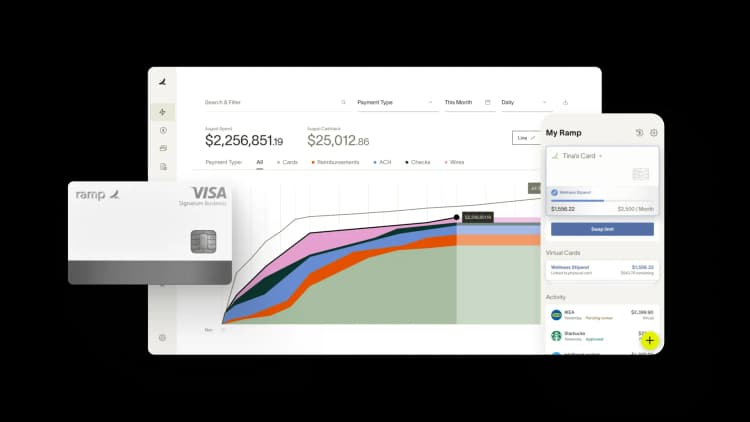
One dashboard across every department's vendor spend. Real-time visibility into what every department owes, to whom, and when it's due—the kind of consolidated view multi-vendor management is built to provide once a vendor list grows past what any one person can track manually.
From invoice to payment: what changes
Step | Manual process across departments | Automated AP workflow |
|---|---|---|
Invoice arrives | Lands in a shared inbox; someone manually identifies the department | Routes automatically based on vendor and cost center |
Approval | Forwarded by email; approver may be out of office for days | Routed to the right approver with automated reminders |
Coding | Business office manually assigns GL codes per line item | Auto-coded based on vendor and historical spend patterns |
Payment | Check run or manual bank transfer, batched weekly or monthly | Paid on negotiated terms, with duplicate detection before it clears |
Setting up department-level routing rules
Map each vendor to a default department before turning on automated routing. You'll likely find that 80% of your vendor list ties cleanly to a single department, with a smaller set of shared vendors (facilities, cleaning, general supplies) needing a manual first assignment.
For that shared-vendor group, route to a single AP coordinator who assigns the correct cost center on first receipt. Then let the system remember that assignment for future invoices from the same vendor.
Consolidating vendor relationships across departments
Once invoices route and code automatically, the same system gives you a single, real-time view of what every department spends and with whom. That's the same consolidation Ramp's accounts payable platform delivers for any multi-department organization.
Stop chasing invoices department by department
Automated routing, coding, and duplicate detection turn scattered department-level AP into one system your business office can actually manage. See how Ramp’s Accounts Payable platform automates vendor invoice processing across every department.

FAQs
Automate invoice routing to the correct department approver based on vendor and cost center, rather than relying on a shared inbox and manual forwarding.
Use AP software that checks every invoice against fraud signals—including duplicate detection—before payment clears.
Yes—automated coding and routing work by vendor and cost center, so each department's invoices flow through the same system without requiring a single centralized ordering process first.
An outpatient center typically runs several distinct vendor ecosystems under one roof—radiology, lab, physical therapy, front office. A single-site practice usually has one vendor list and one approval chain.


“I assumed I would have to choose between speed and control. What I found is that you can have both. A well-designed system takes friction out, for the finance function and for everyone else.”
Justin Webster
CFO, Denver Broncos

“A well-run district should not have to choose between getting work done at the school site and keeping control of the dollars behind it. We're not hiring more people to do more jobs, so we have to be smarter about the process. With Ramp, the purchase, the receipt, and the record stay together from the start. ”
Nick Brizeno
Director of Purchasing, San Marcos Unified School District

“In senior living, scale only works if the communities still feel personal. We needed the back office to carry more of the complexity, not the people serving residents. Ramp helped us build that infrastructure, so the experience in the community could stay human.”
Ryan Cole
CFO, Agemark Senior Living

“AI is moving faster than the finance context around it. Prices change, models change, and the value is not always obvious from an invoice. We needed enough detail to know which bets deserved more investment — and which ones did not.”
Greg Cooley
Controller, AngelList

“Invoices, cards, tokens. The categories change but the principle doesn't: know where the money is going, remove the work around it, and make sure the spend is worth it.”
Maciej Mylik. Finance
ElevenLabs

“We weren’t trying to retrofit an old finance system. We had a blank canvas, and Ramp gave us the foundation to build a global finance function of the future.”
Justin Dourado
Director of Finance, Othership

“There's just no surprises anymore. No more waiting two months to find out how a job did. We know how it's doing as it's happening.”
Erich Kuss
Financial Systems Manager, Infinity Home Services

“More token spend isn’t proof that AI is working. Less isn’t proof that it isn’t. What matters is whether we’re buying the right level of intelligence for the work. Ramp lets us make that judgment in the same place we manage every other type of spend.”
Cody Nutt
Senior Director of Business Systems, Daxko
