Best business credit cards for medical practices in 2026

- Why medical practices need a dedicated business credit card
- How to choose the best credit card for your medical practice
- Best business credit cards for doctors and medical practices
- Cashback vs. travel rewards for healthcare providers
- How to maximize rewards on your medical practice credit card
- Integrating your credit card into your financial workflow
- How Ramp helps medical practices and suppliers spend more time on patient care
- Modernize your healthcare business credit card program
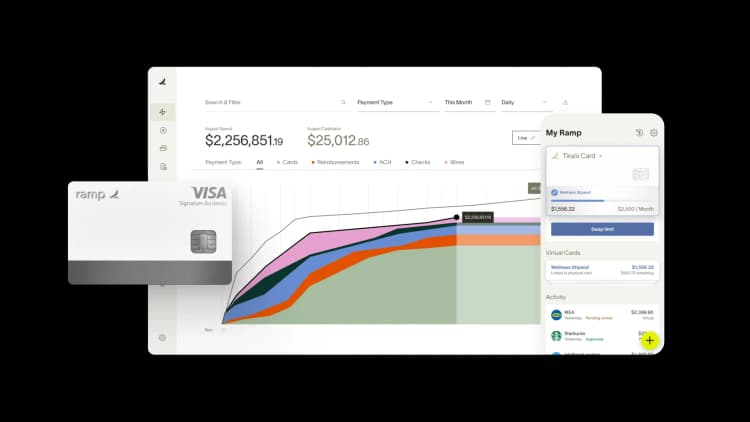
Business credit cards give healthcare providers and medical practices a dedicated way to manage expenses and simplify purchasing. These cards typically come with higher credit limits, specialized expense tracking tools, and rewards programs tailored to business spending.
A good business credit card helps you manage your practice's finances better. You can consolidate vendor payments onto one platform instead of juggling multiple payment methods. These cards also help you build business credit separate from your personal credit score, which matters when you need financing later on.
When you face high supply costs or delayed insurance payments, business credit cards give you the flexibility to manage your cash flow. Plus, you can earn rewards on your regular business spending.
Why medical practices need a dedicated business credit card
Healthcare practices deal with financial challenges that most businesses don't face. You likely manage payments from multiple sources—private insurance, government programs, and individual patients—each with different reimbursement rates and timelines.
Business credit cards help here by giving medical practices and suppliers a tool to manage their finances and operate more efficiently:
- Managing cash flow: Healthcare practices often deal with uneven cash flow due to insurance payment cycles and seasonal demand. Business credit cards give you a rotating line of credit to help bridge those gaps, giving you flexibility when you need to stock up for busy periods or when insurance payments are delayed.
- Building business credit: Responsible use of a business credit card over time helps you build business credit, which can help you get better terms on loans or lines of credit. If you ever need equipment loans, facility expansions, or other financing down the line, a strong credit history is a must.
- Streamlining expense management: The best business credit cards offer built-in expense management software that can automatically track, categorize, and reconcile your expenses. These tools simplify budgeting and reporting while supporting compliance and cost-efficiency in a highly regulated and cost-sensitive industry.
Business credit cards also tend to offer rewards structures designed to benefit your practice. A card that offers elevated rewards at office supply stores can be useful for stocking up on necessary supplies for your lab. A card that offers points for travel can help offset the cost of attending conferences or continuing education events.
How to choose the best credit card for your medical practice
The right card for your medical practice should support your financial health and help you comply with regulations. Here are the key features to evaluate.
Feature comparison at a glance
| Feature | Why it matters for medical practices |
|---|---|
| Expense tracking tools | Simplifies categorization of supplies, equipment, and payroll |
| Bonus reward categories | Maximizes returns on high-volume healthcare spending |
| Software integrations | Reduces manual bookkeeping and reconciliation |
| Credit limit | Supports large equipment purchases or seasonal cash flow needs |
Expense tracking and documentation
The best business credit cards for healthcare practices should offer integrated expense tracking and categorization tools. This software automatically sorts your transactions by department, vendor, or service line, giving you clear visibility into where your money goes. Real-time visibility helps you monitor cash flow and make more informed financial decisions.
Look for software that also automatically categorizes expenses. Automated expense categorization saves hours of manual reconciliation each month, freeing your staff to focus on patient care and giving you audit-ready documentation when tax season comes.
Rewards tailored for healthcare spending
Look at rewards and cashback programs based on how your practice actually spends money. Review your highest spending categories and narrow your search to cards that give you elevated cashback rewards or points multipliers in those areas.
If your practice spends heavily on office supplies, software subscriptions, advertising, or shipping, look for cards with bonus points in those categories. Even a small multiplier on high-volume recurring expenses can add up to significant savings over a year.
Accounting software integrations
A card that integrates with your accounting software reduces the need for manual data entry, which minimizes errors and saves staff valuable time. Integrated systems simplify monthly reconciliation and quickly generate accurate financial reports.
This is especially important in healthcare, where clear financial records support compliance, audits, and insurance documentation. As your practice grows, having a scalable, automated system becomes critical. Integration ensures the financial side of your business keeps pace with clinical operations, allowing you to stay focused on patient care.
Annual fees, interest rates, and credit limits
Interest rates and fees directly affect your bottom line, especially if you sometimes carry balances during cash flow gaps. A card with a $95 annual fee might still be worth it if its rewards structure gives you more than $95 in benefits each year. If you pay in full each month, focus on rewards over APR. If you need payment flexibility, look at introductory APR offers.
Credit limits and spending flexibility matter, too. Make sure the initial credit line can handle your largest expected business expenses. Check whether the issuer has a good track record of increasing credit limits for responsible cardholders. Some cards offer flexible payment options for large purchases, which helps when investing in new medical technology or facility upgrades.
Best business credit cards for doctors and medical practices
The right business credit card is a major asset for medical providers and suppliers. Here are 5 top picks based on the criteria above.
Card comparison at a glance
| Card | Best for | Key benefit |
|---|---|---|
| Ramp | Practices wanting automated expense management | Built-in spend controls and receipt matching |
| Amex Business Gold | High spenders on advertising/shipping | 4x points on top categories |
| Ink Business Preferred | Practices valuing flexible rewards | Strong signup bonus, versatile points |
| Capital One Spark Cash Plus | Simplicity seekers | Flat-rate unlimited cashback |
| Bank of America Customized Cash | Budget-conscious practices | Customizable bonus category, no annual fee |
1. Ramp Business Credit Card: Best for practices wanting automated expense management
The Ramp Business Credit Card is the best overall card for healthcare practices and medical suppliers. Ramp provides financial management tools that help you track expenses, control budgets, stay compliant, and get real-time reports on your practice's spending.
Ramp is specifically designed to save healthcare companies time and money. It offers cashback on purchases and up to $350,000 in partner rewards, perks, and discounts for common vendors such as UPS and Amazon Business. This all adds up to an average savings of 5% a year across all spending.
Benefits include:
- Credit limits higher than traditional business credit cards, up to $100,000 or more for some businesses
- Built-in expense management features, including automated receipt collection and expense reporting
- Integrations with popular accounting software and ERPs such as QuickBooks, Xero, and NetSuite, reducing manual reconciliation and expense categorization
- Unlimited free physical and virtual employee cards with customizable spend limits at the card, department, vendor, and category levels
- No annual fee or foreign transaction fees, especially useful for practices or suppliers with an international supplier base
The Ramp card doesn't require a credit check or personal guarantee. U.S. businesses just need an EIN and at least $25,000 in a business bank account.
2. American Express Business Gold Card: Best for high spenders on advertising and shipping
The American Express Business Gold Card offers a flexible rewards structure tailored to healthcare practices with diverse spending needs. It earns Membership Rewards points at an accelerated rate, providing 4x points in the two categories where your practice spends the most each billing cycle, from a list of eligible categories.
Benefits include:
- 4x points on eligible purchases in specific categories (often advertising and telecom for medical practices)
- 3x points on flights and pre-paid hotels booked through Amex Travel
- Flexible points system with numerous redemption options
- No international transaction fees
- $240 flexible business credit for purchases at select business vendors
However, the card comes with a hefty $375 annual fee. The 4x rewards rate is also capped at $150,000 in combined purchases each calendar year, which may affect medical suppliers or practices with high annual spending needs.
3. Ink Business Preferred Credit Card: Best for practices valuing flexible rewards
The Ink Business Preferred Credit Card is a strong option for medical practices that want versatile rewards and a generous signup bonus. You earn 3x points per dollar on the first $150,000 spent in combined purchases on travel, shipping, internet, cable, phone services, and advertising each account anniversary year.
Benefits include:
- Strong signup bonus that can offset major equipment or supply purchases
- 3x points on travel, shipping, advertising, internet, cable, and phone services
- Points transfer to Chase travel partners for potentially higher redemption value
- No foreign transaction fees
- Cell phone protection when you pay your monthly bill with the card
The $95 annual fee is modest relative to the rewards potential. Keep in mind that the 3x bonus categories are capped at $150,000 in combined spending per year, and purchases beyond that earn 1x. If your practice's top expenses fall outside those categories, you may get more value elsewhere.
4. Capital One Spark Cash Plus: Best for simplicity seekers
The Capital One Spark Cash Plus card offers medical practices and suppliers a flexible spending limit—you're not restricted by a fixed credit line, letting you make purchases as needed. You can earn 2% cashback on all business purchases, with no caps or limits, and an additional 5% back on hotel and rental car bookings through Capital One Business Travel.
Benefits include:
- Unlimited 2% cashback rewards on all purchases
- No preset spending limit
- No foreign transaction fees
- $150 statement credit to offset annual fee if you hit a minimum spending threshold
- Virtual card numbers available
The Spark Cash Plus is a good choice if you want straightforward cashback rewards, but you may miss out on the points and other benefits you'd get with a more tailored rewards structure. The card also requires full balance payments each month, so it's not a great choice if you plan to occasionally carry a balance.
5. Bank of America Business Advantage Customized Cash Rewards: Best for budget-conscious practices
The Bank of America Business Advantage Customized Cash Rewards card lets you choose your own 3% cashback category from a list that includes options such as office supply stores, travel, and gas stations. This flexibility is useful for practices whose spending patterns shift throughout the year.
Benefits include:
- 3% cashback in a category you choose, 2% on dining, and 1% on everything else
- No annual fee
- 0% introductory APR on purchases for the first seven billing cycles
- Cashback bonus boosted up to 75% more if you're a Preferred Rewards for Business member
- Online and mobile banking tools for tracking spending
The 3% and 2% cashback categories are capped at $50,000 in combined purchases per year, which may be limiting for larger practices. But for smaller or newer practices watching every dollar, the combination of no annual fee and a customizable bonus category makes this card a practical choice.
Cashback vs. travel rewards for healthcare providers
Choosing between cashback and travel rewards comes down to how your practice operates day to day.
When cashback cards make sense
Cashback cards work best if you want straightforward value you can apply directly to operating costs. If you or your staff don't travel frequently for conferences or between locations, cashback gives you a predictable return without the complexity of managing points or transfer partners.
A flat-rate cashback card like the Capital One Spark Cash Plus simplifies things further. You earn the same percentage on every purchase, so you don't need to track bonus categories or worry about spending caps. That predictability is valuable when you're focused on running a practice, not optimizing a rewards portfolio.
When travel rewards cards are worth it
Travel rewards cards can stretch your dollars further if you regularly attend medical conferences, CME events, or manage multiple practice locations. Points redeemed through airline and hotel transfer partners often deliver more value per point than a straight statement credit.
For example, if you attend two or three conferences a year, a card like the Ink Business Preferred lets you earn 3x points on travel and then transfer those points to airline partners at a higher redemption rate. Over a year, that difference can cover an extra flight or a few hotel nights. If travel is a regular part of your professional life, the extra effort of managing points pays off.
How to maximize rewards on your medical practice credit card
Using reward points with intention can meaningfully improve your practice's bottom line. Here are four ways to get more from your card.
Match bonus categories to your largest expenses
Review your past statements to identify your top spending areas—supplies, software, advertising, shipping—and select a card that rewards those categories. Even a 1% difference in cashback on a high-volume category adds up over 12 months.
Claim signup bonuses strategically
Time new card applications around large planned purchases, such as equipment upgrades or office renovations, to meet minimum spend requirements without changing your normal spending habits. Buying $10,000 in diagnostic equipment during a 0% APR introductory period lets you spread payments over several months without interest while earning a welcome bonus.
Issue employee cards with built-in spending limits
Let staff make necessary purchases while you maintain control through preset limits and real-time alerts. This reduces the need for expense reimbursements and gives you visibility into spending as it happens.
Automate receipt capture and expense reporting
Use cards with automatic receipt matching (like Ramp) to eliminate manual data entry and ensure compliance-ready records. Many business cards also offer perks beyond the main rewards program, such as discounts on practice management software, telehealth services, or shipping for medical supplies.
Integrating your credit card into your financial workflow
Your business credit card should fit into your practice's financial management system without creating extra work. Proper integration boosts financial visibility and reduces administrative burden.
Here's how to get started:
- Develop a rollout plan: If you plan to distribute credit cards for your employees, you'll need to establish clear protocols for card usage, receipt submission, and expense approval. Train all cardholders on proper documentation requirements, emphasizing the importance of detailed records for healthcare compliance.
- Designate expense categories for card use: Put all medical supplies and equipment purchases on the card for easier tracking and to generate rewards. Set up recurring payments (utilities, software, memberships) on the card for consistent documentation.
- Align card usage with your budget: Set spending limits that match your monthly or quarterly allocations. Create category-specific thresholds to avoid overspending, and implement approval workflows for purchases above certain amounts.
- Connect your card to accounting and practice management software: Most systems offer direct integration, automatically importing transactions. Configure expense categories in your software to match your card statements for easy reconciliation, and set up regular sync schedules to keep records current.
- Review card usage and benefits regularly: Ongoing management is key to getting the most out of your practice's credit card. Review monthly statements to verify transactions and spot unusual patterns, assess your rewards accumulation and redemption strategy quarterly, and evaluate your card's features annually to ensure it still meets your needs.
How Ramp helps medical practices and suppliers spend more time on patient care
Surgical Affiliates Management Group (SAMGI), a healthcare organization providing surgical care and leadership, faced a common challenge: time-consuming manual processes for credit card and expense management.
Corporate controller Kathleen Cole recalls the growing pains of using traditional bank cards with rigid, outdated systems. "Many employees avoided the corporate cards because it was easier to use personal credit cards and submit expense reports," she explains.
The manual expense system not only added workload but also increased fraud risk, with duplicate expense submissions being a concern. As SAMGI rapidly expanded, adding more than 200 employees in a few years, the administrative burden became overwhelming. "Every moment spent managing cards took attention away from our primary mission: supporting providers and improving patient care," Kathleen says.
SAMGI partnered with Ramp to modernize their business credit card program and simplify operations. With Ramp's virtual cards, SAMGI could assign cards directly to individuals with built-in budgets and merchant restrictions. Transactions were pre-coded, making them easy to use and manage. "It has been a game-changer," says Kathleen. "We transitioned to Ramp without a hitch—our vendors didn't even notice."
Since adopting Ramp, SAMGI has seen enthusiastic employee adoption, reduced fraud risk, and a simplified review process. Employees can simply snap a photo of receipts, add notes, and submit via mobile. For the accounting team, Ramp's automated coding and receipt-matching save significant time. "Now, our accounting specialist can rely on Ramp's green check mark system, eliminating the need to manually verify every line item," Kathleen explains.
Ultimately, the efficiencies gained through Ramp allow SAMGI to focus more on delivering exceptional patient care. By automating manual card and expense processes, healthcare organizations like SAMGI can redirect their energy toward supporting providers and fulfilling their core mission. Ramp's spend management platform eliminates the distractions of outdated financial workflows, empowering healthcare teams to prioritize what matters most.
Modernize your healthcare business credit card program
The Ramp Business Credit Card can instantly modernize your practice's spending, improving efficiency at every step of the purchasing process.
Unlimited physical and virtual cards help you drastically reduce or even eliminate employee expense reimbursements, and automated expense tracking and categorization help you make better financial decisions, save time on reconciliation, and stay compliant.
Take charge of your practice's finances, reduce manual effort, and spend more time focusing on patient care. Try an interactive demo and see why Ramp cardholders save an average of 5% a year across all spending.

FAQs
You shouldn't. Mixing personal and business expenses creates accounting headaches and potential tax issues. The IRS expects you to keep business and personal finances separate, and commingling them can complicate deductions, trigger audit flags, and make reconciliation much harder. Use a dedicated business card for practice expenses only.
Most business credit cards require good to excellent personal credit, typically a score of 670 or higher. However, approval also depends on your business revenue, time in operation, and overall financial profile. Newer practices with limited business history may need to rely more heavily on the owner's personal credit score during the application process.
The 2/3/4 rule is a set of informal guidelines specific to Chase credit card applications. Generally, Chase may decline your application if you've opened too many cards in a short period. The most commonly referenced version is the
No — Ramp is open to businesses in the United States and Canada, and neither application requires a personal guarantee or credit check. U.S. applicants must have a registered corporation, LLC, or LP, an EIN, and at least $25,000 in a business bank account to qualify. Canadian businesses must be registered in a supported province and have at least CA$25,000 across connected accounts. See Ramp’s Canadian eligibility requirements for the full details.


“I assumed I would have to choose between speed and control. What I found is that you can have both. A well-designed system takes friction out, for the finance function and for everyone else.”
Justin Webster
CFO, Denver Broncos

“A well-run district should not have to choose between getting work done at the school site and keeping control of the dollars behind it. We're not hiring more people to do more jobs, so we have to be smarter about the process. With Ramp, the purchase, the receipt, and the record stay together from the start. ”
Nick Brizeno
Director of Purchasing, San Marcos Unified School District

“AI is moving faster than the finance context around it. Prices change, models change, and the value is not always obvious from an invoice. We needed enough detail to know which bets deserved more investment — and which ones did not.”
Greg Cooley
Controller, AngelList

“Invoices, cards, tokens. The categories change but the principle doesn't: know where the money is going, remove the work around it, and make sure the spend is worth it.”
Maciej Mylik. Finance
ElevenLabs

“We weren’t trying to retrofit an old finance system. We had a blank canvas, and Ramp gave us the foundation to build a global finance function of the future.”
Justin Dourado
Director of Finance, Othership

“There's just no surprises anymore. No more waiting two months to find out how a job did. We know how it's doing as it's happening.”
Erich Kuss
Financial Systems Manager, Infinity Home Services

“More token spend isn’t proof that AI is working. Less isn’t proof that it isn’t. What matters is whether we’re buying the right level of intelligence for the work. Ramp lets us make that judgment in the same place we manage every other type of spend.”
Cody Nutt
Senior Director of Business Systems, Daxko

“Most banks treat the back office as a cost to keep down. We treat ours as a return to compound, which is why we run it on Ramp. Now we put our clients on Ramp, too.”
Patrick Gaughen
President & COO, Hingham Institution for Savings
