
- What a CIO's technology spend looks like
- Why unmanaged spend is a security problem
- AI's dual role in IT spend management
- What CIOs should look for in a spend management platform
- Measuring IT spend management outcomes
- How Ramp Enterprise helps CIOs govern technology spend
- An enterprise-grade platform both finance and IT can get behind
If you're a Chief Information Office (CIO), enterprise spend management is fundamentally a governance problem. You probably oversee 300 to 600 SaaS applications, multi-cloud infrastructure across multiple providers, and hundreds of vendor contracts. And that's just the tools you know about. All of it lives in separate systems with their own approval logic, renewal cycles, and blind spots.
Your board wants you to fund AI, automate operations, and modernize legacy systems—without increasing the IT budget. That math only works if you can find and redirect waste at scale across your entire technology portfolio.
What a CIO's technology spend looks like
Your technology spend is fragmented across every purchasing channel in the organization. Your SaaS subscriptions alone might flow through procurement, credit card transactions, and direct invoices depending on who bought them and when.
Cloud spend lives in provider consoles that finance never sees. Hardware, telecom, and professional services each run through separate channels with their own approval logic. Add vendor relationships that different teams established at different times, and no single view ties any of it together.
That fragmentation lets governance gaps pile up without anyone noticing, which means you have to assemble the complete picture before you can optimize anything.
Shadow IT as a governance, security, and cost problem
Assembling that complete picture is harder than it sounds, because a big chunk of technology spend happens where you can't see it. Technology purchased or deployed outside your visibility compounds every type of risk you manage. For example:
- Duplicate tools pile up across departments because no one can see what's already licensed
- Licenses auto-renew for tools nobody uses because there's no centralized tracking
- And volume discounts become impossible because purchasing is too scattered to consolidate
Each of those unsanctioned apps is also processing company data through servers you've never assessed, creating third-party risk that's completely outside your security review.
Solving this requires embedding governance into how technology gets purchased, making security review part of the purchasing workflow from the start.
Where CIOs find the most savings fastest
Once governance is embedded in the purchasing workflow, you can start targeting the spend categories that produce the fastest results. You can consistently find savings in SaaS licenses, cloud capacity, and vendor overlap within 90 days. That speed matters most if you're under pressure to show ROI—common in PE-backed companies, post-acquisition integrations, or your first year in a new role.
1. SaaS license governance
SaaS is your most controllable spend lever. You'll routinely find that a quarter or more of your software licenses go unused: seats purchased for employees who've left, tools adopted for a single project and never cancelled, premium tiers paying for features nobody touches.
Start by flagging any seat inactive beyond 30 days, comparing total seat counts against current headcount, and categorizing every tool by function to spot overlap. If engineering, product, and design each run their own analytics platform, that's 3 contracts for 1 need. Enforcing centralized purchase approval before new subscriptions start prevents the problem from regrowing.
SaaS license cleanup recovers budget faster than most other optimization work. That recovered capital often funds the larger governance program and the AI investments your board is asking for.
2. Cloud cost governance as an organizational problem
Cloud cost governance is an organizational problem because the optimization techniques are already well-documented. Cloud costs grow out of control when cloud budgets live with the infrastructure team but consumption decisions happen in engineering and product, and nobody owns the spend.
Developers provision resources for a sprint and never deprovision them, and teams default to the largest instance type because oversizing has no consequence.
Chargeback and showback models fix this by making business units see and own the cost of their consumption. Governed purchasing has to be faster and easier than the workaround, because if the path of least resistance is the governed path, adoption follows without mandates.
3. Vendor consolidation through a security lens
Vendor consolidation is typically framed as a cost exercise, but the risk reduction case is just as strong. Each vendor is a third-party integration point that requires a security assessment, ongoing monitoring, and incident response coordination. Consolidating from 3 analytics tools to 1 saves on licensing while eliminating 2 sets of data flows, 2 integration points, and 2 third-party risk profiles.
The rationalization process itself surfaces governance gaps. Cataloging every tool by function and comparing across departments reveals applications nobody in security has ever assessed, data flowing to services outside the approved architecture, and contracts that auto-renewed without review.
Why unmanaged spend is a security problem
Every technology purchase that happens outside governed channels is a security decision made without security input. That could be a SaaS tool processing customer data through servers you've never assessed, or an AI assistant sending proprietary content to a third-party model.
Spend management closes this gap by making security review part of the purchasing workflow. Vendors get assessed before data flows to them, and applications get cataloged in the technology portfolio.
If you're at a regulated enterprise in financial services, healthcare, or government contracting, this is especially critical. Showing that 100% of your technology purchases went through an approved process with documented security review puts you in a much stronger audit position.
AI's dual role in IT spend management
Good governance and optimization work also creates the funding path for AI investment, giving AI a dual role in your spend management strategy. Inside the platform, AI reduces manual work by:
- Auto-categorizing expenses
- Flagging anomalous transactions
- Coding to GL accounts based on historical patterns
- Auto-approving routine purchases that meet policy criteria
Strategically, the savings you recover from SaaS optimization, cloud right-sizing, and vendor consolidation become the capital source for AI investment elsewhere in your organization.
The governance model you approve for spend management today becomes the template for AI agents across finance tomorrow. The architecture question isn't just about expense reports—it's about whether your controls scale to the next wave of autonomous finance tools.
Vendors are also embedding AI into existing products and raising prices. If you don't have granular visibility into whether those AI features are actually being used, you'll pay more without getting more. The same governance discipline that catches unused SaaS licenses needs to catch unused AI features bundled into vendor renewals.
What CIOs should look for in a spend management platform
Not all spend management platforms are built for CIOs. Three capabilities consistently separate the ones that simplify governance from the ones that add to the problem.
1. Integration depth as the credibility test
Start with integration depth, because it determines whether a platform consolidates your work or creates another silo. Ask whether the platform syncs with your ERP in real time, pulls employee data from HRIS for approval routing, and connects to your ITSM and procurement systems rather than sitting alongside them. Real-time, bi-directional integration with entity-level GL mapping is the threshold, because anything less means manual reconciliation.
2. Unified architecture vs. assembled point solutions
A unified platform where cards, expenses, AP, procurement, and travel share one data layer, one policy engine, and one audit trail eliminates governance gaps. Disconnected tools create those gaps.
Architecture matters more than any individual feature, because a best-of-breed approach for every category replicates the fragmentation the platform is supposed to solve.
3. Preventive controls and multi-entity governance
Governance at enterprise scale depends on preventive controls and multi-entity support. Preventive controls enforce policies at the point of purchase through card-level restrictions by merchant, category, or amount. Automated approval routing catches out-of-policy purchases before they happen.
Multi-entity support matters because every acquisition brings its own SaaS portfolio, vendor relationships, and shadow IT. In the first 90 days, you need to discover what the acquired entity has, migrate purchasing to governed channels, and reconcile overlapping vendor contracts while the business continues operating. Policies, approval workflows, and vendor catalogs should extend to new entities by default with entity-level configuration.
Measuring IT spend management outcomes
Selecting the right platform is half the decision, and the other half is knowing whether it's working. These 5 metrics connect spend management directly to the outcomes you report to the CFO and the board.
| Metric | What it measures | Why it matters |
|---|---|---|
| Spend under management | Percentage of total technology spend flowing through governed channels | Every dollar outside governed channels is invisible to policy enforcement, security review, and audit |
| SaaS and cloud utilization | Ratio of paid licenses and provisioned capacity to actual usage | Directly measures waste in the two fastest-growing spend categories |
| Vendor count and consolidation trajectory | Whether the portfolio is getting simpler or more complex over time | Tracks progress on consolidation efforts and their impact on pricing and security posture |
| Processing cost per transaction | Total cost from purchase request through approval, coding, reconciliation, and close | Measures whether automation is reducing operational cost across the spend lifecycle |
| Run vs. change ratio | Share of IT budget going to maintaining existing operations versus funding new capabilities | Translates spend management into the board-level metric that matters most: spending less to maintain and more to build |
If you can show 95% of technology spend under governance with recovered budget redirected from waste to new capabilities, you're making a compelling case to the board.
How Ramp Enterprise helps CIOs govern technology spend
When you evaluate a spend management platform, you're answering a different set of questions than the finance team driving the purchase. Security, integration depth, IT overhead, and AI governance all have to hold up before you sign off.
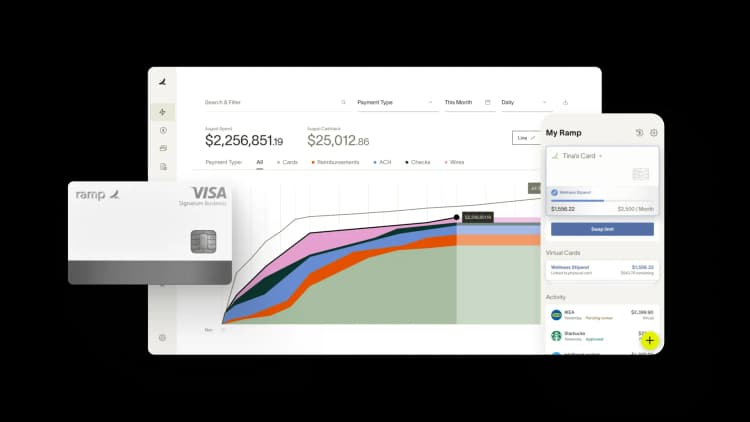
Ramp Enterprise brings corporate cards, expense management, bill pay, procurement, travel, and accounting automation together on a single data layer. It's built for multi-entity organizations.
Ramp operates across 190+ countries with local currency issuing in 30+ markets. AI controls run across policy, fraud, and accounting to intercept out-of-policy spend before it clears, and early customers catch 7x more out-of-policy spend with the Policy Agent than they did before. Every AI decision includes explainable reasoning, producing an audit trail you and your legal team can review.
Proactive controls
Ramp's Policy Agent screens every transaction against organizational policies and historical context in real time, with 99% accuracy on in-policy determinations, declining out-of-policy purchases at point of sale. Ramp's card-level controls are restricted by merchant, category, amount, time, or geography.
AI-powered automation
Ramp's AI agents handle the manual work across the spend lifecycle:
- Accounting Agent auto-codes transactions to entity-specific GL accounts
- AP Agent provides auto-coding and approval recommendations for invoices
- Policy Agent auto-approves low-risk items and surfaces anomalies with explainable reasoning
- Fraud detection quarantines duplicate receipts, repeated merchant anomalies, and suspicious patterns
Up to 85% of transactions are automatically approved by Ramp's AI, reducing the exception queues and manual workarounds that create IT support tickets downstream. Every automated decision includes transparent reasoning—what the agent evaluated, what it determined, and why—so you and your audit team can review the logic.
Global multi-entity support
Ramp supports local currency card issuing and reimbursements across 190+ countries, with entity-level configuration for billing, local bank account funding, expense policies, and accounting settings managed from a single instance.
- Card issuing in USD, CAD, GBP, AUD, SGD, JPY, MXN, BRL, and more
- International reimbursements paid in local currency in most countries globally
- Phased, risk-managed global rollouts with dedicated implementation support
Integration depth
Ramp integrates with the ERPs and systems you already manage, including NetSuite, Sage Intacct, Oracle Fusion, Acumatica, Microsoft Dynamics BC/FO, Workday, QuickBooks, and Xero. All integrations are bi-directional with entity-level GL mapping and real-time sync.
- HRIS continuous sync for approval routing
- Travel integrations with TravelPerk and Spotnana
- 200+ total integrations, SSO/SAML, SCIM provisioning, and API access for audit logs, custom records, and procurement
Enterprise security
Ramp Enterprise meets the security and compliance standards you require.
- SOC 2 Type II, ISO 27001, and PCI DSS certifications
- Role-based access controls with segregation of duties for SOX compliance support
- Immutable, append-only audit trails for every transaction and action
- AI decisions are transparent and auditable, with every policy enforcement, approval, and coding recommendation including explainable reasoning
What this means for CIOs
Ramp Enterprise replaces fragmented spend tools with a single platform that reduces tool sprawl and keeps your data consistent across every entity.
- Reduce IT overhead: Your finance team can self-serve on Ramp's API-first platform with minimal IT involvement post-setup. No dedicated IT staff required for ongoing configuration or maintenance
- Gain visibility into shadow IT: Ramp surfaces SaaS purchases made on corporate cards without IT approval, flagging new vendors, duplicate subscriptions, and unapproved tools as they appear
- Meet AI governance requirements: Every automated decision includes explainable reasoning—what was evaluated, what was determined, and why. Configurable human-in-the-loop gates preserve segregation of duties under SOX
- Reduce integration maintenance burden: Bi-directional real-time sync with NetSuite, Sage Intacct, Oracle Fusion, Workday, and 200+ other systems. SSO/SAML and SCIM provisioning for automated user lifecycle management
- Strengthen compliance: Immutable audit trails and continuous policy enforcement replace periodic spot-check reviews with complete, always-on auditability
With Ramp Enterprise, you and your finance team spend less time maintaining integrations and workarounds and more time on the infrastructure that supports the business.
An enterprise-grade platform both finance and IT can get behind
Most CIOs inherit a patchwork of spend tools bolted together across entities and vendor contracts, each with its own API, security assessment, and maintenance burden.
Ramp Enterprise replaces that patchwork with a single governed platform that brings together real-time controls, unified vendor visibility, and policy enforcement that works across every entity and spend channel.
If you want to see how it maps to your vendors, ERP stack, and compliance requirements, our team will walk you through it.
Explore Ramp Enterprise.


“I assumed I would have to choose between speed and control. What I found is that you can have both. A well-designed system takes friction out, for the finance function and for everyone else.”
Justin Webster
CFO, Denver Broncos

“A well-run district should not have to choose between getting work done at the school site and keeping control of the dollars behind it. We're not hiring more people to do more jobs, so we have to be smarter about the process. With Ramp, the purchase, the receipt, and the record stay together from the start. ”
Nick Brizeno
Director of Purchasing, San Marcos Unified School District

“In senior living, scale only works if the communities still feel personal. We needed the back office to carry more of the complexity, not the people serving residents. Ramp helped us build that infrastructure, so the experience in the community could stay human.”
Ryan Cole
CFO, Agemark Senior Living

“AI is moving faster than the finance context around it. Prices change, models change, and the value is not always obvious from an invoice. We needed enough detail to know which bets deserved more investment — and which ones did not.”
Greg Cooley
Controller, AngelList

“Invoices, cards, tokens. The categories change but the principle doesn't: know where the money is going, remove the work around it, and make sure the spend is worth it.”
Maciej Mylik. Finance
ElevenLabs

“We weren’t trying to retrofit an old finance system. We had a blank canvas, and Ramp gave us the foundation to build a global finance function of the future.”
Justin Dourado
Director of Finance, Othership

“There's just no surprises anymore. No more waiting two months to find out how a job did. We know how it's doing as it's happening.”
Erich Kuss
Financial Systems Manager, Infinity Home Services

“More token spend isn’t proof that AI is working. Less isn’t proof that it isn’t. What matters is whether we’re buying the right level of intelligence for the work. Ramp lets us make that judgment in the same place we manage every other type of spend.”
Cody Nutt
Senior Director of Business Systems, Daxko
