
- At a glance: PEX Card alternatives compared
- Why nonprofit organizations look for PEX Card alternatives
- 1. Best overall PEX Card alternative: Ramp
- 2. BILL Spend & Expense (Divvy)
- 3. Brex
- 4. SAP Concur
- 5. Expensify
- How to choose a PEX Card alternative
- What is the best PEX Card alternative?
PEX Card is a prepaid spend control card used by many nonprofit organizations and churches. It works for basic purchasing controls, but most organizations outgrow the prepaid model when they need reimbursements, bill pay, deeper accounting sync, or fund-level expense coding. If you're looking for a PEX Card alternative, here are five options worth evaluating:
- Ramp (best overall PEX alternative for nonprofits)
- BILL Spend & Expense (Divvy)
- Brex
- SAP Concur
- Expensify
To compile this list, we evaluated corporate card providers and spend management platforms on nonprofit-specific features (fund coding, volunteer reimbursements, accounting sync), and how many of the tools nonprofit organizations typically run alongside PEX each platform can replace.
At a glance: PEX Card alternatives compared
| Platform | Best for | Fund-level coding | Reimbursements | Bill pay | Accounting sync |
|---|---|---|---|---|---|
| Ramp | All-in-one replacement for PEX + reimbursements + bill pay + accounting | Custom fields | Yes | Yes | QuickBooks, Sage Intacct (bi-directional) |
| BILL Spend & Expense | Basic card controls and budgeting | No | Yes | Separate BILL AP product | QuickBooks, NetSuite, Xero, Sage Intacct |
| Brex | Higher spend volume, rewards | No | Yes | Yes | Major platforms |
| SAP Concur | Enterprise travel and expense | No | Yes | Yes | SAP ERP & NetSuite, QuickBooks, Sage, Oracle (via its partner ecosystem) |
| Expensify | Receipt scanning and expense reporting | No | Yes | Yes (paid add-on) | Major platforms |
Why nonprofit organizations look for PEX Card alternatives
PEX solves one problem well: giving program staff and volunteers purchasing power with guardrails. But the prepaid model creates friction that compounds as your organization grows.
Your program director's card declines mid-purchase because nobody loaded funds. A volunteer buys $200 in supplies and waits three weeks for a reimbursement check. Your finance team exports PEX transactions to a CSV, then manually maps them to QuickBooks fund codes. Rent, contractor invoices, and utility payments happen in a completely separate system.
The result is PEX for cards, a paper process for reimbursements, a checkbook for bill pay, and manual data entry to get any of it into your books. Four workflows, none of them connected.
1. Best overall PEX Card alternative: Ramp
Full disclosure: this is the Ramp blog, so we're biased—but Ramp is purpose-built to solve the exact problem that drives most nonprofit organizations away from PEX.
Ramp is purpose-built to solve the exact problem that drives most nonprofit organizations away from PEX: the patchwork of separate tools for cards, reimbursements, bill pay, and accounting data entry.
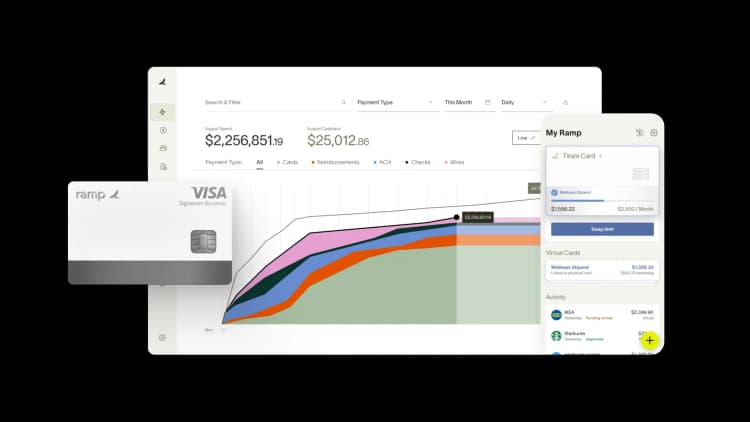
Ramp replaces prepaid cards with corporate charge cards, so no one has to manually load funds. But the real difference is everything beyond the card: expense management, bill pay, procurement, and travel all run on the same platform with native sync to QuickBooks and Sage Intacct.
Key Ramp features for nonprofit organizations
- Issue virtual cards tied to specific grants or restricted funds with per-card spend limits and merchant category restrictions
- Volunteers and program staff submit reimbursements via SMS, mobile app, or Slack/Teams and get paid in 1-2 business days
- Automates categorization and syncing so coding happens earlier in the workflow, reducing manual data entry at month-end
- Customizable approval routing and permissions for bill pay, including threshold-based rules
- No personal guarantee required
- Free core plan: no subscription fees, no per-card fees
Why nonprofit organizations choose Ramp over PEX
Ramp replaces PEX and the three or four tools you've built around it. Instead of a prepaid card plus a separate reimbursement process, plus a separate bill pay system, plus manual accounting data entry, everything runs on one platform. Ramp automates categorization and syncing to your accounting system, so transactions flow to the right accounts without manual re-keying.
For nonprofit organizations managing restricted grants, this is the core value: automated categorization and bi-directional syncing with your accounting system means less manual coding at month-end and a cleaner path to Form 990 functional expense reporting.
| Feature | PEX Card | Ramp |
|---|---|---|
| Card type | Prepaid (load funds manually) | Corporate charge card (no manual loading) |
| Personal guarantee | N/A (prepaid) | No |
| Spend limits and category restrictions | Yes (limited categories) | Yes (per merchant category, per card) |
| Receipt capture | Limited | AI-powered automatic matching |
| Reimbursements | No | Yes (1-2 business days) |
| Bill pay / AP automation | No | Yes (customizable approvals and permissions) |
| QuickBooks / Sage Intacct sync | Limited / No | Native bi-directional sync |
| Fund/grant expense coding | No | Yes (custom fields for categorization) |
| Procurement controls | No | Yes (approval workflows) |
| Cost | Monthly fees per card | Free core plan |
2. BILL Spend & Expense (Divvy)
BILL Spend & Expense, formerly Divvy, combines corporate cards with expense management and budgeting. It replaces PEX's prepaid model with corporate cards that draw against set budgets, eliminating the manual fund loading that causes mid-purchase declines.
Key features
- Budgets by department, program, or project
- Real-time spend visibility and automatic transaction categorization
- Physical and virtual corporate cards with customizable controls
- Built-in receipt capture and reimbursement tools
How BILL compares to PEX
BILL solves PEX's biggest friction point (manual fund loading) and adds budgeting visibility. The free tier covers basic card issuance and expense categorization with no per-card fees.
Where it falls short for nonprofits: No fund-level coding for restricted grants. No bill pay or procurement. Accounting sync is surface-level compared to Ramp's bi-directional QuickBooks and Sage Intacct integrations. If your problem with PEX is the prepaid model specifically, BILL solves that. If your problem is the four-tool patchwork, BILL only replaces one of the four.
3. Brex
Brex offers corporate cards with higher credit limits and a rewards program, along with expense management and bill pay. Brex has historically focused on tech startups and venture-backed companies, so nonprofit organizations should evaluate whether the platform's roadmap aligns with their needs.
Key features
- Corporate cards with no personal guarantee
- Expense management with receipt capture
- Bill pay and vendor payments
- Integrations with major accounting platforms
How Brex compares to PEX
Brex replaces the prepaid model and adds expense management and bill pay in one platform. It targets organizations with significant spend volume.
Where it falls short for nonprofits: Nonprofit-specific features (fund coding, restricted grant tracking, volunteer reimbursements) are thinner than platforms built with nonprofit workflows in mind. Brex has historically focused on tech startups and enterprise companies, not the nonprofit sector.
4. SAP Concur
SAP Concur is an enterprise travel and expense management platform. It handles travel booking, expense reporting, and invoice management. For nonprofit organizations already using SAP systems, Concur integrates with that ecosystem.
Key features
- Automated expense report creation and compliance monitoring
- Travel booking with policy enforcement
- Invoice capture and approval workflows
- Deep SAP ERP integration
How Concur compares to PEX
Concur covers travel management, which PEX doesn't touch. For organizations with significant travel budgets and complex approval requirements, Concur offers those controls within the SAP ecosystem.
Where it falls short for nonprofits: Enterprise pricing and complexity make it overkill for most nonprofit organizations. Not built for fund accounting or restricted grant tracking. Implementation typically takes 8–16 weeks, and often longer for complex mid-market and enterprise deployments.
5. Expensify
Expensify is an expense management platform with receipt scanning (SmartScan) and straightforward expense submission and approval workflows. If your primary PEX frustration is the lack of receipt management, Expensify addresses that specific gap.
Key features
- SmartScan receipt capture with OCR
- Automated expense categorization
- Flexible reimbursement options
- The Expensify Card with cashback rewards
How Expensify compares to PEX
Expensify is known for its receipt scanning feature and mobile experience. The platform handles expense submission and approval for organizations that primarily need receipt management.
Where it falls short for nonprofits: No native fund or program coding for nonprofit reporting. Bill pay is only available as a paid add-on, and there's no procurement module. The Expensify Card is separate from expense management. You'd be replacing one piece of the PEX patchwork with a different single-purpose tool.
How to choose a PEX Card alternative
All five platforms listed here improve on PEX in different ways. Here are some key considerations to guide your decision:
How many of your current tools do you want to replace?
If you only need a different card model than prepaid, BILL or Brex can work. If you want to eliminate the reimbursement process, bill pay system, and manual accounting data entry alongside the card, you need a platform that covers all four.
Ramp is positioned as an all-in-one platform that can replace multiple point solutions, covering cards, expense management, bill pay, and procurement on a free core plan.
Do you need fund-level coding?
If you manage restricted grants or need Form 990 functional expense categorization, you need a tool that automates categorization and syncing to your accounting system. Most general-purpose spend management platforms don't handle this natively.
Ramp's custom fields and automated categorization help code transactions earlier in the workflow, reducing manual re-keying at month-end.
How complex is your approval process?
If your organization requires threshold-based approvals or role-based permissions for spending, you need configurable approval routing. Not all platforms support this natively; Ramp does, with multi-level workflows that route based on amount, department, vendor, or grant.
Do you need travel management?
If your organization has significant travel spend (field staff, conferences, site visits), SAP Concur or Ramp cover travel booking with policy enforcement. PEX, BILL, and Expensify don't.
What is the best PEX Card alternative?
For most nonprofit organizations, the answer is Ramp. It's an all-in-one platform that replaces PEX's card controls and the reimbursement process, bill pay system, and manual accounting data entry that most organizations run alongside PEX. Automated categorization, bi-directional accounting sync, and volunteer reimbursements come built in, and the core plan is free.
If you're tired of maintaining four separate financial workflows, consolidating to one platform is the right move.

FAQs
Ramp's core plan is free: no subscription fee, no per-card fees, no setup costs.
No. Ramp corporate cards don't require a personal guarantee. Your ED's personal credit isn't at risk for organizational spending.
Yes. Both systems run in parallel during the transition. You start using Ramp cards while PEX cards remain active, then wind down PEX once the transition is complete. Many organizations can complete the full transition in about a week.
PEX is a prepaid card control tool. Ramp is a spend management platform that covers corporate cards, expense management, bill pay, and procurement with bi-directional accounting sync. The gap isn't the card: it's everything around the card.
Yes. Ramp’s free plan includes unlimited cards with issuing controls, automatic receipt capture/matching, reimbursements, and accounting automation/sync for supported ERPs (notably QuickBooks Online and Xero).
Don't miss these


“I assumed I would have to choose between speed and control. What I found is that you can have both. A well-designed system takes friction out, for the finance function and for everyone else.”
Justin Webster
CFO, Denver Broncos

“A well-run district should not have to choose between getting work done at the school site and keeping control of the dollars behind it. We're not hiring more people to do more jobs, so we have to be smarter about the process. With Ramp, the purchase, the receipt, and the record stay together from the start. ”
Nick Brizeno
Director of Purchasing, San Marcos Unified School District

“In senior living, scale only works if the communities still feel personal. We needed the back office to carry more of the complexity, not the people serving residents. Ramp helped us build that infrastructure, so the experience in the community could stay human.”
Ryan Cole
CFO, Agemark Senior Living

“AI is moving faster than the finance context around it. Prices change, models change, and the value is not always obvious from an invoice. We needed enough detail to know which bets deserved more investment — and which ones did not.”
Greg Cooley
Controller, AngelList

“Invoices, cards, tokens. The categories change but the principle doesn't: know where the money is going, remove the work around it, and make sure the spend is worth it.”
Maciej Mylik. Finance
ElevenLabs

“We weren’t trying to retrofit an old finance system. We had a blank canvas, and Ramp gave us the foundation to build a global finance function of the future.”
Justin Dourado
Director of Finance, Othership

“There's just no surprises anymore. No more waiting two months to find out how a job did. We know how it's doing as it's happening.”
Erich Kuss
Financial Systems Manager, Infinity Home Services

“More token spend isn’t proof that AI is working. Less isn’t proof that it isn’t. What matters is whether we’re buying the right level of intelligence for the work. Ramp lets us make that judgment in the same place we manage every other type of spend.”
Cody Nutt
Senior Director of Business Systems, Daxko
